Half-automated flash point testing with all-electric ignition
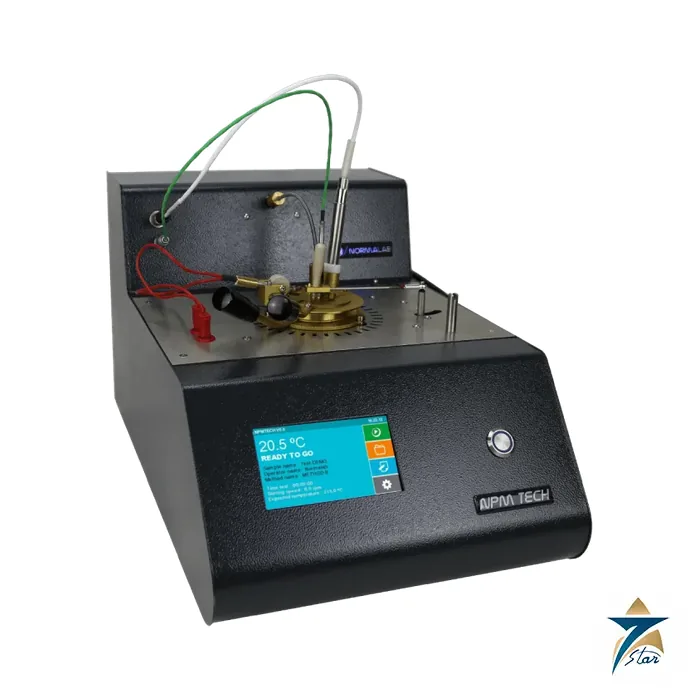
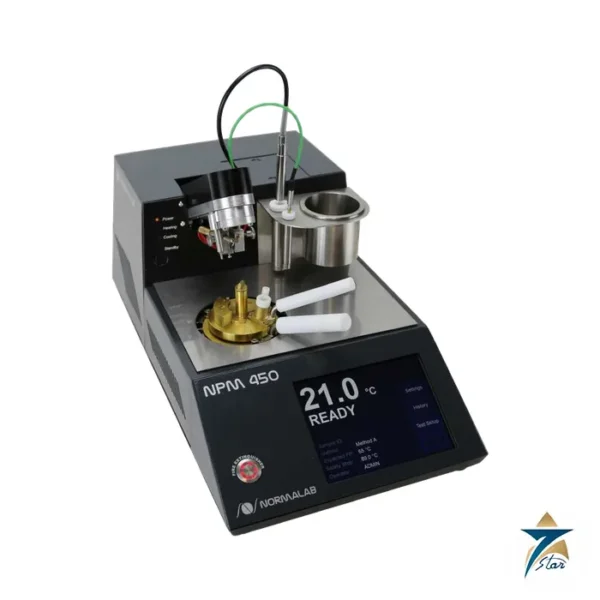
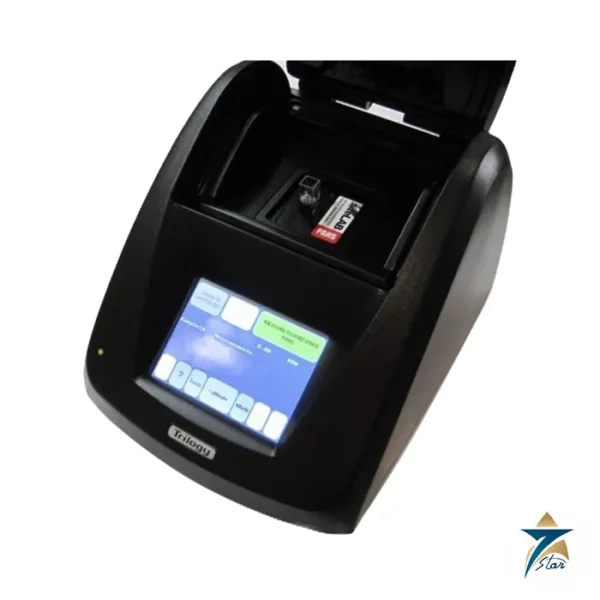
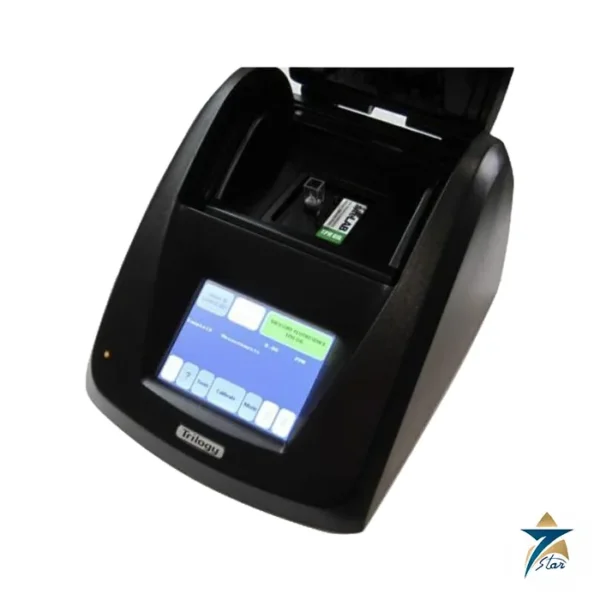
The Normalab NPM Tech is a half-automated Pensky-Martens closed-cup flash point tester. Heating, stirring and flash detection are controlled by the instrument through a 4.3 inch resistive colour touch screen, while the operator triggers the ignitor presentation with a push button. Because the ignitor is electric, the tester needs no gas supply, which simplifies installation in offices, mobile labs and sites where flammable gas is restricted.
Technical specifications
| Parameter |
Specification |
| Manufacturer / model |
Normalab NPM Tech |
| Order number |
42100 |
| Temperature range |
Ambient to 400 °C, in °C or °F |
| Temperature accuracy |
0.2 °C |
| Temperature probe |
Pt 100, class B |
| Predefined methods |
A, A+, B and C, plus 1 research mode and 1 safety mode |
| Stirring speed |
Adjustable, 0 to 250 rpm |
| Detection and ignition |
Thermocouple, no calibration required; 100% electrical ignition |
| Cooling |
Mechanical fan |
| Data |
Micro SD, 20 results; RS232C output |
| Power |
230 V, 50/60 Hz, 5 A |
| Dimensions and weight |
275 x 440 x 250 mm; 10.5 kg |
Standards, software and applications
The brochure lists ASTM D93, IP 34, ISO 2719, NF M07019, DIN 51758 and GBT 261 and related methods, with petroleum products from 40 to 370 °C and biodiesel from 60 to 190 °C. The product page adds ASTM D8175 and ISO 15267. Named applications are the petroleum, cosmetics and perfumes, pharmaceutical and chemical industries, REACH work, transportation class for hazardous goods, biodiesel and lubricants.
Software features include predefined temperature rates per method, a predefined temperature range depending on the method, preheating with or without stirring, barometric correction with temperature compensation, up to five calibration offsets, software update through micro USB and French/English menus. Password protection guards the settings. Safety covers a thermal fuse on the electric ignitor, a dedicated alarm for each error message, and audible and visual alerts.
Delivery and options
The package contains a lid with ignitor (P/N 42115) and thermocouple (40379), a cup (9411930), a power cable, a stirring cable (42110) and a stylus (42003). Options are an RS232 ticket printer, the NCAL calibration kit and a stainless support for cover and lid.
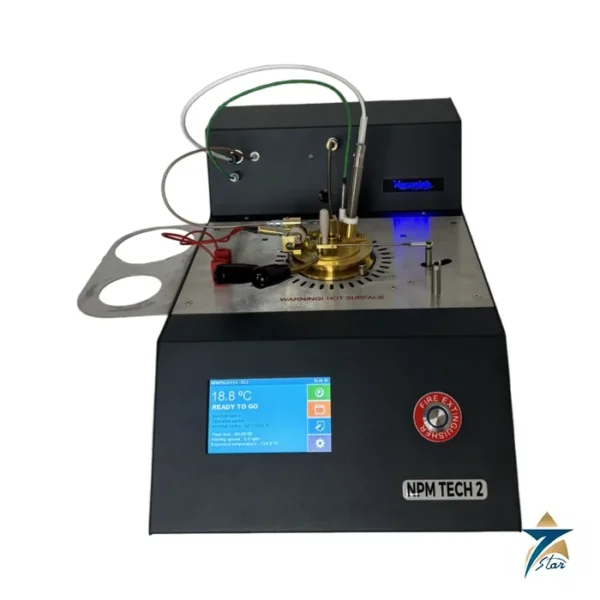
The NPM Tech suits laboratories that want electronic temperature control, stored results and calibration offsets but still prefer the operator to confirm each ignitor presentation. It shares its 4.3 inch screen, method list and electric ignitor with the automated NPM TECH 2, so staff trained on one model can move to the other with little retraining. For high sample counts or unattended operation, the automated model is the better fit; for occasional testing, the NPM Tech keeps cost and complexity lower.
Calibration is simple: the thermocouple detector needs none, the temperature probe takes up to five stored offsets, and the optional NCAL kit gives the laboratory a way to verify the readings between external calibrations.
Before ordering, check which procedure your specification names. The leaflet lists ASTM D93, IP 34 and ISO 2719, while the product page also names ASTM D8175 and ISO 15267, so ask the manufacturer to confirm support for the exact method and edition you must report against.
Key features of the NPM Tech
- Pensky-Martens closed-cup method with predefined procedures A, A+, B and C, so the operator selects the method and the instrument applies the matching heating rate and stirring.
- All-electric ignition: no gas bottle, regulator or gas piping in the lab.
- Thermocouple flash detection that needs no calibration, reducing the subjectivity of visual flash judgement.
- Temperature range up to 400 °C with a Pt 100 class B probe and 0.2 °C accuracy.
- Compact footprint of 275 x 440 x 250 mm and 10.5 kg, suitable for crowded benches and mobile labs.
- Research mode for non-standard work and a safety mode for screening unknown samples.
Semi-automatic versus fully automatic testers
In a semi-automatic tester the instrument controls heating, stirring and detection, while the operator triggers the ignitor presentation. This keeps the purchase cost and complexity below a fully automatic instrument while still giving controlled heating rates and objective detection. Labs with a modest number of flash point tests per day, or which need a dependable back-up instrument, usually find the semi-automatic approach a good balance. High-throughput labs running many samples every shift typically consider a fully automatic model.
Choosing the right procedure
| Procedure (ASTM D93) |
Typical samples |
| A |
Distillate fuels such as diesel and kerosene, new and used lubricating oils, and other homogeneous petroleum liquids |
| B |
Residual fuel oils, cutback residua, used lubricating oils and liquids that tend to form a surface film or contain suspended solids |
| C |
Biodiesel (B100) |
The standard itself is the reference for which procedure applies to a given product; the table above gives the general split.
Installation and routine care
- Install the tester in a draught-free location, as air currents over the cup affect results; a fume hood with the sash adjusted to avoid drafts across the cup is commonly used.
- Verify the instrument regularly with a certified reference material and record the result; the calibration offsets in the software help correct small systematic deviations.
- Use the barometric correction so results are reported at standard pressure.
- Clean the cup, lid and stirrer after every test, since residues from a previous sample lower the flash point of the next.
- Keep results on the micro SD card or transfer them through RS232C to a LIMS or printer for traceability.
Applications in Oman and the GCC
Flash point is a key quality and safety parameter for fuels, lubricants and chemicals handled in the region: fuel terminals, refinery labs, bunkering surveyors, lubricant blending plants, power stations checking incoming diesel and laboratories classifying goods for transport. A gas-free instrument is particularly convenient for site labs and port inspection offices.
What to include in your RFQ
- Order number 42100 and quantity.
- Standards and procedures you need to run.
- Power supply available (230 V, 50/60 Hz specified).
- Accessories or spare cups needed, and any printer or reference materials.
- Requirements for installation, training or calibration documentation.
Documents and quotation
The Normalab brochure is linked above. Seven Star LLC, an independent supplier in Muscat, includes the NPM Tech in its liquid analytical systems listings. Please confirm the method set, the printer or calibration kit options and the required certificates before ordering.







Reviews
There are no reviews yet.