A manual Cleveland tester for flash and fire point
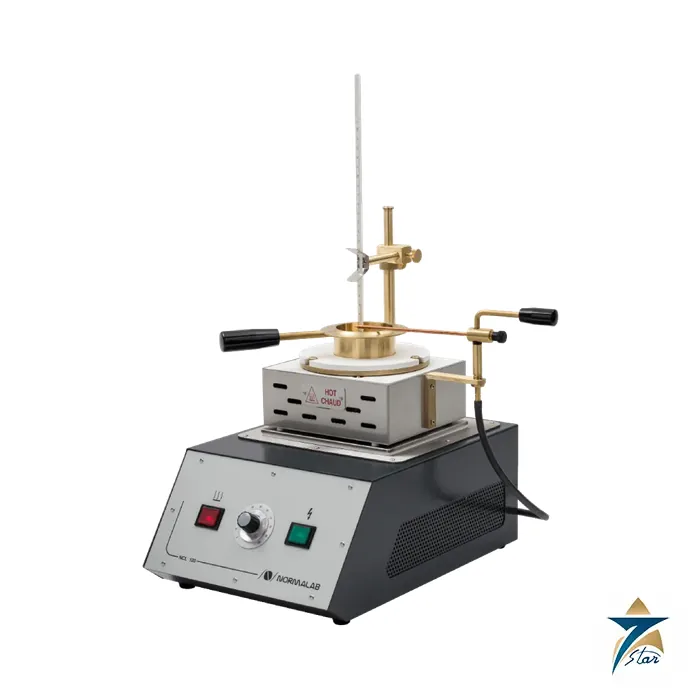
The Normalab NCL 120 is a manual Cleveland open-cup tester that allows the determination of both flash point and fire point. An electric heater is controlled from the front panel by an energy regulator, and the pilot flame and test flame are adjustable by knob. The operator watches the cup and applies the flame by hand; there is no automatic detection, so the instrument is simple, robust and easy to keep in service.
Technical specifications
| Parameter |
Specification |
| Manufacturer / model |
Normalab NCL 120 |
| Order number |
942611 |
| Temperature range |
Up to 400 °C |
| Heating |
Electric; power adjusted by energy regulator |
| Temperature control |
Standard thermometer (ASTM 11C delivered) |
| Flame |
Gas flame; pilot and test flame adjustable by knob; propane/butane at 50 mbar |
| Flash detection |
Visual |
| Safety |
Temperature safety by thermostat |
| Power |
230 V, 50/60 Hz, 1000 W |
| Dimensions and weight |
350 x 250 x 400 mm; 7 kg |
Standards and sample types
The brochure states ASTM D92, IP 36 and ISO 2592 and related methods. The test describes the determination of flash point and fire point of petroleum products by a manual or automated Cleveland open-cup apparatus, applicable to products with flash points above 79 °C and below 400 °C, except fuel oils. Typical samples are lubricating oils, bitumen and heavier petroleum products, which are not suited to closed-cup testers because the open cup lets vapour escape to the room.
An open-cup flash point is generally higher than the closed-cup value for the same material, so results from the two methods must not be compared directly. A laboratory should use the cup type that its product specification requires.
Scope of delivery and options
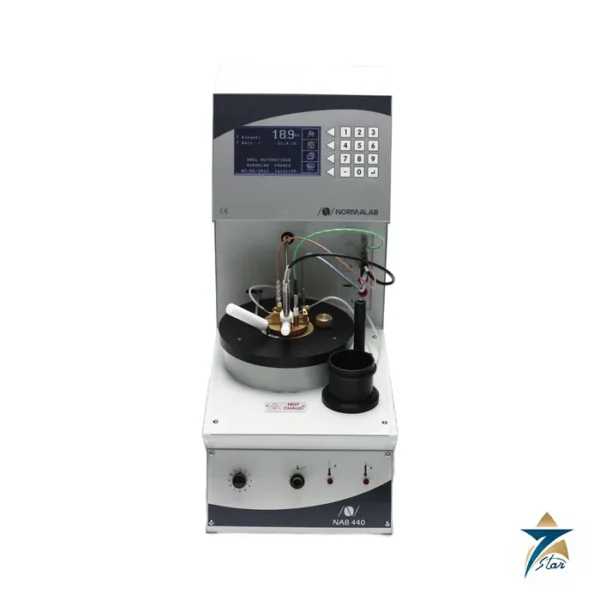
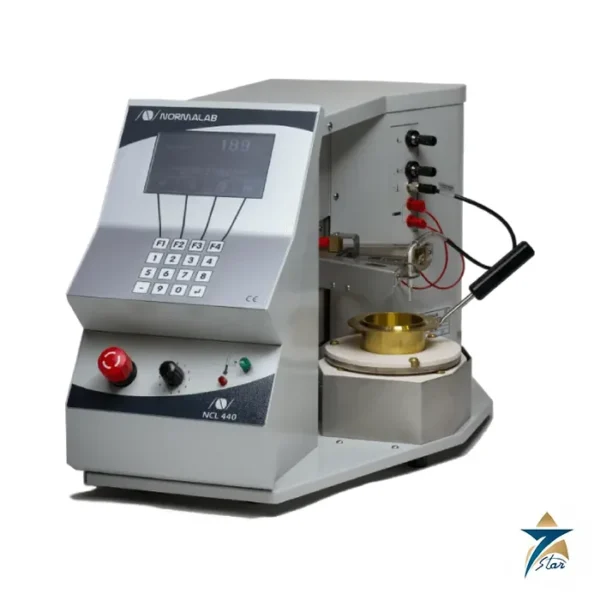
The NCL 120 is delivered ready to use with one cup (P/N 941613), one ASTM 11C thermometer (11498; without certificate, calibration on request) and one insulating board (941615). A pair of heat-resistant gloves is listed as an option. For automatic ignition and ionisation detection, see the NCL 440.
The NCL 120 is selected where an inspector needs the basic Cleveland procedure without electronics: the operator sets heating power with the energy regulator, watches the thermometer and lowers the test flame across the cup at the temperature steps given in the standard. It is also used for training, because the flash and fire events can be seen directly. Laboratories that later need automatic flame application, ionisation detection and stored results can move to the NCL 440, which uses the same Cleveland principle with a 0 to 400 °C range.
Practical points for installation: place the tester away from draughts, keep the gas line short with a regulator set to 50 mbar, and allow the insulating board to cool before handling the base. Both flash and fire point are recorded by reading the thermometer when the flame event occurs, so a stopwatch and the standard test report form are the only other items needed at the bench.
Setting up the Cleveland bench
Before the first test, choose a stable, level bench made of non-combustible material and keep solvents, rags and sample stocks well away from the open cup. Because the flash is judged by eye, the operator needs good, even lighting without glare on the cup surface; many laboratories fit a simple three-sided shield or work in a quiet corner rather than inside a fume hood with strong airflow, since moving air can sweep vapour away from the test flame and delay the flash. Fume extraction can still be arranged above the area, provided it is gentle and is switched to the same setting for every run.
Connect the gas supply with a suitable hose and fittings rated for propane or butane, check every joint with leak-detection fluid, and confirm that the regulator holds the pressure stated on this page. Plug the tester into an earthed socket on a circuit that can carry its rated load, and keep the mains cable clear of the hot zone around the heater.
Commissioning and routine checks
A first commissioning run is best done with a reference material of known flash point. Light the pilot, adjust the test flame to the size required by the method, and run the full procedure while recording heating behaviour, flame pass timing and the observed result. If the value falls outside the tolerance given for the reference material, review the heating rate, the thermometer immersion and the flame size before testing customer samples.
For daily work, clean the cup thoroughly between samples so that residue from a previous oil or bitumen does not affect the next result, inspect the thermometer for a separated liquid column, and check that the cup sits correctly in its holder. Keep a log of reference checks so that drift can be spotted early and supported during an audit.
Thermometer care
The thermometer is the measuring element of a manual tester, so treat it accordingly. Store it vertically or in its case, avoid thermal shock when moving it from the hot cup to a cold surface, and arrange periodic calibration against a traceable reference through an accredited laboratory if your quality system requires it.
Working in Oman and GCC laboratories
Many refinery, terminal and power plant laboratories in the region sit close to the coast or in desert locations, and both conditions affect an open-cup test. High ambient temperature in summer means samples and the cup may start warmer than expected, so allow them to settle to the starting temperature the method requires before heating. Air-conditioning outlets create draughts, which should be redirected away from the bench. Fine dust can settle in the cup and on the heater surroundings, so cover the instrument when it is idle and wipe it down before use.
Humid coastal air can encourage corrosion on gas fittings and the metal base over time; a periodic visual check of hoses, connectors and the regulator is a sensible part of the laboratory safety routine. Barometric pressure also influences flash point, and the standard methods describe how to correct an observed reading to standard pressure, so keep a calibrated barometer in the laboratory and record the reading with each result.
Documents and quotation
The Normalab brochure is linked here. Seven Star LLC, an independent supplier in Muscat, supplies it under liquid analytical systems. Confirm the gas arrangement, the thermometer certificate and the mains supply before ordering.









Reviews
There are no reviews yet.