Automated Abel flash point for low-flash-point liquids
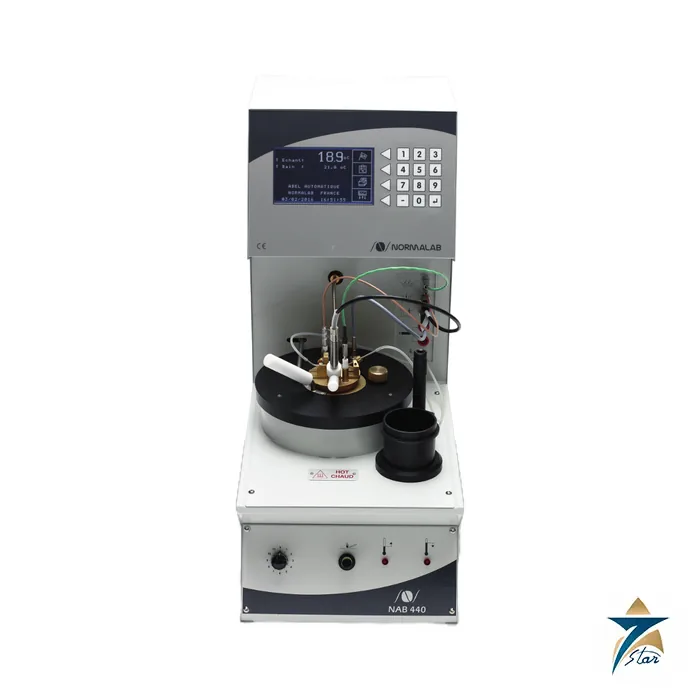
The Normalab NAB 440 is an automated Abel closed-cup flash point tester developed by Normalab. It targets combustible liquids with flash points from -30 to 75 °C, such as solvents, light fuels, paints and chemicals, and it carries three preset standard methods and one quick search method. Detection is dual: a thermocouple and an ionization ring watch for the flash, and the ignition source can be either gas or electric, selected in the configuration menu.
Technical specifications
| Parameter |
Specification |
| Manufacturer / model |
Normalab NAB 440 |
| Order number |
41300 |
| Temperature range |
-30 to +110 °C (cryostat mandatory below ambient) |
| Temperature accuracy |
0.1 °C, Pt 100 probe |
| Stirring |
2 speeds: 30 rpm and 75 rpm |
| Detection |
Thermocouple and/or ionization |
| Ignition |
Automatic, gas or electric |
| Cooling |
Connection to a cryostat |
| Data storage |
200 results; RS232C output |
| Units |
°C, °F, mbar, mmHg |
| Heating cut-off |
At 130 °C measured in the bath, independent of the microprocessor, with audible alarm |
| Power |
AC 230 V, 50/60 Hz, 4 A |
| Dimensions and weight |
270 x 500 x 550 mm (product page); 20 kg |
Standards, software and safety devices
The brochure lists ISO 13736, IP 170 and NF M 07 011. The scope covers manual and automated closed-cup flash points between -30 and 75 °C, although the method precision is valid only from -8.5 to 75.0 °C. Applications named are petroleum, cosmetics and perfumes, pharmaceutical and chemical industries, REACH, transportation class for hazardous goods, biodiesel, lubricants and waste.
Software features include automatic barometric correction with manual input of atmospheric pressure, calibration of temperature measurements, result deviation correction of plus or minus 9.9 °C, a sample security device programmable 3 to 10 °C above the expected temperature, a buzzer, and printing of results with or without the heating gradient. Safety devices cover a heating cut-off, a sample safety stop, a probe-missing check (no temperature rise of 3 °C in 10 minutes) and optical detection of flame absence with automatic gas cut-off after 30 seconds.
Scope of delivery and options
Included: cup (P/N 41301), cover (41303), Pt 100 probe (41310), flexible stirrer (41306), insulated tubing to the cryostat (60214), detection thermocouple (40379), detection cable (41309) and electric ignitor (40613). Options are a cryostat, an RS232 ticket printer, the NCAL calibration kit and a gas cartridge kit (P/N 60457) that keeps less gas in the laboratory. The brochure prints the depth as 50 mm while the product page gives 500 mm, so confirm the footprint before planning the bench.
The Abel method heats the sample in a closed cup while a flame or electric spark is introduced into the vapour space at fixed temperature steps; the flash point is the lowest temperature at which the vapour ignites. Many laboratories use it for solvents, light fuels and paint thinners, and it is widely quoted in older specifications and in transport regulations based on IP 170. Because the sample is chilled for low flash points, plan the cryostat capacity and coolant before commissioning, and keep the insulated tubing short to limit condensation on the bench.
Deciding whether the NAB 440 suits your laboratory
The Abel method is chosen mainly because a product specification, a customer contract or a transport classification calls for it. Before selecting this tester, list the standards your samples are tested against and check that they match the methods programmed in the instrument. Laboratories that also test heavier products with higher flash points normally need a second instrument for methods such as Pensky-Martens, because the NAB 440 is aimed at the low flash point range.
- Estimate how many of your samples have expected flash points below room temperature; these require the cryostat, so its capacity and coolant should be chosen with the instrument.
- Decide between gas and electric ignition. Electric ignition avoids storing gas, while gas ignition may be required by the procedure your customers expect; the gas cartridge kit is the option for laboratories that want to keep gas volumes small.
- Plan how results will be recorded: the internal memory and RS232C output, a ticket printer, or transfer to a laboratory information system.
- Include the NCAL calibration kit if the laboratory wants to verify the instrument in-house between external calibrations.
Installation and commissioning
Place the tester on a stable bench in a draught-free area, because air movement over the cup affects flash detection. Provide fume extraction suitable for the solvents and fuels being tested, and keep flammable sample stocks away from the instrument. Connect the cryostat with the insulated tubing supplied, and check for leaks before the first cooling cycle. If gas ignition is used, install the gas supply according to local safety rules and the Normalab instructions.
At commissioning, enter the local atmospheric pressure or confirm the barometric correction, then verify the temperature measurement and run a reference material with a known flash point. Compare the result against the certified value before releasing the instrument for routine work, and keep the record as part of the laboratory quality file.
Routine care and troubleshooting
Clean the cup, cover and stirrer after every test so residues do not affect the next sample. Inspect the ionization ring and the detection thermocouple for deposits, which can delay or prevent flash detection. If the instrument reports no flash where one is expected, check the ignition source, the detection settings and the sample security setting before repeating the test with fresh sample. Repeated probe-missing alarms usually indicate a probe that is not seated correctly or a faulty connection.
Laboratory conditions in Oman and the GCC
Refinery, terminal and fuel-testing laboratories in the region often handle products whose flash points sit near local ambient temperatures, which makes reliable sample cooling essential. Keep samples sealed and chilled before testing, because volatile fractions are lost quickly in a hot room and can raise the measured flash point. A stable air-conditioned laboratory helps the cryostat reach low temperatures efficiently, while condensation on cold tubing should be controlled to keep the bench dry. Fine dust carried into laboratories near industrial zones can settle in the cup and on the cover, so keep the instrument covered when not in use.
Documents and quotation
The brochure is linked on this page. Seven Star LLC, an independent supplier in Muscat, offers the tester under liquid analytical systems. Before ordering, confirm the cryostat, the gas or electric ignition choice and the calibration kit.








Reviews
There are no reviews yet.