Dissolved sodium at ppb level in alkaline high-purity water
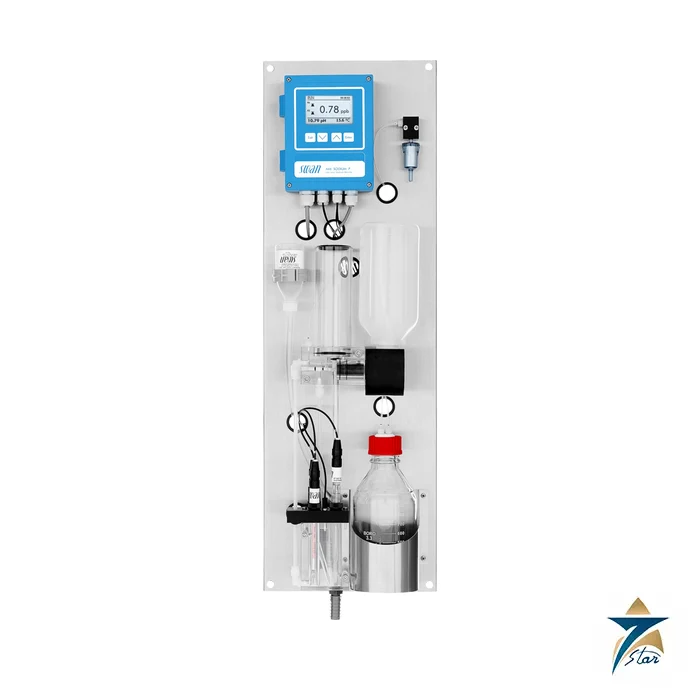
The Swan AMI Sodium P measures dissolved sodium in steam, condensate and high-purity water. The manual lists quality control, monitoring of mixed bed ion exchanger breakthrough, detection of condenser leaks and prevention of caustic corrosion of turbines. It is suitable for samples with a pH value higher than 7; for samples below pH 7 the manual refers to the AMI Sodium A.
The principle is potentiometric, with a sodium-sensitive glass electrode and a reference electrode. A temperature sensor corrects the reading to 25 C. The 0.1 ppb measuring limit requires conditioning of the sample to at least pH 10.5, best done with diisopropylamine (DIPA). The swan.ch page covers the AMI Sodium P 28 version with a 0.1 ppb detection limit and lists P 40 and KM versions as separate items.
Technical specifications
Values are from the Operator’s Manual A-96.250.211 (section 2.1) and the swan.ch product page for the P 28.
| Parameter |
Specification |
| Measuring range (product page, P 28) |
0.1 ppb to 10 ppm sodium |
| Accuracy and repeatability (product page) |
Accuracy +/-5% of reading, repeatability 5% |
| Response time (product page) |
180 s (95%) |
| Sample pH |
7.0 or higher |
| Ammonium concentration |
Below 10 ppm |
| Sample flow |
Minimum 100 ml/min |
| Sample temperature and pressure |
5 to 45 C (41 to 113 F); inlet 0.3 to 3 bar (4 to 43 PSI); outlet pressure-free |
| Connections |
Sample inlet tube 4 x 6 mm; outlet 1/2 in hose nozzle for 20 x 15 mm flexible tube |
| Power supply |
100-240 VAC (+/-10%), 50/60 Hz, or 10-36 VDC; maximum 35 VA |
| Transmitter |
Aluminum, IP 66 / NEMA 4X; -10 to +50 C; backlit LCD 75 x 45 mm |
| Standard panel |
Stainless steel, 280 x 850 x 200 mm, 9.0 kg (19.85 lb) without sample water |
| Panel with second sample stream |
Stainless steel, 400 x 850 x 200 mm, 12.0 kg (26.5 lb) |
Bubble stream and reagent addition
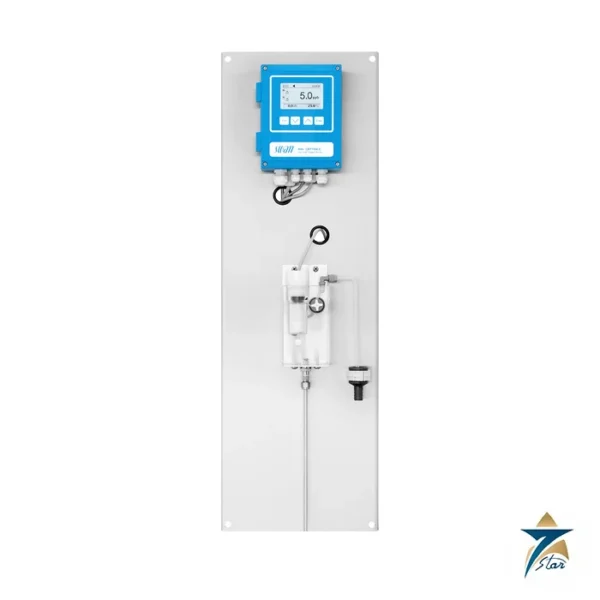
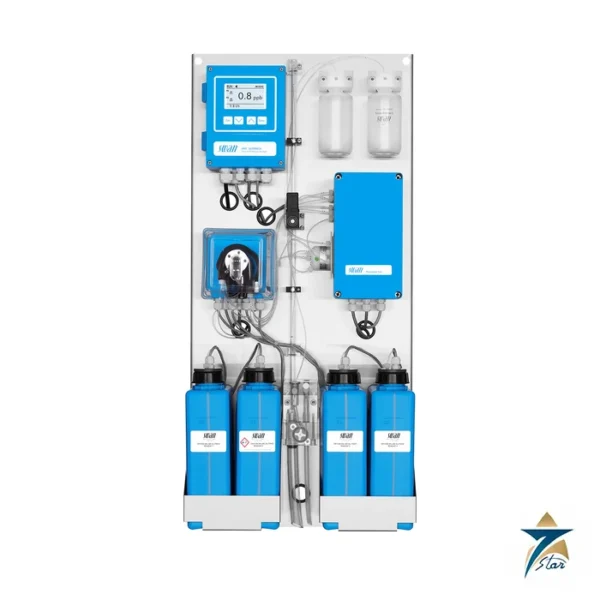
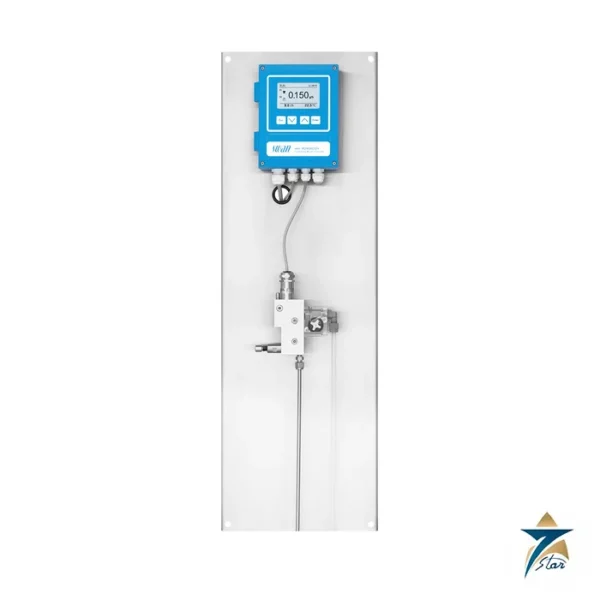
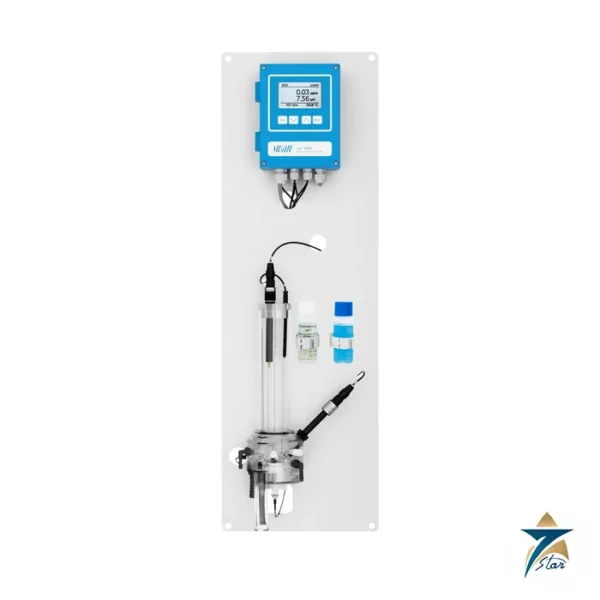
The sample enters a constant head through a flow regulating valve and flows into a measuring chamber with the sodium electrode, then a second chamber with the pH electrode, temperature sensor and reference electrode. In normal operation the sample falls into a reaction tube. Because of the level difference, reagent-saturated air is sucked in, which raises the pH to 10.5 and creates a regular stream of air bubbles.
A bubble detector monitors that stream. If sample flow becomes inconsistent the bubble formation stops and the instrument reports a system error. A 100 ml KCl filling for the reference electrode lasts about one month of operation.
Options and routine work
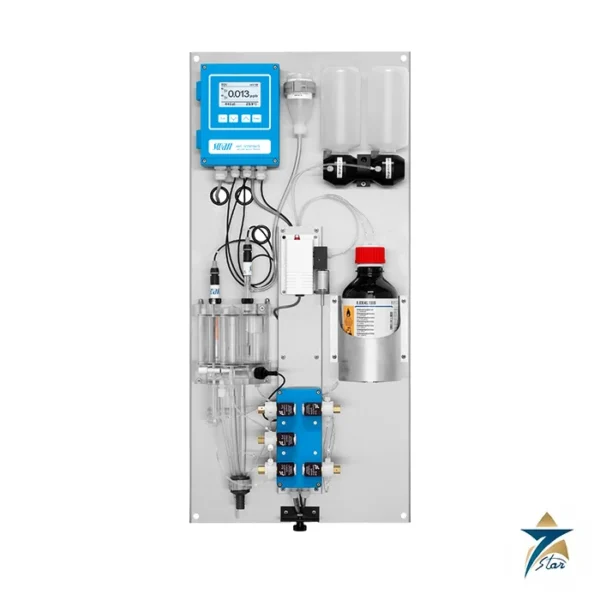
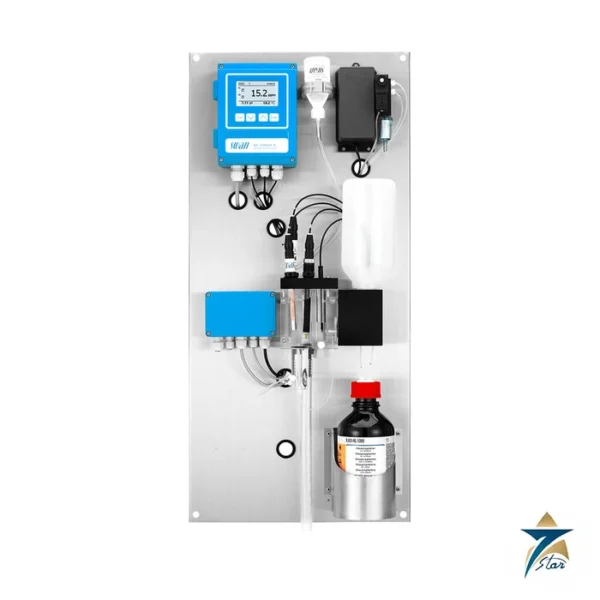
Optional modules are a second sample stream (needing a 400 mm or 375 mm panel width), a sample sequencer for up to six streams and an automatic regeneration module that etches the sodium sensor at configurable intervals (needing the 400 mm panel). The standard bottle holder is also used for calibration and for grab sample measurement. One liter of standard is used in about 10 minutes, and the sodium electrode must reach a constant reading in that time for an exact calibration.
Confirm the sample pH is at least 7, which panel width is needed for the options, the supply type, and the consumables: DIPA, KCl electrolyte, sodium standard and an etching kit.
How the Swan AMI Sodium P works
The analyzer measures sodium with a glass electrode that responds to sodium ions, and compares it with a reference electrode. The sample flows through a measuring chamber. Before measuring, the sample is raised to a pH above 10.5, so hydrogen ions do not disturb the sodium reading. This is done by passing reagent vapour, such as diisopropylamine, through the sample. A temperature sensor corrects the reading to 25 degrees C.
Where the AMI Sodium P is used
- Steam and condensate monitoring
- High-purity boiler water
- Mixed bed ion exchanger breakthrough
- Condenser leak detection
- Prevention of caustic corrosion of turbines
Selection checklist for the AMI Sodium P
- Sample pH of 7 or higher
- Ammonium below 10 ppm
- Measuring range from 0.1 ppb
- Number of sample streams
- Sample flow of at least 100 ml/min
- Reagent supply
- Power: 100 to 240 VAC or 10 to 36 VDC
- Panel size
Installation, commissioning and maintenance notes for the AMI Sodium P
Mount the panel on a wall and connect the sample inlet and the drain. Keep the sample line short and clean, since sodium picks up contamination easily. Fill the reagent bottle and calibrate with standard solutions. Check the electrodes, the reagent level and the flow on a regular schedule.
Requesting a quotation for the Swan AMI Sodium P
Please send the version, the number of streams, the power supply and the quantity. Seven Star LLC serves industrial customers in Oman and the GCC and replies with a quotation based on the information provided.
AMI Sodium P measuring range
The product page for the P 28 lists 0.1 ppb to 10 ppm sodium.
AMI Sodium P accuracy
Accuracy is plus or minus 5 percent of reading, with 5 percent repeatability.
AMI Sodium P sample conditions
Sample temperature runs from 5 to 45 degrees C. Inlet pressure runs from 0.3 to 3 bar.
AMI Sodium P transmitter
The aluminium transmitter is IP 66 and NEMA 4X, with a backlit LCD.
AMI Sodium P panels
The standard panel is stainless steel and weighs 9.0 kg. A second stream panel weighs 12.0 kg.
Water records for the AMI Sodium P
Record the readings, the calibration dates and the reagent changes.
Choosing the right AMI Sodium P version
For samples below pH 7 the manual refers to the AMI Sodium A instead.
AMI Sodium P reagent
The manual names diisopropylamine as the best reagent to condition the sample to pH 10.5.
AMI Sodium P response time
The product page lists a response time of 180 seconds to 95 percent.
AMI Sodium P connections
The sample inlet tube is 4 by 6 mm and the outlet is a hose nozzle for flexible tube.
Documents and quotation
The attached Swan Operator’s Manual A-96.250.211 (firmware V6.22 and higher) and the swan.ch product page are the sources for this page. Seven Star LLC supplies Swan products as an independent supplier in Muscat. Send the version, options, supply and quantity with your enquiry. Browse liquid analytical systems for related analyzers.








Reviews
There are no reviews yet.