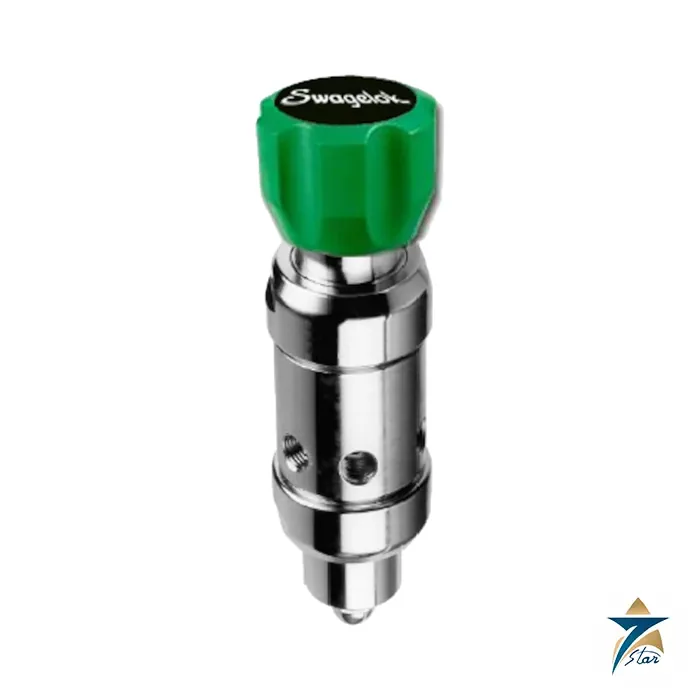
Swagelok KCY series two-stage pressure-reducing regulator for cylinder and high-pressure supply
The Swagelok KCY is a two-stage, spring-loaded pressure-reducing regulator for applications that need a steady outlet pressure while the inlet pressure changes widely. A typical example is a gas cylinder that depletes during use: with a single-stage regulator the outlet pressure creeps up as the cylinder empties, an effect known as supply-pressure effect. The KCY puts two regulating stages in one body to cancel most of it. Seven Star LLC supplies Swagelok KCY regulators in Oman and the GCC as an independent supplier in Muscat.
According to the catalog, the first stage is factory set to reduce the inlet pressure to 500 psig (34.4 bar), and the second stage is adjusted with the handle to the required outlet pressure. The result is comparable to two single-stage regulators connected in series. When the inlet pressure falls below the first-stage setting, the regulator simply behaves as a single-stage unit.
| Parameter |
Specification |
| Manufacturer / part number |
Swagelok KCY series two-stage pressure-reducing regulator |
| Function |
Pressure reduction with two stages, minimized supply-pressure effect |
| Maximum inlet pressure |
3,600 psig (248 bar); 6,000 psig (413 bar) with PEEK seat |
| Outlet control ranges |
0 to 10, 25, 50, 100, 250 or 500 psig (0 to 0.68 up to 34.4 bar) |
| Flow coefficient (Cv) |
0.06 and 0.20; 0.50 also available |
| Body materials |
316 stainless steel or brass (CW721R) |
| Seat materials |
PCTFE or PEEK |
| Maximum operating temperature |
176 °F (80 °C) with PCTFE seat; 392 °F (200 °C) with PEEK seat; 212 °F (100 °C) with PEEK seat above 3,600 psig inlet |
| Ports |
1/4 in. female NPT |
| Diaphragm |
Convoluted, nonperforated, Alloy X-750; metal-to-metal diaphragm seal |
Why two stages: supply-pressure effect and the KCY design
Supply-pressure effect, or SPE, is the change in outlet pressure caused by a change in inlet pressure. In a single-stage regulator an inlet drop reduces the closing force on the poppet and so the outlet pressure rises as the supply falls. The KCY reduces this by holding the interstage pressure constant at 500 psig, so the second stage always sees nearly the same inlet. The first-stage setting can be reduced by observing the interstage pressure at the interstage port, though the catalog warns that lower flow may result.
Other design details that matter in service are the convoluted, nonperforated diaphragm and metal-to-metal diaphragm seal for excellent set-point stability, and the high-flow dual-gauze filter built into the inlet ports, which protects the seat from particles. Self-venting and captured-vent sensing options exist, with self-vent available through the second stage on Cv 0.06 and 0.20.
- Two stages in one body, so the outlet pressure stays steady as a cylinder or supply line depletes.
- Interstage port for monitoring first-stage pressure.
- Built-in filter at the inlet ports.
- Handle styles: knob, antitamper nut, and panel-mount versions for the second stage; the first stage uses an antitamper nut.
Decoding the KCY ordering number
The ordering number is built from sixteen positions after the series. Key designators from the catalog are summarized here.
| Position |
Designators |
| Body material |
1 = 316 SS; 2 = brass CW721R; C and D = SC-11 cleaned 316 SS and brass |
| Outlet pressure range |
C = 0 to 10 psig; D = 0 to 25; E = 0 to 50; F = 0 to 100; G = 0 to 250; J = 0 to 500 psig |
| Maximum inlet pressure |
P = 3,000 psig; R = 3,600 psig; T = 4,351 psig (300 bar); W = 6,000 psig (413 bar) |
| Seat material |
1 = PCTFE; 2 = PEEK |
| Flow coefficient |
2 = 0.06; 5 = 0.20; 7 = 0.50 |
| Sensing and vent |
A = X-750 diaphragm, no vent; C = self vent; E = captured vent; F = self and captured vent |
| Handle |
2 = knob; 3 = antitamper nut; 6 or 7 = second-stage panel mount; 9 = first-stage panel mount |
Inlet pressures of 4,351 and 6,000 psig are available only with the 316 SS body and PEEK seat, and 6,000 psig is not available on regulators assembled with isolation valves. The catalog shows a worked example in the form KCY1FRF4…, and the current catalog table should always be used to confirm the full number.
Typical configuration of a KCY and where it fits
A KCY is generally mounted directly on a gas cylinder through a cylinder connection or on a high-pressure supply line, feeding calibration gas, carrier gas or instrument gas to analyzers, chromatographs and test benches. Options in the catalog include cylinder connections, isolation and relief valves, inlet and outlet gauges, and flexible hose assemblies, such as a 3 ft FX series metal flexible hose or a TH series PTFE-lined braided hose with a 1/4 in. female NPT inlet. Select hose and fittings with their own pressure ratings in mind, since these may limit the inlet pressure available.
Compared with the Swagelok KPR single-stage regulator already shown on this site, the KCY costs more and weighs more, but it is the better choice when the supply varies or the downstream device is sensitive.
Selection checklist for a KCY
- Supply pressure range, particularly the maximum, to choose 3,600, 4,351 or 6,000 psig versions.
- Outlet pressure and control range.
- Flow, to choose Cv 0.06, 0.20 or 0.50.
- Gas type and cleanliness, including SC-11 cleaning for oxygen service; ASTM G175 ignition-test versions are available on select KCY regulators.
- Body material and seat: PCTFE for general use up to 80 °C, PEEK for high temperature and pressure.
- Sensing and vent options, handle, panel mounting and antitamper requirements.
- Accessories: gauges, isolation and relief valves, cylinder connection, hose.
Installation and operation notes
Always set the second-stage handle to the off position before the supply is turned on or off, to protect the diaphragm and the downstream gauges. Isolate the supply, vent the downstream line, and check for leaks with a suitable leak-test liquid at each port after assembly. With an antitamper nut the setting cannot be changed by the operator, which is useful on calibration systems that must hold their pressure. The regulator is not intended as a shutoff device.
For oxygen service the catalog offers ASTM G93 Level C cleaning on select KCY regulators, but the design and operation of oxygen systems remains the responsibility of the user.
KCY use in Oman and the GCC
Two-stage regulators are widely installed on calibration gas racks at gas processing plants, on cylinder manifolds feeding laboratory and online analyzers in refineries and petrochemical complexes, and on test rigs in workshops and universities. In power stations and desalination plants they supply instrument-quality gases to emission analyzers and water quality analyzers. The 316 SS body is the usual choice near the coast, while the PEEK-seat versions suit higher inlet pressures from 300 bar cylinder banks.
KCY compared with other K series regulators
| Series |
Notes |
| KPR |
Single-stage, general purpose; cataloged separately |
| KCY |
Two-stage, Cv 0.06 / 0.20 / 0.50, inlet to 6,000 psig |
| KLF, KHF |
Other low-flow and high-flow pressure-reducing series |
| KBP |
Back-pressure regulator, Cv 0.20 |
Information to send with a KCY RFQ
- Gas or liquid, supply pressure range and temperature.
- Required outlet pressure and flow.
- Body, seat, handle, vent and accessory options.
- Cleaning requirement and documentation.
- Quantity and delivery location.
Documents and quotation
The Swagelok K series pressure regulator catalog covering the KCY is attached to this page. Send your supply pressure, outlet pressure and flow and we will confirm the ordering number and available documents.
Other Models in the Swagelok K Series Regulators Range
Seven Star LLC supplies models from the Swagelok K Series Regulators range in Oman and the GCC. Compare the related models below and request a quote for the one that matches your application.























Reviews
There are no reviews yet.