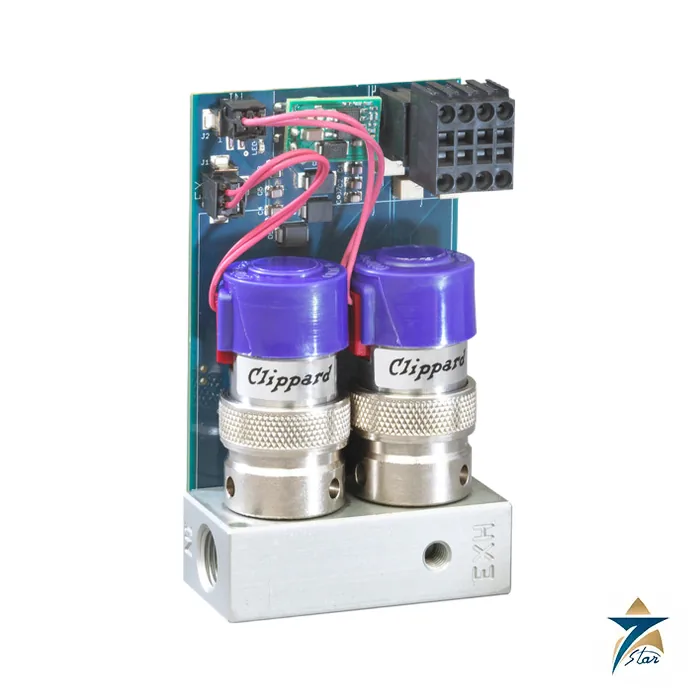
The Clippard Cordis CPC-CFE-FA is a closed-loop electronic pressure controller: a microcontroller, an integrated pressure sensor and two Clippard proportional valves on one manifold. Read against the ordering table in the data sheet, it is a card unit (C) with 1/8 inch NPT porting (F), a 0 to 10 VDC command (E), a 0 to 100 psig calibrated range (F) and the smallest flow class (A, 0.25 cubic inch or 2.7 l/min). These code readings are derived from the printed table, so confirm them against your order.
How the Cordis holds a set point
The inlet valve connects to a moderately regulated supply and the exhaust valve to a port that vents to atmosphere. When the command rises, the inlet valve opens and supply pressure passes over the sensor; if the sensor reads above the command, the exhaust valve modulates open and vents the excess. Because both valves are proportional, fill and bleed are smooth and non-pulsing, there is no constant bleed to maintain pressure and no integral bleed is needed. The PID tuning is set at the factory to the Cordis standard, or to your application if you give Clippard the details, and real-time adjustable PID is listed as a feature.
Resolution is 5 mV on a 0 to 10 VDC command, which the data sheet describes as 200 command steps within one volt, and calibration test equipment is stated to be NIST traceable.
Technical specification
| Parameter |
Specification |
| Type (this code) |
Card unit, CPC-C style |
| Porting |
1/8 inch NPT (G1/8 and manifold options exist) |
| Command signal |
0 to 10 VDC (also 0-5 VDC, 4-20 mA, 3.3 VDC serial on other codes) |
| Calibrated range |
0 to 100 psig; maximum inlet 115 psig for this range |
| Operating pressure |
Vacuum to 150 psig (10 bar) |
| Accuracy |
Plus or minus 0.25% of full scale |
| Linearity |
Plus or minus 0.05% BFSL |
| Maximum hysteresis |
Plus or minus 0.05% of full scale |
| Resolution |
5 mV or less |
| Response time |
Under 20 ms typical, application dependent |
| Supply voltage |
15 to 24 VDC |
| Current draw |
Under 250 mA |
| Typical flow |
2.7 to 65 l/min across the family, plus or minus 10% at 100 psig (7 bar) |
| Flow class A |
At least 0.25 cubic inch volume / 2.7 l/min at maximum pressure |
| Valve type |
Normally-closed proportional |
| Medium |
Clean, dry, non-corrosive gases |
| Filtration |
40 micron recommended |
| Operating temperature |
32 to 120 F (0 to 49 C), proportional valves |
| Wetted materials |
Nitrile elastomers, anodized aluminum manifold, polyamide sensor, nickel plated brass valves |
| Indicators |
Power LED (red) and command-mode LED (blue; solid analog, flashing serial) |
| Mounting attitude |
Any |
| Length / weight |
3.19 inch / 0.2 lb (part page) |
Selecting a Cordis part number
The ordering string is CPC, then type, porting, signal, then calibrated range and flow class. Type C is the bare card, H is a housed unit with an IP65 rated enclosure, E is a CE approved housed unit (4-20 mA only) and Z adds an external downstream sensor. Flow class B to D step up to 6.7, 25 and 65 l/min, and F is a 32 l/min class. The range letter must match your pressure: the data sheet lists a maximum inlet for every calibrated range, 115 psig for a 0 to 100 psig range, and custom ranges can be entered. The housed IP65 rating applies to housed units; this card version is not enclosed, so mount it in a panel or enclosure.
Wiring, accessories and set-up
Filter the supply to 40 micron, feed positive pressure to IN and exhaust or vacuum to EXH, and take the controlled pressure from OUT. Clippard lists accessories CPCH-C1 (8-pin actuation cable, 6 ft), CPCH-C2 (3.3 VDC serial cable, 3 ft), CPCH-B1 (mounting bracket) and CPCH-CA6 (power cord, 6 ft), and a WiFi adapter (CPCW-B1) sold separately. Allow for the volume downstream: the data sheet includes a selection diagram relating valve orifice size to downstream volume, from fast but poorly stable on large orifices with small volumes to slow but stable on small orifices with large volumes.
Where it is used
Typical uses include gas delivery for analysers, pressure-driven flow control in laboratory automation, test and calibration stands and bag or cell-culture pressure control. The gas must be clean, dry and non-corrosive, so in Gulf plants take it from an instrument air or nitrogen line after dryers. Hazardous-area approval is not stated on the data sheet and is not claimed. Manual alternatives are in our Regulators range.
CPC-CFE-FA questions
What does a Cordis pressure controller do?
It compares a command signal with an internal pressure sensor and drives an inlet and an exhaust proportional valve to hold the downstream pressure.
What accuracy is stated?
Plus or minus 0.25% of full scale accuracy, 0.05% linearity and 0.05% maximum hysteresis, with resolution of 5 mV or less.
What supply voltage and signal does it need?
The supply is 15 to 24 VDC at under 250 mA; the CPC-CFE-FA reading is a 0 to 10 VDC command.
Is the card unit rated IP65?
No. The data sheet gives IP65 for the housed versions and the external sensor; the card unit needs a panel or enclosure.
Which gases can it control?
Clean, dry, non-corrosive gases, with 40 micron filtration recommended.
Using it in Oman and the GCC
Electronic pressure controllers are used in the region by machine builders, laboratories, medical and analytical equipment makers and test rigs, where pressure must follow a command signal precisely. Supply the controller with clean, dry, filtered air or gas, because compressed air in hot and humid coastal plants often carries water and dust that affect small proportional valves. Keep the electronics within the stated ambient temperature, especially in equipment that runs in hot workshops.
Record the settings at commissioning, so replacement units can be configured the same way.
Information to send with an enquiry
- Pressure range, command signal and porting
- Gas or air to be controlled
- Quantity
Documents and quotation
The Cordis CPC data sheet can be downloaded here. Seven Star LLC supplies Clippard Cordis controllers from Muscat; send the complete part number and quantity to request a quotation.







Reviews
There are no reviews yet.