- Automation & ControlView all 2,895 products
- Automation Accessories
- AC Drives
- PLC & I/O Cards
- Industrial Communications
- Vibration Monitoring
- Controllers & Data Acquisition
- Isolator & Barrier
- Safety Switches & Guard Locking
- Motor Soft Starters
- CCTV & Security
- Encoders
- Pneumatic Cylinders
- HMI Displays
- Servo Drives
- Industrial Computers
- Machine Vision
- Automation Software
- Robotics
Brand: Parker
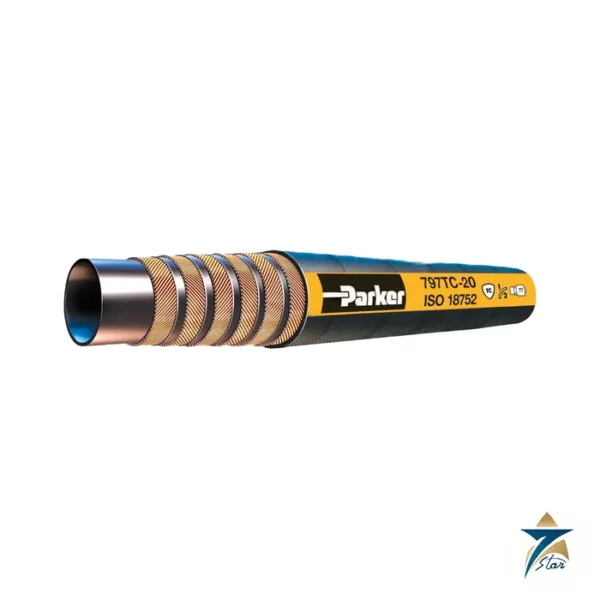
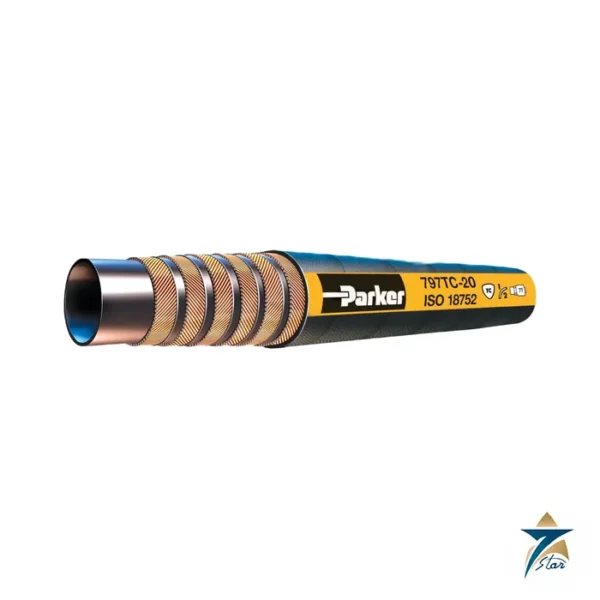
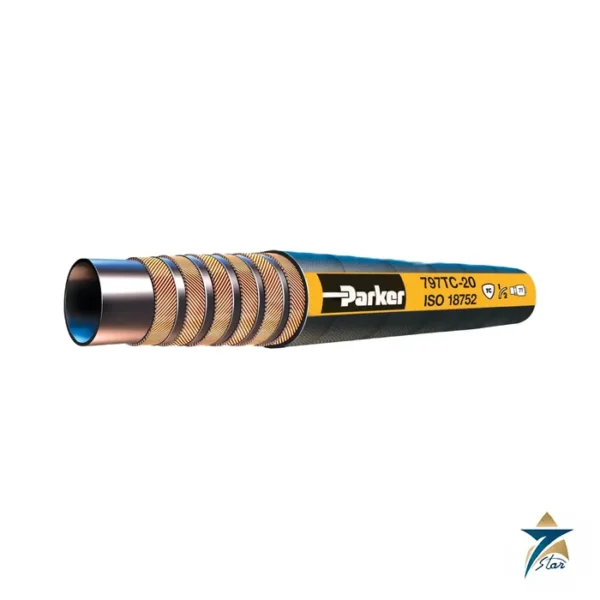
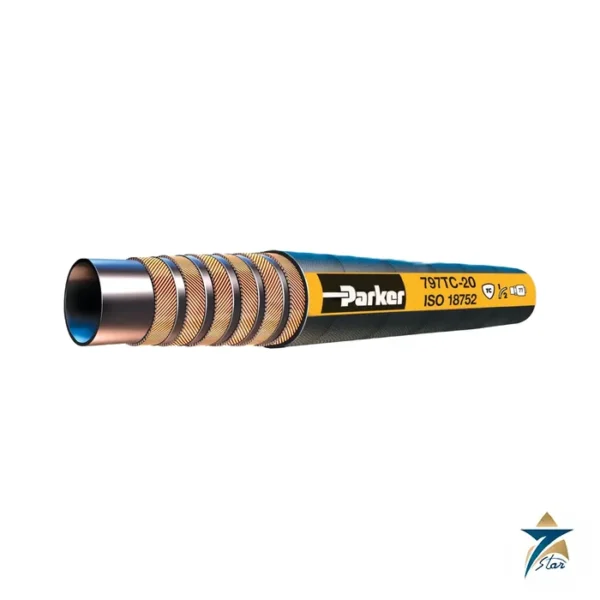
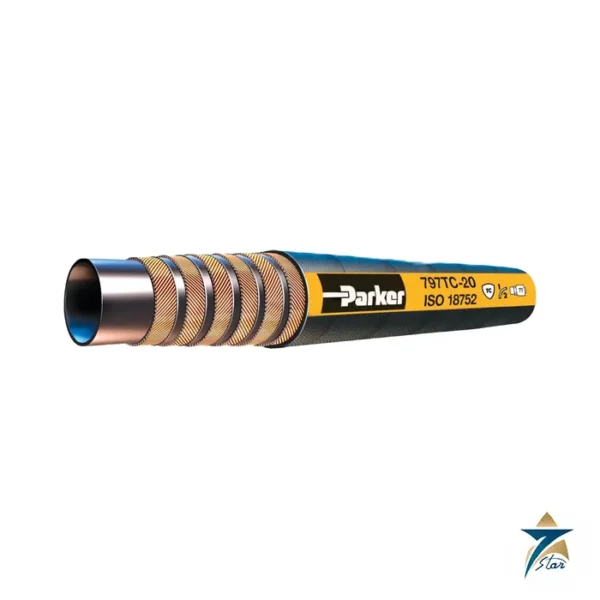
Parker 387-6 387 Hydraulic Hose -6 (3/8 in)
Description
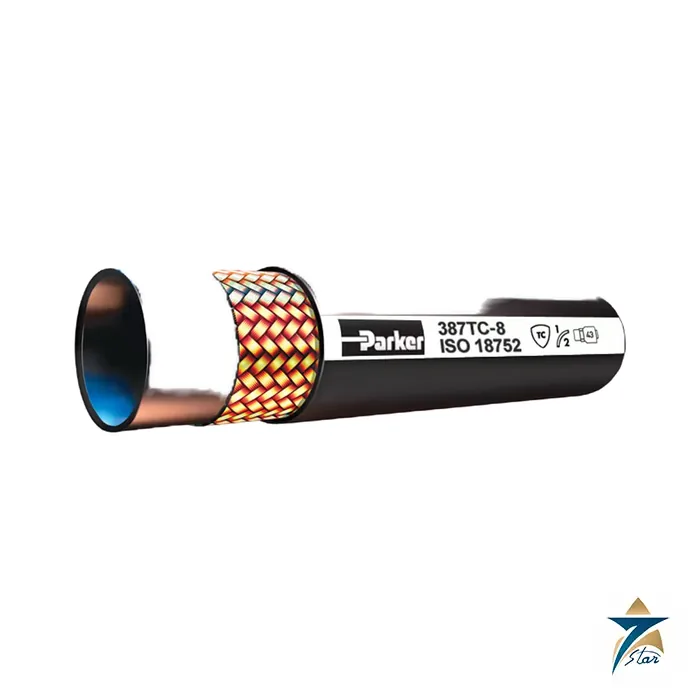
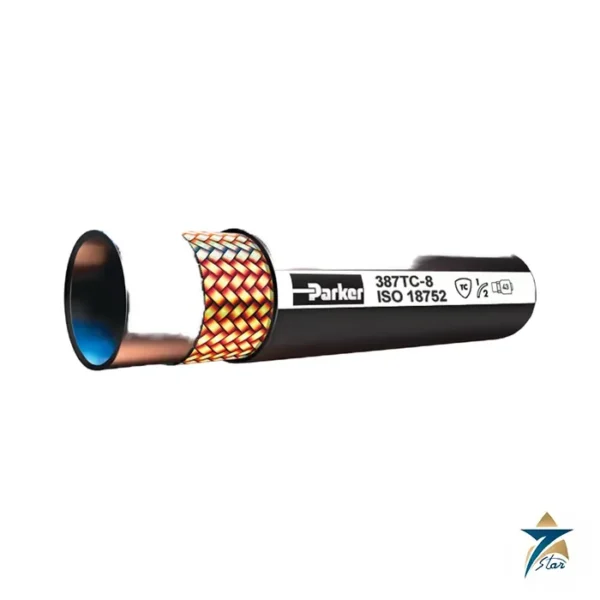
387-6 Parker GlobalCore 387 hose, size -6 (3/8 in)
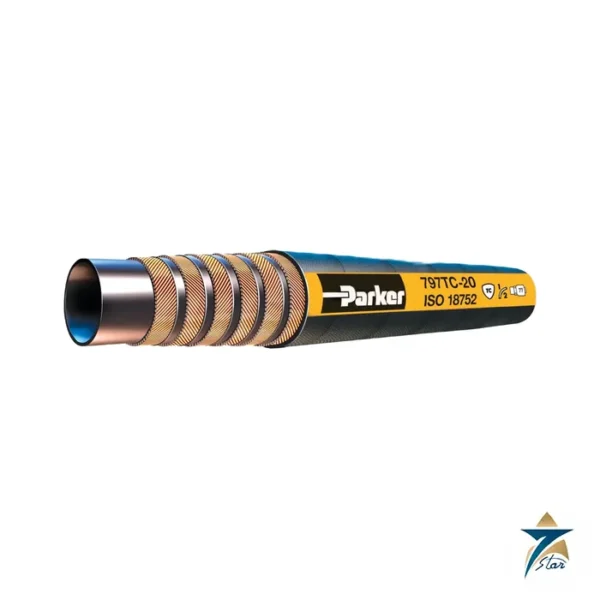
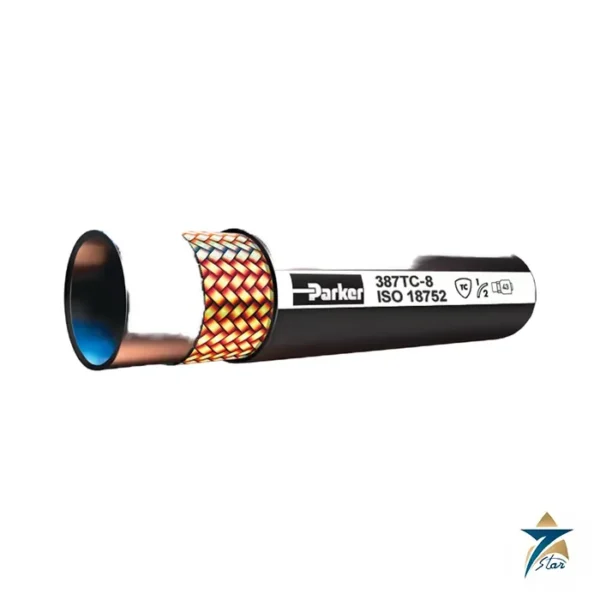
The Parker 387-6 is a 3000 psi constant working pressure hydraulic hose from the GlobalCore 387 line, in dash size -6 with an inside diameter of 3/8 in (10 mm). It is rated for 3000 psi (210 bar) maximum operating pressure, works with lubricants and petroleum hydraulic fluids, and meets ISO 18752 Type AC. Parker 387-6 is built with 1 braid of steel wire over a synthetic rubber tube and finished with a standard synthetic rubber cover.
The 387 family is the 3000 psi member of the GlobalCore group: a flexible, single- or double-braid hose for general hydraulic circuits where moderate pressure is enough and flexibility matters. Parker 387-6 is the -6 size, so it fits the same dash-size logic used for tube and port sizes in hydraulic systems. Below you will find the decoded part number, the verified technical data, selection guidance and installation notes.
How to read 387-6
- 387 – the hose series (GlobalCore 387, 3000 psi class).
- No cover suffix – the standard cover is fitted.
- -6 – the dash size, meaning 6/16 in nominal inside diameter (3/8 in).
Parker 387-6 technical specifications
| Parameter | Specification |
|---|---|
| Manufacturer / part number | Parker 387-6 |
| Series | GlobalCore 387 Hose, 3000 psi constant working pressure |
| Size (dash number) | -6 |
| Inside diameter | 3/8 in (10 mm) |
| Nominal hose inside diameter | 10 mm |
| Maximum operating pressure | 3000 psi (210 bar, 21 MPa) |
| Operating temperature | -40 °C to 100 °C (-40 °F to 212 °F) |
| Media | Lubricants and petroleum hydraulic fluids |
| Application | Lubricating oils, petroleum-base hydraulic fluids |
| Inner tube | Synthetic rubber |
| Outside diameter | 0.690 in (17.4 mm) |
| Reinforcement | 1 braid of steel wire |
| Cover | Standard synthetic rubber cover |
| Specification met | ISO 18752, Type AC |
| Compatible fitting series | 43 Series |
| Minimum bend radius | 2-1/2 in (65 mm) |
| Weight | 0.23 lb/ft (0.34 kg/m) |
All values above are taken from the manufacturer’s product page for 387-6. Pressure is the maximum operating pressure of the hose itself; the rating of an assembly is limited by the lowest-rated component, including the coupling, so always confirm the complete assembly.
Construction and behaviour of the 387-6 hose
The reinforcement of 387-6 is 1 braid of steel wire. Braided wire gives a hose that is comparatively easy to flex and to route, and it spreads the pressure load evenly around the circumference. The result is a hose with a modest bend radius for its bore, which is why 387-6 can follow tight machine contours.
The inner tube is a synthetic rubber chosen for lubricants and petroleum-base hydraulic fluids; the standard synthetic rubber cover protects the reinforcement from abrasion and weather. The standard cover is suited to protected routing; add a sleeve or guard where the hose rubs against structure. The permitted fluid temperature runs from -40 °C up to 100 °C (212 °F).
Flow indication for size -6
As an illustration only (not a manufacturer rating), a common design guide for pressure lines is a fluid velocity of around 4 m/s. In a bore of 10 mm that corresponds to roughly 19 litres per minute. Faster flow raises pressure drop and heat, so long runs or high-viscosity oil may justify the next size up.
Handling data for size -6
For planning, a 10 m length of 387-6 weighs about 3.4 kg and a 30 m coil about 10.2 kg, using the catalogue weight of 0.34 kg/m for the hose alone. The minimum bend radius of 65 mm is about 6.5 times the inside diameter, a useful figure when you compare 387-6 with other sizes for light equipment routing. Count the weight of couplings and fluid as well when you size clamps and supports.
Fittings and related sizes for 387-6
Parker states that 387-6 is compatible with the 43 Series of crimp-style couplings. Always use the coupling designated for the specific hose type and size, and have the assembly crimped to the manufacturer’s recommended specification.
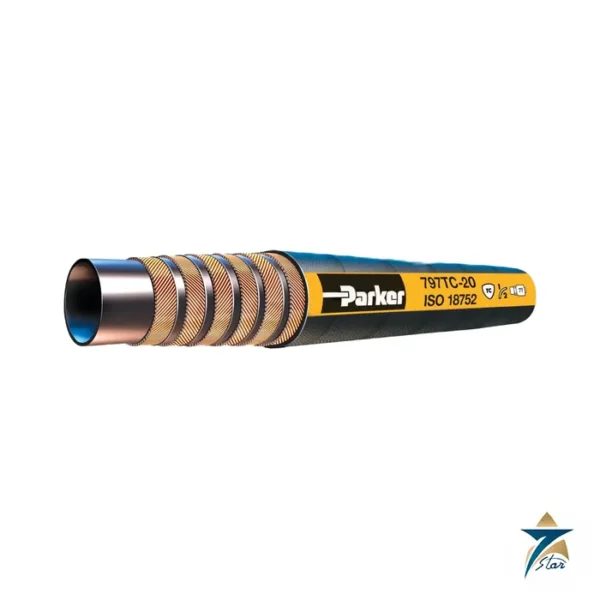
Within the same series, the neighbouring sizes are 387-8, 387-12, 387-16. If the system pressure or bend space does not suit 387-6, the sister series are 487 (4000 psi) and 797 (6000 psi); each has its own fitting series and bend radius, so compare them against the working pressure instead of switching on size alone.
| Part number | Size | Inside diameter | Min. bend radius | Fitting series |
|---|---|---|---|---|
| 387-6 | -6 | 3/8 in (10 mm) | 2-1/2 in (65 mm) | 43 Series |
| 387-8 | -8 | 1/2 in (12.5 mm) | 3-1/2 in (90 mm) | 43 Series |
| 387-12 | -12 | 3/4 in (19 mm) | 4-3/4 in (120 mm) | 43 Series |
| 387-16 | -16 | 1 in (25 mm) | 6 in (150 mm) | 43 Series |
Selection checklist for 387-6
- Pressure: include surge and spikes, not only the nominal set pressure; the series rating is 3000 psi (210 bar).
- Fluid: the hose is listed for lubricants and petroleum hydraulic fluids. For fire-resistant fluids, water-based fluids or aggressive chemicals, confirm compatibility in writing before ordering.
- Temperature: fluid and ambient together must stay between -40 °C and 100 °C. Radiated heat near turbines or exhaust may need a sleeve.
- Bend radius: 387-6 needs at least 2-1/2 in (65 mm); measure the real routing, including the coupling length.
- Size: the -6 bore (3/8 in) should match the flow and pressure drop you need; the table above gives the neighbouring sizes.
- Cover: a standard cover is fitted, so plan abrasion protection where needed.
Installing and maintaining 387-6 assemblies
Assemblies made from 387-6 should be crimped with the matching coupling and the correct crimp diameter; do not mix coupling brands or hose types, because the crimp specification is matched to each hose. Cut the hose square, clean the bore of debris, and pressure-test the finished assembly before it goes into service.
During installation, route the hose without twisting it, because torsion shortens the life of the reinforcement and can loosen couplings under pressure. Leave a little slack for length change under pressure, keep to the 2-1/2 in bend radius, and support heavy runs: 387-6 weighs 0.23 lb/ft (0.34 kg/m), which adds up on long lengths.
In service, inspect for cover cracking, abrasion down to the wire, blisters, leakage at the couplings and kinks. Replace the assembly, not just the visible damage, when the reinforcement is exposed. Keep a record of the assembly date and replace on a schedule suited to the duty.
Where the 387-6 hose is used in Oman and the GCC
Mid-small runs such as cylinder feeds on light equipment, test-bench connections, hydraulic tools and auxiliary circuits on skid-mounted power units. In Oman and across the GCC, this type of hose is found on drilling and workover support skids, valve actuation power units, crane and lifting equipment, desalination and power-plant maintenance rigs, and mobile construction and mining machinery.
Local conditions make cover choice important. Heat, strong sunlight, sand and dust accelerate cover wear and contaminate fluid when a coupling is opened, so keep the hose clear of hot surfaces, use sleeves where there is abrasion, and keep protective caps on the ends of spare lengths. Because 387-6 has the standard cover, a guard sleeve is a sensible addition on exposed outdoor runs.
Information to send with an RFQ for 387-6
- Part number 387-6 and the quantity or the length needed (metres or feet).
- Whether you need bulk hose or finished assemblies, and the coupling type, thread and orientation on each end.
- Working pressure, peak pressure and the fluid used.
- Ambient and fluid temperature range and the routing environment.
- Any marking, test, cleanliness or certificate requirements for the assembly.
Documents and quotation
The official Parker GlobalCore brochure (English) is attached on this page as a PDF and covers the 387 constant working pressure hose used for the Parker 387-6. It explains the GlobalCore pressure classes, lists the 387 inside diameters, working pressure, minimum bend radius and weight for each dash size, and shows the matching 77 and 43 Series fittings and the cover options. Check the dash size, the working pressure and the fitting series for your circuit, then send us the length and the delivery location for a quotation.
Other Models in the Parker 387 Hose Range
Seven Star LLC supplies models from the Parker 387 Hose range in Oman and the GCC. Compare the related models below and request a quote for the one that matches your application.
| Model | Category | |
|---|---|---|
| Parker 387-6 387 Hydraulic Hose -6 (3/8 in) | Hydraulic Valves & Components | You are viewing this model |
| Parker 387-8 387 Hydraulic Hose -8 (1/2 in) | Hydraulic Valves & Components | View details |
| Parker 387-12 387 Hydraulic Hose -12 (3/4 in) | Hydraulic Valves & Components | View details |
Datasheets & Documents
- Datasheet Parker GlobalCore Hydraulic Hose and Fitting System Brochure (PDF) Download
Reviews (0)
How would you rate this product? Cancel reply
About brand
Parker Hannifin is an American manufacturer of motion and control technologies, founded in 1917 in Cleveland, Ohio, by Arthur L. Parker as the Parker Appliance Company. Its first product was a pneumatic brake system for trucks and buses. In 1957 the company bought Hannifin, a maker of hydraulic and pneumatic cylinders and valves, and took the Parker Hannifin name. It is headquartered in the Cleveland area and listed on the New York Stock Exchange.
Seven Star LLC supplies the Parker items that maintenance teams request most: Lucifer solenoid valves, including NAMUR types for actuated valves, along with filter elements and hydraulic gear pumps.
Parker company profile
| Founded | 1917, Cleveland, Ohio, USA, by Arthur L. Parker |
|---|---|
| Headquarters | Cleveland area, Ohio, USA |
| Ownership | Public company, New York Stock Exchange (PH), listed since 1964 |
| First product | Pneumatic brake system for trucks and buses |
| Product families | Hydraulic pumps, cylinders and valves, pneumatic valves and FRLs, instrumentation fittings and valves, hoses and couplings, filtration (including Racor and Velcon), seals and O-rings |
Milestones
- 1917: Arthur L. Parker starts the Parker Appliance Company in Cleveland.
- 1924: Parker restarts the business after a 1919 accident destroyed its inventory.
- 1957: Parker acquires Hannifin and becomes Parker Hannifin.
- 1964: The shares are listed on the New York Stock Exchange.
Parker product lines listed here
Most of the listing is Lucifer, the Parker solenoid valve line that many nameplates still show as a brand in its own right. The 341N types (341N01, 341N22, 341N31) are NAMUR-interface valves that bolt straight onto a pneumatic actuator to pilot it. The E131K03 is a direct-acting 3/2 valve, and the 322K4706 and 7341NAKBHNM0 are further Lucifer solenoid valves. Parker sells Lucifer valve bodies and their coils or electrical parts as separate items, so one body can be combined with different voltages and enclosure types.
Other Parker lines appear: a hydraulic gear pump (P51A478BEY25-07-ZY), a coalescing filter element (9000040001) and a Triple-Lok 37-degree flare tube fitting.
Where Parker components are used
Lucifer NAMUR valves sit on quarter-turn actuators for on-off and shutdown valves in oil and gas, power and water plants across the GCC. Line-mounted solenoid valves switch instrument air, water, steam and light oils on skids and machines. Gear pumps drive hydraulic power units and mobile equipment, and coalescing elements protect instrument air and gas sampling systems from oil and water aerosols.
Parker products we list
Ordering Parker parts: what we need
Parker part numbers are long and every character counts. Please send:
- Solenoid valves: valve number from the body, coil or electrical part number, voltage and frequency, and the Ex marking if the coil is certified
- Gear pumps: the complete code from the nameplate, including the assembly number, which fixes displacement, shaft, ports and rotation
- Filter elements: element number and the housing model it fits
A photo of the nameplate is welcome. We check the code against Parker documentation and identify the manufacturer's current equivalent if a number has been superseded.
Facts checked against Parker's centennial timeline and the Encyclopedia of Cleveland History, October 2026.
Browse Parker products by category: Solenoid Valve, Filtration Elements, Pumps.
FAQ
Questions about the Parker 387-6 387 Hydraulic Hose -6 (3/8 in)
Answers from our engineering team on installation, compatibility and integration.
01What is the pressure rating of the 387-6?
The 387-6 hose is listed with a maximum operating pressure of 3000 psi (210 bar, 21 MPa). The rating of a finished assembly is limited by its lowest-rated component, so the coupling must be checked too.
02What fluids can the 387-6 carry?
The manufacturer lists lubricants and petroleum hydraulic fluids for 387-6. For fire-resistant, water-based or chemical fluids, confirm compatibility with the manufacturer before ordering.
03What size and bend radius does the 387-6 have?
387-6 is dash size -6 with an inside diameter of 3/8 in (10 mm) and a minimum bend radius of 2-1/2 in (65 mm). Allow for the coupling length when you check the routing.
04Which fittings fit the 387-6?
Parker lists the 43 Series of crimp-style couplings as compatible with 387-6. Use the coupling designated for this hose and size, and crimp it to the manufacturer's specification.
05What temperature range does the 387-6 cover?
The range is -40 °C up to 100 °C. Fluid temperature and ambient heat both count, so shield the hose from hot surfaces in Gulf climates.


Reviews
There are no reviews yet.