- Automation & ControlView all 3,044 products
- Automation Accessories
- AC Drives
- PLC & I/O Cards
- Industrial Communications
- Vibration Monitoring
- Isolator & Barrier
- Controllers & Data Acquisition
- Safety Switches & Guard Locking
- Motor Soft Starters
- Encoders
- CCTV & Security
- Pneumatic Cylinders
- HMI Displays
- Servo Drives
- Industrial Computers
- Machine Vision
- Automation Software
- Robotics
Brand: MTL (Eaton)
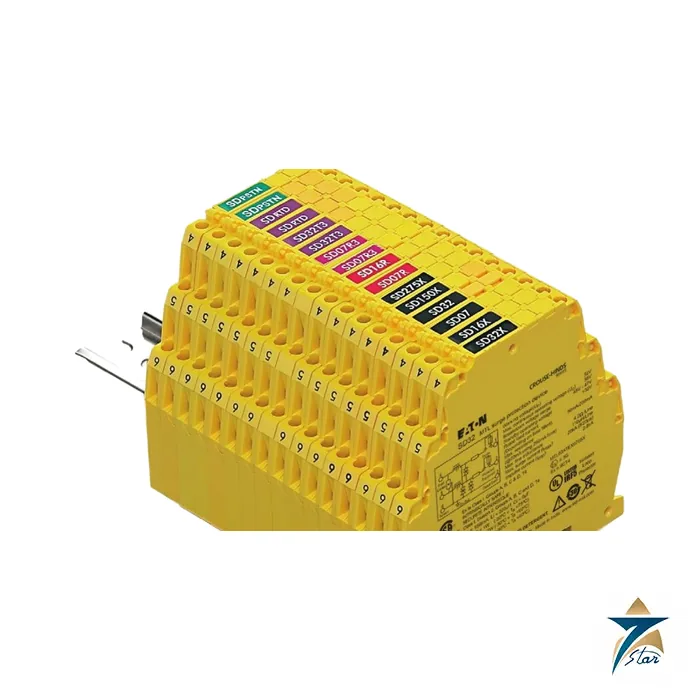
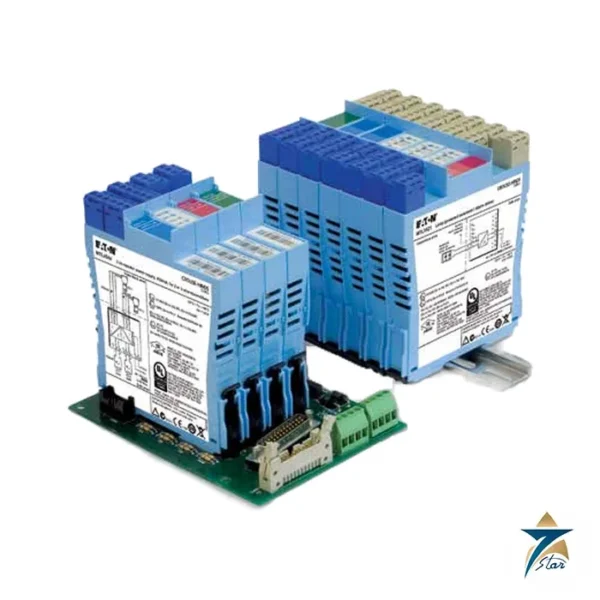
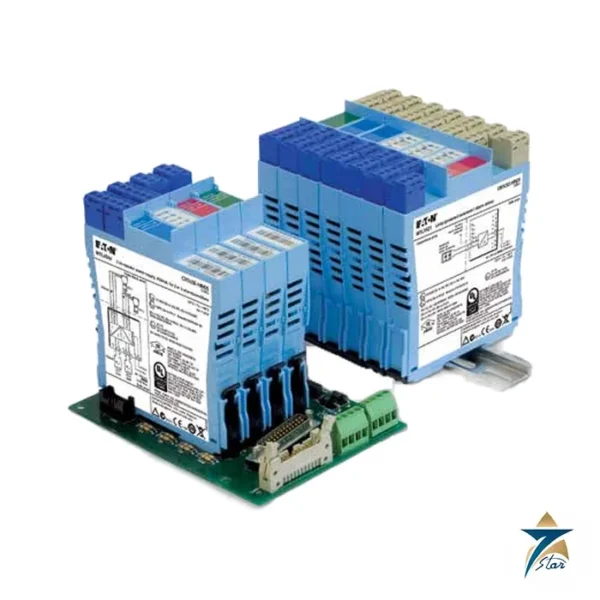
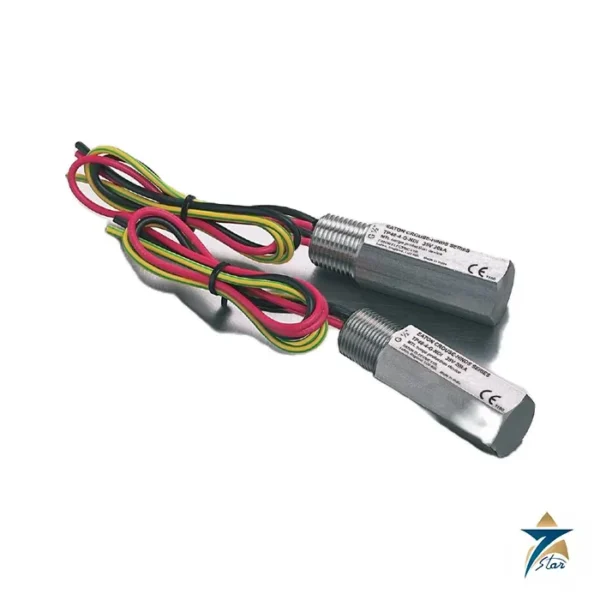
MTL SDRTD 3-Wire RTD Surge Protection Device
Description
Protecting an RTD without disturbing its reading
A resistance thermometer works by sensing tiny changes in resistance, so anything added to the circuit is a potential error. Ordinary surge protectors leak current or add resistance that would shift the reading. The MTL SDRTD was designed for exactly this: three wires in one housing, a leakage current of just 0.3 microamp and a degradation accuracy of 0.1 percent for RTDs above 100 ohm, or 0.1 ohm for lower resistances. It is the datasheet’s recommended product for 3-wire RTDs.
SDRTD specification in detail
| Model | SDRTD |
|---|---|
| Application | 3-wire RTD |
| Nominal voltage | 1 V dc / 0.75 V ac |
| Series resistance | 2.7 ohm |
| Maximum leakage current | 0.3 microamp |
| Rated voltage (MCOV) | 5 V |
| Protection level at 1 kV per microsecond | below 12 V |
| Residual voltage at isn | 38 V |
| Bandwidth | 50 MHz |
| RTD resistance range | 10 to 1500 ohm |
| Degradation accuracy at 1 mA | 0.1 percent above 100 ohm; 0.1 ohm below 100 ohm |
| Maximum surge current | 20 kA (8/20 microseconds) |
| Lightning impulse current | 2.8 kA (10/350 microseconds) |
| ATEX | Ex ia IIC T4 Ga, Li = 0, Ii = 260 mA at Ui up to 60 V |
| Temperature | -40 to +80 degrees C |
| Weight | about 70 g |
Setting the excitation current for SDRTD circuits
The datasheet gives a simple design rule: pick an energising current so that the voltage across the RTD never exceeds 1 V over the full range. For a Pt100 that stays below roughly 376 ohm at 800 degrees C, 1 mA gives 0.38 V, comfortably inside the limit and the manufacturer’s recommended value. A Pt1000 passes 1500 ohm at roughly 140 degrees C, beyond the module’s stated range at higher temperatures, so the SDRTD is aimed at Pt100 and other low-resistance sensors.
Stay at about 1 mA for a Pt100 and keep the three conductors the same length, so the 2.7 ohm of each leg is matched and lead compensation in the transmitter can work.
SDRTD versus other SD devices for temperature signals
Thermocouples and mV sources are better served by the SD07 or SD16 (and their X versions), whose voltage rating suits millivolt signals. The SDRTD is for resistance measurement. Placing an SD07R3, which leaks up to 500 microamps, on an RTD would add noticeable error, whereas the SDRTD leaks only 0.3 microamp. That difference is the reason for a dedicated RTD part.
If an RTD is wired into a transmitter in the field, a TP48 on the transmitter housing is an alternative for the transmitter’s own terminals.
Applications for SDRTD in Oman and GCC facilities
- Bearing and winding RTDs on large motors at power stations and water pumping plants
- Process temperature RTDs at refineries and gas processing units where lightning exposure is high
- Tank farm temperature elements on storage tanks
- Heat-tracing and reactor temperature points at chemical plants
- RTD signal cables running between buildings or across pipe racks
Installing the SDRTD
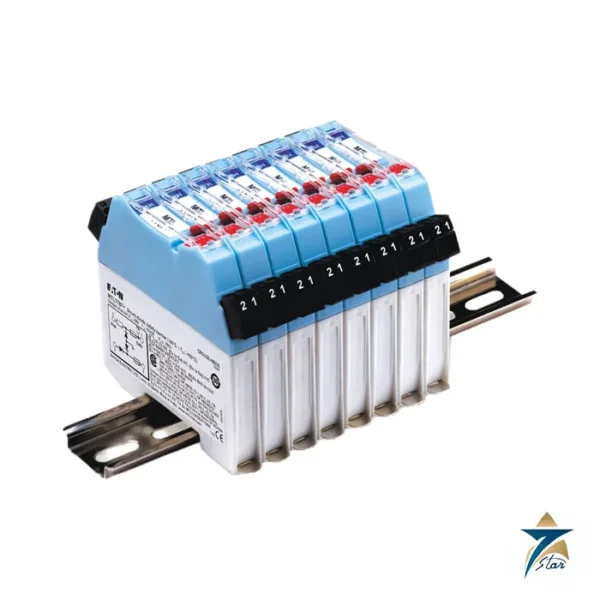
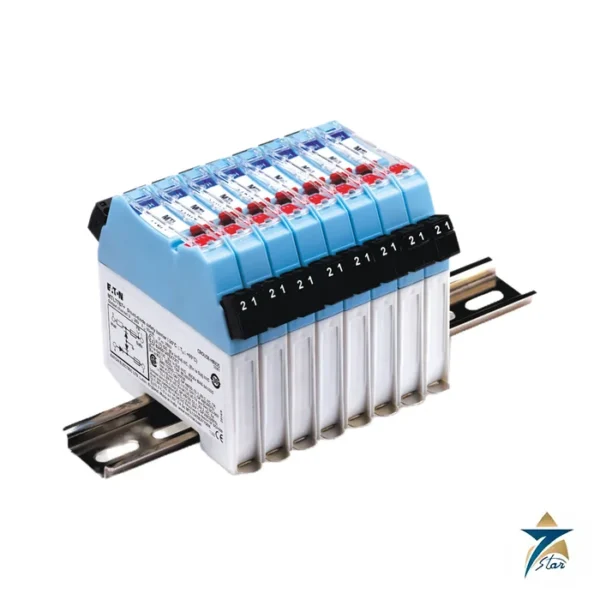
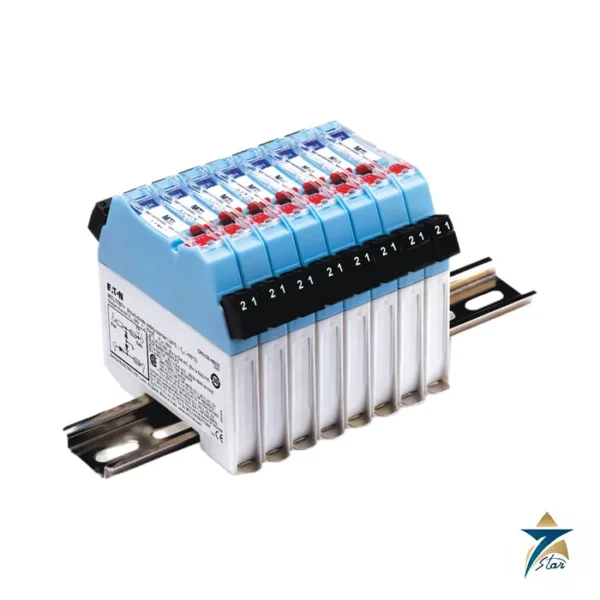
Mount the SDRTD on 35 mm rail in the junction box or marshalling cabinet within one metre of the sensor where practical. Wire the three RTD conductors through the field terminals and on to the protected terminals. Bond the sensor housing to nearby steelwork. Keep the SDRTD on the field side of the temperature transmitter or isolator, and keep it clear of safe-area wiring by at least 50 mm.
After installation, measure the loop with a decade box. The reading should match the box within the quoted degradation accuracy.
Upkeep of SDRTD
Include the SDRTD in annual loop checks. A hybrid that has been stressed by a surge may have increased leakage, which shows up as a slow upward drift in temperature indication. Seven Star LLC is an independent supplier serving Oman and the GCC and is not affiliated with the manufacturer.
Estimating the effect of an SDRTD on a Pt100 reading
At 100 degrees C a Pt100 reads about 138.5 ohm. The datasheet accuracy figure of 0.1 percent above 100 ohm corresponds to roughly 0.14 ohm or a third of a degree C. Below 100 ohm, where the Pt100 is below 0 degrees C, the error is quoted as 0.1 ohm, about 0.26 degrees C. These figures apply at 1 mA energising current. In a three-wire circuit the controller subtracts lead resistance by comparing the two sensing legs, so matched legs through the SDRTD cancel part of the 2.7 ohm series resistance.
To keep self-heating negligible, the 1 mA recommendation also limits dissipation in a Pt100 to about 0.14 milliwatt at 100 degrees C. The SDRTD’s 5 V rated voltage is far above the 0.4 V seen across the sensor, so the surge protector stays quiescent during normal operation.
Ordering note: the SDRTD has a unique rated 1 V working voltage, so it must not be substituted by a signal-loop type just because the housing looks the same.
Approvals recorded for the SDRTD
Beyond the ATEX certificate Baseefa02ATEX0211X for Ex ia IIC T4 Ga with an ambient range starting at minus 30 degrees C, the datasheet shows the SDRTD in the IECEx certificate BAS 12.0003X, in the CSA listing LR 36637 and in the UL 497B listing E220693 for isolated loop communication circuits. The Ex nA certificate MTL03ATEX0755X also covers it. For intrinsically safe use the allowed power rating Pi is 1.0 W between minus 30 and plus 75 degrees C, 1.2 W up to plus 60 degrees C and 1.3 W up to plus 40 degrees C.
Make a note on the instrument index that the SDRTD is in-line with the sensor.
Documents and quotation
Use the SD range datasheet for approvals, accessories and ordering. Send an RFQ naming SDRTD, quantity and delivery location in Oman or the GCC.
Documentation and Compliance
Industrial buyers often need more than the hardware. When you order the MTL SDRTD, tell us which documents your project or quality team requires, such as certificates of origin, conformity declarations, calibration or test records, or hazardous-area certificates where the variant carries them. Mentioning these at the enquiry stage avoids delays at customs and at goods receipt on site. For tenders and project packages, we can also align the quotation with your line-item format so that MTL (Eaton) isolator & barrier items can be checked against the bill of materials quickly.
Other Models in the MTL SD Surge Range
Seven Star LLC supplies models from the MTL SD Surge range in Oman and the GCC. Compare the related models below and request a quote for the one that matches your application.
| Model | Category | |
|---|---|---|
| MTL SD07R3 Low-Voltage 3-Terminal Surge Protector | Isolator & Barrier | View details |
| MTL SD32T3 Three-Terminal Surge Protection Device | Isolator & Barrier | View details |
| MTL SD275X 240 V AC High-Current Surge Protector | Isolator & Barrier | View details |
| MTL SDPSTN Telephone Line Surge Protector | Isolator & Barrier | View details |
| MTL SDRTD 3-Wire RTD Surge Protection Device | Isolator & Barrier | You are viewing this model |
Datasheets & Documents
- Datasheet MTL SDRTD 3-Wire RTD Surge Protection Device Datasheet Download
Reviews (0)
How would you rate this product? Cancel reply
About brand
MTL is a British maker of intrinsic safety interfaces, surge protection and hazardous-area equipment, founded in 1971 in Luton as Measurement Technology Ltd, a spin-off from Kent Instrumentation. In 2008 Cooper Industries bought MTL Instruments for £144 million and placed it in its Crouse-Hinds division; Eaton acquired Cooper in 2012. MTL is now part of Eaton's Crouse-Hinds business, alongside the MEDC signalling range.
Seven Star LLC lists MTL isolators, a fieldbus barrier and the configuration tools for them, and supplies MTL (Eaton) barriers and spare modules to sites in Oman as an independent supplier.
MTL (Eaton) company profile
| Founded | 1971, Luton, England, as Measurement Technology Ltd |
|---|---|
| Origin | Spin-off from Kent Instrumentation |
| Headquarters | Luton, England |
| Ownership | Eaton (Crouse-Hinds), via Cooper Industries from 2008 |
| Product families | MTL5500 and MTL4500 isolators, MTL7700 zener barriers, 9300 fieldbus barriers, surge protection devices, process junction boxes, PCS45 configuration software; MEDC beacons, sounders and call points |
Milestones
- 1971: Measurement Technology Ltd is founded in Luton.
- 2007: MTL acquires ELPRO Technologies, RTK Instruments and Ocean Technical Systems.
- 2008: Cooper Industries acquires MTL Instruments for £144 million.
- 2012: Eaton acquires Cooper Industries.
MTL product families listed here
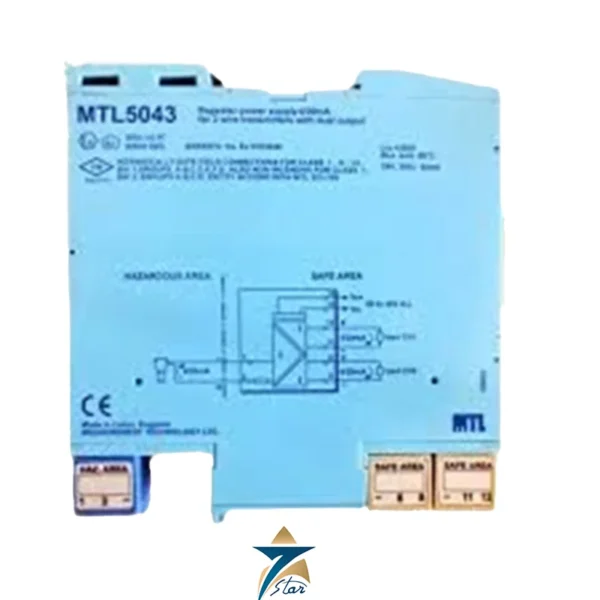
Most of the listed items are DIN-rail galvanic isolators. The MTL5541 repeater power supply and the MTL5576-THC temperature converter belong to the MTL5500 range, and the MTL 5043 repeater power supply comes from the earlier MTL5000 range that many plants still run. The MTL 9370-FB2 is a fieldbus barrier for intrinsically safe FOUNDATION fieldbus spurs. PCS45 software with the PCL45USB link is the configurator for MTL converter modules. For the listed part CPM08-BN, please send a label photo so the number can be matched to the manufacturer's records. Newer labels show Eaton MTL, older ones Measurement Technology Ltd, and the module numbers are the same. The MTL 9608 is a fieldbus junction box with eight spur outlets plus a trunk-in connection, listed under the Crouse-Hinds series part number FCS-9608.
Where MTL barriers and isolators are used
These interfaces sit in marshalling cabinets wherever instruments are located in Zone 0, 1 or 2 areas: gas plants, refineries, offshore platforms, tank farms and chemical units across the GCC. They power 2-wire transmitters, pass HART, convert thermocouple signals and drive solenoids or alarms while limiting energy to the field circuit.
MTL (Eaton) products we list
Ordering MTL modules: what we need
Send the full module number including every suffix, for example MTL5576-THC and not just MTL5576, and the quantity. Tell us if the module mounts on DIN rail or on a backplane, because MTL5500 and MTL4500 parts are not interchangeable. For a fieldbus barrier give the number of spurs and the enclosure reference. A photo of the side label, which shows the certificate numbers, helps when the certificate for your project file must match.
Facts checked against the Eaton MTL company history and Drives & Controls coverage of the 2008 Cooper offer, October 2026.
Browse MTL (Eaton) products by category: Isolator & Barrier, Automation Software.
FAQ
Questions about the MTL SDRTD 3-Wire RTD Surge Protection Device
Answers from our engineering team on installation, compatibility and integration.
01What RTD resistance range does the SDRTD cover?
The datasheet lists 10 to 1500 ohm, which covers Pt100 up to high temperatures and also higher-resistance types.
02How much error does the SDRTD add to a measurement?
The degradation accuracy at 1 mA is 0.1 percent when the RTD resistance is above 100 ohm, and 0.1 ohm when below 100 ohm.
03What excitation current is recommended?
Choose an energising current that keeps the voltage across the RTD below 1 V over the full measurement range. For a Pt100 the manufacturer recommends 1 mA.
04What are the electrical ratings of the SDRTD?
Nominal voltage 1 V dc or 0.75 V ac, series resistance 2.7 ohm, leakage 0.3 microamp, MCOV 5 V, protection level below 12 V at 1 kV per microsecond and 50 MHz bandwidth.
05Is it certified for hazardous areas?
Yes, ATEX Ex ia IIC T4 Ga with Li = 0 and Ii = 260 mA for Ui up to 60 V, IECEx and North American approvals are also listed for SDRTD.


Reviews
There are no reviews yet.