Brand:

Kyoritsu KEW 3552 Digital Insulation Tester 1000V

Description

Overview

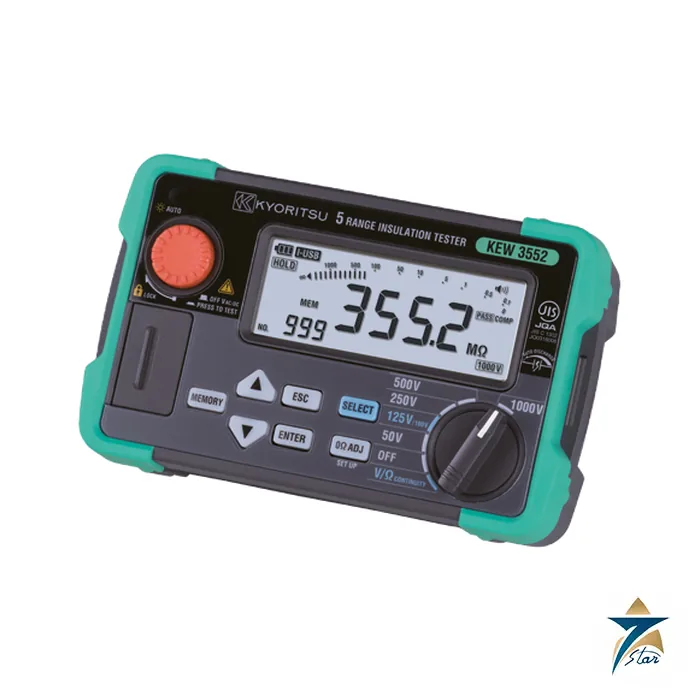
Kyoritsu KEW 3552 is a digital insulation and continuity tester with six selectable test voltages from 50 V to 1000 V, an auto-ranging display up to 40 GΩ and a built-in memory for storing results. The maker describes its measurement speed as world-class at about 0.5 seconds, which shortens the time spent holding probes against energised-looking equipment and lets an inspector work through a long cable schedule without waiting for the reading to settle. Seven Star LLC is an independent supplier serving Oman and the GCC, and this guide explains what the KEW 3552 can and cannot do so that you can specify it correctly.

Test voltages and ranges of the Kyoritsu KEW 3552

An insulation tester applies a DC voltage to a circuit and measures the leakage through the insulation. The KEW 3552 offers 50 V, 100 V, 125 V, 250 V, 500 V and 1000 V. The low voltages are useful for electronic equipment, telecom lines and sensitive instruments; the 250 V and 500 V steps cover most low-voltage installation and motor tests; the 1000 V step is used on higher rated cables and equipment. Maximum displayed values are 100 MΩ, 200 MΩ, 250 MΩ, 500 MΩ, 20 GΩ and 40 GΩ respectively, with the instrument choosing the range automatically.

Accuracy depends on the zone of the scale. In the first effective measuring range, for example 0.100 to 10.00 MΩ at 50 V or 0.100 to 1000 MΩ at 1000 V, accuracy is plus or minus 2 percent of reading plus 2 digits. In the second effective range, such as 10.01 to 100.0 MΩ at 50 V or 1001 to 4000 MΩ at 1000 V, it is plus or minus 5 percent of reading. The rated test current is 1.0 to 1.1 mA and the output short-circuit current is 1.5 mA at most.

Kyoritsu KEW 3552 specification table

Item KEW 3552 data
Insulation test voltages 50, 100, 125, 250, 500, 1000 V
Display ends 100.0 MΩ, 200.0 MΩ, 250.0 MΩ, 500.0 MΩ, 20.00 GΩ, 40.00 GΩ
Mid-scale values 2, 5, 5, 10, 100 and 200 MΩ
Continuity ranges 40.00, 400.0, 4000 Ω auto-ranging; plus or minus 2.5 percent plus 8 digits
Continuity test source 5 V open circuit; short-circuit current 200 mA or more
Voltage measurement AC 2.0 to 600 V (45 to 65 Hz); DC plus or minus 2.0 to 600 V; plus or minus 1 percent plus 4 digits
Standards IEC 61010 CAT III 600 V / CAT IV 300 V, IEC 61010-2-034, IEC 61557-1, -2, -4, IEC 61326, IP40 enclosure
Power Four LR6/R6 (AA) cells
Interface USB through an optional adapter
Size and mass 97 x 156 x 46 mm; about 490 g with batteries

Where KEW 3552 sits in its range

Three models share the same catalogue. KEW 3551 is the standard model; KEW 3552 adds a memory function for saving results; KEW 3552BT adds memory and Bluetooth communication. If you only need a quick judgement on a motor winding, the standard model is enough. If a contract requires you to keep a record of each insulation reading per circuit, the KEW 3552 with memory is the lowest model that satisfies that, and its USB adapter route allows the data to be transferred to a PC for report writing with the manufacturer’s KEW Report software. Choose the BT version only if wireless transfer to a mobile device is wanted.

Where the tester is used

  • Commissioning and periodic testing of low-voltage distribution boards and final circuits in commercial buildings in Muscat and Sohar.
  • Motor winding and cable checks in oil and gas, water treatment and utility plants before re-energising after a shutdown.
  • Factory acceptance and maintenance of control panels, using the 50 V and 100 V steps to avoid stressing electronics.
  • Telecom and solar balance-of-system work where low test voltages protect sensitive components.

Test lead options and practical tips

The kit is supplied with test lead 7260, which includes a remote control switch on the probe so the test can be started without touching the instrument, test lead 7261A with an alligator clip, extension probe 8017A, carrying case 9173 and shoulder strap 9121. Optional parts include the L-shaped probe 7243A, hook probe 8016, carrying case 9186A, cord case 9187 and USB adapter 8212-USB. For long cable runs, always discharge the cable after the test; allow the reading to stabilise and remember that long, dry cables have large capacitance that takes time to charge.

Before using the instrument, confirm that the circuit is isolated and verify there is no live voltage with the voltage function, which reads AC and DC up to 600 V. Disconnect electronic loads, surge arresters and any device that cannot take the test voltage. Record the temperature and humidity at the time of the test, because insulation resistance falls as temperature and moisture rise.

Reading and recording results

An insulation reading is a trend as much as a number. Compare each new value with the previous record for the same circuit, because a steady fall over several inspections warns of moisture, contamination or ageing long before the absolute value reaches a failure limit. Use the same test voltage every time so that readings are comparable, hold the probes steadily until the display settles, and note the ambient conditions. For motors, test between each winding and earth with the other windings connected to earth. For multi-core cables, test each core against the others and against the screen or armour. Keep the memory function for the final value of each circuit so that your report matches what the instrument stored. Because the measurement time is short, the meter suits large schedules where an inspector may take several hundred readings in a shift.

Maintenance

Replace the four AA cells when the battery indicator shows, and remove them for long storage. Wipe the body with a damp cloth, keep the instrument out of dust and spray because the enclosure is rated IP40 only, and inspect test leads for cracked insulation before each job. Calibration should follow your quality procedure.

Ordering Kyoritsu KEW 3552

When you request the Kyoritsu KEW 3552, state the quantity, whether you want the optional USB adapter or the extra carrying cases, and the delivery location in Oman or elsewhere in the GCC. If you want to compare the three models in the range, tell us how many circuits you test per day and whether records are required.

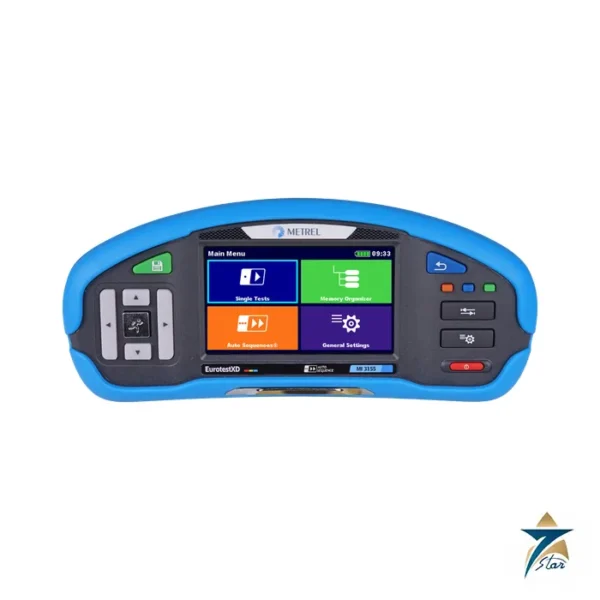
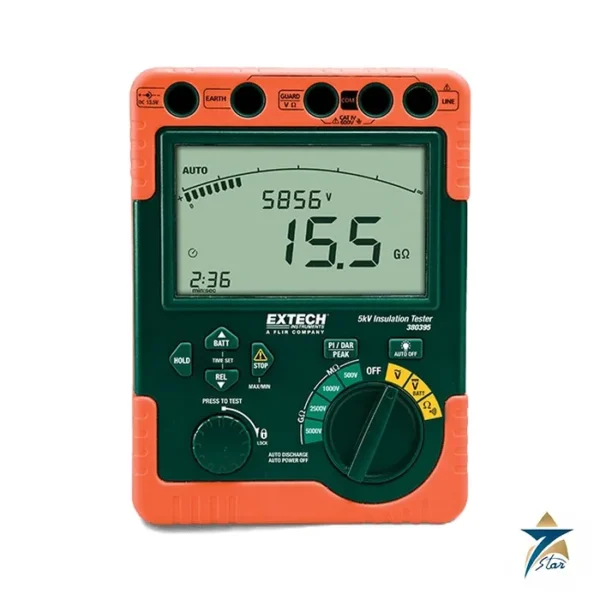
Related items you may also need: Metrel MI 3155 EurotestXD Industrial Installation Tester | Extech EX840A 1000 A True RMS AC/DC Clamp Meter with IR | Extech 380395 5 kV Digital Insulation Resistance Tester | All Kyoritsu products.

Documents and quotation

The catalogue sheet for KEW 3551, KEW 3552 and KEW 3552BT is attached as the datasheet for this page. To obtain a quotation, send an RFQ that includes the part number KEW 3552 and the quantity, and we will confirm availability and lead time for your site.

Datasheets & Documents
  • PDF Datasheet Kyoritsu KEW 3552 Digital Insulation Tester 1000V Datasheet Download
Reviews (0)

Reviews

There are no reviews yet.

How would you rate this product?

It takes about 10 seconds — just tap a star. Your email is never published.

About brand

Kyoritsu is the Japanese maker of hand-held electrical test and measuring instruments sold worldwide under the KEW name: clamp meters, multimeters, insulation testers, earth testers and multifunction installation testers. The business began in 1940, when Takeo Kuramoto set up the Kyoritsu Electronic Research Institute and started making electrical measuring instruments. It was incorporated in 1950 as Kyoritsu Electrical Instruments Works, Ltd., published an English catalogue the following year to reach overseas buyers, and moved to its present site in Meguro-ku, Tokyo in 1957. Its instruments now reach electricians and maintenance engineers in many countries.

Kyoritsu company profile

Founded 1940, Japan, by Takeo Kuramoto (Kyoritsu Electronic Research Institute); incorporated 1950
Headquarters Meguro-ku, Tokyo, Japan
Company Kyoritsu Electrical Instruments Works, Ltd.; capital 42 million yen; about 200 employees
Core technology Clamp-on current measurement, digital multimeters, insulation and earth resistance testers, installation testers
Typical applications Electrical maintenance, installation inspection, commissioning and periodic testing of power and control systems
Standards Instruments designed to IEC 61010 measurement categories; installation testers to the IEC 61557 series

Milestones

  • 1940: Takeo Kuramoto founds the Kyoritsu Electronic Research Institute in Japan.
  • 1950: The institute is incorporated as Kyoritsu Electrical Instruments Works, Ltd.
  • 1965: The company develops Japan's first clamp meter and starts production and sales.
  • 1968: The compact DC multi-range clamp meter KS-7 is developed, a world first according to the company.
  • 1979: The auto-ranging digital clamp meter with peak hold, KS-777 (MODEL 2001), is developed as a first in Japan.
  • 2015: The company marks 75 years and establishes Kyoritsu Instruments Asia Pte. Ltd. in Singapore.

How a clamp meter works

A clamp meter measures the current in a conductor without breaking the circuit. The jaw opens, closes around one conductor and senses the magnetic field that the current produces, so the circuit stays energised and in service while you read the load. On an AC clamp the jaw works like a current transformer. AC/DC models such as the KEW 2046R and KEW 2056R also respond to direct current, which makes them suitable for battery systems and drives as well as mains circuits. For a valid reading, enclose a single conductor only: placing line and neutral together in the jaw cancels the field and the display falls close to zero. Check the jaw opening against the largest cable or busbar, the current range against the expected load, and the measurement category against the location of the test.

Where these instruments are used in Oman and the GCC

These testers serve the routine work of electrical teams in Oman and across the Gulf: load and imbalance checks on distribution boards, insulation tests on motors and cables in oil, gas and water plants, earth electrode verification at substations and towers, and periodic inspection of commercial and residential installations.

Kyoritsu models we list

Family Examples
AC/DC clamp meters KEW 2046R, KEW 2056R
Digital multimeters KEW 1062
Insulation testers KEW 3552, KEW 3125B
Earth testers KEW 4105A
Installation testers KEW 6516

Ordering Kyoritsu products: what we need

Send the exact model name as printed on the front panel, for example KEW 3552 rather than a general description, together with the quantity and your delivery location. Add the accessories you want, such as temperature probes, USB adapters, carrying cases or extra test leads, because the standard kit differs between models. For spare leads on older units, include the serial number so that we can match the correct lead series. Seven Star LLC is an independent supplier serving Oman and the GCC, and we reply to each RFQ with availability and lead time.

Facts checked against the Kyoritsu Electrical Instruments Works corporate data, company history and product pages, November 2026.

FAQ

Questions about the Kyoritsu KEW 3552 Digital Insulation Tester 1000V

Answers from our engineering team on installation, compatibility and integration.

01What test voltages does the Kyoritsu KEW 3552 provide?
It provides six insulation test voltages: 50, 100, 125, 250, 500 and 1000 V. Maximum display values range from 100 MΩ at 50 V up to 40 GΩ at 1000 V, with auto-ranging.
02How fast is the KEW 3552 measurement?
The manufacturer describes the measurement speed as world-class fast, at about 0.5 seconds. Rated test current is 1.0 to 1.1 mA with a 1.5 mA maximum short-circuit current.
03What is the difference between KEW 3551, 3552 and 3552BT?
KEW 3551 is the standard model, KEW 3552 adds memory, and KEW 3552BT adds memory plus Bluetooth communication. All three are covered by one catalogue sheet.
04Can the KEW 3552 also test continuity and voltage?
Yes. It has auto-ranging continuity at 40, 400 and 4000 Ω with a 200 mA test current and a voltage function for AC 2.0 to 600 V and DC up to plus or minus 600 V.
05What safety standards apply to the KEW 3552?
It is rated IEC 61010 CAT III 600 V and CAT IV 300 V and complies with IEC 61010-2-034 and IEC 61557-1, -2 and -4. The enclosure protection is IP40.