Brand:

Druck RPS 8000 and DPS 8000 High Accuracy Resonant Pressure Sensors

Description

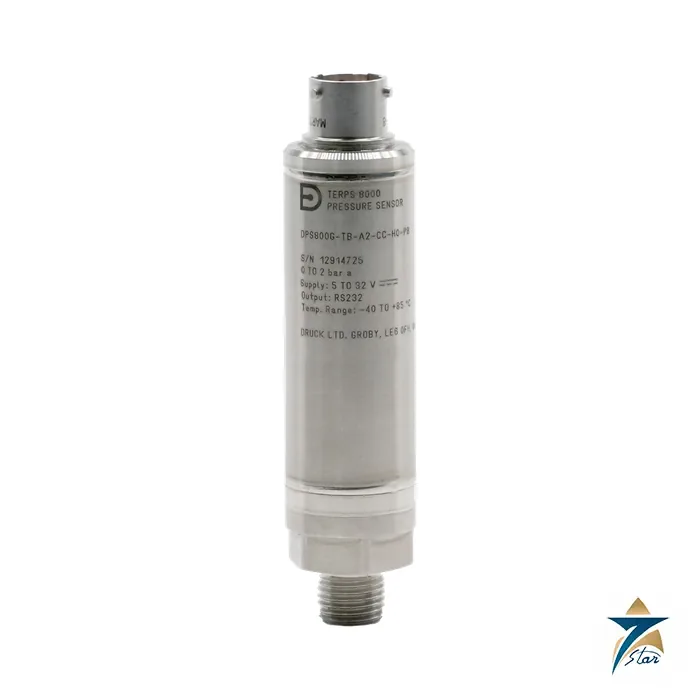
The Druck RPS 8000 and DPS 8000 are high accuracy resonant pressure sensors built on Druck TERPS resonant silicon technology. They give a digital or frequency output for applications that need very high accuracy and stability, such as calibration standards and research.

Seven Star LLC supplies Druck instruments from Muscat with the manufacturer datasheet available before quotation.

TERPS resonant silicon technology

Druck states that the RPS/DPS 8000 was the first product to use the TERPS resonant silicon pressure sensor platform, which provides an order of magnitude greater accuracy and stability than conventional technologies. The sensor is media isolated and made from 316L stainless steel and Hastelloy C276, so it suits harsh environments. It is not suitable for media with oxygen concentration above 21% or other strong oxidizing agents.

Two accuracy levels are offered: A1 standard at 0.02% FS and A2 improved at 0.01% FS, both including non-linearity, hysteresis, repeatability and temperature error over the compensated range. Long-term stability is stated as 0.01% FS per year. For frequency and diode outputs the accuracy is reached by using the supplied coefficient data in a polynomial curve fit.

  • Output options: RS-232, RS-485, USB 2.0, CANbus, frequency and diode (TTL)
  • Wide choice of pressure and electrical connections
  • Calibration traceable to UKAS-operating standards
  • Barometric ranges available in the RPS/DPS 8100 series

Technical specifications

Parameter Specification
Base pressure ranges 0 to 2, 7, 14, 20, 35, 70, 100 and 200 bar absolute
Calibrated ranges Any zero-based range from 1 to 200 bar; lowest calibrated pressure 35 mbar absolute
Accuracy A1 0.02% FS; A2 0.01% FS
Long-term stability 0.01% FS per annum
Overpressure 1.5 x FS; sensor failure pressure 2.0 x FS
Compensated temperature ranges -10 to +50, -40 to +85, -40 to +125, -55 to +125 degC (the last two for TTL, RS-485 and CANbus)
Supply 5 to 32 VDC (frequency, RS-485, RS-232), 7.5 to 30 VDC (CANbus), 4.8 to 5.2 VDC (USB)
Orientation sensitivity Less than 0.2 mbar/g
Vibration and shock BS EN 60068-2-6 and -64; DO-160E shock 20 g, 11 ms
Certifications CE marked, RoHS; EMC EN 61000-6-1, -6-2, -6-3

Applications and what to confirm before ordering

Druck lists industrial, aerospace, oil and gas and research environments. Because accuracy code, base range, output, electrical connector and pressure connector are all ordering options, send the pressure range, output type (for example RS-485 or CANbus), temperature range, connector requirement and accuracy level when requesting a quotation. Note the data sheet warning to seal only on the intended sealing face when mounting.

Related Druck products: Druck PDCR 1800 / PTX 1800 Titanium Submersible Level Pressure Sensor, Druck PTX300 Subsea Pressure Transmitter, 228 to 1035 bar, Druck PTX400 Subsea Wellhead Pressure and Temperature Transmitter and Druck UNIK 5600/5700 Marine-Approved 4-20 mA Pressure Transmitter.

Where the RPS/DPS 8000 is used

Most industrial transmitters are accurate to a few tenths of a percent, which is enough for process control. Calibration laboratories, pressure standards, metrology, aerospace test and research need much better accuracy and long-term stability. The Druck RPS 8000 and DPS 8000 use the TERPS resonant silicon sensor. Druck states it gives an order of magnitude better accuracy and stability than conventional technology. Accuracy is 0.02% FS (A1 standard) or 0.01% FS (A2 improved), including non-linearity, hysteresis, repeatability and temperature effects, with long-term stability of 0.01% FS per year.

Typical applications

  • Reference sensors in pressure calibrators and calibration benches.
  • Barometric and altitude measurement in meteorology and aerospace test.
  • Precise flow and level measurement where small pressure differences matter.
  • Research and test rigs that log pressure digitally over long periods.

RPS or DPS: choosing the output

  • RPS 8000 gives frequency and diode (TTL) outputs. The host system reads the raw frequency and applies the supplied coefficient data in a polynomial curve fit to reach the stated accuracy.
  • DPS 8000 gives digital outputs such as RS-232, RS-485, USB 2.0 or CANbus, with the calculation done inside the sensor.
  • Choose RPS where an existing instrument already handles frequency sensors, and DPS where a PC or controller should read pressure directly.

Media and mechanical points

  • The sensor is media isolated and wetted by 316L stainless steel and Hastelloy C276, which suits many harsh liquids and gases.
  • It is not suitable for media with more than 21% oxygen or for other strong oxidising agents. Don’t use it on oxygen service.
  • The range, pressure type and pressure and electrical connections are all chosen through the ordering code. Check each item against your system before ordering.
  • Mount the sensor where temperature is stable and vibration is low, to get the best performance in practice.

Calibration and traceability

A reference sensor is only as good as its calibration record. Keep the calibration certificate and coefficient data with the sensor, and plan recalibration intervals to suit your quality system.

Laboratories in the region
Calibration laboratories and oil and gas metering teams in Oman need traceable reference sensors. Laboratory air conditioning helps keep the sensor within its compensated temperature range.

For a quotation, give the full ordering code, or the pressure range, pressure type, accuracy class (A1 or A2), output, and pressure and electrical connections.

Questions to answer before ordering

  • What pressure range and accuracy class are needed?
  • Which output, frequency or digital, does the system read?
  • Which pressure connection and calibration certificate are needed?

Documents and quotation

To request a quotation for the RPS/DPS 8000 sensor, send Seven Star LLC the full model or order code, quantity, and any nameplate data from an existing unit that is being replaced or matched. Our Muscat team checks the request against the manufacturer document, which can be downloaded from this page, and replies with a formal quotation. Prices, stock and lead times are confirmed per inquiry.

Related reading on this site: the pressure instrumentation category.

Datasheets & Documents
  • PDF Datasheet Druck RPS/DPS 8000 High Accuracy Resonant Pressure Sensor Datasheet Download
Reviews (0)

Reviews

There are no reviews yet.

How would you rate this product?

It takes about 10 seconds — just tap a star. Your email is never published.

About brand

Druck is a British maker of pressure sensors and pressure calibration instruments, founded in 1972 in Leicester by Mike Bertioli and John Salmon to commercialise silicon piezoresistive pressure sensors; the name is the German word for pressure. Druck joined GE in 2002, later became a Baker Hughes business, and since 1 January 2026 has been part of Crane Company.

Seven Star LLC is an independent supplier in Muscat. We list Druck calibration equipment and pressure sensors for instrument technicians, calibration labs and offshore users in Oman and the GCC.

Druck company profile

Founded 1972, Leicester, England, by Mike Bertioli and John Salmon
Name From the German word Druck, meaning pressure
Key technology Silicon piezoresistive pressure sensing
Ownership Crane Company since 1 January 2026, as part of the Precision Sensors & Instrumentation business bought from Baker Hughes
Product families DPI 620 Genii and DPI 611/612 portable calibrators, PACE pressure controllers, UNIK 5000 pressure sensors, ADTS air data test sets, hand pumps and pressure stations

Milestones

  • 1972: Druck is founded in Leicester.
  • 2002: Druck becomes part of GE.
  • 2017: With GE's oil and gas business, Druck becomes a Baker Hughes business.
  • 2026: Crane Company completes its purchase of Baker Hughes' Precision Sensors & Instrumentation, including Druck.

Druck product series

Calibration equipment includes the DPI 611 hand-held pressure calibrator, the DPI 880 multi-function calibrator for electrical, temperature and pressure, the PV624 portable automatic pressure controller and the PACE5000 and PACE6000 modular bench pressure controllers. Hand pumps include the PV211 pneumatic pump for 40 bar, the PV212 hydraulic pump for 700 and 1000 bar and the PV411A four-in-one pressure and vacuum pump.

Sensors and transmitters include the PDCR 1800 and PTX 1800 titanium submersible level sensors, the PTX300 subsea transmitter and PTX400 subsea wellhead pressure and temperature transmitter, the UNIK 5600 and 5700 marine-approved transmitters and the RPS 8000 and DPS 8000 resonant pressure sensors for high accuracy.

Where Druck products are used

Field and workshop calibration of pressure transmitters, gauges, switches and safety valves, well and tank level measurement, subsea and wellhead monitoring, and high-accuracy reference measurement.

Druck products we list

Family Examples
Portable Test & Measurement DPI 611 Hand-Held Pressure Calibrator, DPI 880 Multi-Function Calibrator for El…, PACE5000 / PACE6000 Modular Pressure Con…, PV211 Pneumatic Pressure and Vacuum Hand…, PV212 Hydraulic Hand Pump, PV411A Four-in-One Pressure and Vacuum H…, PV624 Portable Automatic/Hybrid Pressure…
Pressure Instrumentation PDCR 1800 / PTX 1800 Titanium Submersibl…, PTX300 Subsea Pressure Transmitter

Ordering Druck products: what we need

Send the model, pressure range and type (gauge, absolute or differential), accuracy class, pressure connection, electrical connection and output, and any options such as HART, intrinsic safety or accessories. For calibrators, state the modules and test leads required.

Facts checked against Baker Hughes' Druck history page and Crane Company's January 2026 completion release, October 2026.

FAQ

Questions about the Druck RPS 8000 and DPS 8000 High Accuracy Resonant

Answers from our engineering team on installation, compatibility and integration.

01What accuracy does the RPS/DPS 8000 offer?
0.02 percent of full scale as standard (A1) and 0.01 percent of full scale as improved (A2).
02What pressure ranges are available?
Base ranges from 0 to 2 bar up to 0 to 200 bar absolute, with any zero-based calibrated range from 1 to 200 bar.
03What outputs can it provide?
RS-232, RS-485, USB 2.0, CANbus, frequency and diode (TTL).
04What is its long-term stability?
0.01 percent of full scale per year.
05Can it be used with oxygen?
No. The datasheet says it is not suitable for media with oxygen concentration above 21 percent or other strong oxidizing agents.