- Automation & ControlView all 3,100 products
- Automation Accessories
- AC Drives
- PLC & I/O Cards
- Industrial Communications
- Vibration Monitoring
- Isolator & Barrier
- Controllers & Data Acquisition
- Safety Switches & Guard Locking
- Encoders
- Motor Soft Starters
- CCTV & Security
- Pneumatic Cylinders
- HMI Displays
- Servo Drives
- Industrial Computers
- Machine Vision
- Automation Software
- Robotics
Brand: Autonics
Autonics ENC-1-2-T-24 Wheel Type Rotary Encoder 1 cm
Description
Overview
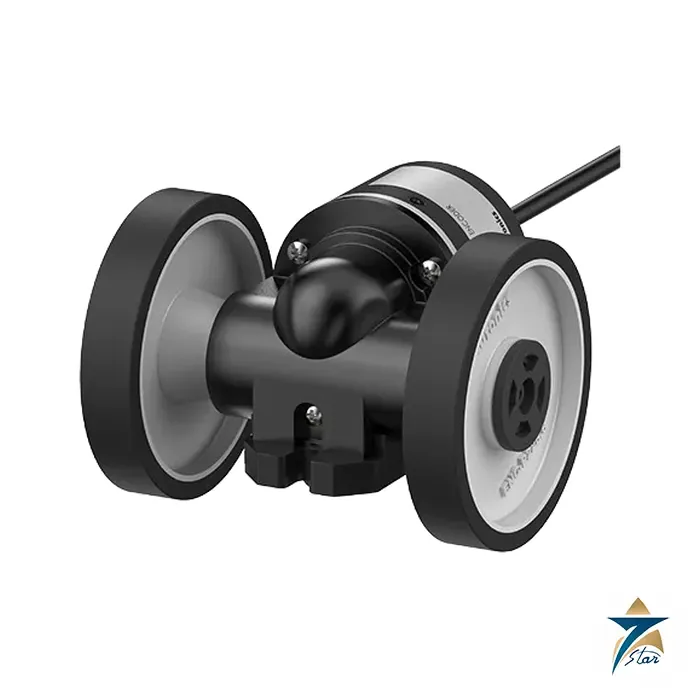
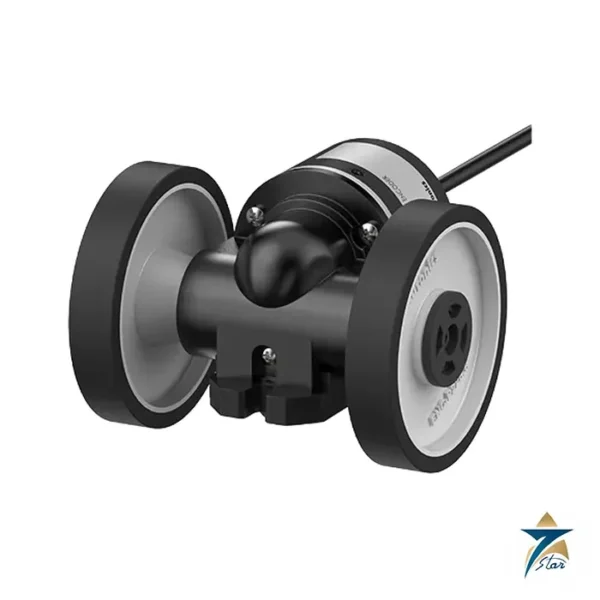
Not every length measurement needs millimetre detail. Where a centimetre is fine, the Autonics ENC-1-2-T-24 gives a pulse train that is ten times slower and far easier for a simple counter to follow. It is the 1 cm per pulse version of the Autonics wheel type incremental encoder, with totem-pole outputs on phases A and B, a 12 to 24 V DC supply and a measuring wheel that rolls on the product. Seven Star LLC is an independent supplier serving Oman and the GCC.
Decoding Autonics ENC-1-2-T-24
ENC is the wheel type encoder series. The first digit 1 selects two output phases, A and B. The second digit, 2 in this case, selects a measuring unit of 1 cm per pulse; the options run from 1 for 1 mm, through 3 for 1 m, to 4, 5 and 6 for 0.01, 0.1 and 1 yard. T is totem-pole, 24 is 12 to 24 V DC, and the missing final letter means an axial cable of 2 m.
Parameters of Autonics ENC-1-2-T-24
| Item | Data |
|---|---|
| Minimum measuring unit | 1 cm per pulse |
| Pulses per encoder rotation | 100, gear ratio 4 to 1 |
| Wheel | 250 mm circumference side wheels; four wheel turns per encoder rotation |
| Outputs | A and B totem-pole; sink 30 mA, source 10 mA |
| High level | supply minus 3.0 V or more |
| Residual voltage | 0.4 V DC or less |
| Supply | 12 to 24 V DC plus or minus 5 percent |
| Consumption | 80 mA or less |
| Max response frequency | 180 kHz |
| Max revolution | 5,000 rpm |
| Ambient | minus 10 to plus 70 degrees C, IP50 |
| Cable | 5 mm, 4-wire, shielded, 2 m |
| Weight | about 494 g |
How the Autonics ENC-1-2-T-24 differs from other ENC variants
Take the manual’s wheel table as the guide. For the 1 mm unit, the wheel circumference is 250 mm, the encoder gives 250 pulses per rotation and the gear ratio is 1 to 1. For the 1 cm unit of the Autonics ENC-1-2-T-24, the encoder gives 100 pulses per rotation through a 4 to 1 gear, which means the side wheels turn four times for each encoder turn, and the pulse rate is cut to a tenth. The 1 m unit gives only one pulse per rotation, again at 4 to 1. All three share the same body, 494 g mass, 180 kHz limit and wiring. Choose the Autonics ENC-1-2-T-24 when the counter is slow or the accuracy needed is a centimetre.
Reading the numbers
For a quick estimate, one pulse is 1 cm, so 100 pulses equal a metre. With a line moving at 60 m per minute, the pulse rate is 100 Hz, which even the slowest PLC input can read. The same line with the 1 mm model would produce 1 kHz. If your counter has a prescaler or can multiply the A and B edges by four, you can recover finer resolution electronically, but the wheel and gear accuracy still bound the true precision, so do not expect millimetre repeatability from a centimetre model.
Choosing the measuring unit for the Autonics ENC-1-2-T-24
The manual offers six measuring units, and the decision should follow the cutting tolerance of the process and the speed of the counter. A cut tolerance of plus or minus 5 mm needs a 1 mm unit or at least a unit with four-edge counting, but a tolerance of 2 cm is comfortably served by the 1 cm unit of this code. A second consideration is the pulse rate at the highest line speed: divide the speed by the length per pulse to get the frequency, and compare it with the input rating of the counter. A basic electromechanical counter handles 30 Hz, a typical compact digital counter 1 kHz to 10 kHz, and a PLC high-speed input tens of kilohertz. The 1 cm unit gives a pulse rate low enough for nearly all of these, even at line speeds of several hundred metres per minute.
A third consideration is the type of unit used by the plant: yard-based units are provided for textile and film industries that still trade in yards, with 0.01, 0.1 and 1 yard options. In metric plants, the 1 mm, 1 cm and 1 m units cover everything from fine trimming to coarse piece counting. If you are unsure, the finer unit is the safer choice because the counter can always scale down, whereas a coarse unit cannot recover resolution that was never produced.
For reversing lines that must return exactly to a start point, the 1 mm model, which has a direct 1 to 1 ratio between wheel and encoder, is the more natural choice.
Typical uses in Oman and the GCC
Centimetre resolution is adequate for cutting pipe, hose, timber, sheet, rolls of fabric and rolls of plastic film to length, for metering coils and for counting parcels and cartons by length. The low pulse rate lets the encoder work with simple, low-cost counters, including battery counters and timers. Many regional workshops pair it with a counter that has a relay to trigger the cutter.
Installation
Mount the encoder on a spring arm so that the wheel presses against the material with constant force. Keep the wheel clean and make sure that the material does not slip. Avoid mounting where the product vibrates or jumps. Protect the body from water and dust, since it is rated IP50, and provide a cover in dirty areas. Do not pull the cable with a force over 30 N after it has been secured.
Connections
Use the M17 connector cable sold separately or the fixed axial cable. Black is output A, white is output B, brown is the supply positive, blue is 0 V, and the shield connects to frame ground. Leave unused wires insulated. The A to B phase difference is a quarter cycle with a tolerance of one eighth, so the counter can determine direction in the usual way. Route the cable away from power and motor wiring.
Tuning and verifying
Run a known length of product, for example 10 m, and compare the counter value. If the counter reads 1,000 counts, the calibration is exact. A small deviation can be corrected with a scale factor in the counter. Repeat the test after replacing the wheel or changing the product type, as surface and thickness change the effective rolling circumference slightly.
Maintenance
Look at the wheel for wear, flats and contamination, check the spring pressure, and keep the unit dry. The encoder does not require lubrication and cannot be repaired on site.
Related items you may also need: Autonics E40S6-2500-6-L-5 Rotary Encoder Incremental | ABB RTAC-01 Pulse Encoder Interface Module for ACS800 | SICK SRS50-HGA0-K22 Motor Feedback | All Autonics products.
Documents and quotation
The ENC series product manual covering the Autonics ENC-1-2-T-24 is attached with ordering information, waveforms, wiring and wheel table. Send an RFQ with the part number Autonics ENC-1-2-T-24, quantity and delivery location in Oman or the GCC.
Other Models in the ENC Range
Seven Star LLC supplies models from the ENC range in Oman and the GCC. Compare the related models below and request a quote for the one that matches your application.
| Model | Category | |
|---|---|---|
| Autonics ENC-1-1-T-24 Wheel Type Rotary Encoder 1 mm | Encoders | View details |
| Autonics ENC-1-2-T-24 Wheel Type Rotary Encoder 1 cm | Encoders | You are viewing this model |
Datasheets & Documents
- Datasheet Autonics ENC-1-2-T-24 Wheel Type Rotary Encoder 1 cm Datasheet Download
Reviews (0)
How would you rate this product? Cancel reply
About brand
Autonics is a South Korean maker of sensors and controllers, founded in 1977 as a small engineering business making controllers for looms. It took the Autonics name in 1988 and opened a new corporate headquarters in Busan in 2014. Autonics makes proximity and photoelectric sensors, rotary encoders, temperature controllers, counters, timers and stepper motor systems, with factories in Busan and Yangsan.
Seven Star LLC lists the Autonics E40S6-2500-6-L-5 incremental rotary encoder and supplies Autonics sensors and control devices in Oman and the GCC.
Autonics company profile
| Founded | 1977, South Korea |
|---|---|
| Current name | Autonics, since 1988 |
| Headquarters | Busan, South Korea |
| Factories | Busan and Yangsan |
| Product families | E40 and E50 rotary encoders, PR proximity sensors, BJ photoelectric sensors, TK temperature controllers |
Milestones
- 1977: The company is founded.
- 1988: Renamed Autonics Corporation.
- 2014: Opens its Busan headquarters.
Reading the Autonics E40S encoder code
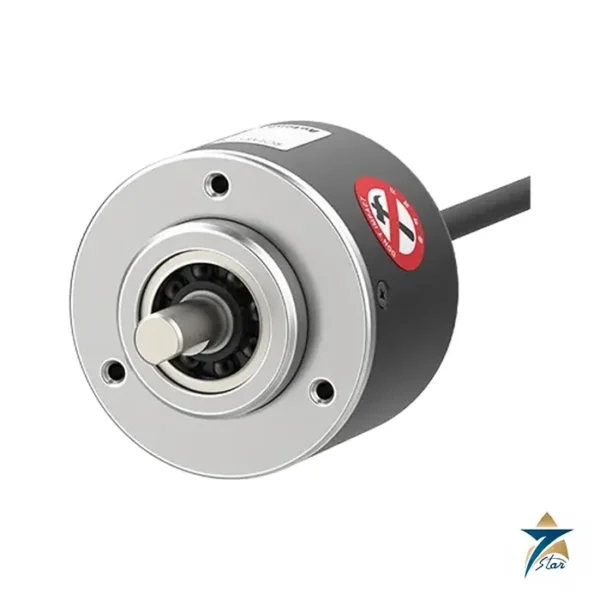
E40S is the 40 mm diameter shaft-type incremental encoder, and the 6 that follows is the 6 mm shaft. 2500 is the resolution in pulses per revolution. The next 6 means six output signals: A, B and Z with their inverted signals. L is a line driver output and the final 5 is a 5 V DC supply. The same 40 mm body is made in hollow shaft form as the E40H and E40HB series.
Where Autonics encoders are used
Servo and spindle feedback, conveyor length measurement, packaging and printing machines.
Ordering Autonics encoders: what we need
Send the complete model string from the label. If it is worn off, give the body and shaft diameter, pulses per revolution, output type, supply voltage and cable or connector style.
Facts checked against Autonics corporate profiles, October 2026.
Browse Autonics products by category: Encoders.
FAQ
Questions about the Autonics ENC-1-2-T-24 Wheel Type Rotary Encoder 1 cm
Answers from our engineering team on installation, compatibility and integration.
01What does the Autonics ENC-1-2-T-24 measure per pulse?
It is the 1 cm model: each pulse represents 1 cm of travel, with 100 pulses per encoder rotation through a 4 to 1 gear.
02How does the Autonics ENC-1-2-T-24 differ from the 1 mm model?
The pulse rate is ten times lower because of the 4 to 1 gear and 100 pulses per rotation, against 250 pulses and a 1 to 1 ratio on the 1 mm model.
03What output does the Autonics ENC-1-2-T-24 provide?
A totem-pole output on phases A and B, sinking 30 mA and sourcing 10 mA, powered from 12 to 24 V DC.
04What is the connection of the Autonics ENC-1-2-T-24?
The plain code has a 2 m, 5 mm, 4-wire shielded axial cable; a C suffix would give an axial cable connector with an M17 6-pin plug.
05What protection does the Autonics ENC-1-2-T-24 have?
The housing is IP50 and the ambient range is minus 10 to plus 70 degrees C, so it should be protected from water and dust.


Reviews
There are no reviews yet.