- Automation & ControlView all 2,638 products
- Automation Accessories
- AC Drives
- PLC & I/O Cards
- Industrial Communications
- Vibration Monitoring
- Controllers & Data Acquisition
- Isolator & Barrier
- Safety Switches & Guard Locking
- Motor Soft Starters
- CCTV & Security
- Encoders
- HMI Displays
- Servo Drives
- Pneumatic Cylinders
- Industrial Computers
- Machine Vision
- Automation Software
- Robotics
















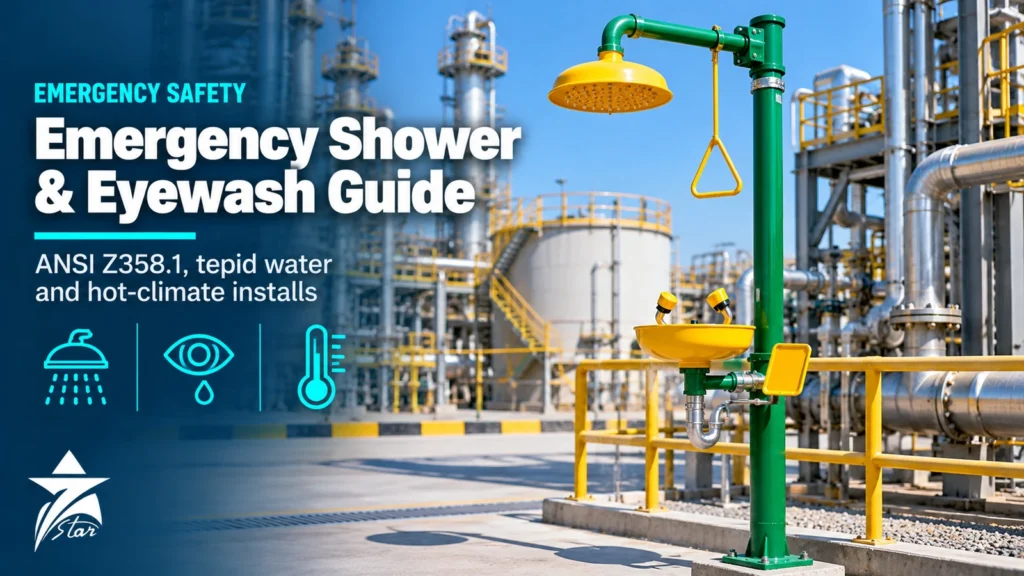
An emergency shower and eyewash station is the first line of treatment when a worker is splashed with acid, caustic, solvent or another hazardous chemical. The first seconds decide how much damage is done to the eyes and skin, so the equipment must be close, easy to operate, deliver enough water and keep delivering it for the full flushing period. In the Gulf there is a further problem that many standard designs ignore: water standing in exposed pipes and tanks can become far too hot to use. This guide explains the main requirements of ANSI/ISEA Z358.1, how to choose between plumbed and self-contained units, how to place them, and how to keep the flushing water tepid on sites in Oman and the GCC.
Emergency showers and eyewashes do not replace correct protective equipment. They are the response when goggles, face shields, gloves or respiratory protection were not enough, or were not worn.
Which Standard Applies?
The most widely referenced standard for this equipment is ANSI/ISEA Z358.1, American National Standard for Emergency Eyewash and Shower Equipment. Most international oil and gas operators, EPC contractors and laboratory designers in the region specify it, and most manufacturers state compliance against it. The European EN 15154 series covers similar equipment with its own flow and dimensional requirements and is sometimes specified on European-led projects. Always check which standard and which edition your client or project specification calls for, because the details differ.
The values below summarise the main ANSI/ISEA Z358.1 performance and installation requirements. They are a practical overview for selection, not a substitute for the standard itself.
Types of Emergency Shower and Eyewash Equipment
| Type | What it does | Typical use |
|---|---|---|
| Drench shower | Floods the whole body from an overhead head | Large splashes, chemical spills on clothing, fire on clothing |
| Eyewash | Two low-pressure streams that flush both eyes at once | Chemical or particle exposure to the eyes |
| Eye/face wash | Larger spray heads that flush the eyes and the face together | Splashes to the face as well as the eyes |
| Combination unit | Drench shower plus eyewash or eye/face wash on one frame | Process plants, tank farms, chemical unloading points |
| Self-contained (portable) unit | Gravity-fed or pressurised tank with its own flushing fluid | Remote areas, temporary works, sites without a potable supply |
| Tank-fed shower | Large header tank feeding a drench shower, often with temperature control | Remote wellsites, pipelines, desert locations without mains water |
| Drench hose | Hand-held hose for spot flushing | A supplement to a shower or eyewash, not a replacement |
Personal eyewash bottles are useful for immediate first flushing while a person walks to the station, but they cannot deliver the flow or duration required and are classed as supplementary equipment only.
Key ANSI Z358.1 Performance Requirements
| Requirement | Drench shower | Eyewash | Eye/face wash |
|---|---|---|---|
| Minimum flow | 75.7 L/min (20 US gpm) | 1.5 L/min (0.4 US gpm) | 11.4 L/min (3.0 US gpm) |
| Minimum duration | 15 minutes | 15 minutes | 15 minutes |
| Activation | Valve on in 1 second or less, stays on without the user holding it | Same | Same |
| Head height | 208 to 244 cm (82 to 96 in) above the standing surface | Flushing fluid between 84 and 135 cm (33 to 53 in) above the standing surface, at least 15 cm (6 in) from a wall or obstruction | Same as eyewash |
| Spray pattern | At least 51 cm (20 in) diameter at 152 cm (60 in) above the floor | Flushes both eyes at once, at a velocity low enough not to injure the eye | Flushes eyes and face together |
| Water temperature | Tepid, 16 to 38 °C (60 to 100 °F) | Tepid | Tepid |
The shower actuator must be easy to find and reach, and no higher than about 173 cm above the floor. The centre of the spray pattern should be at least 41 cm away from any obstruction. For an eyewash, a single motion should activate it and the user must then have both hands free to hold the eyelids open.
Location: The 10-Second Rule
ANSI Z358.1 requires the equipment to be reachable within 10 seconds, which the standard relates to roughly 17 metres (55 feet) of travel for an unimpaired person. In practice a splashed worker may be partly blinded and in pain, so treat that distance as a maximum, not a target.
- Install the unit on the same level as the hazard, with no stairs, ramps, doors that open against the user, or obstacles on the route.
- Where strong acids or caustics are handled, place the unit immediately next to the hazard. A unit 17 metres away is too far for a concentrated acid splash.
- Mark the location with a highly visible sign and keep the area well lit, including at night on outdoor plants.
- Do not install units where they can become contaminated, for example directly under a chemical line flange or in the discharge path of a relief valve.
- Consider an alarm or flow switch that alerts the control room when the unit is activated, especially in areas where people work alone.
On hydrocarbon facilities, decide early whether the unit must be suitable for a hazardous area. Electrical options such as heaters, coolers, alarms and lighting then need suitable explosion-protected equipment. Fixed gas detection and emergency showers are usually laid out together in the safety design.
Why Tepid Water Matters in Oman and the GCC
The standard requires tepid flushing fluid because a casualty must be able to stay under the water for the full 15 minutes. Water that is too cold causes hypothermia and makes people leave early; water that is too hot can scald and can speed up some chemical reactions with the skin. In the Gulf the risk is almost always heat. In summer, water in an exposed steel pipe, a sun-facing header tank or a portable unit left in the open can become far hotter than 38 °C, and the first minutes of flow may be hot enough to cause burns on their own.
Ways to keep the emergency shower and eyewash water within the tepid range in hot climates:
- Bury or insulate the supply line and keep the dead leg from the main to the unit as short as possible.
- Shade the unit. A canopy or an enclosure reduces solar gain on the pipework and on the user.
- Use a temperature-controlled unit. Tank-fed and plumbed showers are available with built-in cooling, heating or both, such as the Hughes temperature-controlled safety shower.
- Fit a thermostatic mixing or bleed valve designed for emergency fixtures. A bleed valve dumps the hot water that has stood in the pipe until cooler water arrives; a mixing valve blends supplies to a set temperature. Any valve must fail in a way that still supplies flushing water.
- Insulated cubicles and tank units such as the Hughes jacketed 1,500 L tank-fed safety shower help keep a large volume of water at a stable temperature on remote sites.
- Check temperature as part of the weekly test in summer, not just whether water flows.
Plumbed vs Self-Contained Units
A plumbed unit connected to a reliable potable water supply gives unlimited flushing time and needs little maintenance beyond flushing and inspection. It is the normal choice in fixed plants, workshops and laboratories. The supply must be able to deliver the required flow at the same time as other users, so check pressure and pipe size, particularly for a combination unit where shower and eyewash may run together.
Self-contained units carry their own fluid and are used where there is no plumbed supply. They must hold enough fluid for the full 15-minute flow; an eyewash at 1.5 L/min needs at least about 23 litres for that alone. Fluid must be changed or treated according to the manufacturer instructions, usually with a preservative or on a fixed change interval, and the unit must be protected from heat. Check the stated standard compliance of any portable unit before you rely on it as the primary station.
Materials and Corrosion
Coastal plants, desalination sites and chemical areas are hard on equipment. Galvanised steel is common for general industrial use, while stainless steel such as 316 is preferred near seawater and many chemicals. Plastic-coated or high-visibility coated pipework improves corrosion resistance and makes the unit easier to see. Bowls may be stainless steel, ABS plastic or coated metal. Covers on eyewash heads keep sand, dust and insects out and should open automatically when the unit is activated.
Testing and Maintenance
- Weekly activation of plumbed units to confirm flow and to flush stagnant water from the line. This also reduces bacterial growth in warm pipes.
- Annual inspection of every unit against the standard: flow, height, spray pattern, activation, signage, access and water temperature.
- Self-contained units are inspected and maintained to the manufacturer schedule, including fluid replacement.
- Keep records of each test with the date, result and name of the tester. Many audits ask for them.
- Train people where the nearest unit is, how to operate it and to keep flushing for the full 15 minutes while someone calls for medical help.
Close enough to reach in seconds, enough water for 15 minutes, and water a person can actually stand under: those three checks decide whether an emergency shower and eyewash will do its job.
Emergency Shower and Eyewash Units From Our Catalog
These are examples of the emergency shower and eyewash equipment in our catalog. Each link goes to the product page.
See the full range in our emergency showers and eyewash category. To get a matching quotation, tell us the hazard, the location (indoor, outdoor, hazardous area), the water supply available, the material you need and whether temperature control is required, through our quote request form or by email to [email protected].
Sourcing Emergency Showers and Eyewash Stations in Oman
Seven Star LLC is an independent supplier in Oman of safety equipment and industrial instrumentation for oil and gas, utilities, laboratories and manufacturing. We quote emergency showers, eyewashes and tank-fed units from manufacturers such as Haws, Hughes Safety Showers and Speakman, help match a project specification to the right model and options, and confirm the stated standard compliance, materials and lead time with the manufacturer data before you order. The same team supplies portable gas detectors and other safety equipment for the same areas.
Frequently asked questions
What flow rate does ANSI Z358.1 require for an emergency shower and eyewash?
A drench shower must deliver at least 75.7 L/min (20 US gpm), an eyewash at least 1.5 L/min (0.4 US gpm) and an eye/face wash at least 11.4 L/min (3.0 US gpm). All of them must keep flowing for at least 15 minutes and switch on in one second or less.
How far can an emergency shower be from the hazard?
ANSI Z358.1 requires the unit to be reachable within 10 seconds, about 17 metres of unobstructed travel on the same level. Where strong acids or caustics are handled, the unit should be immediately next to the hazard.
What water temperature should an emergency shower deliver?
The flushing water must be tepid, generally between 16 and 38 degrees Celsius. In hot climates such as Oman, insulated or buried supply lines, shading, bleed or mixing valves and temperature-controlled units are used to stop the water becoming too hot.
Can a portable eyewash replace a plumbed eyewash station?
A self-contained unit that meets the standard for flow and 15-minute duration can be the primary station where there is no plumbed supply. Squeeze bottles and personal eyewash units are supplementary only and cannot replace a compliant station.
How often should emergency showers and eyewashes be tested?
Plumbed units should be activated weekly to confirm flow and flush the line, and every unit should be inspected annually against the standard. Self-contained units follow the manufacturer maintenance schedule, including fluid replacement.
Who supplies emergency showers and eyewash stations in Oman?
Seven Star LLC is an independent supplier in Oman that quotes emergency showers, eyewashes and tank-fed safety showers from makers such as Haws, Hughes Safety Showers and Speakman. Send your hazard, location, water supply and material requirements through the quote request form or to [email protected].
Was this guide helpful?One click helps us write better guides for engineers.
Thank you! Glad it helped. Need this equipment for your project? Request a quotation
Thank you. We will use this to improve the guide.