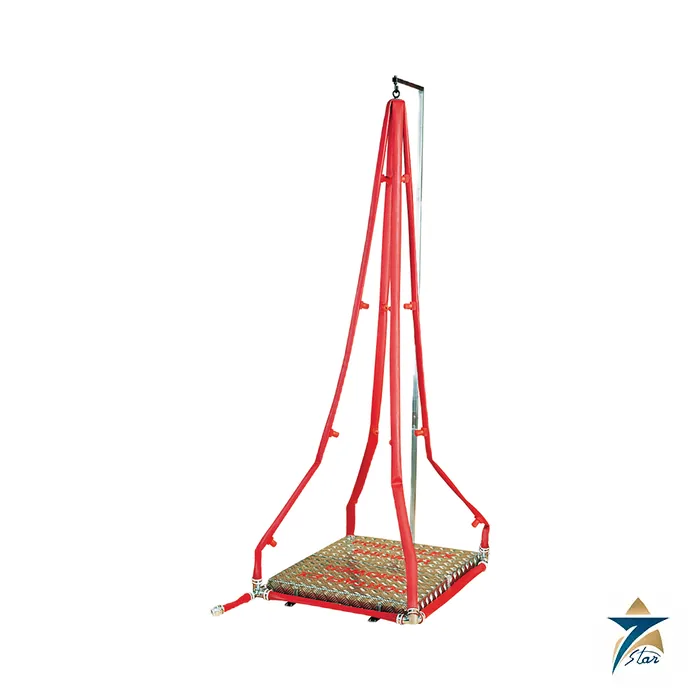
The Hughes PORTAflex 300/16e is a lightweight portable multi-nozzle decontamination shower that packs into an aluminium case and is erected by connecting it to a hydrant.
A decontamination shower that deploys in under two minutes
The datasheet describes it as popular for stand-by use by emergency responders and the military. Four lay-flat hoses form four shower legs, each fitted with four spray nozzles, 16 in all. When water is admitted from a hydrant the hoses become rigid under pressure and curve into shape, giving 360 degree decontamination. The aluminium carrying case doubles as a non-slip base platform, and the product page says the unit can be deployed in less than 2 minutes.
The minimum flow is 750 litres per minute at 3 to 7 bar g through a 2 1/2 inch male instantaneous coupling, so it is a high-volume mass decontamination device rather than a personal safety shower. The hose is a synthetic rubber core with polyamide woven jacket and a 38 mm internal diameter.
Technical specifications
| Parameter |
Specification |
| Model |
PORTAflex 300/16e |
| Case |
Aluminium |
| Hose |
High grade synthetic rubber, polyamide woven jacket |
| Nozzles |
1/2 in machined PVC, 16 in total (four legs of four) |
| Inlet size |
2 1/2 in male instantaneous coupling (other couplings available on request) |
| Operating pressure |
3 to 7 bar g (43 to 101 psi) |
| Minimum flow rate |
750 L/min (198 US gal/min) |
| Hose internal diameter |
38 mm (1 1/2 in) |
| Hose burst pressure |
Short length 50 bar g (725 psi); maximum use 22 1/2 bar g (326 psi) |
| Assembled dimensions (W x D x H) |
854 x 1359 x 2503 mm |
| Packed dimensions (W x D x H) |
750 x 164 x 460 mm |
| Weight |
23 kg (50.7 lb) |
Water source, drainage and who uses it
Flow demand is the planning issue. At 750 litres per minute the shower needs a hydrant or pump able to hold 3 to 7 bar g while discharging, and the runoff has to be contained or directed, particularly where the contaminant is hazardous. Check the coupling against the local hydrant or hose standard: the datasheet notes that other inlet couplings are available on request.
This is a response asset. Typical owners are fire and rescue teams, industrial emergency teams and plant response crews, who keep it in a vehicle or at a muster point. Train the team to erect it, protect the casualty from cold wind after the shower and arrange for dry clothing, and include it in the periodic equipment inspection, including the hoses and couplings.
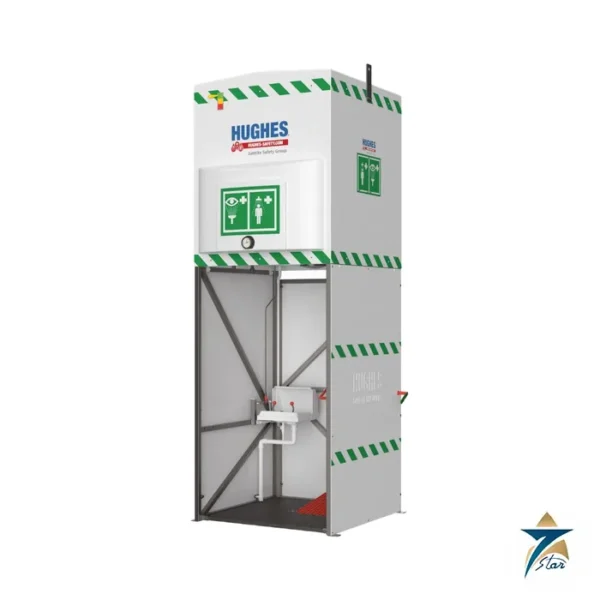
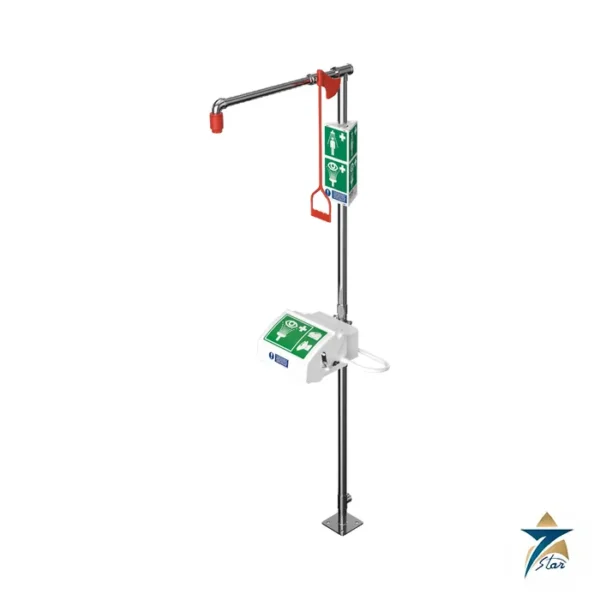
| Hughes model |
Configuration |
Typical use |
| STD-40K/45G |
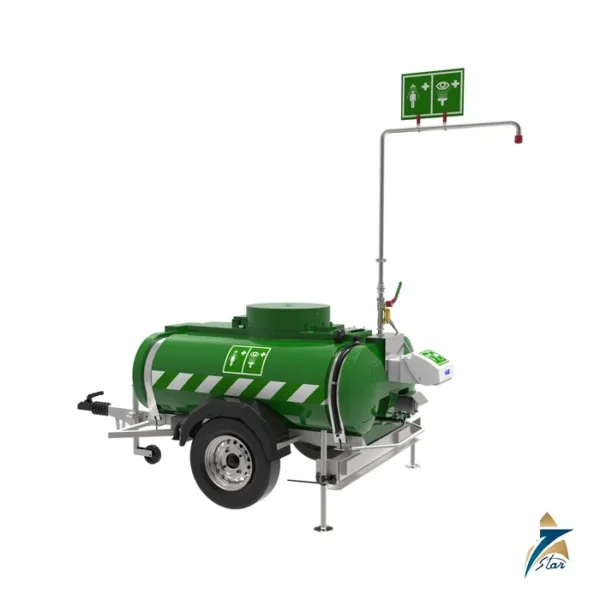
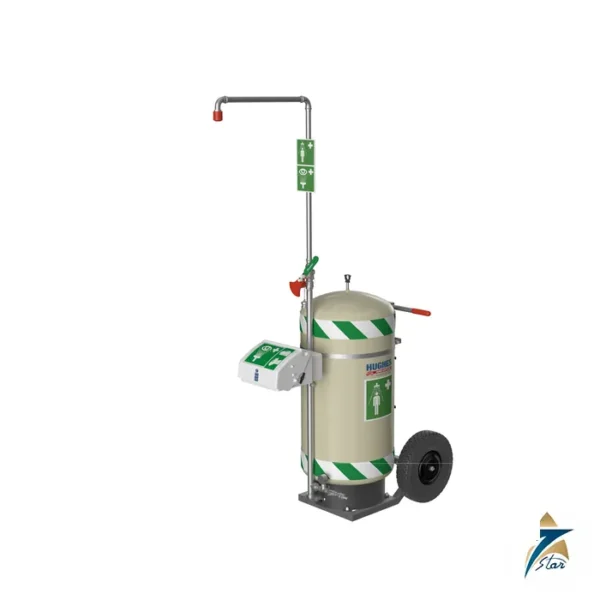
Mobile 114 L shower and eye wash |
Stand-by and shutdown cover |
| STD-MH-P-1200L |
Towable heated 1200 L shower and eye wash |
Remote work fronts |
| STD-68G |
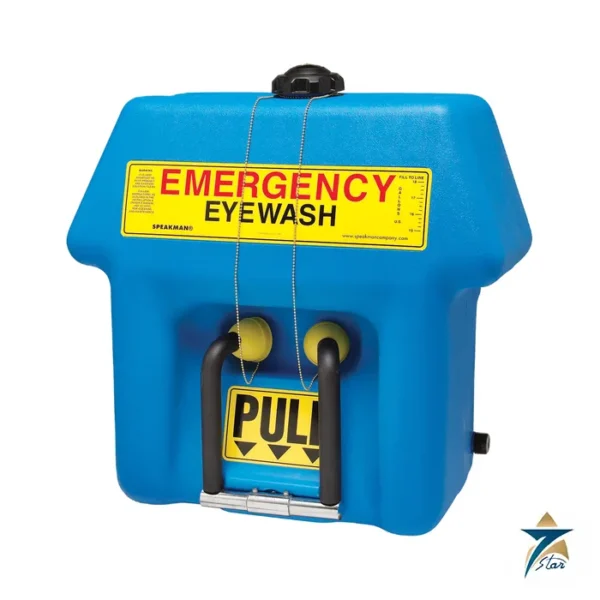
45 L portable gravity fed eye wash |
Table or wall mounted back-up |
| STD-58G |
28 L portable stainless eye wash |
Secondary eye rinse |
Options and what to confirm before ordering
The datasheet lists no optional fittings beyond inlet couplings. Confirm the coupling type and size, the available hydrant pressure and flow, the runoff plan and where the 23 kg case will be stored.
Setting up the shower at an incident
Choose a level, open area upwind and uphill of the contaminated zone, with room for casualties to queue on the dirty side and leave on the clean side. Open the aluminium case flat on the ground so it forms the base platform, lay the four hose legs out without kinks or twists, and connect the inlet to the hydrant or pump line using a hose that is rated for the supply pressure. Open the water slowly so the legs fill and rise in a controlled way rather than whipping, then check that all 16 nozzles are spraying and that no coupling is leaking. Mark the entry and exit points clearly and agree who controls the valve, so flow can be stopped quickly if a leg collapses or a casualty falls.
Runoff and the clean side
Decide before an incident where the contaminated water will go. Bunding, sumps, drain covers or temporary collection should be part of the plan, and the environmental team or local authority may need to approve it. Keep towels, blankets and replacement clothing on the clean side, and plan privacy screening where the public may be treated.
Using it in Oman and GCC conditions
Heat changes how decontamination is run in the Gulf. Responders in protective suits reach their limits quickly in summer sun, so plan shade, rest and drinking water for the crew operating the shower. Water from hydrant mains or tankers left in the sun can be very warm; check the temperature before casualties go through. In winter evenings and in wind, the opposite applies and wet casualties chill fast. Wind-blown sand sticks to wet skin and equipment, so site the unit away from loose ground where possible. After use on coastal or desalination sites, rinse the hoses and case with fresh water to remove salt before they are packed.
Inspection and storage between call-outs
Because the unit may sit unused for months, a routine check is what keeps it ready. Open the case at set intervals, unroll the legs and look for cuts, abrasion, cracking of the rubber or damage to the woven jacket, and check the nozzles for blockage and the coupling for wear or a missing seal. A periodic wet test from a hydrant confirms that the legs still rise and spray as they should. Dry the hoses completely before repacking, since folding a wet hose into a closed case in a hot vehicle encourages mould and early wear. Store the case out of direct sun, and follow the inspection steps in the Hughes installation, operation and maintenance guide.
Documents and quotation
Two Hughes documents are linked from this page: the English datasheet for PORTAflex 300/16e and the installation, operation and maintenance guide for its family, both unaltered. Seven Star LLC is an independent supplier in Muscat and prepares quotations for PORTAflex 300/16e and related Hughes models once the request states where the unit will work, how it will be filled or connected, and the duration of cover required. More site safety equipment is listed under Safety and PPE.

Reviews
There are no reviews yet.