- Automation & ControlView all 2,615 products
- Automation Accessories
- AC Drives
- PLC & I/O Cards
- Industrial Communications
- Vibration Monitoring
- Controllers & Data Acquisition
- Isolator & Barrier
- Safety Switches & Guard Locking
- Motor Soft Starters
- CCTV & Security
- Encoders
- HMI Displays
- Pneumatic Cylinders
- Servo Drives
- Industrial Computers
- Machine Vision
- Automation Software
- Robotics
















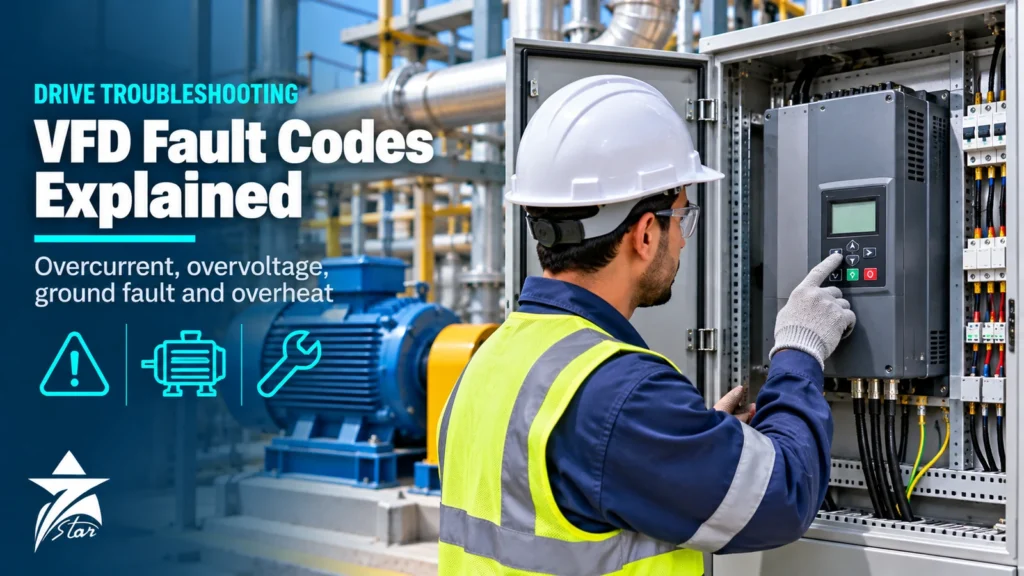
VFD fault codes are the drive telling you which protection stopped the motor. The code itself is rarely the root cause: an overcurrent trip can come from a seized pump, a damaged cable, a ramp time that is too short or a failing output stage, and each of those needs a different fix. Resetting the drive and hoping it does not happen again is how a small fault becomes a burnt motor or a destroyed power module. This guide explains the main families of trips, what each one is measuring, the most common causes we see in plants, pumping stations and HVAC systems in Oman and the GCC, and a safe order of checks to find the real problem.
For selection and sizing of drives in hot climates, harmonics and motor protection, see our companion article on variable frequency drive selection for hot climates. This page is about what to do when a running drive trips.
How a VFD Decides to Trip
A variable frequency drive rectifies the incoming three-phase supply into a DC bus, smooths it with capacitors, then switches IGBTs to build a variable-frequency, variable-voltage output for the motor. The control board continuously measures input voltage, DC bus voltage, output current in each phase, the earth current, the heat sink temperature and a thermal model of the motor. When one of these leaves its safe window, the drive switches off the IGBTs within microseconds and records a fault. Most drives separate two levels of event:
- Warnings or alarms that let the drive keep running, often while it limits current or reduces speed to protect itself.
- Faults or trips that stop the output immediately. The motor then coasts unless a mechanical brake is applied.
Almost every modern drive also keeps a fault history with time stamps and a snapshot of current, DC bus voltage, frequency and temperature at the moment of the trip. Reading that log before resetting is the single most useful step in diagnosing VFD fault codes, because it tells you whether the drive tripped during acceleration, at steady speed, during deceleration or at standstill.
The Main Fault Families at a Glance
| Fault family | What the drive measured | Most common causes |
|---|---|---|
| Overcurrent | Output current above the hardware or software limit, typically around two to three times rated current, for microseconds to milliseconds | Acceleration too fast, mechanical jam, motor or cable short, wrong motor data, output contactor opening under load |
| DC bus overvoltage | DC link voltage above the trip level, roughly 800 to 850 V DC on many 400 V class drives | Deceleration too fast, overhauling loads, high supply voltage, no braking resistor where one is needed |
| DC bus undervoltage | DC link voltage below the minimum, or loss of supply | Supply dips, generator changeover, loose input terminals, a blown input fuse, a failing pre-charge circuit |
| Ground (earth) fault | The three output currents no longer add up to zero | Damaged motor insulation, moisture in terminal boxes, cable damage, long cables with high capacitive leakage |
| Drive overheat | Heat sink or internal temperature above the limit | Blocked filters, failed cooling fan, hot panel, high carrier frequency, drive undersized for the ambient |
| Motor overload | Motor thermal model (I²t) or a PTC thermistor above the limit | Real overload, low speed operation of self-cooled motors, wrong nominal current setting |
| Input or output phase loss | Ripple on the DC bus, or one output phase missing | Blown fuse, loose connection, an open cable core, a failed output contactor |
Overcurrent Faults: Fast, Violent and Often Mechanical
Overcurrent is the most common of all VFD fault codes and the one most likely to be reset without investigation. The key question is when it happens:
- At start or during acceleration. The acceleration ramp may be too short for the load inertia, the torque boost may be set too high, or the motor may be starting into a load that is already turning, such as a fan in a draught or a pump with a leaking non-return valve. Lengthen the ramp, enable a flying start function where the load can freewheel, and confirm that the motor nameplate data has been entered and an identification run has been done.
- At steady speed. Suspect the load first: a jammed conveyor, a pump bearing failure, a blocked impeller or a damaged gearbox. Then check the motor and cable insulation.
- Immediately on the run command, even with no load. This points to a short circuit in the output cable or motor, or a failed IGBT. Never keep resetting a drive that trips instantly, as each attempt can damage the power stage further.
A contactor or isolator between the drive and the motor that opens or closes while the drive is running will also cause overcurrent trips and can destroy the output stage. Interlock any output switching so that it only operates when the drive is stopped.
DC Bus Overvoltage: Energy Coming Back From the Load
When the drive slows a motor faster than the load would stop on its own, the motor acts as a generator and pushes energy back into the DC bus. The capacitors charge up until the drive trips on overvoltage. Typical cases are high-inertia fans, centrifuges, cranes and hoists lowering a load, and downhill conveyors.
- Lengthen the deceleration ramp, or switch the stop mode to coast where the process allows it.
- Enable the overvoltage controller, which automatically extends the ramp when the bus voltage rises.
- Where fast stopping is needed, fit a correctly rated braking chopper and resistor, or use a regenerative drive that returns energy to the supply.
- Measure the supply voltage. A supply running near the top of its tolerance, for example at light load during the night, leaves less headroom on the DC bus.
If the drive trips on overvoltage while the motor is not decelerating, look for supply transients, a capacitor bank switching on the same network, or a faulty braking resistor circuit.
Undervoltage and Supply Problems
Undervoltage trips are often blamed on the drive when the cause is upstream. Generator-backed sites, long rural feeders and plants with large motors starting direct-on-line all produce voltage dips that a drive will see. Check the incoming voltage on all three phases under load, the tightness of the input terminals, the condition of the input fuses or breaker, and whether the trips line up with a generator start, a transfer switch changeover or a large motor starting nearby. Many drives offer a power loss ride-through function, sometimes called kinetic buffering, that uses the load inertia to hold up the DC bus during short dips; on pumps and fans this can turn a nuisance trip into an invisible event.
An undervoltage fault that appears every time the drive is powered up can indicate a problem with the pre-charge circuit or the DC bus capacitors, especially on drives that have been in storage. Capacitors in drives stored without power for a long period may need reforming before use; follow the manufacturer procedure.
Ground Fault: Insulation, Moisture and Long Cables
A ground fault trip means some of the output current is returning through earth instead of through the other phases. Before replacing anything, isolate the drive, lock it out, wait for the DC bus to discharge, disconnect the motor cable at the drive and test the cable and motor insulation to earth with an insulation tester at a voltage suitable for the motor. Never apply an insulation test to the drive terminals themselves.
- Moisture. Motors that stand idle on humid coastal sites can draw condensation into the terminal box and windings. Anti-condensation heaters and correctly sealed glands help.
- Cable damage. Cable tray abrasion, rodent damage and crushed conduit are common on outdoor runs.
- Long motor cables. The capacitance of long screened cables leaks high-frequency current to earth. This can trigger a ground fault or overcurrent trip even when the insulation is perfect. Use an output reactor or dv/dt filter and respect the maximum cable length in the drive manual.
Insulation problems are covered in more detail in our guide to electric motor failure causes and condition checks.
Overheat Trips in Hot Panels
Heat is the leading cause of nuisance trips and early drive failure in Oman. Drive ratings are usually given up to 40 or 50 degrees Celsius ambient, and the output current must be derated above that. A panel standing in the sun with blocked filters can easily run well above the outside air temperature.
- Check that the heat sink fan runs and that the heat sink fins are clean. Dust and sand quickly clog them on desert sites.
- Clean or replace panel filters and confirm the panel fan or air conditioner works and is sized for the drive losses.
- Lower the switching (carrier) frequency if motor noise is not critical, as a higher carrier frequency raises IGBT losses.
- Confirm that the drive is rated for the actual ambient and altitude using the manufacturer derating curves; if not, a larger frame size may be needed.
Cooling fans are wear parts. On drives older than five to seven years in hot service, replacing the fans before they fail is cheaper than a stopped line.
Motor Overload and Thermistor Faults
A motor overload trip comes from the thermal model in the drive or from a PTC thermistor in the windings. First compare the actual current with the motor nameplate current entered in the drive. If the parameter is set too low the drive trips early; if it is set too high the motor is not protected at all. Self-cooled motors lose cooling at low speed, so a motor running a constant torque load at 15 Hz can overheat at less than rated current. A separately powered cooling fan or a larger motor solves this. A thermistor fault with a cold motor usually means a broken thermistor circuit or wiring fault.
VFD Fault Codes Across Common Brands
Each manufacturer uses its own numbering, but the protection behind the code is the same. The table below shows typical VFD fault codes on widely installed drive families. Codes and names can change between firmware versions and product series, so always confirm them against the manual for your exact drive.
| Fault | ABB ACS580 / ACS880 | Danfoss VLT FC series | Siemens SINAMICS G120 | Schneider Altivar | Allen-Bradley PowerFlex 525 |
|---|---|---|---|---|---|
| Overcurrent | 2310 | Alarm 13 | F30001 | OCF | F012 |
| DC bus overvoltage | 3210 | Alarm 7 | F30002 | ObF | F005 |
| DC bus undervoltage | 3220 | Alarm 8 | F30003 | USF | F004 |
| Ground (earth) fault | 2330 | Alarm 14 | F30021 | SCF3 | F013 |
| Drive overheat | 4210 | Alarm 29 | F30004 | OHF | F008 |
| Motor overload | Motor overload fault (see manual) | Alarm 10 | F07011 | OLF | F007 |
| Input phase loss | 3130 | Alarm 4 | F30011 | PHF | See manual |
If you work with other brands such as Yaskawa GA700, Delta CP2000, Fuji Electric FRENIC-AQUA or Control Techniques Commander C200, the same logic applies: identify the protection family, read the fault log, then work back to the cause.
A Safe Troubleshooting Sequence for VFD Fault Codes
Drives hold dangerous voltages on the DC bus for several minutes after the supply is switched off. Only qualified people should open a drive or panel, and only after isolation, lock-out and checking with a suitable meter that the DC bus has discharged. With that in place, this order solves most VFD fault codes quickly:
- Record before you reset. Note the code, the time and the fault log values, and ask the operator what the machine was doing.
- Check the supply. Measure all three input phases under load and look for dips or imbalance.
- Check the load. Turn the motor shaft by hand where it is safe to do so, and inspect couplings, valves, dampers and belts.
- Check the motor and cable. Test the insulation with the cable disconnected from the drive, check terminal tightness and look for moisture.
- Check the parameters. Motor data, ramp times, current limits, stop mode, carrier frequency and protection settings, especially after a drive replacement or firmware update.
- Check the environment. Heat sink fan, filters, panel cooling and the ambient temperature at the time of the trip.
- Only then suspect the drive. Repeated instant overcurrent or ground faults with a healthy motor and cable usually mean a failed power stage.
A fault code tells you which protection acted, not why. Read the fault log first, then check the supply, load, motor and cooling before you condemn the drive.
Preventing Repeat Trips
- Keep a written record of the fault history for each critical drive so that patterns become visible.
- Back up parameters with the commissioning software or keypad memory, so a replacement drive can be set up exactly as before.
- Schedule cleaning of heat sinks and panel filters before the summer, and replace cooling fans on a time basis.
- Use output reactors or dv/dt filters on long motor cables and on older motors with weaker insulation.
- Review ramps and stop modes whenever the process or the load changes.
- Hold critical spares: a complete drive for single points of failure, plus fans and keypads for common models.
Harmonic distortion from many drives on one supply can also overheat transformers and cause nuisance trips of other equipment. See our article on power factor correction and harmonic filters for site-wide measures, and soft starter vs VFD if you are deciding whether a drive is needed at all.
Replacement Drives From Our Catalog
When a drive has failed or reached the end of its life, these are some of the AC drives we quote regularly. Each link goes to the product page in our catalog.
| Drive | Range | Typical use |
|---|---|---|
| ABB ACS580 General Purpose Drive | General purpose | Pumps, fans, conveyors, compressors |
| ABB ACS880-01-363A-3 Wall-Mounted Drive 200 kW | Industrial, high performance | Heavy process duty |
| ABB ACQ580-01-12A7-4 Water Drive 5.5 kW | Water and wastewater | Pumping and lift stations |
| Danfoss VLT AutomationDrive FC 302 7.5 kW | Industrial automation, encoder feedback | Process lines, positioning |
| Danfoss FC 102 HVAC Drive 30 kW IP55 | HVAC | Chillers, air handling units, cooling tower fans |
| Siemens SINAMICS G120X Infrastructure Drive | Pumps and fans | Water, buildings, infrastructure |
| Schneider Electric Altivar 320 ATV320U75N4B 7.5 kW | Machine drive | Packaging, material handling |
| Allen-Bradley PowerFlex 525 0.4 kW | Compact drive | Small machines, conveyors |
| Allen-Bradley PowerFlex 755 30 kW | High performance | Process and coordinated drive systems |
| Eaton PowerXL DG1 Variable Frequency Drive | General purpose | Pumps, fans, HVAC |
| Mitsubishi FR-CS80 FREQROL Inverter | Compact | Light machinery |
| Lenze 8200 vector Frequency Inverter 2.2 kW | Machine drive | Conveyors, small process lines |
Browse the full range in our AC drives category. When you request a replacement, send a photo of the drive nameplate, the motor nameplate, the fault codes you have seen and a parameter backup if you have one, through our quote request form or to [email protected].
Sourcing Drives in Oman Through Seven Star LLC
Seven Star LLC is an independent supplier in Oman of AC drives, soft starters, motors and spares for maintenance teams, OEMs and contractors across Oman and the GCC. We match the exact drive installed in your panel, or propose an equivalent with the same supply voltage, current rating and options where the original is obsolete, and we flag any differences in dimensions, I/O or communication before you order. Availability and lead time are confirmed at quotation.
Frequently asked questions
What should I do first when a VFD shows a fault code?
Record the fault code and read the fault log before resetting. The log shows current, DC bus voltage, frequency and temperature at the moment of the trip, which tells you whether the problem happened during acceleration, steady running or deceleration. Then check the supply, load, motor and cable, parameters and cooling in that order.
Why does my VFD trip on overcurrent during acceleration?
The most common causes are an acceleration ramp that is too short for the load inertia, too much torque boost, wrong motor data, or a load that is already spinning when the drive starts. Lengthen the ramp, run a motor identification and enable flying start where the load can freewheel.
What causes a DC bus overvoltage fault on a drive?
Energy returning from the motor during deceleration, or from an overhauling load, raises the DC bus voltage. Longer deceleration ramps, the overvoltage controller, coast to stop, a braking resistor or a regenerative drive are the usual fixes. A high supply voltage reduces the headroom.
Can long motor cables cause VFD ground fault trips?
Yes. Long screened cables have capacitance to earth, and the fast switching of the drive pushes high-frequency leakage current through it. This can cause ground fault or overcurrent trips even with good insulation. Respect the maximum cable length and use output reactors or dv/dt filters where needed.
How do I stop VFD overheat trips in summer?
Clean heat sinks and filters, confirm the fans run, check the panel cooling capacity, lower the carrier frequency where possible and make sure the drive is derated correctly for the real ambient temperature. In hot panels in Oman, replacing cooling fans on a time basis prevents many summer trips.
Who supplies replacement VFDs and drive spares in Oman?
Seven Star LLC is an independent supplier in Oman that quotes AC drives and spares from makers such as ABB, Danfoss, Siemens, Schneider Electric, Allen-Bradley, Yaskawa, Eaton and Lenze. Send the drive and motor nameplates and the fault codes through the quote request form or to [email protected].
Was this guide helpful?One click helps us write better guides for engineers.
Thank you! Glad it helped. Need this equipment for your project? Request a quotation
Thank you. We will use this to improve the guide.