- Automation & ControlView all 1,695 products
- AC Drives
- Industrial Communications
- PLC & I/O Cards
- Vibration Monitoring
- Automation Accessories
- Controllers & Data Acquisition
- CCTV & Security
- Safety Switches & Guard Locking
- Encoders
- Isolator & Barrier
- Industrial Computers
- Servo Drives
- Motor Soft Starters
- HMI Displays
- Pneumatic Cylinders
- Automation Software
- Machine Vision
- Robotics
















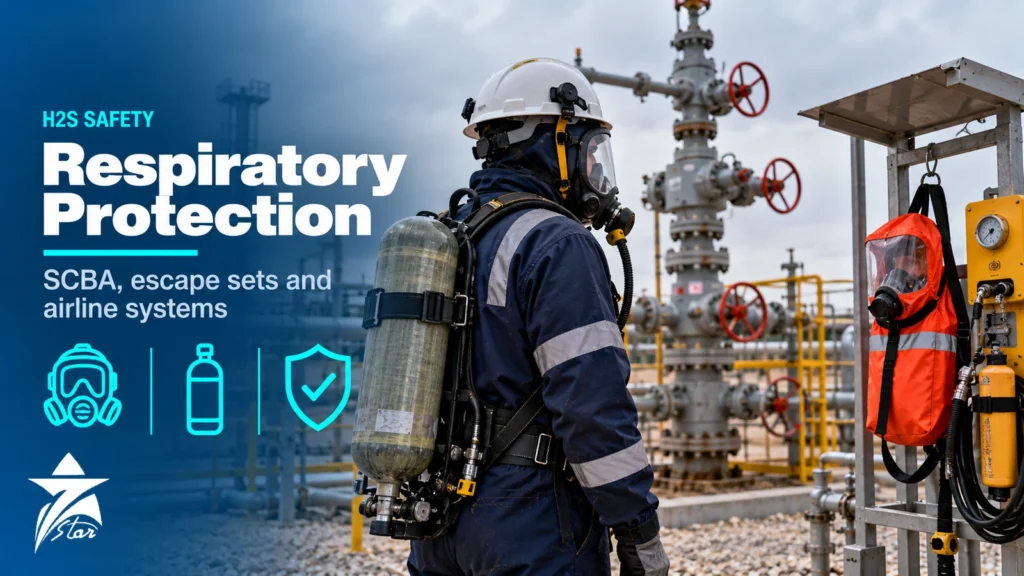
Choosing the right respiratory protection for H2S and other industrial hazards is not a matter of picking the most expensive mask. An air-purifying half mask that is perfect for paint mist can be fatal in a sour-gas release, while a full SCBA is heavy, time-limited and unnecessary for routine dust work. Selection starts with the hazard and its concentration, moves through the protection factor each device can deliver, and ends with fit testing, training and air quality. This guide compares air-purifying respirators, powered units, airline systems and self-contained breathing apparatus, explains why H2S is treated differently from most toxic gases, and sets out how fit testing works.
Two Families: Air-Purifying vs Air-Supplying
Every respirator falls into one of two groups. Air-purifying respirators (APR) clean the surrounding air through a filter or cartridge; they depend on the atmosphere containing enough oxygen and on the contaminant being known, filterable and below the limits of the device. Air-supplying respirators deliver breathable air from a separate source – a cylinder on the back (SCBA) or a compressed-air line (airline or supplied-air respirator). They are required for oxygen-deficient atmospheres, for unknown or very high concentrations and for atmospheres that are immediately dangerous to life or health (IDLH).
| Type | How it works | Typical use | Main limits |
|---|---|---|---|
| Filtering half mask / elastomeric half mask | Negative pressure through particle filter or gas cartridge | Dust, mist, low-level vapours | Low protection factor; needs good fit; not for IDLH |
| Full-face APR | Negative pressure, full facepiece with canister or cartridges | Higher vapour or particle levels, eye irritants | Not for oxygen deficiency or IDLH; cartridge life |
| PAPR | Battery blower pushes filtered air into hood or mask | Long shifts, heat, workers with beards (loose hoods) | Still air-purifying; battery and flow checks |
| Airline (SAR) with escape cylinder | Compressed breathing air via hose from cylinders or compressor | Tank entry, long jobs in toxic atmospheres | Hose length and trailing; needs air quality control |
| SCBA | Worker carries a compressed-air cylinder, positive pressure | Emergency response, rescue, IDLH entry | Weight, limited duration, training needed |
| Escape set | Short-duration hood or mask with small cylinder | Self-rescue only | Not for work or rescue |
Assigned Protection Factors
An assigned protection factor (APF) is the level of protection a properly fitted and used respirator is expected to give. Under the US OSHA respiratory protection standard (29 CFR 1910.134), examples include:
- Half mask air-purifying respirator: APF 10
- Full facepiece air-purifying respirator: APF 50
- Loose-fitting PAPR: APF 25; tight-fitting full-face PAPR: APF 1,000
- Supplied-air respirator, pressure-demand, full facepiece: APF 1,000
- SCBA, pressure-demand, full facepiece: APF 10,000
The maximum use concentration is roughly the exposure limit multiplied by the APF, and it can never exceed the cartridge manufacturer’s limit or the IDLH value for an air-purifying device. In Europe, EN 529 gives guidance on selection and uses nominal and assigned protection factors that differ from US values, so stay with one framework consistently.
Why H2S Calls for Supplied Air
Hydrogen sulfide has an IDLH of 100 ppm, deadens the sense of smell at higher levels and can cause collapse within a few breaths at high concentrations. A sour-gas release can move from trace to lethal levels in seconds. For these reasons oil and gas practice, reflected in recommended practices such as API RP 55 and RP 49, specifies SCBA or airline respirators with escape cylinders for work where H2S concentrations may exceed safe limits, rather than cartridge respirators.
Gas cartridges marked type B under EN 14387 do adsorb hydrogen sulfide, and some are used for low-level nuisance odours, but they give no warning of breakthrough, depend on knowing the concentration and fail completely in an oxygen-deficient or IDLH atmosphere. Most operators therefore do not allow cartridge respirators for H2S work zones. Personal H2S monitors remain essential to decide when supplied air is needed and when to evacuate; our gas detector selection guide covers fixed detection on the same sites.
Filters and Cartridges: Reading the Markings
European filter markings follow EN 143 for particles and EN 14387 for gases and vapours. Common letters and colours are:
- A (brown) – organic vapours with boiling point above 65 °C
- B (grey) – inorganic gases such as chlorine, hydrogen sulfide and hydrogen cyanide
- E (yellow) – sulfur dioxide and acid gases
- K (green) – ammonia and organic amines
- AX (brown) – low-boiling organic compounds
- P1, P2, P3 (white) – particle filters in increasing efficiency
The number after the letter (1, 2 or 3) gives the capacity class. In the US, NIOSH approves N95, P100 and similar particulate filters and colour-codes chemical cartridges differently, so read the approval label rather than assuming colours match across regions. Replace gas cartridges on a change schedule based on concentration and manufacturer data, never by waiting for smell or taste.
Fit Testing: Qualitative and Quantitative
A tight-fitting facepiece only protects if it seals to the wearer’s face. Fit testing checks that seal for a specific make, model and size.
Qualitative fit testing (QLFT)
The wearer is exposed to a test agent – isoamyl acetate (banana oil), saccharin, Bitrex or irritant smoke – while performing set exercises. If they detect the agent, the fit fails. Under OSHA, QLFT may only be used for respirators that must achieve a fit factor of 100 or less, which in practice means half masks.
Quantitative fit testing (QNFT)
An instrument measures leakage numerically, usually by counting particles inside and outside the mask (condensation particle counting) or by controlled negative pressure. The result is a fit factor. OSHA requires at least 100 for half masks and 500 for full facepieces used in negative-pressure mode.
Fit testing rules that catch people out
- Fit tests are repeated at least annually and whenever weight, dental work or facial changes affect the seal.
- Facial hair that crosses the sealing surface is not allowed with tight-fitting facepieces; loose-fitting hoods are the alternative.
- A user seal check (positive and negative pressure) is done each time the mask is put on – it does not replace the fit test.
- Fit tests are model-specific: a pass on one brand or size does not transfer to another.
- Spectacle kits are needed for full facepieces; normal glasses break the seal.
Breathing Air Quality for SCBA and Airline Systems
Air-supplying respirators are only as safe as the air they deliver. In Europe, EN 12021 sets limits for oxygen, carbon monoxide, carbon dioxide, oil and water content of compressed breathing air; in North America, CGA G-7.1 Grade D is the common reference. Compressors need suitably located intakes away from engine exhaust and process vents, filtration and, for oil-lubricated machines, CO monitoring or alarms. Cylinder air should be sampled and tested at intervals set by the safety programme.
Duration is another practical limit. A common 6.8-litre cylinder filled to 300 bar holds roughly 2,000 litres of free air, but real working time depends on breathing rate, which rises sharply with heat, workload and stress. Plan entries on conservative durations, rely on the low-pressure warning whistle as a leave signal, and use airline systems with escape cylinders for long tasks.
Standards Referenced on Industrial Sites
- EN 137 – self-contained open-circuit compressed-air breathing apparatus
- EN 14593 – compressed-air line breathing apparatus with demand valve
- EN 402 – self-contained escape apparatus with full face mask or mouthpiece
- EN 136 and EN 140 – full face masks and half masks
- EN 12941 and EN 12942 – powered filtering devices
- 29 CFR 1910.134 and NIOSH 42 CFR Part 84 – US programme and approval rules
Heat, Comfort and Wear Time in the GCC
Respiratory protection adds breathing resistance and heat load. In summer site conditions, workers in tight-fitting masks and SCBA tire quickly, which raises air consumption and the risk of removing equipment early. Practical measures include PAPRs for long dusty tasks, cooling vests under SCBA, scheduled rest breaks in shade, shorter entry durations and cleaning facepieces between users. Store masks and cartridges out of direct sun, as heat ages rubber and shortens the shelf life of sealed cartridges.
Inspection, Cleaning and Storage
Reusable respirators need a routine just like any other safety-critical equipment. Before each use, check the facepiece for cracks, distortion and hardened rubber, confirm that inhalation and exhalation valves seat properly and that straps still hold tension. SCBA sets need a pre-use check of cylinder pressure, the warning whistle, the demand valve and the harness, plus periodic servicing and cylinder hydrostatic testing at the intervals set by the cylinder standard and manufacturer.
- Clean and disinfect shared facepieces after each use, following the manufacturer’s agents and drying method.
- Store masks in sealed bags or cases, away from heat, sunlight, solvents and crushing.
- Keep a log of inspections, repairs and parts replaced for every SCBA and airline set.
- Use only the manufacturer’s spare parts; mixing components can void the approval.
Respiratory Protection Programme Checklist
- Hazard assessment with measured or estimated concentrations
- Device selection using APF and maximum use concentration
- Medical evaluation of wearers where required
- Fit testing records by make, model and size
- Training on donning, seal checks, limitations and emergencies
- Cartridge change schedule and storage rules
- Breathing air quality tests and compressor maintenance
- Inspection, cleaning and repair records for SCBA and airline sets
- Standby rescue arrangements for confined spaces and H2S zones
Respiratory Protection We Supply
These examples cover negative pressure, powered and supplied air protection.
| Product | Type | Where it fits |
|---|---|---|
| 3M 6200 Reusable Half Facepiece Respirator (Medium) | Reusable half-face respirator | Particulates and low concentrations of gases and vapours with the right filter. |
| Moldex 9000 Series Reusable Full Face Respirator | Reusable full-face respirator | Higher protection and eye protection. |
| Optrel swiss air PAPR Back-Worn Powered Air Respirator | Powered air purifying respirator | Long shifts where breathing resistance matters. |
| Optrel suppliedair Comfort Supplied-Air Respiratory Unit | Supplied-air respiratory unit | Work where the air cannot be filtered safely. |
| Donaldson Ultrapure Smart ALG 0005-0100 Breathing Air Unit | Breathing air unit | Producing clean breathing air from compressed air. |
Air-purifying respirators are not suitable for H2S above safe limits. Send the hazard, concentration and duration through our quote request form.
Sourcing Respiratory Protection Through Seven Star LLC
Seven Star LLC supplies half and full face masks, filters and cartridges, PAPRs, airline sets, SCBA and escape sets on request, from manufacturers such as 3M, Dräger, MSA and Honeywell. Browse our respiratory protection range, the wider safety and PPE category and fire and gas detectors for H2S monitoring. We help with selection and cross-checking part numbers for facepieces, filters and spares, and availability and lead time are confirmed at quotation.
Need masks, cartridges or SCBA spares? Send us the model on the nameplate or label, the hazard and concentration you are protecting against, or your RFQ, and we will reply with matched options and a clear quotation.
Frequently asked questions
Can a cartridge respirator be used for H2S?
Type B cartridges adsorb hydrogen sulfide, but they give no warning of breakthrough and cannot be used in IDLH or oxygen-deficient atmospheres. Oil and gas operators therefore normally require SCBA or airline respirators wherever H2S may exceed safe limits.
What is an assigned protection factor?
It is the level of protection a respirator is expected to provide when properly fitted and used. Under OSHA, a half mask APR has an APF of 10, a full facepiece APR 50 and a pressure-demand SCBA 10,000.
What is the difference between qualitative and quantitative fit testing?
Qualitative testing relies on the wearer detecting a taste or smell agent such as saccharin or isoamyl acetate, and is limited to masks needing a fit factor of 100 or less. Quantitative testing measures leakage with an instrument and gives a numeric fit factor, suitable for both half and full facepieces.
How often must fit testing be done?
OSHA requires fit testing before first use and at least annually afterwards. It must also be repeated when the wearer changes mask model or size or has facial changes that could affect the seal.
Can workers with beards wear respirators?
Not tight-fitting ones where hair crosses the sealing surface, because the seal cannot be achieved reliably. Loose-fitting hoods or helmets with PAPR or supplied air are the usual alternatives.
What standard covers breathing air quality?
EN 12021 is used in Europe and many GCC projects, and CGA G-7.1 Grade D is common in North America. Both limit oxygen range, CO, CO2, oil and moisture in compressed breathing air.
Was this guide helpful?One click helps us write better guides for engineers.
Thank you! Glad it helped. Need this equipment for your project? Request a quotation
Thank you. We will use this to improve the guide.