- Automation & ControlView all 2,608 products
- Automation Accessories
- AC Drives
- PLC & I/O Cards
- Industrial Communications
- Vibration Monitoring
- Controllers & Data Acquisition
- Isolator & Barrier
- Safety Switches & Guard Locking
- Motor Soft Starters
- CCTV & Security
- Encoders
- HMI Displays
- Pneumatic Cylinders
- Servo Drives
- Industrial Computers
- Machine Vision
- Automation Software
- Robotics
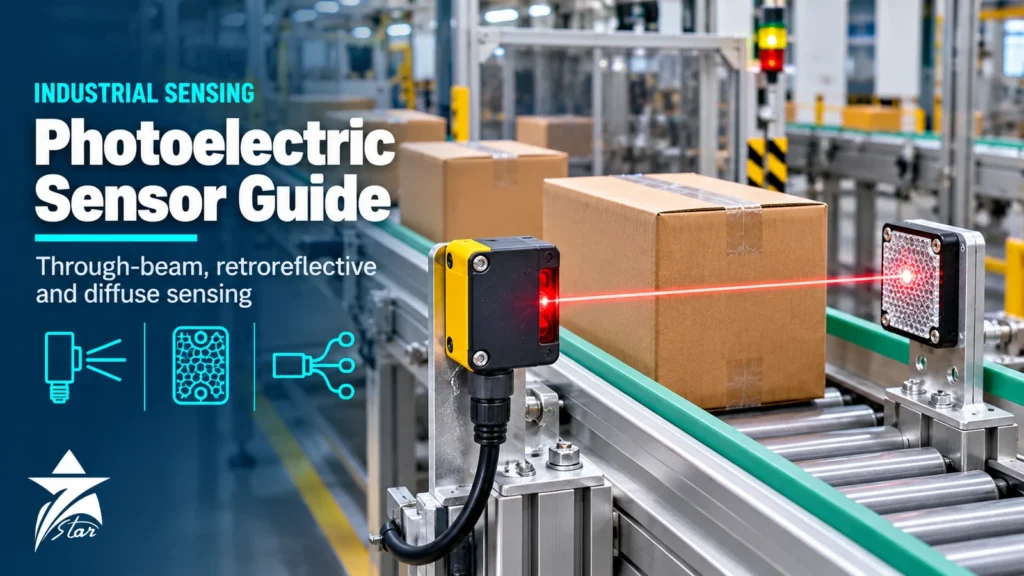
A photoelectric sensor detects an object by watching what happens to a beam of light. Either the object breaks a beam, or it reflects light back to the sensor. These sensors count bottles on a filling line, check that a carton is in place before it is sealed, stop a conveyor when bags pile up, and confirm that a truck has cleared a loading gate. Choosing the wrong sensing mode is the most common reason a photoelectric sensor “works on the bench” but chatters or misses targets in the plant. This guide explains the three main modes, background suppression, light sources, excess gain, output wiring and IO-Link, and the checks that make an installation reliable.
How a Photoelectric Sensor Works
Every photoelectric sensor has an emitter, which sends pulsed light, and a receiver, which measures how much of that light comes back. The light is modulated at a fixed frequency so the receiver can ignore ambient light from lamps and sunlight. When the received signal crosses a switching threshold, the output changes state. Two terms describe that output:
- Light-on (light operate): the output is active when the receiver sees light. For a diffuse sensor this means “object present”; for a through-beam or retroreflective sensor it means “beam clear”.
- Dark-on (dark operate): the output is active when the receiver does not see light. For a through-beam or retroreflective sensor this means “object present”.
Many sensors let you choose light-on or dark-on with a switch, a wire, a teach button or IO-Link, so check which logic the PLC program expects before you install a replacement.
Through-Beam vs Retroreflective vs Diffuse
The sensing mode is the first and most important choice. It decides the range, how reliable detection is in dirt and dust, and how much wiring and alignment the installation needs.
| Mode | How it works | Typical range | Strengths | Limits |
|---|---|---|---|---|
| Through-beam (opposed) | Separate emitter and receiver face each other; the object breaks the beam | Up to tens of metres (some models 30 m and more) | Longest range, highest excess gain, best in dust, detects opaque objects of any colour | Two devices to mount, wire and align; small or transparent objects can slip through |
| Retroreflective | Emitter and receiver in one housing; light returns from a reflector; the object breaks the beam | Typically up to about 5 to 20 m with the specified reflector | Only one device to wire, simple alignment, good for conveyors and doors | Shiny objects can reflect light back like a reflector unless the sensor is polarised; reflector must stay clean |
| Diffuse (proximity) | Emitter and receiver in one housing; the object itself reflects light back | Millimetres to around 1 m; more for energetic and distance types | No reflector or second unit, easy to fit in tight spaces | Range depends on colour and surface of the target; a bright background can cause false switching |
Through-beam sensors
Use a through-beam pair when you need long range, dirty or steamy conditions, or a very reliable detection of opaque objects such as pallets, vehicles or bags. Because the receiver sees the emitter directly, the signal margin is high and the sensor tolerates dirty lenses for longer. Mount the pair so the beam crosses the narrowest part of the target path, and remember that a target smaller than the effective beam can pass without fully breaking it.
Retroreflective sensors
A retroreflective photoelectric sensor is the usual choice on conveyors. A polarised version sends polarised light and only accepts light whose polarisation has been rotated by a corner-cube (prismatic) reflector, so shrink-wrapped cartons, metal cans and glossy labels do not fool it. Polarised sensors need the correct prismatic reflector; some reflective tapes do not rotate the polarisation and give poor results. For clear bottles, film and glass, choose a version designed for transparent objects, which uses a lower switching threshold and often coaxial optics to detect the small loss of light a clear object causes.
Diffuse sensors
A standard (energetic) diffuse sensor switches when enough light comes back from the target, so a white carton is detected further away than a black one. That is acceptable when the target is close and the background is far away or dark. When the background is bright, or targets vary in colour, use background suppression instead.
Background Suppression, Foreground Suppression and Distance Sensors
A diffuse sensor with background suppression (BGS) uses triangulation: the receiver has two or more detector elements, and the angle at which the light returns tells the sensor how far away the surface is. Anything beyond the set distance is ignored, whatever its colour. This is why BGS sensors detect a black product in front of a shiny stainless-steel machine frame, where a standard diffuse sensor would switch on the frame.
- Background suppression: detects objects up to a set distance and ignores everything behind it. The best general choice for product detection on conveyors.
- Foreground suppression (FGS): watches a known background, such as a conveyor belt, and switches when something appears in front of it or the background is no longer seen. Useful for flat or irregular objects.
- Time-of-flight distance sensors: measure the travel time of the light and give a distance value or several switching points over metres, often with IO-Link. Used for fill level in hoppers, stack height and vehicle positioning.
Remember the colour effect does not disappear completely with BGS: very dark or very glossy targets still shorten the usable range, so read the data sheet curves for black (about 6% remission) and white (90%) targets.
Light Source: Red, Infrared, Laser or White Light
| Light source | Why choose it | Watch out for |
|---|---|---|
| Visible red LED | Easy alignment because the spot is visible; good general purpose | Shorter range than infrared on some models |
| Infrared LED | Longer range and better penetration of dust and light fog | Invisible beam, so alignment is harder |
| Laser (class 1 or 2) | Very small spot for small parts and precise edge detection; long range in retroreflective mode | Class 2 lasers need the usual eye-safety labelling; a small spot is sensitive to vibration |
| White or full-spectrum LED | Contrast and colour detection, for example registration marks and labels | Shorter range; best kept for contrast tasks |
Excess Gain and Dirty Environments
Excess gain is the ratio between the light the receiver actually gets and the minimum light it needs to switch. A value of 1 means the sensor is exactly at its threshold, which is not reliable. Manufacturers publish excess gain curves against distance, and a commonly used rule of thumb is:
| Environment | Minimum excess gain (guideline) |
|---|---|
| Clean, indoor, air-conditioned | about 1.5 |
| Slightly dirty, light dust | about 5 |
| Moderately dirty, dust on lenses and reflectors | about 10 |
| Very dirty, heavy dust, fog or steam | about 50 or more |
In cement plants, mines, bagging lines and outdoor gates in Oman, dust and sand build up on lenses quickly. Through-beam sensors give the most margin in these places. For retroreflective and diffuse sensors, work at a shorter distance than the maximum on the label, and plan a cleaning interval. Many modern sensors show a stability or contamination warning on an LED or over IO-Link before detection fails.
Outputs, Wiring and IO-Link
Most industrial optical sensors are 3-wire or 4-wire DC devices, typically 10 to 30 V DC, with a transistor output. The key choice is PNP or NPN, and it must match the PLC input card.
| Output type | Behaviour | Typical PLC input |
|---|---|---|
| PNP (sourcing) | Switches the positive supply to the load | Sinking inputs, common in Europe and the Middle East |
| NPN (sinking) | Switches the load to 0 V | Sourcing inputs, common on Asian machines |
| Push-pull | Drives both high and low; works with either input type | Either, and required for IO-Link communication |
| Relay output (AC/DC) | Volt-free contact, often with a universal 24 to 240 V supply | Older panels, direct switching of small loads |
For M12 and M8 4-pin connectors the common colour code is: pin 1 brown (+V), pin 3 blue (0 V), pin 4 black (switching output or IO-Link C/Q), and pin 2 white (second output, inverted output or a test input, depending on the model). Always check the data sheet, because pin 2 functions vary.
IO-Link turns the sensor into a smart device on a point-to-point link through an IO-Link master. It lets you set switching distance, light-on or dark-on, timers and logic from the PLC, read signal quality and contamination warnings, and store parameters so a replacement sensor is configured automatically. It is worth specifying on new lines and for hard-to-reach sensors. If a sensor must sit in a hazardous area, follow the area classification and use certified equipment or intrinsically safe circuits; our hazardous area classification guide explains zones, gas groups and temperature classes.
Installation and Troubleshooting
- Align, then confirm margin. Use the stability LED or IO-Link signal value, not just the output LED. A sensor that only just switches will fail when the lens gets dusty.
- Avoid direct sunlight and strong lamps shining into the receiver, especially at outdoor gates and loading bays.
- Prevent mutual interference. Stagger neighbouring sensors, alternate emitter sides on through-beam pairs, or use models with interference suppression.
- Angle retroreflective sensors slightly when detecting glossy objects, even with polarised optics, so direct reflections miss the receiver.
- Choose the housing for the duty: metal or stainless housings and IP69K ratings for washdown in food and beverage plants, compact plastic housings for machinery, M18 threaded housings for easy replacement.
- Check response time against the line speed and object gap, especially on fast bottling and packaging lines.
| Symptom | Likely cause | What to do |
|---|---|---|
| Output chatters | Low excess gain, target at edge of range, vibration | Shorten distance, realign, choose a higher gain or BGS model, add a short on-delay |
| Shiny products not detected (retroreflective) | Non-polarised sensor or wrong reflector | Use a polarised sensor with a prismatic reflector, angle the sensor |
| Diffuse sensor switches with no product | Bright background reflecting light | Use background suppression or move the sensor |
| Clear bottles not detected | Standard retroreflective threshold too high | Use a sensor designed for transparent objects and teach it on the actual bottle |
| Works in the morning, fails later | Dust build-up or sunlight angle | Clean lenses, add a hood, plan more margin |
If the application is to detect metal targets at a few millimetres in dirty or wet conditions, an inductive sensor is often more robust than an optical one; see our inductive proximity sensor guide. For longer distances to liquids or bulk solids, look at ultrasonic sensors or laser distance and radar sensors. When the sensors feed a new control system, our PLC selection guide covers I/O count and communication choices.
Photoelectric Sensors We Supply
We quote optical sensors, reflectors and fibre-optic amplifiers from makers often found on machines and production lines in Oman, including SICK, Omron, Keyence, Banner Engineering, Pepperl+Fuchs, ifm and Baumer. You can browse the full range in our photoelectric sensors category. A selection by sensing mode:
| Product | Type | Where it fits |
|---|---|---|
| SICK GSE6-P4212 G6 Through-Beam Sensor Set | Through-beam set, up to 15 m, M8 | Compact machines and conveyor guarding. |
| Omron E3Z-T62 Through-Beam Sensor, 30 m | Through-beam, 30 m, NPN | Long-range detection across wide conveyors and gates. |
| Keyence PR-G51N Thrubeam Sensor, 30 m, NPN | Through-beam, stainless housing | Harsh or washdown areas needing long range. |
| SICK GRL18-P2432 M18 Retro-Reflective Sensor | Polarised retroreflective, M18, 6 m | Carton and case detection on conveyors. |
| Banner Q20-2PLP-2M Polarized Retroreflective Sensor | Polarised retroreflective, 5 m | Shiny or film-wrapped products. |
| Pepperl+Fuchs RL31-54/73c/136 Retroreflective Sensor, 9 m | Polarised retroreflective, push-pull | Logistics and packaging lines. |
| SICK WL150-P420 Retro-Reflective Sensor for Transparent Objects | Clear-object retroreflective | PET and glass bottle detection. |
| Banner QS18VP6LLP Polarized Retroreflective Laser Sensor | Laser retroreflective, up to 10 m | Small gaps and precise edge detection. |
| ifm OGH580 Diffuse Sensor BGS, 200 mm, Metal Housing, M18 | Diffuse with background suppression | Mixed-colour products in front of metal frames. |
| Baumer O200.GP-GW1J.72NV/E022 Miniature Sensor | Miniature diffuse with background suppression | Tight spaces in packaging machines. |
| Omron E3Z-D61 Diffuse Sensor, 100 mm | Standard diffuse, 100 mm | Short-range presence checks. |
| ifm O5D100 Photoelectric Distance Sensor, 2 m, IO-Link | Time-of-flight distance sensor | Stack height, positioning and level in hoppers. |
| Keyence PS-N11N Digital Photoelectric Amplifier, Main Unit, NPN | Amplifier for separate sensor heads | Multi-sensor machines with compact heads. |
For a quotation, send the existing part number or, for a new point, the target (size, colour, shiny or clear), distance, sensing mode, output (PNP, NPN, push-pull or IO-Link), connector or cable, and the environment, through our quote request form or to [email protected].
Buying a Photoelectric Sensor in Oman Through Seven Star LLC
Seven Star LLC is an independent supplier in Oman of through-beam, retroreflective and diffuse sensors, reflectors, fibre-optic sensors and amplifiers, and related automation parts for packaging, food and beverage, cement, logistics, oil and gas and utility sites. We match the exact model on your machine, or offer a comparable sensor with the same mode, range, output and connector where the original is obsolete. Availability and lead time are confirmed at quotation. For a wider view of the instrument brands we work with, see our sensors and transmitters suppliers overview, and for legacy machines our guide to sourcing obsolete automation parts.
Send a photo of the sensor label or the part number from the machine drawing, and we will prepare a quotation for the same sensor or a checked equivalent, with the matching reflector or cable.
Frequently asked questions
What is a photoelectric sensor?
A photoelectric sensor is a non-contact sensor that uses a light beam to detect an object. It has an emitter and a receiver, and its output switches when the object breaks the beam or reflects enough light back to the receiver. It is used to detect, count and position products, vehicles and parts.
What is the difference between through-beam, retroreflective and diffuse sensors?
A through-beam sensor has a separate emitter and receiver and detects when the beam between them is broken; it has the longest range. A retroreflective sensor has both in one housing and uses a reflector. A diffuse sensor uses light reflected by the object itself, so its range depends on the colour and surface of the target.
What does background suppression mean on a photoelectric sensor?
Background suppression uses triangulation to measure how far away the reflecting surface is, so the sensor only detects objects up to a set distance and ignores anything behind, whatever its colour. It prevents false switching on bright or shiny backgrounds such as machine frames.
Why do I need a polarised retroreflective sensor?
A polarised retroreflective sensor only accepts light whose polarisation has been rotated by a prismatic reflector. Glossy objects such as cans, foil and shrink-wrap reflect light without rotating it, so the sensor is not fooled into thinking the beam is clear.
Should I choose a PNP or NPN photoelectric sensor?
Match the output to the PLC input card. PNP outputs switch the positive supply and suit sinking inputs, which are common in Europe and the Middle East. NPN outputs switch to 0 V and are common on Asian machines. Push-pull outputs work with either and are used for IO-Link.
Who supplies photoelectric sensors in Oman?
Seven Star LLC is an independent supplier in Oman that quotes photoelectric sensors, reflectors and amplifiers from makers such as SICK, Omron, Keyence, Banner Engineering, Pepperl+Fuchs, ifm and Baumer. Send the part number or the application details through the quote request form or to [email protected].
Was this guide helpful?One click helps us write better guides for engineers.
Thank you! Glad it helped. Need this equipment for your project? Request a quotation
Thank you. We will use this to improve the guide.