Brand:

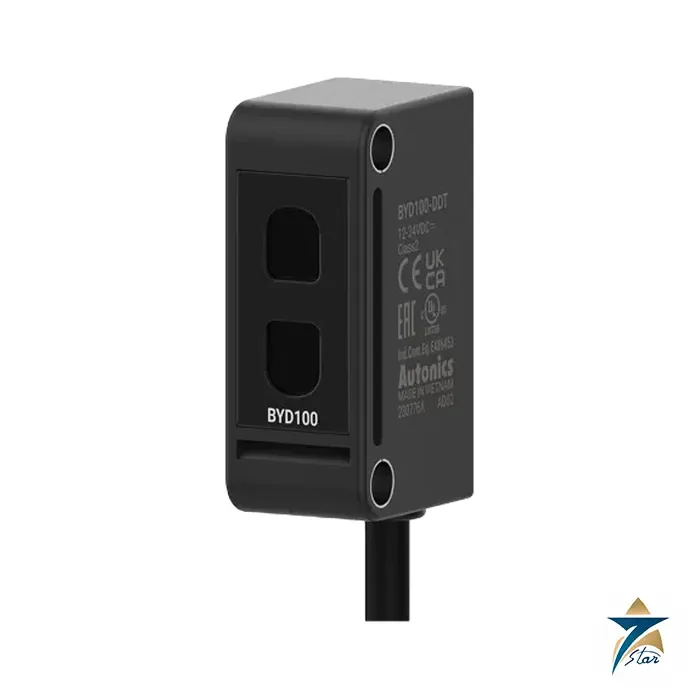
Autonics BYD100-DDT Miniature Diffuse Reflective Sensor 100 mm

Description

Overview

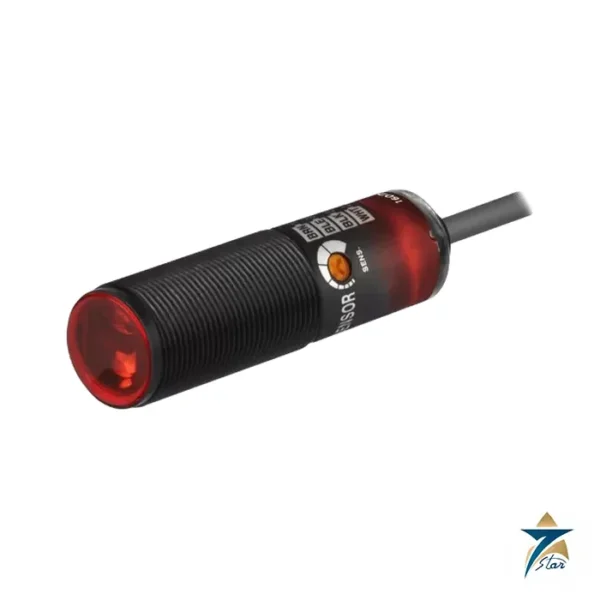
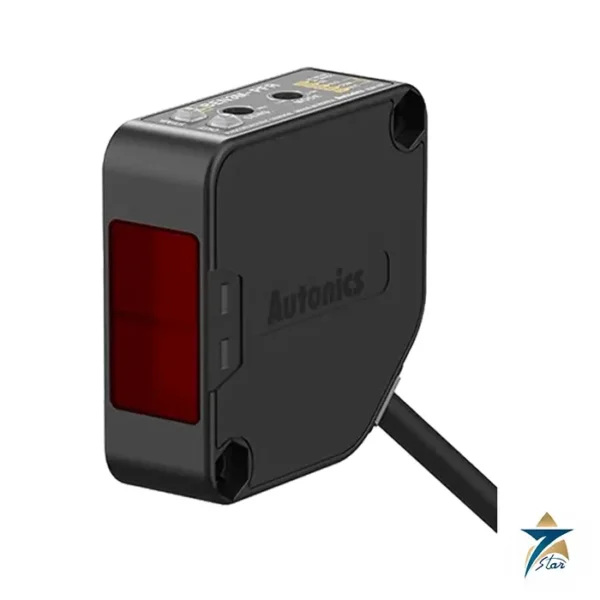
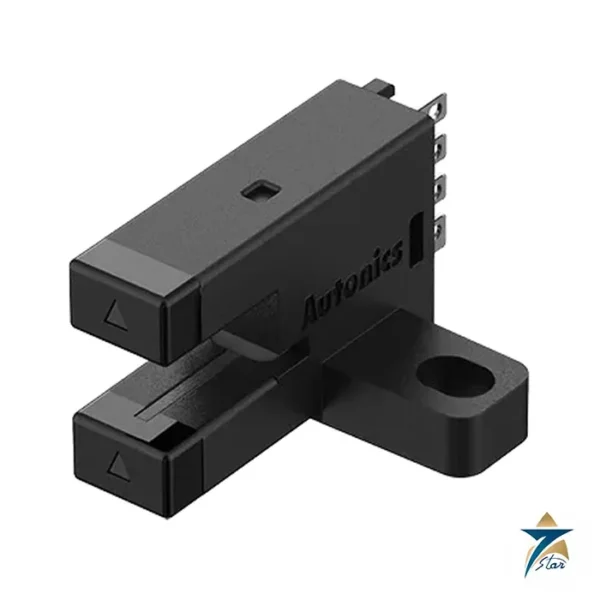
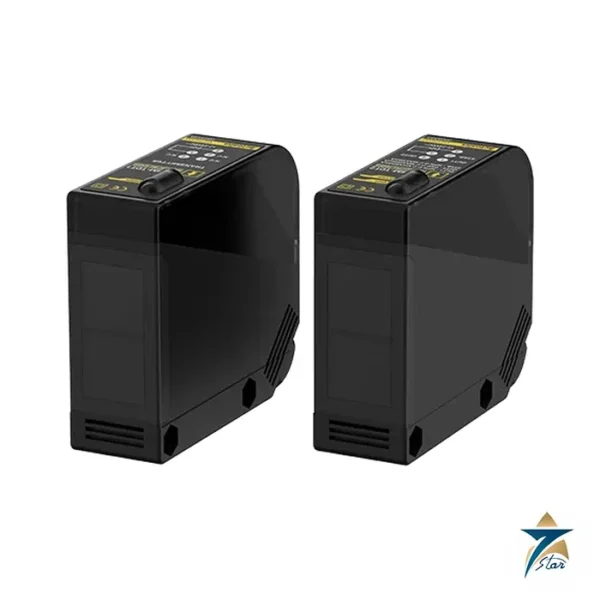
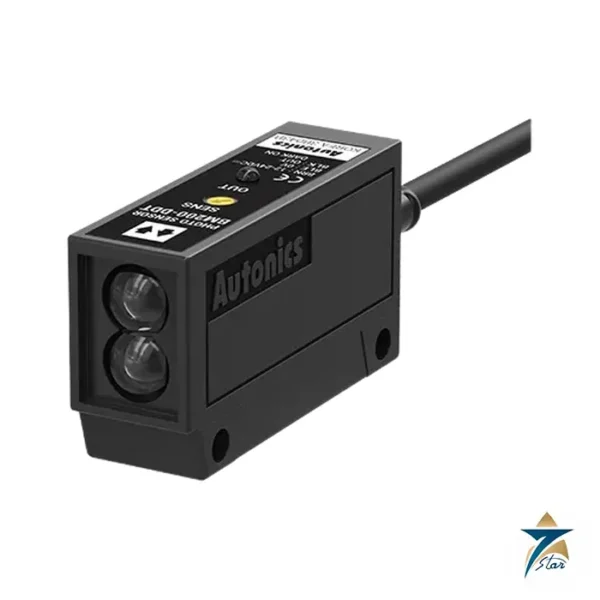
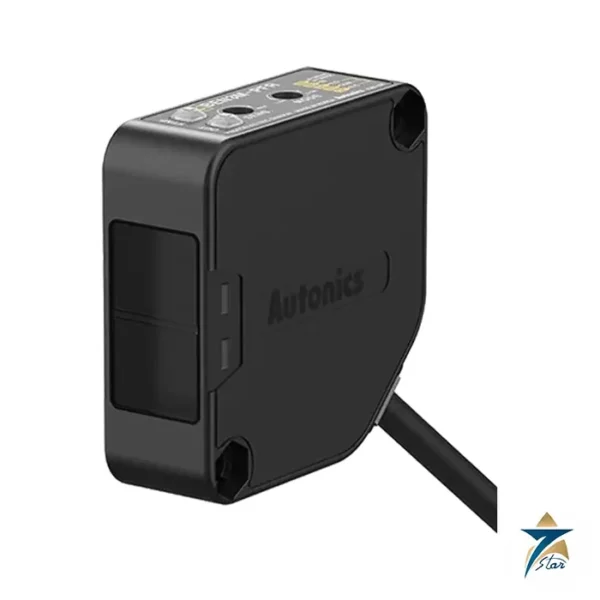
The Autonics BYD100-DDT is the diffuse reflective member of the miniature BYD photoelectric series. Its single housing holds an infrared emitter and a receiver side by side; light is sent out, bounces off whatever is in front, and returns to the receiver if the object is close enough. The set distance is 100 mm, measured on a non-glossy white sheet of 50 by 50 mm. It operates on 12 to 24 VDC and switches an NPN open collector output.

Seven Star LLC is an independent supplier serving Oman and the GCC. We include this BYD part in quotations for compact machines, because the housing is only about 38 g and still carries a trimmer for sensitivity.

Quick reference for the Autonics BYD100-DDT

Parameter Value
Model BYD100-DDT, NPN output, cable type
Sensing type Diffuse reflective
Sensing distance 100 mm on non-glossy white paper, 50 x 50 mm, with a tolerance of plus or minus 10 percent
Detectable materials Opaque and translucent materials
Hysteresis 25 percent of sensing distance or less
Light source Infrared
Sensitivity Adjustable by trimmer
Operation mode Light ON
Power supply 12 to 24 VDC, plus or minus 10 percent
Current consumption 35 mA or less
Control output NPN open collector, up to 50 mA, 26.4 VDC
Residual voltage 1 VDC or less
Indicator Red operation indicator on the front
Ambient temperature -20 to 65 C
Protection rating IP50
Cable 3.5 mm, 3 wires, 2 m
Weight About 38 g, about 75 g packaged

Why Autonics BYD100-DDT suits compact machines

  • Short and light housing that fits between guide rails and inside covers.
  • Trimmer sensitivity adjustment, so the threshold can be tuned to suppress the background.
  • Light ON mode: the output is on while an object is present in front of the lens.
  • Reverse power protection and output short-circuit protection built in.
  • Detects opaque and translucent materials, including thin plastic film and paper.
  • Package contents: the sensor, an adjustment screwdriver, one bracket A and two M3 bolts and nuts.

How BYD100-DDT differs from other BYD variants

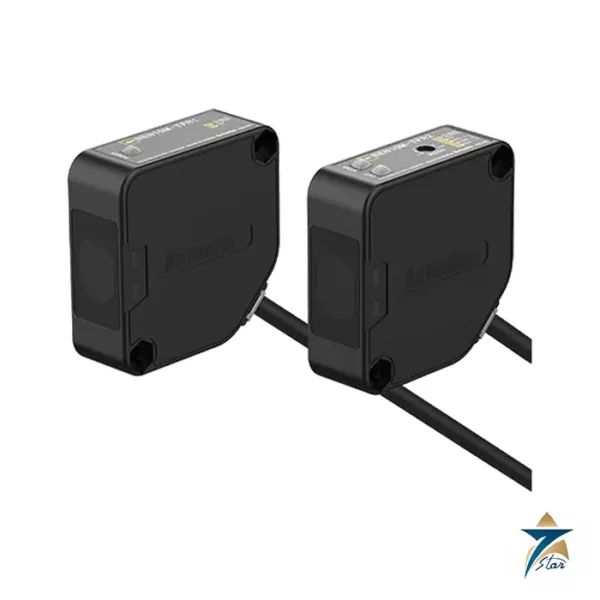
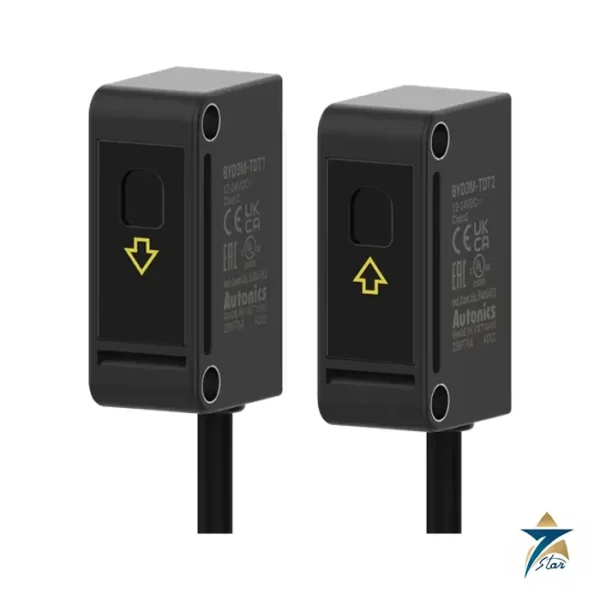
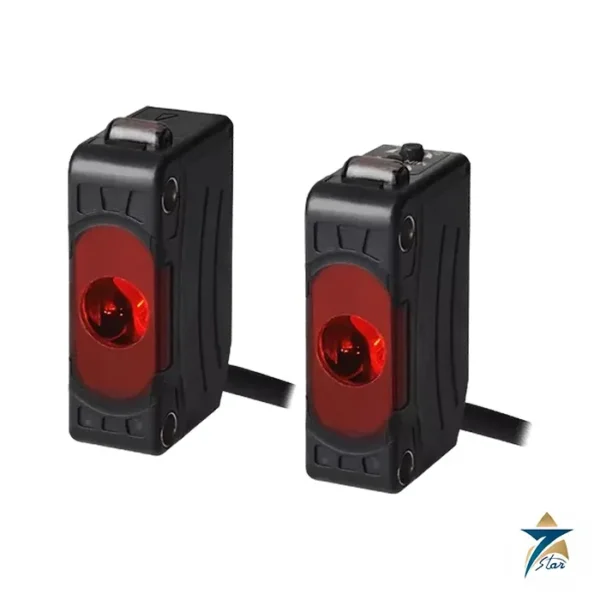
In the BYD family, the through-beam pair BYD3M-TDT reaches 3 m but needs two housings and has no trimmer. Convergent models in the series, with windows of 10 to 30 mm or 10 to 50 mm, ignore anything outside a small zone. The Autonics BYD100-DDT lies between them: a single unit with 100 mm reach and an adjustable threshold.

Electrically, this diffuse model switches up to 50 mA, while the through-beam receiver of the same series handles 100 mA. Its enclosure rating is IP50, lower than the IP64 of the through-beam pair, so keep it away from washdown spray. Its hysteresis of up to 25 percent is wider than the 10 percent of convergent types, which means the release point sits further out than the switching point.

Where it is used in Oman and the GCC

A reach of 100 mm is perfect for presence checks inside machines: bottles on a starwheel, trays in a thermoformer, sachets in a feeder, or a lid in a capping head. Small conveyors for cartons and pharmaceutical blister lines use the same distance class. In utility and water plants it can prove that a small valve actuator flag or a pump guard is in place.

Because infrared light is invisible and the housing is light, the unit is a common choice for OEM equipment shipped to Gulf customers, where stable settings and easy replacement matter more than long reach.

Wiring

Connect the brown wire to the positive supply, the blue wire to 0 V and the black wire to the load or PLC input. With an NPN output, the load connects between black and the positive supply and must stay below 50 mA. A diode across any relay coil protects the transistor, and a short cable run keeps electrical noise from reaching the input. If the PLC input card is slow, remember that the output stays on only while the target is inside the switching zone, so very quick passes of thin parts should be tested on the actual machine before release. Use a stable regulated supply within 12 to 24 VDC and keep the wire away from motor cables.

Setting the sensitivity

Present the target at the distance where it should be detected. Turn the trimmer from minimum until the red indicator lights, and note this point. Remove the target, continue turning until the indicator lights on the background, and note that point. Choose the middle. Dark or shiny backgrounds behave differently, so run the test with the real background in place. Pale targets reflect more infrared than dark ones, which means a black rubber part may be detected at a shorter distance than the white test card used for the rating. If you must detect both pale and dark parts, set the sensitivity for the darkest one and make sure the background stays beyond reach. Do not turn the trimmer with force.

Installation and care

Fix the bracket with M3 bolts at about 0.5 N m. Keep the face parallel to the target. When several sensors work close together, mutual interference may cause false outputs, so separate them or angle the beams. Wipe the lens gently with a soft dry cloth. Impacts and repeated bending of the cable reduce the housing seal.

Ordering notes

Quote Autonics BYD100-DDT with the quantity needed. If your PLC card needs a sourcing input, ask for the PNP version, which has a P suffix. Bracket B and the other series accessories can be added to the same request.

Related items you may also need: Autonics PR18-8DN M18 Inductive Proximity Sensor 8 mm | Autonics BEN5M-MFR Retroreflective Photoelectric Sensor 5 m | Autonics E40S6-2500-6-L-5 Rotary Encoder Incremental | All Autonics products.

Documents and quotation

The manufacturer publishes a product manual that covers Autonics BYD100-DDT, and the PDF is attached to this page for download so your engineers can check wiring, ratings and dimensions before ordering. Please send your RFQ with the part number and the quantity you need, plus the delivery site, and our team will reply with availability and lead time.

Other Models in the BYD Range

Seven Star LLC supplies models from the BYD range in Oman and the GCC. Compare the related models below and request a quote for the one that matches your application.

ModelCategory
Autonics BYD30-DDT Compact Convergent Photoelectric SensorPhotoelectric SensorsView details
Autonics BYD3M-TDT Miniature 3 m Through-Beam SensorPhotoelectric SensorsView details
Autonics BYD100-DDT Miniature Diffuse Reflective Sensor 100 mmPhotoelectric SensorsYou are viewing this model
Datasheets & Documents
  • PDF Datasheet Autonics BYD100-DDT Miniature Diffuse Reflective Sensor 100 mm Datasheet Download
Reviews (0)

Reviews

There are no reviews yet.

How would you rate this product?

It takes about 10 seconds — just tap a star. Your email is never published.

About brand

Autonics is a South Korean maker of sensors and controllers, founded in 1977 as a small engineering business making controllers for looms. It took the Autonics name in 1988 and opened a new corporate headquarters in Busan in 2014. Autonics makes proximity and photoelectric sensors, rotary encoders, temperature controllers, counters, timers and stepper motor systems, with factories in Busan and Yangsan.

Seven Star LLC lists the Autonics E40S6-2500-6-L-5 incremental rotary encoder and supplies Autonics sensors and control devices in Oman and the GCC.

Autonics company profile

Founded 1977, South Korea
Current name Autonics, since 1988
Headquarters Busan, South Korea
Factories Busan and Yangsan
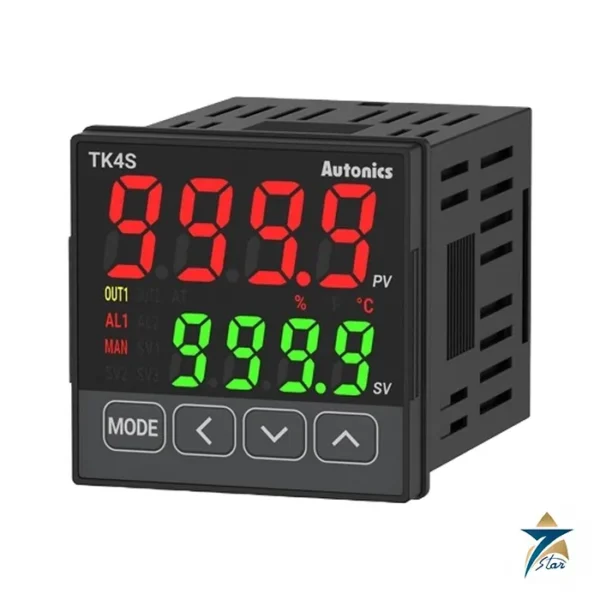
Product families E40 and E50 rotary encoders, PR proximity sensors, BJ photoelectric sensors, TK temperature controllers

Milestones

  • 1977: The company is founded.
  • 1988: Renamed Autonics Corporation.
  • 2014: Opens its Busan headquarters.

Reading the Autonics E40S encoder code

E40S is the 40 mm diameter shaft-type incremental encoder, and the 6 that follows is the 6 mm shaft. 2500 is the resolution in pulses per revolution. The next 6 means six output signals: A, B and Z with their inverted signals. L is a line driver output and the final 5 is a 5 V DC supply. The same 40 mm body is made in hollow shaft form as the E40H and E40HB series.

Where Autonics encoders are used

Servo and spindle feedback, conveyor length measurement, packaging and printing machines.

Ordering Autonics encoders: what we need

Send the complete model string from the label. If it is worn off, give the body and shaft diameter, pulses per revolution, output type, supply voltage and cable or connector style.

Facts checked against Autonics corporate profiles, October 2026.

FAQ

Questions about the Autonics BYD100-DDT Miniature Diffuse Reflective

Answers from our engineering team on installation, compatibility and integration.

01What is the sensing distance of the Autonics BYD100-DDT?
It is a diffuse reflective sensor set for 100 mm, measured on non-glossy white paper of 50 by 50 mm with a tolerance of plus or minus 10 percent.
02Does the BYD100-DDT have sensitivity adjustment?
Yes. The diffuse reflective type has a trimmer, supplied with a small adjustment screwdriver in the package.
03What is the load current limit?
The NPN open collector output of this diffuse model is rated for up to 50 mA at a maximum of 26.4 VDC.
04What protection rating does it have?
The reflective housing is IP50, so it is meant for dry indoor use inside machines rather than for washdown areas.
05Which materials can it detect?
It detects both opaque and translucent materials, though the real range changes with colour and surface of the target.