- Automation & ControlView all 3,160 products
- Automation Accessories
- AC Drives
- PLC & I/O Cards
- Industrial Communications
- Vibration Monitoring
- Controllers & Data Acquisition
- Isolator & Barrier
- Safety Switches & Guard Locking
- Encoders
- Motor Soft Starters
- CCTV & Security
- Pneumatic Cylinders
- HMI Displays
- Servo Drives
- Industrial Computers
- Machine Vision
- Automation Software
- Robotics
Brand: Autonics
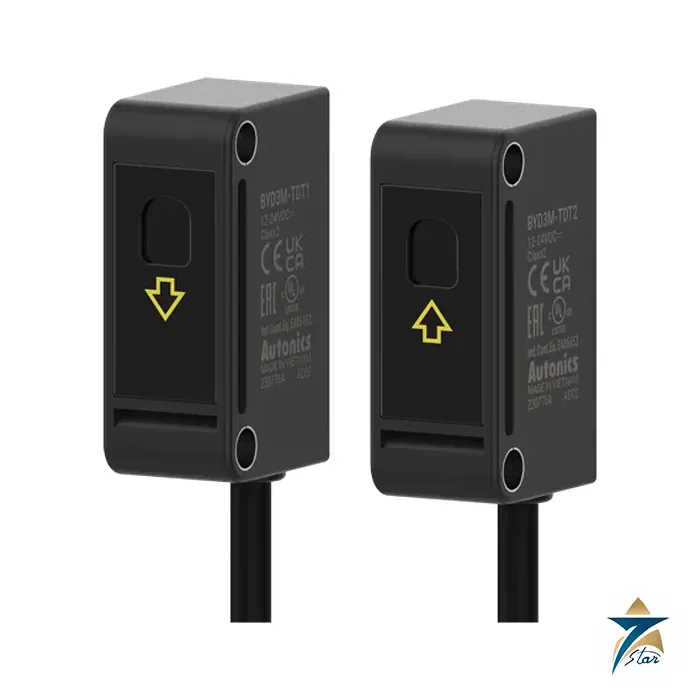
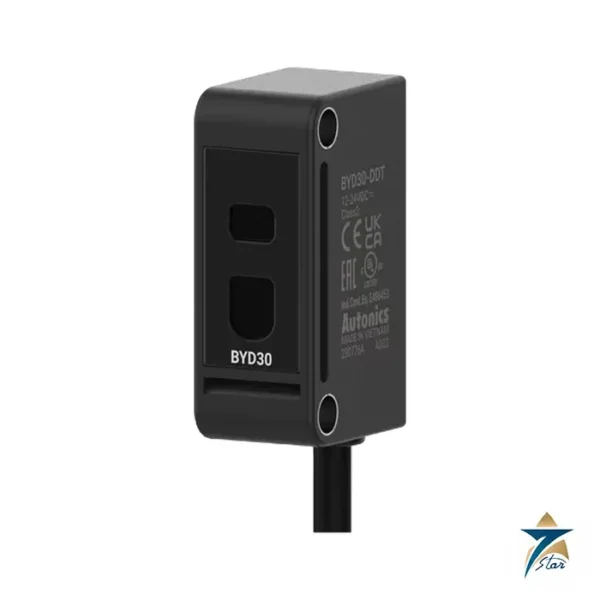
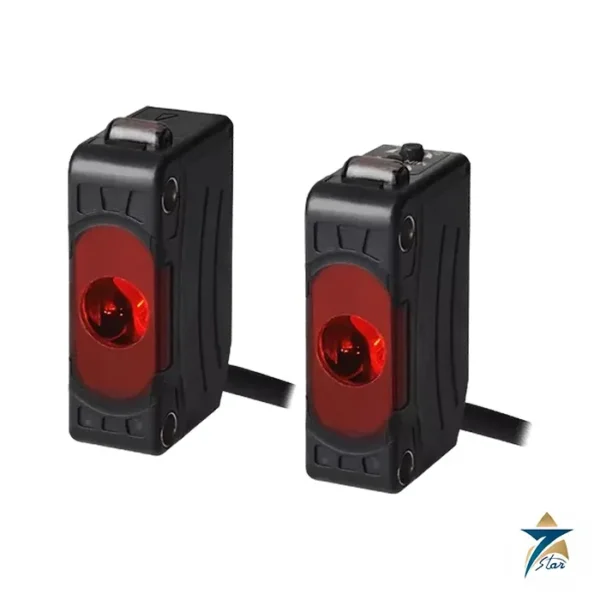
Autonics BYD3M-TDT Miniature 3 m Through-Beam Sensor
Description
Overview
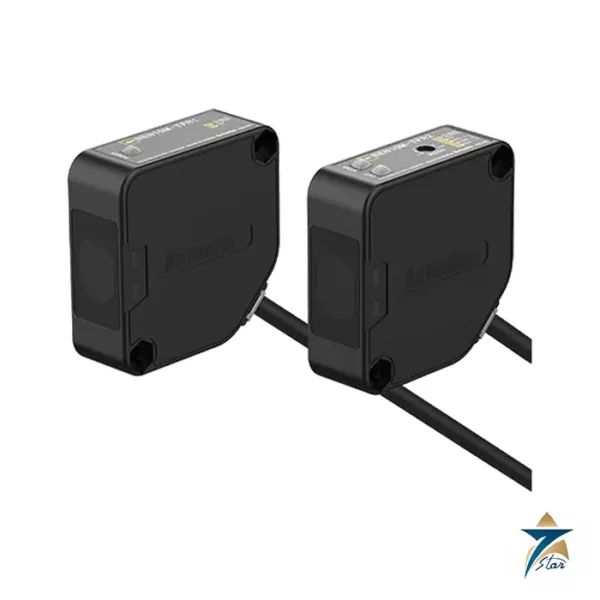
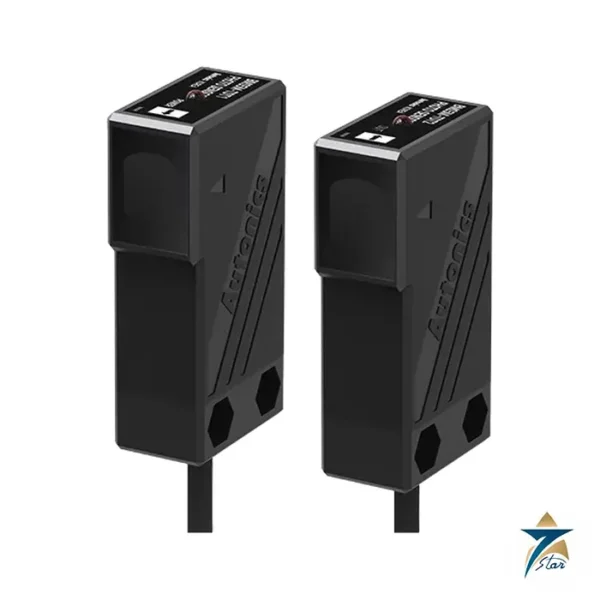
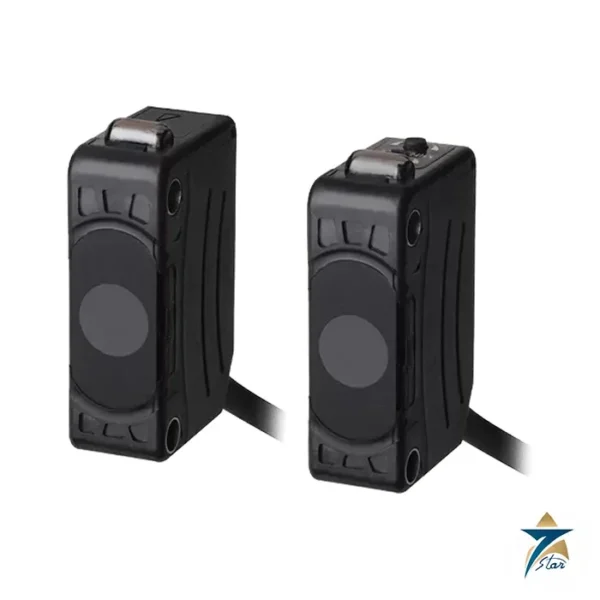
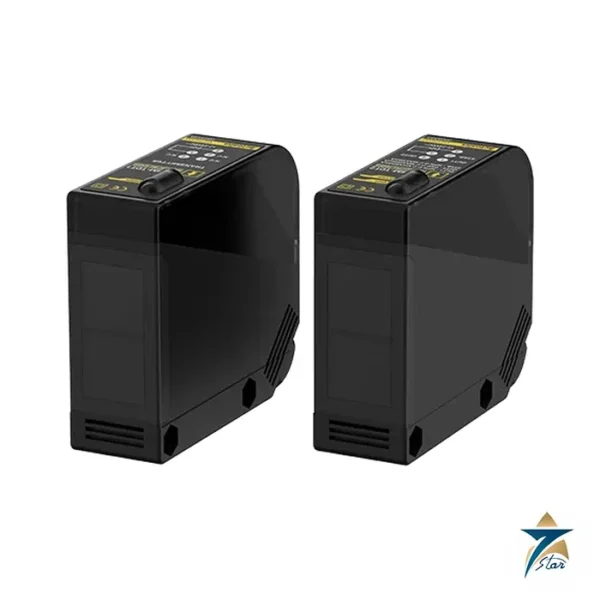
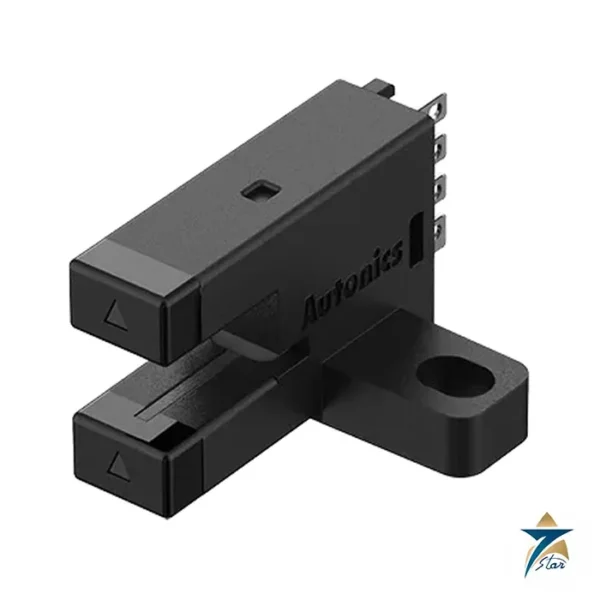
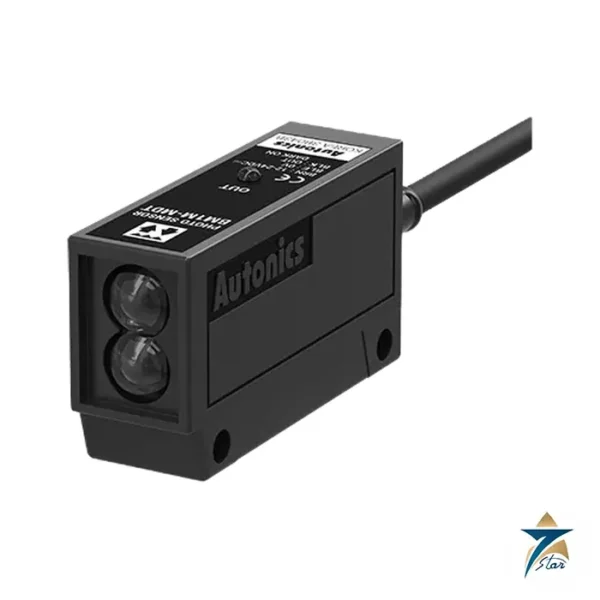
Some detection jobs are won or lost on millimetres of installation space. The Autonics BYD3M-TDT is a miniature through-beam photoelectric pair from the Autonics BYD series: two thin housings, each about 32 mm tall, that watch a gap of up to 3 m. It uses an infrared beam, needs 12 to 24 VDC, and gives an NPN transistor output on the receiver. The pair is supplied ready for use with its brackets, bolts and nuts, and a 2 m cable on each housing.
Seven Star LLC is an independent supplier serving Oman and the GCC. For OEM machine builders and maintenance teams, we can supply this exact code as a replacement or as part of a new design.
Why choose the Autonics BYD3M-TDT
- Compact housing with a tiny optical footprint, designed for tight guides, feeder tracks and small assemblies.
- 3 m beam with an infrared emitter that is not visible to operators and is less affected by ambient lighting.
- Dark ON output logic fixed for through-beam use, so the output changes state when the beam is interrupted.
- No sensitivity adjuster to be disturbed in service, which suits OEM equipment where settings must stay fixed.
- Output protection against reverse supply connection and against short circuits on the load line.
- Optional slit stickers (BYD3M-ST) to narrow the beam when very small parts must be detected.
Autonics BYD3M-TDT electrical and mechanical data
| Parameter | Value |
|---|---|
| Model | BYD3M-TDT, NPN output, cable type |
| Sensing type | Through-beam |
| Sensing distance | 3 m |
| Minimum sensing target | Opaque object of 6 mm diameter or larger |
| Light source | Infrared |
| Power supply | 12 to 24 VDC, plus or minus 10 percent |
| Current consumption | Emitter up to 30 mA, receiver up to 30 mA |
| Control output | NPN open collector, up to 100 mA, 26.4 VDC |
| Residual voltage | 1 VDC or less |
| Response time | 1 ms or less |
| Operation mode | Dark ON |
| Indicator | Operation indicator, red, on the receiver |
| Ambient temperature | -20 to 65 C, storage -25 to 70 C |
| Protection rating | IP64 (front operation indicator version) |
| Cable | 3.5 mm diameter, 2 m, three wires (emitter two wires) |
| Weight | About 80 g for the pair, about 105 g packaged |
| Case material | Polycarbonate, with SPCC steel bracket |
How BYD3M-TDT differs from other BYD variants
The BYD range is not only a through-beam range. Diffuse reflective models such as the BYD100-DDT detect at 100 mm, and convergent reflective models detect in a short window of 10 to 30 mm or 10 to 50 mm. All of them share the 32 mm tall body, but only the BYD3M-TDT is sold as a pair with a 3 m span.
There are electrical differences too. The through-beam receiver can switch up to 100 mA, whereas the diffuse and convergent versions are limited to 50 mA. The through-beam pair is protected to IP64 and weighs about 80 g, while the reflective models weigh about 38 g and have IP50 at the housing. Choose by installation geometry first, then check these numbers.
Applications
Typical jobs for this miniature pair include detecting parts on vibratory feeders, confirming the presence of vials or caps in a filling machine, monitoring sliding guards on compact packaging equipment and counting labels or boxes in narrow chutes. Electronic assembly lines and laboratory automation make frequent use of such sensors.
In Gulf plants the same size class is common on bottling and dairy packaging lines, in pharmaceutical fill-and-finish equipment and in small pump skids where an access hatch needs a position check. Because the housings are small, they can be hidden behind guards to reduce damage during cleaning.
Wiring and installation
The emitter has two wires: brown to the positive supply and blue to 0 V. The receiver has three: brown to the positive supply, blue to 0 V and black to the load. For the NPN output the load sits between the black wire and the positive supply. Do not exceed 100 mA on the black wire.
Fasten each housing with the supplied bracket A and M3 hardware at a torque of about 0.5 N m, and face the two optical axes squarely at each other. Do not hit the housings or flex the cable repeatedly, as that can weaken the sealing. After power-up, the through-beam outputs stay off for about half a second, so allow for this in PLC logic.
Narrowing the beam with slits
The BYD3M-ST sticker kit contains slits that are attached to both the emitter and the receiver. Slit diameters range from 1.0 mm to 2.5 mm. A smaller slit lets the pair detect smaller objects but reduces the maximum distance; for example, the 1.0 mm slit supports objects down to 0.8 mm at up to 500 mm. Wipe the lens before attaching and peel off the protective film afterwards.
Service life tips
Wipe the windows with a soft dry cloth. Because there is no sensitivity adjustment, any change in behaviour means the pair is dirty, misaligned or damaged. Clean first, then realign, then replace. Keep spares as a complete pair, because an emitter and receiver from different production lots are not guaranteed to give the same margin. When the pair sits inside a washdown zone, check the cable entry and the bracket screws at each shutdown, since vibration and cleaning pressure act on those points first. A record of the date of installation helps the maintenance planner decide when to swap the pair preventively on a critical machine.
Ordering notes
Put the exact code Autonics BYD3M-TDT on your request, with quantity and whether NPN is acceptable; PNP versions have a P suffix. Bracket B, slit stickers and similar accessories can be quoted together with the sensors.
Related items you may also need: Autonics PR18-8DN M18 Inductive Proximity Sensor 8 mm | Autonics E40S6-2500-6-L-5 Rotary Encoder Incremental | Autonics BEN5M-MFR Retroreflective Photoelectric Sensor 5 m | All Autonics products.
Documents and quotation
The manufacturer publishes a product manual that covers Autonics BYD3M-TDT, and the PDF is attached to this page for download so your engineers can check wiring, ratings and dimensions before ordering. Please send your RFQ with the part number and the quantity you need, plus the delivery site, and our team will reply with availability and lead time.
Other Models in the BYD Range
Seven Star LLC supplies models from the BYD range in Oman and the GCC. Compare the related models below and request a quote for the one that matches your application.
| Model | Category | |
|---|---|---|
| Autonics BYD30-DDT Compact Convergent Photoelectric Sensor | Photoelectric Sensors | View details |
| Autonics BYD3M-TDT Miniature 3 m Through-Beam Sensor | Photoelectric Sensors | You are viewing this model |
Datasheets & Documents
- Datasheet Autonics BYD3M-TDT Miniature 3 m Through-Beam Sensor Datasheet Download
Reviews (0)
How would you rate this product? Cancel reply
About brand
Autonics is a South Korean maker of sensors and controllers, founded in 1977 as a small engineering business making controllers for looms. It took the Autonics name in 1988 and opened a new corporate headquarters in Busan in 2014. Autonics makes proximity and photoelectric sensors, rotary encoders, temperature controllers, counters, timers and stepper motor systems, with factories in Busan and Yangsan.
Seven Star LLC lists the Autonics E40S6-2500-6-L-5 incremental rotary encoder and supplies Autonics sensors and control devices in Oman and the GCC.
Autonics company profile
| Founded | 1977, South Korea |
|---|---|
| Current name | Autonics, since 1988 |
| Headquarters | Busan, South Korea |
| Factories | Busan and Yangsan |
| Product families | E40 and E50 rotary encoders, PR proximity sensors, BJ photoelectric sensors, TK temperature controllers |
Milestones
- 1977: The company is founded.
- 1988: Renamed Autonics Corporation.
- 2014: Opens its Busan headquarters.
Reading the Autonics E40S encoder code
E40S is the 40 mm diameter shaft-type incremental encoder, and the 6 that follows is the 6 mm shaft. 2500 is the resolution in pulses per revolution. The next 6 means six output signals: A, B and Z with their inverted signals. L is a line driver output and the final 5 is a 5 V DC supply. The same 40 mm body is made in hollow shaft form as the E40H and E40HB series.
Where Autonics encoders are used
Servo and spindle feedback, conveyor length measurement, packaging and printing machines.
Ordering Autonics encoders: what we need
Send the complete model string from the label. If it is worn off, give the body and shaft diameter, pulses per revolution, output type, supply voltage and cable or connector style.
Facts checked against Autonics corporate profiles, October 2026.
Browse Autonics products by category: Encoders.
FAQ
Questions about the Autonics BYD3M-TDT Miniature 3 m Through-Beam Sensor
Answers from our engineering team on installation, compatibility and integration.
01What distance can the Autonics BYD3M-TDT detect?
The through-beam pair detects objects between the emitter and receiver over a gap of up to 3 m, using an infrared beam.
02Is there a sensitivity adjuster on the BYD3M-TDT?
No. The through-beam type has no adjuster and works in Dark ON mode, so the output turns on when the beam is blocked.
03How small an object can it detect?
The minimum sensing target is an opaque body of 6 mm diameter or larger; with BYD3M-ST slit stickers fitted, much smaller objects can be detected at reduced distance.
04What is the output rating?
The NPN open collector receiver output switches up to 100 mA at a maximum of 26.4 VDC, with a residual voltage of 1 VDC or less.
05What cable does it have?
Both housings have a 2 m cable of 3.5 mm diameter; the emitter uses two wires and the receiver uses three.


Reviews
There are no reviews yet.