Brand:

Meinberg SyncFire 1500 Ultra-High-Performance NTP Time Server

Description

Overview

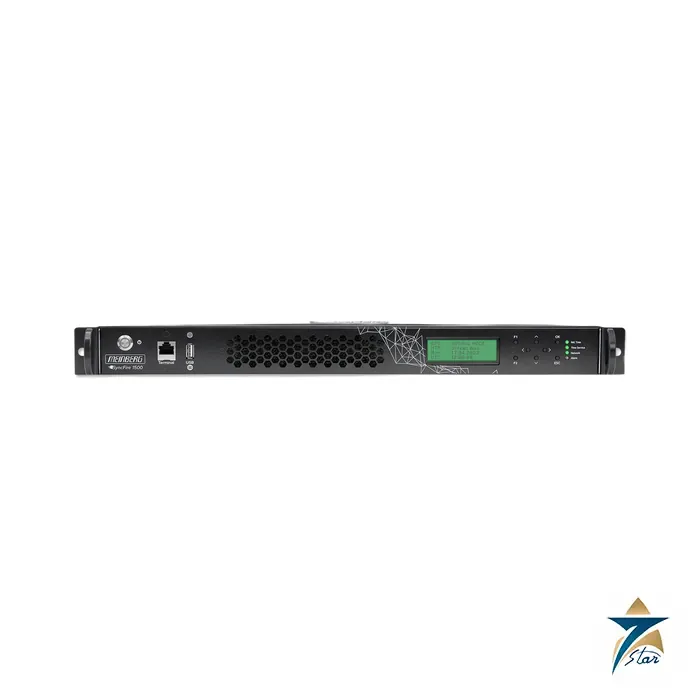
Most NTP servers serve an office floor; the Meinberg SyncFire 1500 is built for a hall of thousands of machines. It is an ultra-high-performance Stratum 1 NTP time server in a 1U, 19 inch chassis, constructed to order with an integrated GPS receiver, a multi-GNSS receiver or a PTP slave interface, and it can process up to 825,000 NTP requests per second thanks to Meinberg’s multi-threading support. Seven Star LLC is an independent supplier serving Oman and the GCC. It suits hyperscale data centres, telecom core networks and large industrial networks where a huge number of clients need one common time reference.

Hardware inside the Meinberg SyncFire 1500

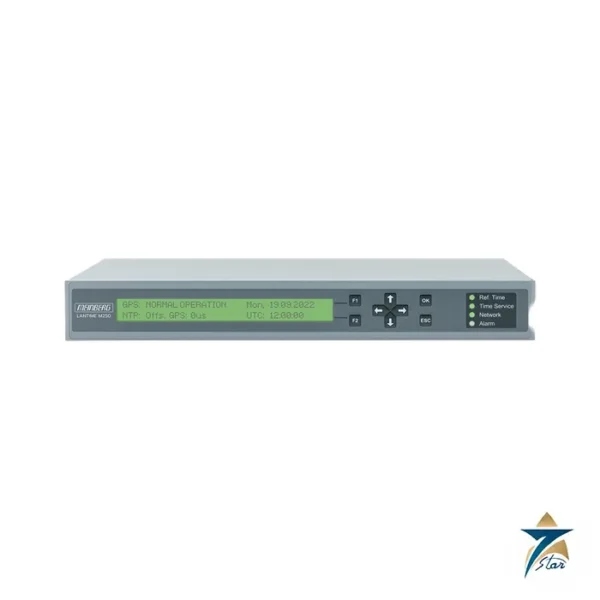
The server is driven by an Intel Xeon E2276G hexa-core CPU at up to 4.90 GHz with 16 GB of ECC DDR4 memory and a 120 GB SSD. The standard network interface is a four-port Gigabit Ethernet card, and the options add four more Gigabit RJ45 ports, four 1/10 Gbit SFP+ ports, two 1/10/25 Gbit SFP28 ports or two 10/40 Gbit QSFP+ ports, so the chassis can hold up to twelve independent Ethernet interfaces. A 4 x 20 character LCD, eight push buttons, four bicolour status LEDs and two USB 3.0 ports complete the front.

Data for Meinberg SyncFire 1500

Parameter Datasheet value
Sync input GPS 12-channel, GNS multi-GNSS (GPS L1, Galileo E1, GLONASS L1OF, BeiDou B1I), or PTP slave NIC
NTP capacity Up to 825,000 requests per second
CPU and memory Intel Xeon E2276G, 16 GB DDR4 ECC, 120 GB SSD
Network Standard 4 x Gigabit RJ45; options for 1, 10, 25 and 40 Gbit
Display LCD 4 x 20 characters
USB Two USB 3.0, one front, one rear
Power supply Two hot-pluggable units, 100 to 240 V AC, 50 to 60 Hz, 400 W maximum
Input current 6.3 A nominal at 240 V AC
Dimensions (W x H x D) 439 x 42 x 602 mm
Operating temperature 0 to 45 degrees C; storage minus 40 to plus 70 degrees C
Operating humidity Maximum 90 percent at 40 degrees C, non-condensing
Operating system LANTIME OS on Linux, LTOS V7.08.002 or newer
Warranty Three years

How the Meinberg SyncFire 1500 differs from other LANTIME servers

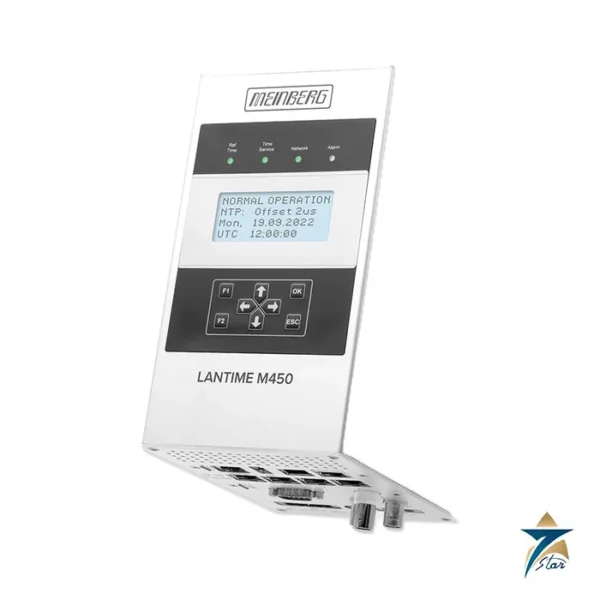
The M450 is a DIN rail unit with an Atom CPU and up to 25,000 NTP requests per second, and the M-series rack models serve thousands of clients. The SyncFire 1500 raises capacity more than thirty times over the M450, with a Xeon processor, twin hot-swap power supplies and up to 40 Gbit links. It cannot be used as a general-purpose server, because it only runs the NTP appliance software and does not allow installing a standard operating system.
Applications in Oman and the GCC
Regional cloud and telecom operators, national data centres and large industrial control networks need a dependable local time source that does not rely on the internet. A Stratum 1 server inside the facility, with its own antenna, provides it. The PTP slave option allows synchronisation from an existing PTP grandmaster instead of a roof antenna, which suits buildings where an antenna cannot be installed.

Selection and design notes

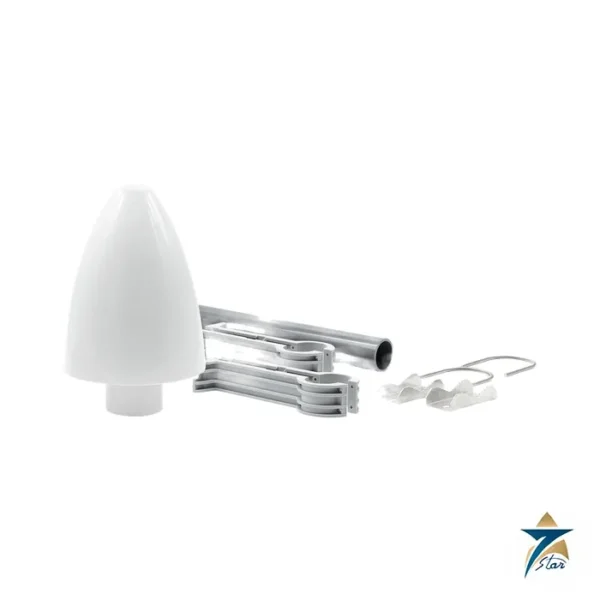
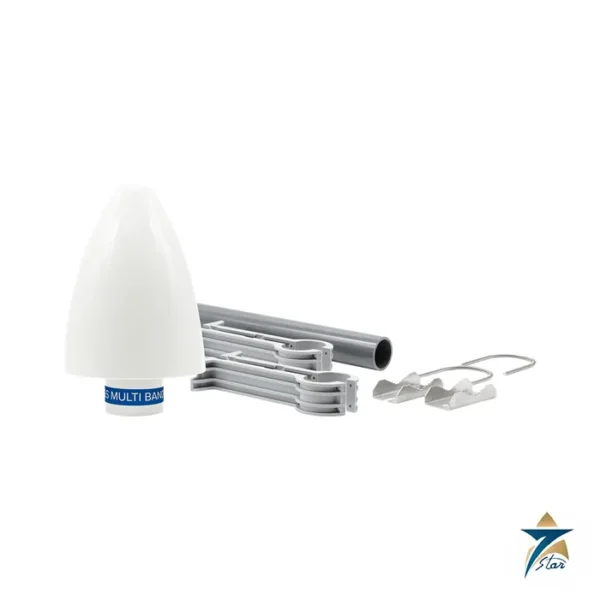
Pick the sync input according to the site: GPS for the plain antenna, GNS for multi-constellation reception, PTP when a master exists on the network. Choose the network card by client load and link speed. Plan two servers for redundancy, on separate power feeds. Models with a GPS card ship with a GPS IF antenna and 20 m of RG58 cable, and GNS models ship with a multi-GNSS antenna and 20 m of Belden H155 cable.

Installation and commissioning

Rack-mount the chassis, connect both power cords to independent feeds, run the antenna cable and set the network address from the front panel. Use the web interface to set NTP, security and notification options, and point clients to the new server after the receiver reports synchronisation. Test the alert notification by email or SNMP.

Maintenance

Firmware can be upgraded from the unit or remotely, with updates free for the product lifetime. Check logs, replace a failed power supply while the other keeps the server running, and keep the antenna system inspected.

Why high request rates matter

When thousands of clients poll a time server at the same moment, such as after a network restart, a weak server drops requests and clients drift. Processing hundreds of thousands of requests per second keeps response times steady, so the time quality seen by each client does not depend on how many others are asking. Multi-threading spreads the load across processor cores, and several fast network ports spread it across links.

Redundancy and monitoring in practice

Two hot-pluggable power supply units mean that a failed unit can be swapped while the server runs, and the alert notification system reports status changes by email, SNMP or an external display. In a data centre, connect the two supplies to separate power feeds and, where possible, place two servers in different racks with separate antennas. Configure SNMP traps towards the monitoring system and test them. Clients should list at least two servers so that a single failure never leaves them without time. Keep a record of the antenna cable route and spare cable length, since a damaged antenna cable is the most common cause of lost reference in the field.

Review the NTP statistics regularly to see request load against capacity.

Security features worth enabling

The datasheet lists MD5 and SHA-1 authentication with Autokey key management, HTTPS and SSH for management access, and SNMP version 3. A time server is a critical piece of infrastructure, so disable unused services, use strong credentials and restrict management access to a dedicated network. Place the server behind firewall rules that allow only NTP from client networks and management from a few addresses, and keep the firmware current through the free updates.

Ordering notes for Meinberg SyncFire 1500

State the sync input type, the network option and the antenna cable length when you request a quotation, because the server is built to order.

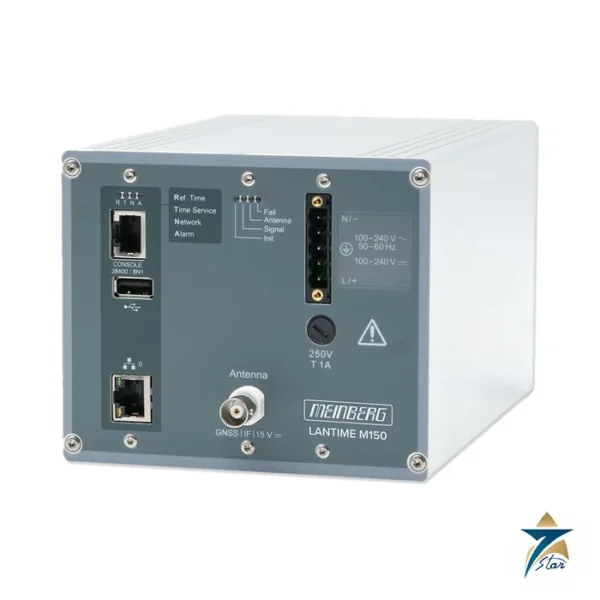
Related items you may also need: Meinberg LANTIME M250 Compact NTP Time Server | Meinberg LANTIME M150 DIN-Rail NTP Time Server | Meinberg LANTIME M320/GPS/AD10 NTP Time Server | All Meinberg products.

Documents and quotation

The manufacturer datasheet for the Meinberg SyncFire 1500 is attached to this page. Send your RFQ with the part number, configuration, quantity and delivery location in Oman or the GCC.

Other Models in the LANTIME Range

Seven Star LLC supplies models from the LANTIME range in Oman and the GCC. Compare the related models below and request a quote for the one that matches your application.

ModelCategory
Meinberg LANTIME M450 DIN Rail NTP Time ServerIndustrial CommunicationsView details
Meinberg SyncFire 1500 Ultra-High-Performance NTP Time ServerIndustrial CommunicationsYou are viewing this model
Datasheets & Documents
  • PDF Datasheet Meinberg SyncFire 1500 Ultra-High-Performance NTP Time Server Datasheet Download
Reviews (0)

Reviews

There are no reviews yet.

How would you rate this product?

It takes about 10 seconds — just tap a star. Your email is never published.

About brand

Meinberg is a German maker of time and frequency synchronisation products, founded in 1979 by the brothers Werner and Günter Meinberg in Bad Pyrmont. It began with DCF77 longwave radio clock receivers and now makes GPS and GNSS-referenced NTP and PTP time servers. Meinberg is family-owned and designs and manufactures its products in Bad Pyrmont.

Seven Star LLC sources and supplies Meinberg LANTIME time servers for utilities and networks in Oman, including the M1000 and M320 listed here.

Meinberg company profile

Founded 1979, Bad Pyrmont, Germany
Founders Werner and Günter Meinberg
Ownership Family-owned
Manufacturing Bad Pyrmont, Germany
Product families LANTIME M150, M250, M320, M500 and M1000 NTP/PTP time servers, IMS modular systems, GNSS and DCF77 receivers, PTP grandmaster clocks

Meinberg LANTIME models listed here

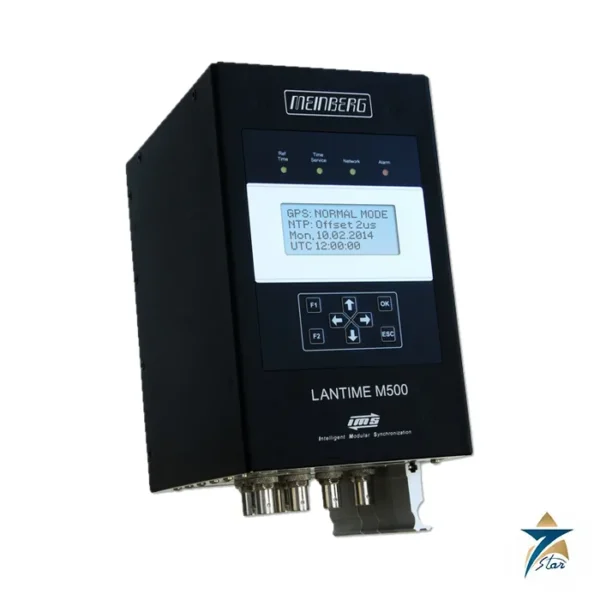
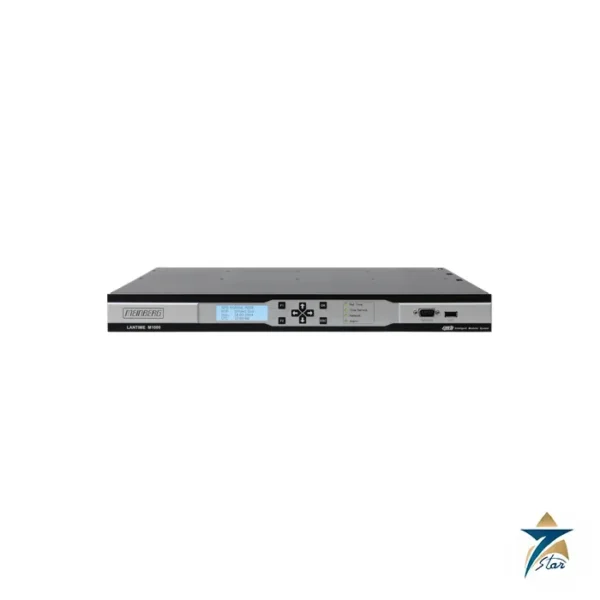
The LANTIME M320 is a 1U rackmount NTP time server. It works as a stratum 1 source with its own reference receiver, and Meinberg offers it with GPS, combined GNSS, DCF77 (PZF), MSF and IRIG time code references. The LANTIME M1000 is a 1U platform on the modular IMS system, with slots for up to two reference clocks, two power supplies and hot-pluggable I/O modules, plus PTP (IEEE 1588) and IEC 61850 time synchronization.

Meinberg products we list

Family Examples
Industrial Communications LANTIME M1000 Modular NTP/PTP Time Serve…, LANTIME M150 DIN-Rail NTP Time Server, LANTIME M250 Compact NTP Time Server, LANTIME M320/GPS/AD10 NTP Time Server, LANTIME M500 Modular DIN-Rail Time Server

Ordering a Meinberg time server: what we need

A Meinberg order code describes the build. In M320/GPS/AD10, GPS is the receiver and AD10 is the wide-range AC/DC power supply. Send the full code or serial number, the reference source, oscillator option, supply voltage, the outputs you need (PPS, 10 MHz, IRIG, extra LAN ports) and the antenna cable length. GCC utility projects often require redundant supplies.

Facts checked against Meinberg's own company history (meinbergglobal.com), October 2026.

FAQ

Questions about the Meinberg SyncFire 1500 Ultra-High-Performance NTP

Answers from our engineering team on installation, compatibility and integration.

01How many NTP requests can the Meinberg SyncFire 1500 handle?
It can process up to 825,000 NTP requests per second using Meinberg's multi-threading support.
02Which sync inputs are offered for the Meinberg SyncFire 1500?
It is built to order with a GPS receiver, a multi-GNSS receiver or a PTP slave network card.
03What network options does the Meinberg SyncFire 1500 offer?
The standard card has four Gigabit RJ45 ports, with options for SFP+, SFP28 and QSFP+ cards, up to twelve interfaces in all.
04Does the Meinberg SyncFire 1500 have redundant power?
Yes. It has two hot-pluggable power supply units for 100 to 240 V AC, 400 W maximum output.
05What size is the Meinberg SyncFire 1500?
It is a 1U rack unit measuring 439 x 42 x 602 mm, operating at 0 to 45 degrees C.