- Automation & ControlView all 3,101 products
- Automation Accessories
- AC Drives
- PLC & I/O Cards
- Industrial Communications
- Vibration Monitoring
- Isolator & Barrier
- Controllers & Data Acquisition
- Safety Switches & Guard Locking
- Encoders
- Motor Soft Starters
- CCTV & Security
- Pneumatic Cylinders
- HMI Displays
- Servo Drives
- Industrial Computers
- Machine Vision
- Automation Software
- Robotics
Brand: Autonics
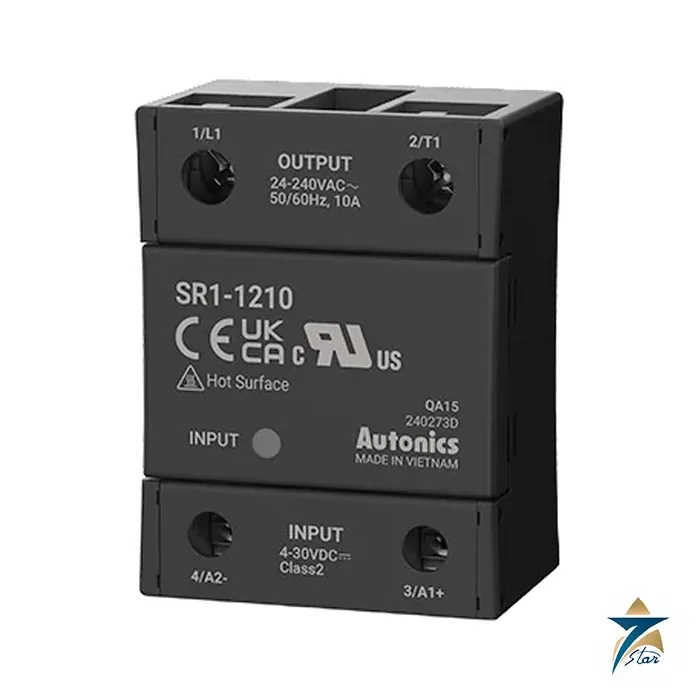
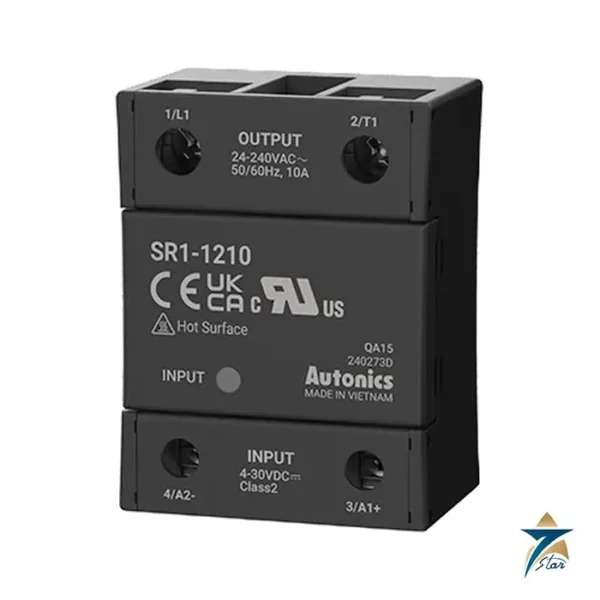
Autonics SR1-4450 50 A Solid State Relay AC Input
Description
Overview
When the control signal is itself an AC voltage, from a thermostat, a limit switch, a contactor contact or a mains-powered controller, an SSR with an AC input saves a DC supply. The Autonics SR1-4450 is exactly that: a 50 A single-phase solid state relay switching loads of 48 to 480 V AC, but driven by 90 to 240 V AC at its input. It is sibling to the DC-input SR1-1450 and shares its output stage, its heat sink needs and its mounting. Seven Star LLC is an independent supplier serving Oman and the GCC.
Reading Autonics SR1-4450
SR1 is the series. The first digit, 4, gives the rated input voltage of 90 to 240 V AC at 50/60 Hz; the DC-input version has 1 in this place. The second digit 4 is the load voltage of 48 to 480 V AC, 50 is the load current in amperes, and no R at the end means zero cross turn-on.
Datasheet values for Autonics SR1-4450
| Item | Data |
|---|---|
| Input voltage | Rated 90 to 240 V AC 50/60 Hz; allowable 85 to 264 V AC |
| Maximum input current | 18 mA |
| Operating and releasing voltage | 85 V AC or more; 10 V AC or less |
| Operating time | 2 cycles of load power plus 1 ms or less |
| Release time | 2 cycles of load power plus 1 ms or less |
| Load voltage | 48 to 480 V AC rms |
| Load current | 50 A rms resistive (AC-1) |
| Surge and I2t | 800 A for one cycle; 3,000 A2s |
| Voltage drop | 1.6 V peak or less |
| Ambient | minus 20 to plus 70 degrees C (AC input) |
| Indicator | Input indicator, green |
| Weight | about 80 g |
How the Autonics SR1-4450 differs from other SR1 variants
Three differences matter. First, timing: the AC-input model needs up to two cycles of the load power, about 40 ms at 50 Hz, to operate and to release, whereas the DC-input model switches within half a cycle plus 1 ms, so the AC version is unsuited to fast proportional control. Second, the ambient temperature range is narrower: minus 20 to plus 70 degrees C for the AC input version, against minus 30 to plus 80 degrees C for the DC input. Third, the AC input version has no random turn-on option, since the R function is available only with the DC input. The load side, heat sink resistance of 0.9 degrees C per watt and the 800 A surge are identical.
When an AC input is the better choice
If the heater is switched by a mains-level thermostat, a pressure switch, a selector switch or a timer contact, wiring that contact straight to the SSR input removes the need for a DC supply and an interposing relay. Industrial heating, hot-water and space-heating panels and simple ovens are typical. The input draws 18 mA at most, so even a light-duty contact or a neon-lit switch can drive it, but the leakage of some electronic switches or long cables may keep the input above the 10 V AC release level, so check for ghost operation when using triacs or proximity switches with a leakage current.
Applications in Oman and the GCC
Typical uses are immersion heaters, band heaters, process water heating, drying ovens, and heat-tracing panels. The 480 V class also allows loads connected between two phases of a 400 V supply, as well as ordinary 230 V single-phase loads. In hot panels the load rating must be derated for the actual ambient temperature, using the curves in the manual, and the heat sink must be ventilated.
Mounting and heat management
Mount the relay on a heat sink with thermal grease, torque the panel screws to 1.8 to 2.5 N m, and leave space around the heat sink for airflow. The manual lists approved greases from GE Toshiba, Kanto-Kasei and Shin-Etsu. If SSRs are installed side by side, keep each below half of its rated current. Fit a cooling fan if the panel is poorly ventilated, and never operate the relay without a heat sink at high load.
Practical cautions for an AC-driven SSR
The input of this relay looks like a small resistive and capacitive load to the circuit that drives it. If the controlling contact is a mechanical switch or a thermostat, this is trivial. If it is an electronic output such as a triac module, a two-wire proximity sensor or a long cable run alongside power wires, the leakage current can hold the input above the release level of 10 V AC and the relay may stay on or flicker. A bleeder resistor across the input, as recommended by many SSR makers, cures most cases, and checking the voltage across the input terminals in the off state with a meter is the quickest test.
The slower response of two load cycles is not a defect but a result of the way an AC input is rectified and filtered before the zero-cross circuit. For on-off control of a large thermal mass, such as a water heater or oven, the delay of about 40 ms at 50 Hz is irrelevant. For time-proportioning control with a one-second cycle from a PID controller, the delay still leaves the on-time accurate to a few percent, but for cycle times of a fraction of a second the DC input relay is the better choice, driven by the SSR output of the controller.
Keep in mind also that the load rating applies at 25 degrees C: use the derating curves, mount on the heat sink with thermal grease and respect the minimum load of 0.5 A, below which the relay may not hold reliably.
Wiring and safety
The input uses M3.5 terminals with 0.75 to 0.96 N m torque, and the output M5 terminals with 1.6 to 2.2 N m. Size the load wire for the current and use round crimp terminals. Because the input is mains-level, treat the input terminals as live. A leakage of up to 10 mA flows through the output when it is off, so isolate the circuit before working on the load, and protect the circuit with a semiconductor fuse and a thermal cutout.
Maintenance
Inspect terminal tightness and the state of the thermal grease at each shutdown and keep dust off the heat sink. If the load does not switch, measure the input voltage, since an input below 85 V AC will not operate the relay, and measure the voltage drop across the output.
Related items you may also need: Autonics E40S6-2500-6-L-5 Rotary Encoder Incremental | SICK WTB12-3P2411 Proximity Sensor | SICK WLL24-2X430 WLL24 Fiber-Optic Amplifier | All Autonics products.
Documents and quotation
The SR1 series product manual covering the Autonics SR1-4450 is attached with ordering information, derating curves and dimensions. Send an RFQ with the part number Autonics SR1-4450, quantity and delivery location in Oman or the GCC.
Other Models in the SR1 Range
Seven Star LLC supplies models from the SR1 range in Oman and the GCC. Compare the related models below and request a quote for the one that matches your application.
| Model | Category | |
|---|---|---|
| Autonics SR1-1450 50 A Single-Phase Solid State Relay | Photoelectric Sensors | View details |
| Autonics SR1-4450 50 A Solid State Relay AC Input | Photoelectric Sensors | You are viewing this model |
Datasheets & Documents
- Datasheet Autonics SR1-4450 50 A Solid State Relay AC Input Datasheet Download
Reviews (0)
How would you rate this product? Cancel reply
About brand
Autonics is a South Korean maker of sensors and controllers, founded in 1977 as a small engineering business making controllers for looms. It took the Autonics name in 1988 and opened a new corporate headquarters in Busan in 2014. Autonics makes proximity and photoelectric sensors, rotary encoders, temperature controllers, counters, timers and stepper motor systems, with factories in Busan and Yangsan.
Seven Star LLC lists the Autonics E40S6-2500-6-L-5 incremental rotary encoder and supplies Autonics sensors and control devices in Oman and the GCC.
Autonics company profile
| Founded | 1977, South Korea |
|---|---|
| Current name | Autonics, since 1988 |
| Headquarters | Busan, South Korea |
| Factories | Busan and Yangsan |
| Product families | E40 and E50 rotary encoders, PR proximity sensors, BJ photoelectric sensors, TK temperature controllers |
Milestones
- 1977: The company is founded.
- 1988: Renamed Autonics Corporation.
- 2014: Opens its Busan headquarters.
Reading the Autonics E40S encoder code
E40S is the 40 mm diameter shaft-type incremental encoder, and the 6 that follows is the 6 mm shaft. 2500 is the resolution in pulses per revolution. The next 6 means six output signals: A, B and Z with their inverted signals. L is a line driver output and the final 5 is a 5 V DC supply. The same 40 mm body is made in hollow shaft form as the E40H and E40HB series.
Where Autonics encoders are used
Servo and spindle feedback, conveyor length measurement, packaging and printing machines.
Ordering Autonics encoders: what we need
Send the complete model string from the label. If it is worn off, give the body and shaft diameter, pulses per revolution, output type, supply voltage and cable or connector style.
Facts checked against Autonics corporate profiles, October 2026.
Browse Autonics products by category: Encoders.
FAQ
Questions about the Autonics SR1-4450 50 A Solid State Relay AC Input
Answers from our engineering team on installation, compatibility and integration.
01What input does the Autonics SR1-4450 need?
An AC input of 90 to 240 V AC at 50/60 Hz, with an allowable range of 85 to 264 V AC and a maximum input current of 18 mA.
02How does the Autonics SR1-4450 differ from the SR1-1450?
The 4450 has an AC input and takes up to two load cycles to operate, while the 1450 has a 4 to 30 V DC input and operates within half a cycle plus 1 ms.
03What load can the Autonics SR1-4450 switch?
50 A rms resistive on 48 to 480 V AC, 50/60 Hz, with a minimum load of 0.5 A and a surge rating of 800 A for one cycle.
04What is the ambient range of the Autonics SR1-4450?
For the 90 to 240 V AC input version the manual gives minus 20 to plus 70 degrees C, narrower than the DC input version.
05Does the Autonics SR1-4450 need a heat sink?
Yes, a heat sink with thermal resistance of 0.9 degrees C per watt or lower is advised for 50 A, as the manufacturer does not supply one.


Reviews
There are no reviews yet.