Brand:

Autonics TCN4S-24R 48×48 Dual Display PID Controller

Description

Overview

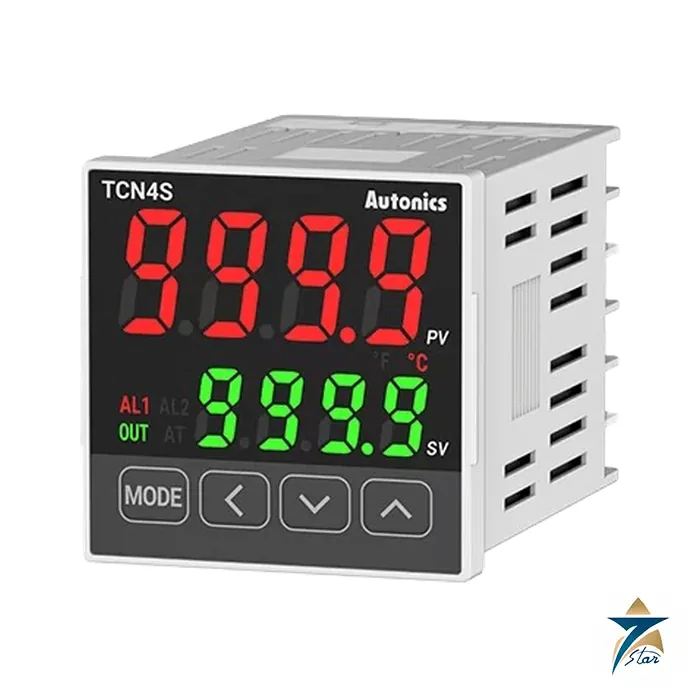
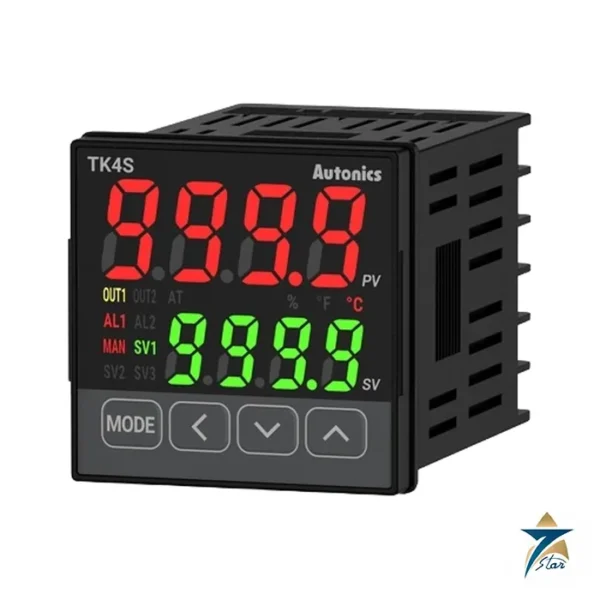
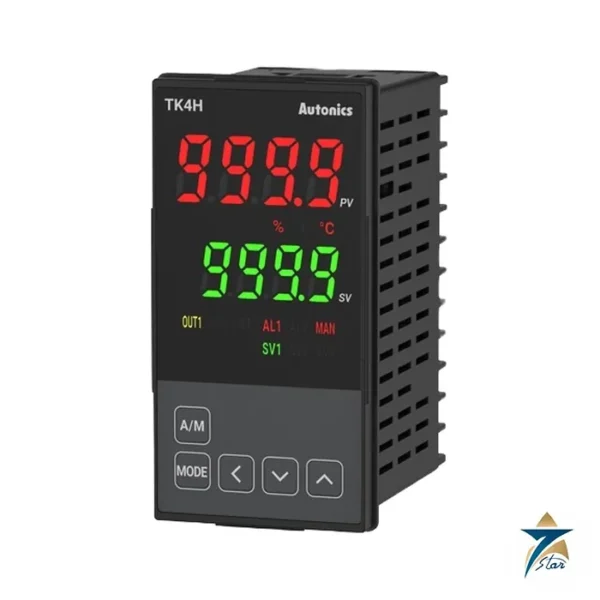
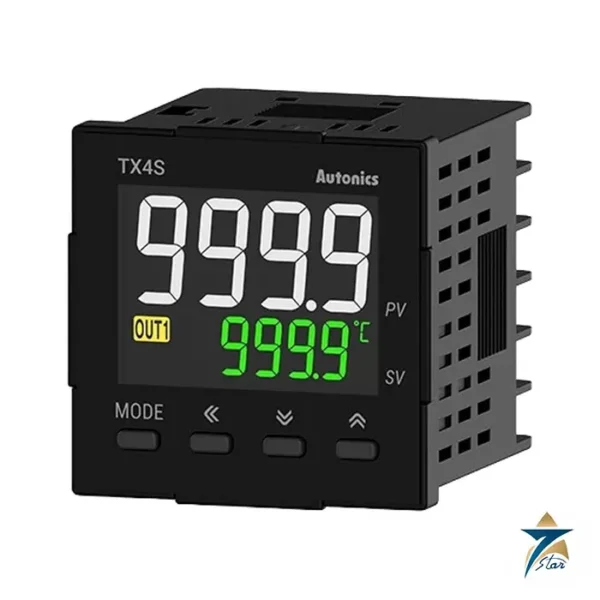
An economical controller can still show both the measured temperature and the setpoint at the same time, and that is the point of the Autonics TCN4S-24R. It is a 48 x 48 mm dual display PID controller from the TCN series, with a red process value above a green setting value, a 100 to 240 V AC supply, a relay output with an additional SSR drive output, and two alarm outputs. It targets machines that need reliable regulation without the extra options of a premium series. Seven Star LLC is an independent supplier serving Oman and the GCC.

What Autonics TCN4S-24R stands for

TCN4 names the four-digit dual display economical series. S is the 48 x 48 mm size. The digit 2 after the dash selects alarm 1 and alarm 2, the digit 4 is the 100 to 240 V AC supply, and R states that the control output is a relay together with an SSR drive output. There is no P at the end, so the wiring is the bolt terminal type and not the connector plug variant.

Technical data of Autonics TCN4S-24R

Item Data
Front size 48 x 48 mm, cut-out 45 mm square
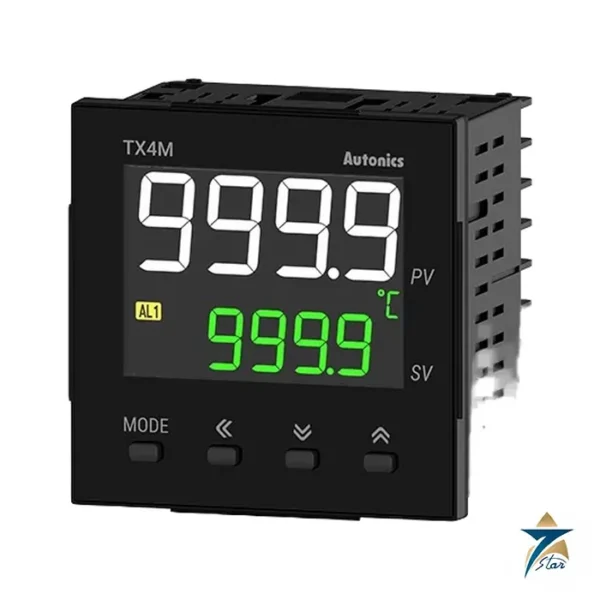
Display Dual 7-segment LED, PV red, SV green
Supply 100 to 240 V AC 50/60 Hz, 5 VA or less
Sampling period 100 ms
Control output Relay 250 V AC 3 A, 30 V DC 3 A, 1a, plus SSR drive 12 V DC plus or minus 2 V, 20 mA or less
Alarm outputs AL1 and AL2, relay 250 V AC 1 A, 1a
Inputs Thermocouples K, J, L, T, R, S; RTD Cu50 and DPt100
Ranges K minus 50 to 1,200; J minus 30 to 800; L minus 40 to 800; T minus 50 to 400; R, S 0 to 1,700; Cu50 minus 50 to 200; DPt100 minus 100 to 400 degrees C
Control modes ON/OFF, P, PI, PD, PID
Control cycle 0.5 to 120.0 seconds
Relay life 200,000 electrical operations at 250 V AC 3 A for the control relay; 300,000 at 250 V AC 1 A for alarm relays
Dielectric strength 2,000 V AC for 1 minute
Ambient minus 10 to plus 50 degrees C
Memory About 10 years
Weight about 100 g, about 147 g packaged

How the Autonics TCN4S-24R differs from other TCN4 variants

The TCN family comes in S (48 x 48 mm, about 100 g), M (72 x 72 mm, about 133 g), H (48 x 96 mm, about 124 g) and L (96 x 96 mm, about 179 g). A supply digit of 2 gives a 24 V AC or 24 to 48 V DC model with 3 W DC consumption and a lower dielectric strength of 1,000 V AC. The Autonics TCN4S-24R is the mains-powered, two-alarm 48 mm unit; adding a P at the end of the code would give the connector plug connection, with a body of 7.7 mm bezel and 65.8 mm depth. In every case control output R means that the relay and the SSR drive are both present, so one code covers either type of final element.

Relay and SSR on one controller

Many controllers force a choice between a relay and an SSR drive at order time. On this code, both outputs are available, so the same part can drive a contactor on one machine and a solid state relay on another. The SSR drive supplies about 12 V DC at up to 20 mA, and the relay switches 3 A at 250 V AC. This is a practical advantage for stockists and maintenance stores, since one stocked item serves several heater types. Use only one of the two outputs for any given loop.

Applications in Oman and the GCC

Typical roles include small furnaces, packaging heat sealers, plastics tooling, water heating, hot-melt units, and incubators. The two alarm outputs are used for a high alarm and a low alarm, or a deviation alarm and an over-limit trip. For environmental reasons, remember that the maximum ambient is 50 degrees C, and a closed panel in direct sun can exceed that, so install ventilation or place the controller in a shaded cabinet.

Wiring and mounting

Open a 45 mm square hole, insert the controller, and push the bracket along the arrow direction with a flathead screwdriver. Use crimp terminals of the fork or round type on the bolt terminals. Wire the supply, relay or SSR drive, alarms and sensor following the diagram, using three equal conductors for RTDs. Do not run sensor cable beside power wiring, and do not use the alarm relay as the only protection against over-temperature.

Selecting the TCN4S-24R correctly

Before ordering, confirm four items: the supply voltage, the number of alarms, the control element and the wiring type. The digit 4 means mains supply of 100 to 240 V AC, and 22R versions in the same family use 24 V AC or 24 to 48 V DC with a consumption of 3 W on DC. The digit 2 for alarms gives two relay alarms of 1 A at 250 V AC, enough for indicator lamps, buzzers and interposing relays but not for heater contactors. The R output covers both a mechanical relay and a solid state relay drive, so most heater types can be served by this one code. Finally, the plain code uses bolt terminals, whereas a P version uses a connector plug connection, which allows the controller to be removed without disturbing the wiring.

Spare part planning is easy with this arrangement: one stocked unit of this code can replace failed controllers on machines with either relay or SSR heaters, provided that the alarm functions are re-entered in the parameters after installation.

Fault messages

The display flashes OPEN when the sensor is disconnected, HHHH when the process value exceeds the input range, and LLLL when it falls below. The manual warns that during an HHHH or LLLL condition the control output may act as if the input were at its maximum or minimum, depending on the control type, so set the alarm and fail-safe logic with this in mind. Check the sensor and connections first and, if the unit still shows the message, replace it.

Accuracy

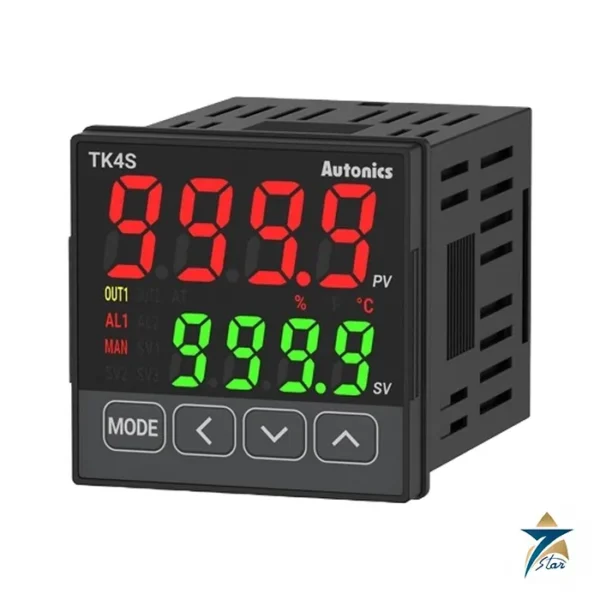
At room temperature, 23 degrees C plus or minus 5, the display accuracy is plus or minus 0.5 percent of the reading or 1 degree C, whichever is greater, plus one digit. For R and S thermocouples below 200 degrees C the allowance grows to 3 degrees C, and for L and Cu50 it is 2 degrees C. This is slightly looser than the premium TK and TX series, which is the trade-off for the economical price class.

Related items you may also need: Autonics E40S6-2500-6-L-5 Rotary Encoder Incremental | SICK WTB250-2P2441 Background Suppression Sensor | SICK VL12-2P430 V12 Retro-Reflective Photoelectric Sensor | All Autonics products.

Documents and quotation

The TCN series product manual covering the Autonics TCN4S-24R is attached with ordering information, input ranges, wiring and dimensions. Send an RFQ with the part number Autonics TCN4S-24R, quantity and delivery location in Oman or the GCC.

Datasheets & Documents
  • PDF Datasheet Autonics TCN4S-24R 48x48 Dual Display PID Controller Datasheet Download
Reviews (0)

Reviews

There are no reviews yet.

How would you rate this product?

It takes about 10 seconds — just tap a star. Your email is never published.

About brand

Autonics is a South Korean maker of sensors and controllers, founded in 1977 as a small engineering business making controllers for looms. It took the Autonics name in 1988 and opened a new corporate headquarters in Busan in 2014. Autonics makes proximity and photoelectric sensors, rotary encoders, temperature controllers, counters, timers and stepper motor systems, with factories in Busan and Yangsan.

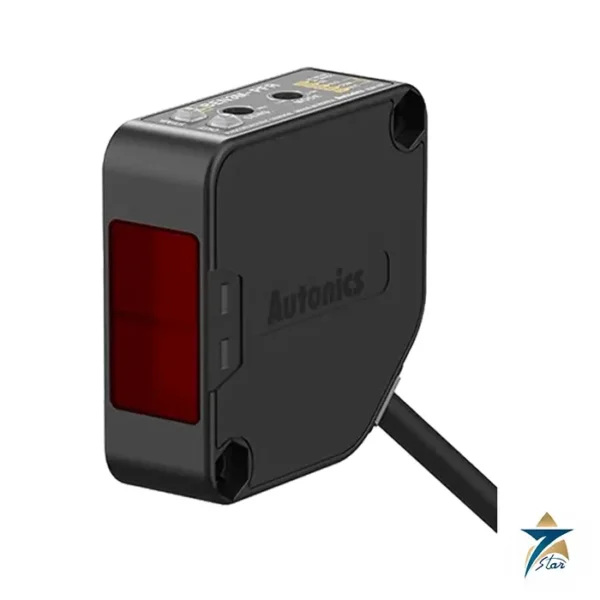
Seven Star LLC lists the Autonics E40S6-2500-6-L-5 incremental rotary encoder and supplies Autonics sensors and control devices in Oman and the GCC.

Autonics company profile

Founded 1977, South Korea
Current name Autonics, since 1988
Headquarters Busan, South Korea
Factories Busan and Yangsan
Product families E40 and E50 rotary encoders, PR proximity sensors, BJ photoelectric sensors, TK temperature controllers

Milestones

  • 1977: The company is founded.
  • 1988: Renamed Autonics Corporation.
  • 2014: Opens its Busan headquarters.

Reading the Autonics E40S encoder code

E40S is the 40 mm diameter shaft-type incremental encoder, and the 6 that follows is the 6 mm shaft. 2500 is the resolution in pulses per revolution. The next 6 means six output signals: A, B and Z with their inverted signals. L is a line driver output and the final 5 is a 5 V DC supply. The same 40 mm body is made in hollow shaft form as the E40H and E40HB series.

Where Autonics encoders are used

Servo and spindle feedback, conveyor length measurement, packaging and printing machines.

Ordering Autonics encoders: what we need

Send the complete model string from the label. If it is worn off, give the body and shaft diameter, pulses per revolution, output type, supply voltage and cable or connector style.

Facts checked against Autonics corporate profiles, October 2026.

FAQ

Questions about the Autonics TCN4S-24R 48×48 Dual Display PID Controller

Answers from our engineering team on installation, compatibility and integration.

01What does the R in Autonics TCN4S-24R mean?
R means the control output is a relay together with an SSR drive output, so the same unit can drive a contactor or a solid state relay.
02How many alarms does the Autonics TCN4S-24R have?
The option digit 2 gives alarm 1 and alarm 2, each a relay rated 250 V AC 1 A, 1a.
03What supply does the Autonics TCN4S-24R use?
The digit 4 means 100 to 240 V AC at 50/60 Hz with a power consumption of 5 VA or less.
04What is the display of the Autonics TCN4S-24R?
It is a dual 7-segment LED display, with the process value in red above the setting value in green.
05What sensors can the Autonics TCN4S-24R read?
Thermocouples K, J, L, T, R and S plus RTD Cu50 and DPt100, with a sampling period of 100 ms.