- Automation & ControlView all 3,044 products
- Automation Accessories
- AC Drives
- PLC & I/O Cards
- Industrial Communications
- Vibration Monitoring
- Isolator & Barrier
- Controllers & Data Acquisition
- Safety Switches & Guard Locking
- Motor Soft Starters
- Encoders
- CCTV & Security
- Pneumatic Cylinders
- HMI Displays
- Servo Drives
- Industrial Computers
- Machine Vision
- Automation Software
- Robotics
Brand: Moore Industries
Moore Industries STZ/PRG/4-20MA/12-42DC/-AIS [DIN] SIL Transmitter
Description
Moore Industries STZ/PRG/4-20MA/12-42DC/-AIS [DIN] at a glance
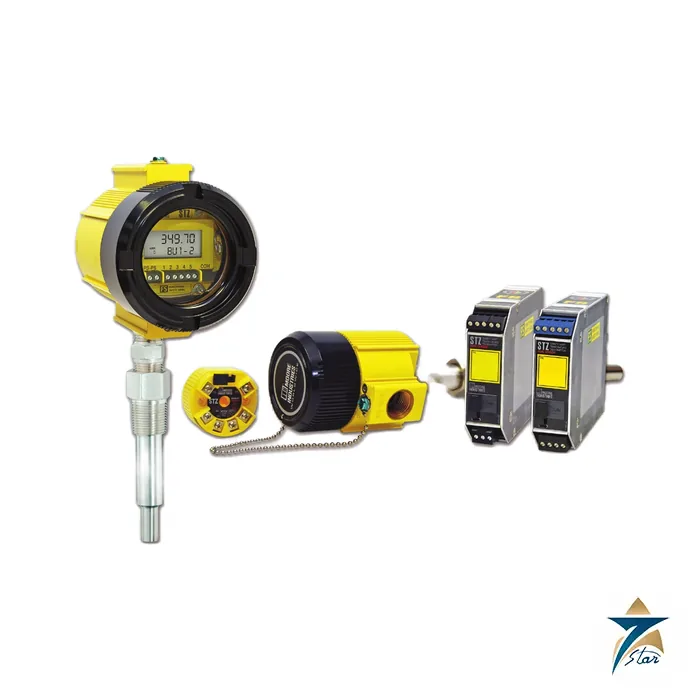
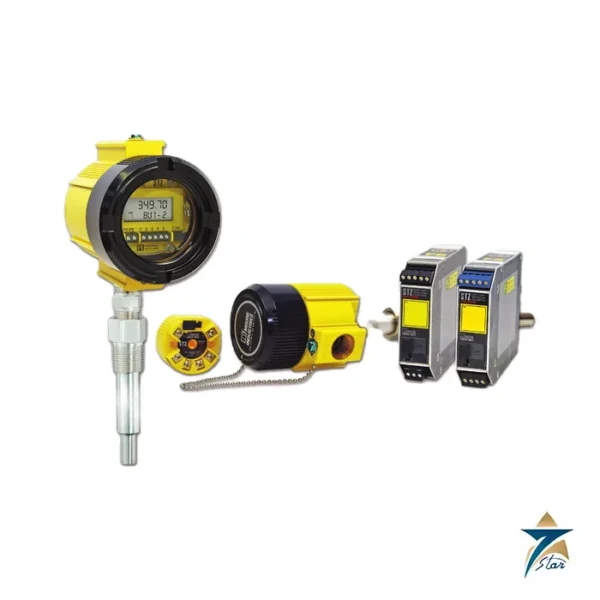
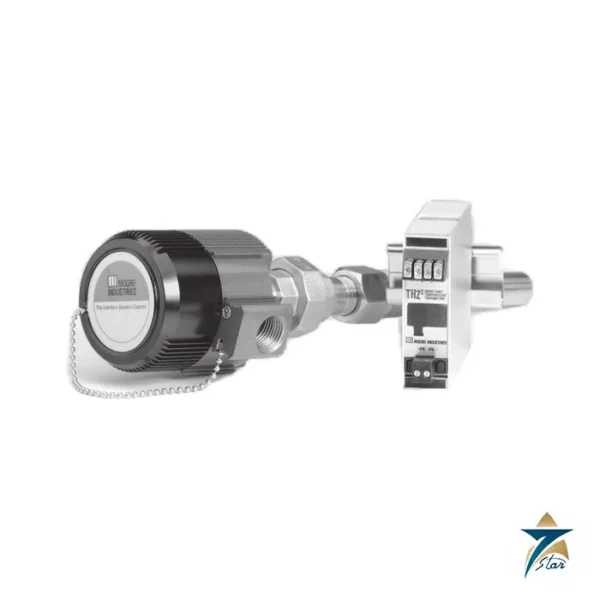
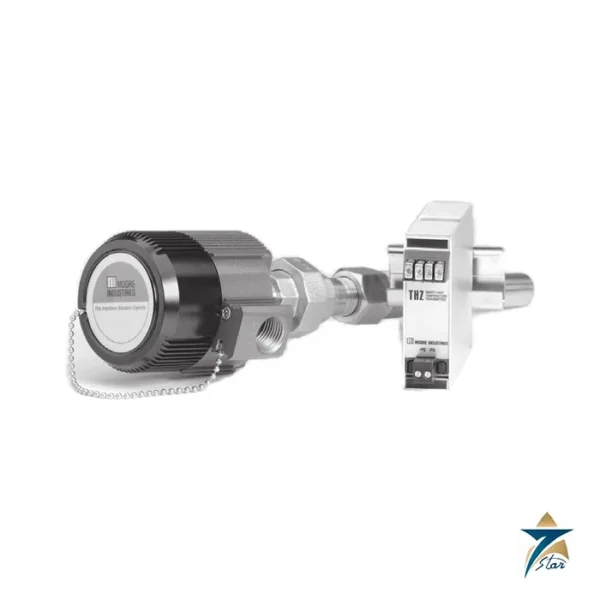
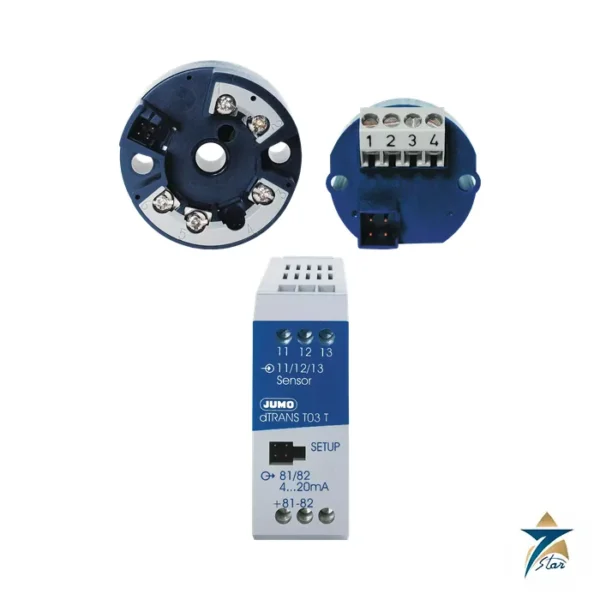
Moore Industries STZ/PRG/4-20MA/12-42DC/-AIS [DIN] is the cabinet-mounted version of the functional safety STZ, ordered with the -AIS option. The option adds intrinsically safe input protection, so thermocouples or RTDs installed in a Class I Division 1 or Zone 0 or 1 area connect directly to the module, with blue terminals marking the I.S. circuit.
Because the STZ carries an exida IEC 61508:2010 certificate, the module is suitable for temperature measurements in a Safety Instrumented System: single use up to SIL 2, redundant use up to SIL 3.
Think of the module as the safety-rated version of a barrier-plus-transmitter pair. The signal path begins at the blue terminals, passes through the intrinsically safe protection, enters the dual-input converter with 20-bit resolution, and leaves as an isolated 4-20 mA signal with HART 7 data riding on it. The result is a short chain with fewer terminals than a separate barrier and transmitter.
Why specify STZ/PRG/4-20MA/12-42DC/-AIS [DIN]
- Safety certification and FMEDA data in a rail-mount format, with the barrier function included.
- Dual input for backup and failover or for averaging two sensors in a vessel.
- HART 7 communication that can be restricted to read-only or turned off to protect the configuration.
- Sensor drift and corrosion diagnostics that give warning before the measurement fails.
- 20 V/m RFI/EMI immunity in the DIN housing.
In one 221 g module the user gets a safety-rated signal conditioner and an I.S. interface, a combination that normally needs separate devices.
Specification data for STZ/PRG/4-20MA/12-42DC/-AIS [DIN]
Values come from the STZ datasheet specification pages.
| Parameter | Value for STZ/PRG/4-20MA/12-42DC/-AIS [DIN] |
|---|---|
| Model code | STZ/PRG/4-20MA/12-42DC/-AIS [DIN] |
| Safety integrity | exida certified to IEC 61508:2010: systematic capability to SIL 3, random integrity to SIL 2; single use up to SIL 2, redundant (1oo2, 2oo3) up to SIL 3 |
| Housing | DIN: DIN-style aluminum housing, 221 g |
| Option | -AIS: built-in intrinsic safety input protection for sensors in Class I Div 1 and Zone 0/1 areas; blue terminals; DIN only |
| Input | PRG: single or dual input; 14 RTD types, 9 thermocouple types (J, K, E, T, R, S, B, N, C), 0 to 4000 ohm, -50 to 1000 mV, potentiometer |
| Output | 4-20 mA, HART 7, addresses 0 to 63 |
| Supply | 12-42 V DC |
| Isolation | 500 Vrms input to output; 1350 Vac for one minute, input-to-output-to-case |
| Cold junction error | Plus or minus 0.45 C (DIN) |
| RFI/EMI | 20 V/m at 80-1000 MHz for DIN; 10 V/m for HPP |
| Step response | 460 ms single, 650 ms dual input |
| Damping | 0 to 60 seconds |
| Start-up | Output at 90% in less than 5 seconds after power-up |
| HART access control | Read Only or Off modes |
| Fail response | Namur 43 compliant |
| Ambient | -40 to +85 C, 0 to 95% RH |
Notice that the table lists a 20 V/m immunity figure for the DIN housing but 10 V/m for the HPP puck. This is a practical advantage inside a busy marshalling cabinet where relays, variable speed drives and radio equipment may sit close to the rail. Also note the 5-second start-up statement, which matters for loops that restart after a power dip because the logic solver must wait for a valid reading.
How STZ/PRG/4-20MA/12-42DC/-AIS [DIN] differs from other STZ codes and from THZ3
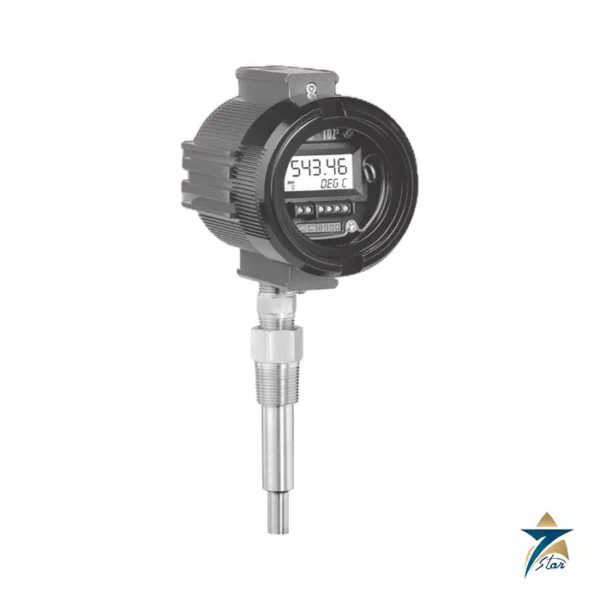
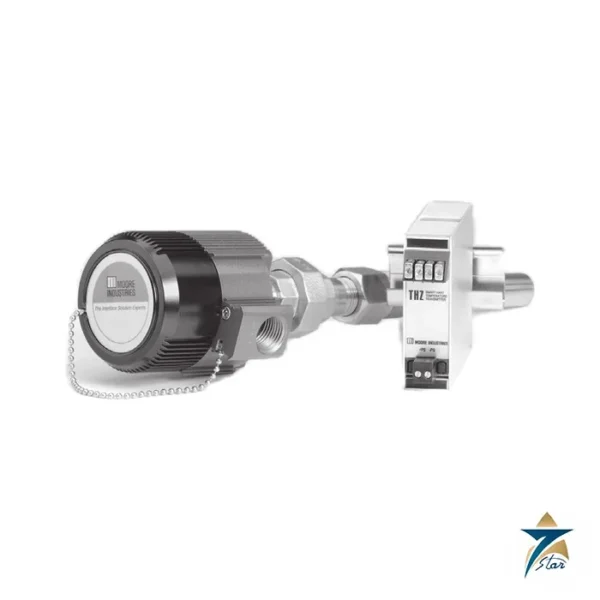
Compared with the STZ LH2NS and BH2NGP field versions, the DIN module is meant for a safe area, so the hazardous-area function comes from -AIS rather than from an explosion-proof case. Compared with a THZ3 DIN -AIS the electronics match, but the STZ adds the certified safety documentation and access control.
Cold junction compensation is plus or minus 0.45 C in the DIN module, compared with 0.25 C in the HPP.
Applications
Use it for shutdown temperature points where the field sensors are in classified areas: pump casing temperatures, heater tube skin points, cracker outlets and fuel gas heaters. The marshalling cabinet then holds the I.S. interface and the transmitter in one device.
For turbine and boiler protection in power plants, the dual input allows a two-sensor redundant measurement with one transmitter, while the logic solver may use a second, independent STZ for a 1oo2 architecture.
A further advantage of the DIN format is easy replacement. If the proof test finds a failed module, a technician can release the rail clip, move the terminals to a pre-configured spare, and restore the safety function in minutes. Keeping a configured spare under controlled storage is a common practice on SIS projects, and a configuration file saved at commissioning makes it simple.
Compatibility
Confirm the sensor parameters against the entity data on the I.S. approval, and keep the blue terminals segregated from non-I.S. wiring. Select 12-42DC for the loop supply and ensure the logic solver input matches a 4-20 mA loop-powered device.
Where the sensors are in a safe area, the plain DIN code without -AIS is sufficient.
Installation
Clip the module on the rail, connect sensors to the blue terminals, wire the loop and configure with HART or DTM. After validating, lock the configuration using HART access control.
Label the unit with the tag, safety function and proof-test date.
Proof test and maintenance
Establish the interval from the FMEDA data. At the test, simulate both sensors, check the average or select function, and verify that failures drive the output to the programmed Namur 43 state.
Retain copies of the configuration file and the safety manual.
When two STZ modules are used for a redundant measurement, mount them on separate rail positions and route the sensor cables separately, so a single wiring fault cannot disable both channels. The dual-input rules inside each module are an additional layer, not a substitute for architectural redundancy.
Supply of STZ/PRG/4-20MA/12-42DC/-AIS [DIN]
Quote STZ/PRG/4-20MA/12-42DC/-AIS [DIN] in full when requesting prices and specify whether the FMEDA report is wanted.
Seven Star LLC is an independent supplier serving Oman and the wider GCC and is not affiliated with the manufacturer; all names and part numbers are used only to identify the product being requested.
Documents and quotation
A datasheet for Moore Industries STZ/PRG/4-20MA/12-42DC/-AIS [DIN] can be provided with our quotation. Send an RFQ with the part number, quantity and delivery point.
Other Models in the STZ Range
Seven Star LLC supplies models from the STZ range in Oman and the GCC. Compare the related models below and request a quote for the one that matches your application.
| Model | Category | |
|---|---|---|
| Moore Industries STZ/PRG/4-20MA/12-30DC [LH2NS] SIL Transmitter | Temperature Transmitters | View details |
| Moore Industries STZ/PRG/4-20MA/12-42DC/-AIS [DIN] SIL Transmitter | Temperature Transmitters | You are viewing this model |
| Moore Industries STZ/PRG/4-20MA/12-42DC [BH2NGP] SIL Transmitter | Temperature Transmitters | View details |
Datasheets & Documents
- Datasheet Moore Industries STZ/PRG/4-20MA/12-42DC/-AIS [DIN] SIL Transmitter Datasheet Download
Reviews (0)
How would you rate this product? Cancel reply
About brand
Moore Industries is an American manufacturer of signal interface instruments, founded in 1968 by engineer Leonard W. Moore in North Hills, California. Its first product was the SCT signal converter, built in a friend's workshop. The company has been at its North Hills headquarters since 1974 and still designs and builds its products there, known for rugged aluminium housings.
Seven Star LLC, an independent supplier in Oman, lists Moore Industries temperature transmitters, limit alarm trips, isolators and a PID backup controller, and sources units and replacements by full model number.
Moore Industries company profile
| Founded | 1968, North Hills, California, USA, by Leonard W. Moore |
|---|---|
| Headquarters | North Hills, California, since 1974 |
| Ownership | Privately owned (Moore Industries-International, Inc.) |
| First product | SCT signal converter |
| Product families | Signal isolators and converters (ECT, SCT), temperature transmitters (TRY, THZ), alarm trip units (SPA), miniMOORE multichannel signal conditioners, HART interfaces, SIL-rated safety logic solvers (STA) |
Milestones
- 1968: Leonard W. Moore founds the company and builds the first SCT signal converter.
- 1974: The company moves into its North Hills headquarters.
- 2009: miniMOORE wins a Control Engineering Engineers' Choice Award.
Moore Industries product families on this page
The manufacturer's catalog is arranged by function, and many of the items listed here map onto it directly:
- Temperature transmitters: the TRX, and the STZ functional safety dual input smart HART transmitter
- Alarm trips: the SPA2 programmable limit alarm trip, including an SPA2 with HLPRG input and four relay outputs
- Signal isolators, repeaters and converters: the SIX
- PID controllers and backup stations: the 535 in 1/4 DIN format
Other catalog groups include temperature assemblies and sensors, I/P and P/I converters, remote I/O, HART gateways and interfaces, indicators, and fieldbus device couplers.
Where Moore Industries instruments are used
These are control room and marshalling cabinet devices, plus field-mounted transmitters. Typical jobs are isolating a 4-20 mA loop between two systems, converting a thermocouple or RTD signal for a DCS input, adding an independent high or low trip next to the control system, and keeping a control loop running on a backup station when the main controller is out of service. Process plants in oil and gas, chemicals and power across the GCC use them for exactly these tasks.
Moore Industries products we list
Ordering Moore Industries instruments: what we need
Moore Industries model numbers are built from fields separated by slashes: unit, input, output, power and options, followed by the housing code in brackets. Every field matters. Send the complete string from the label, the serial number, and for programmable units the input type and range you want set. State any hazardous area or functional safety requirement, because approved versions are ordered with their own option codes.
Facts checked against trade press obituaries of Leonard W. Moore (Control Engineering, Control Global), October 2026.
Browse Moore Industries products by category: Temperature Instrumentation, Controllers & Data Acquisition, Isolator & Barrier.
FAQ
Questions about the Moore Industries STZ/PRG/4-20MA/12-42DC/-AIS [DIN]
Answers from our engineering team on installation, compatibility and integration.
01What does the -AIS option do on an STZ?
It provides intrinsically safe input protection so sensors in Class I Div 1 or Zone 0/1 locations connect directly, using blue terminals, in the DIN housing only.
02What SIL capability does this unit have?
Single use up to SIL 2 and redundant use such as 1oo2 or 2oo3 up to SIL 3, per the exida certificate to IEC 61508:2010.
03How much does the DIN module weigh?
The datasheet lists 221 g (7.9 oz) for the STZ in the DIN housing.
04Does the STZ DIN have a display?
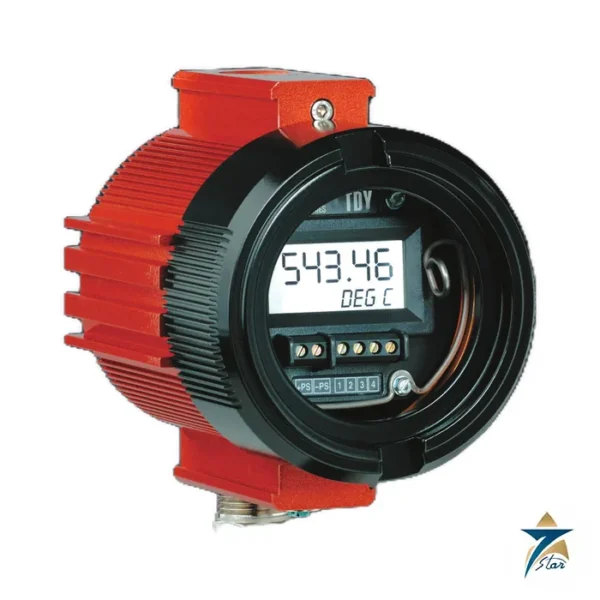
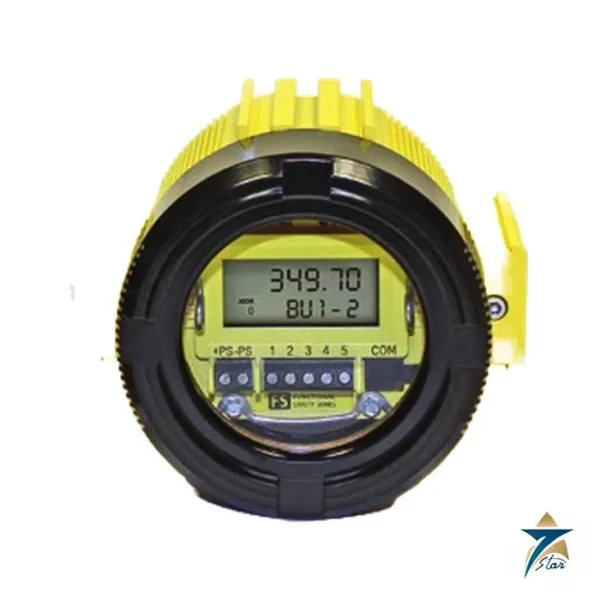
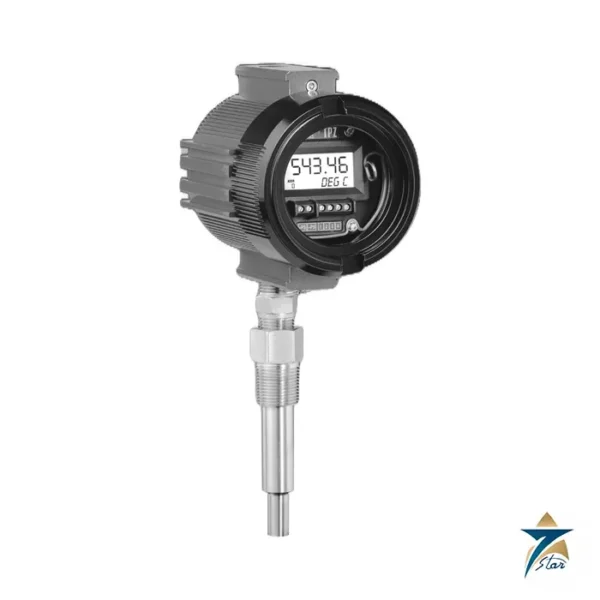
No local display is offered in the DIN housing; displays are in the field enclosures.
05Can HART be disabled?
HART communication can be set to Read Only or Off using the access control feature.


![Moore Industries STZ/PRG/4-20MA/12-42DC/-AIS [DIN] SIL Transmitter Moore Industries STZ/PRG/4-20MA/12-42DC/-AIS [DIN] SIL Transmitter](https://omansevenstar.com/wp-content/uploads/2026/11/moore-industries-stz-prg-4-20ma-12-42dc-ais-din-functional-safety-din-rail-transmitter-ais.webp)
Reviews
There are no reviews yet.