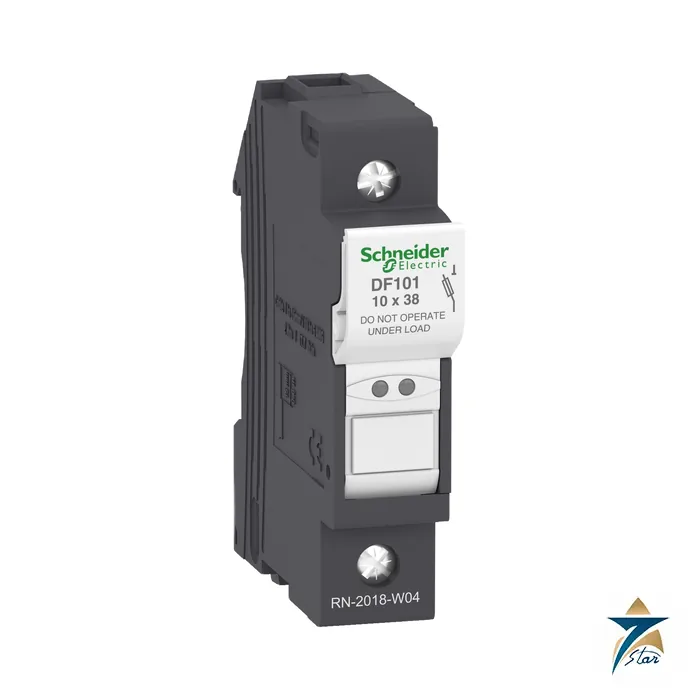
DF101 fuse carrier: a one-pole 10 x 38 mm disconnect
The DF101 is a Schneider Electric TeSys DF fuse carrier: one pole, 32 A, taking cylindrical fuses of 10 x 38 mm. The manufacturer’s title reads: Fuse carrier TeSys DF, 1P 32A, fuse size 10 x 38 mm. It is a DIN-rail device with a toggle lever that holds the fuse cartridge, lets you isolate the circuit by hand and accepts a padlock. Seven Star LLC supplies the DF101 in Oman and the GCC as an independent supplier based in Muscat.
What the DF101 is not: it is not a circuit breaker, and it does not contain a fuse in the supplied form. The datasheet names the DF2CA and DF2CN fuse cartridge as the compatible products, and the fuse itself must be selected by the user, for the supply voltage, the current and the type, either aM (motor-starting) or gG (general purpose), both listed up to 32 A.
Technical specifications of the DF101
| Parameter |
Specification |
| Manufacturer / part number |
Schneider Electric / DF101 |
| Range / type |
TeSys DF fuse carrier, device short name DF10 |
| Poles |
1P |
| Fuse size |
10 x 38 mm |
| Fuse type |
0 to 32 A, aM; 0 to 32 A, gG |
| Compatible cartridges |
DF2CA and DF2CN fuse cartridge |
| Control type |
Toggle, padlockable |
| Utilisation categories |
AC-20B and DC-20B (IEC 60947-3) |
| Rated operational voltage (Ue) |
690 V AC; 690 V DC |
| Rated operational current (Ie) |
32 A at 400 V AC |
| Thermal current (Ith) |
32 A at 20 °C |
| Insulation voltage (Ui) / Uimp |
690 V AC / 6 kV |
| Overvoltage category / pollution degree |
III / 3 |
| Short-circuit withstand |
120 kA at 400 V and 120 kA at 500 V (IEC 60947-3) |
| Maximum power dissipation by fuse |
3 W |
| Mounting |
35 mm symmetrical DIN rail, vertical (tolerance ± 23°) |
| Terminals |
Screw clamp: 1 cable 1 to 16 mm² or 2 cables 1 to 6 mm² |
| Tightening torque |
2.2 N.m (PZ2 or 5.5 mm flat screwdriver) |
| Dimensions (H x W x D) |
79.5 mm x 17.5 mm x 61 mm |
| Net weight |
0.042 kg |
| Degree of protection |
IP20 |
| Ambient temperature, operation |
-40 to 70 °C with derating above 20 °C |
| Ambient temperature, storage |
-40 to 70 °C |
| Operating altitude |
0 to 2000 m |
| Fire resistance |
960 °C (IEC 60695-2-1) |
| Standards |
EN/IEC 60947-3; EN/IEC 60269-2; UL 4248-1; CSA C22.2 No 4248-1; EN 45545-2: R22 HL2 |
| Certifications |
IEC; UL recognized; CSA; CCC; EAC; DNV-GL |
Isolating under no load: the AC-20B rating of the DF101
The utilisation categories AC-20B and DC-20B in the datasheet mean that the DF101 is designed to be opened and closed with no current flowing. It is a disconnector for a fuse, not a load-break switch. De-energise or switch off the load first with a contactor or a switch, and only then open the toggle to remove or replace the fuse. The marking on the device reminds the user not to operate it under load.
The rated operational voltage is 690 V AC and 690 V DC, and the rated operational current is 32 A at 400 V AC, with a conventional thermal current of 32 A at 20 °C. The datasheet also lists overvoltage category III, an impulse withstand of 6 kV and pollution degree 3, which together describe an installation device intended for the distribution level of a building or plant.
Heat, derating and fuse dissipation for the DF101
The datasheet allows operation from -40 to 70 °C but states derating above 20 °C, and it gives a maximum power dissipation of 3 W for the fuse. That combination matters in the Gulf. A fuse carrier near full load in a sealed enclosure on a roof or in a container can heat itself and its neighbours well above the ambient air, so the continuous current should not be assumed to be 32 A at panel temperatures of 50 °C or more.
Practical measures include choosing a fuse cartridge rated above the continuous load current, leaving space between carriers, using a ventilated enclosure and checking the temperature of the carrier on a thermal image survey after commissioning. These are engineering practices, not manufacturer claims, and the derating curve of the fuse and carrier should always be checked with the manufacturer’s data for the specific current.
Short-circuit data and standards for the DF101
The datasheet lists a short-circuit withstand of 120 kA at 400 V and 120 kA at 500 V according to IEC 60947-3. That value is available together with a suitable fuse, and it is the fuse that limits the energy let through. The standards listed are EN/IEC 60947-3 for switches and disconnectors, EN/IEC 60269-2 for fuses, UL 4248-1 and CSA C22.2 No 4248-1 for fuse holders, and EN 45545-2 R22 HL2 for fire behaviour in railway applications.
The certifications listed are IEC, UL recognized, CSA, CCC, EAC and DNV-GL, the last of which is relevant to marine and offshore equipment. The housing resists a glow-wire test at 960 °C according to IEC 60695-2-1. These data are useful for projects with a specification that names approvals: check that the listed certificates cover your project, and ask us before you order if a certificate is required in a particular form.
Wiring, mounting and handling of the DF101
The DF101 snaps onto a 35 mm symmetrical DIN rail and should be mounted vertically, with a tolerance of about 23 degrees either way, as stated in the datasheet. It is 79.5 mm high, 17.5 mm wide and 61 mm deep and weighs 0.042 kg, so many units fit in a distribution board. Screw terminals accept a single conductor of 1 to 16 mm² or two conductors of 1 to 6 mm², with a tightening torque of 2.2 N.m using a PZ2 or 5.5 mm flat screwdriver.
Handling is simple but needs discipline. Use only a cartridge from the compatible family, open the toggle before touching the fuse, lock the toggle with a padlock for maintenance and re-torque the terminals after the first thermal cycles. The datasheet lists IP20, which means finger-safe with no dust protection, so the carrier belongs in a closed enclosure. The datasheet also shows a quantity per set of 12, so confirm the quoted unit with us.
Where the DF101 is used in Oman and the GCC
Fuse carriers of this type protect control transformers, power supplies, small motors, capacitor banks and distribution circuits inside panels at pumping stations, desalination plants, building services plant rooms and oil and gas skids. The range from 0 to 32 A and the 690 V rating allow the same carrier to serve 400 V motor circuits and 24 V DC supply circuits, and DC applications such as solar or battery systems are covered by the 690 V DC rating.
The padlockable toggle is useful where maintenance procedures require lock-out and tag-out, which is standard on oil and gas sites and in utility plants. In dusty locations with sand ingress, regular inspection and cleaning is the main upkeep, and a spare DF101 is cheap insurance because a damaged carrier cannot be repaired in the field.
Information to send with an RFQ for the DF101
- Full reference DF101 and the quantity (and the quoting unit, one piece or a set)
- Fuse cartridge needed: type (aM or gG), current and DF2CA or DF2CN family
- Circuit voltage (AC or DC) and maximum continuous current
- Enclosure ambient temperature and available space
- Delivery location in Oman or the GCC and date required
Documents and quotation
A datasheet for this product is attached on this page. It lists the electrical, mechanical and environmental data summarised above, and it is worth reading beside the panel drawing before you order.
Send us the part number, quantity and application and we will confirm availability and a quotation. Seven Star LLC is an independent supplier in Muscat and is not affiliated with the manufacturer.




















Reviews
There are no reviews yet.