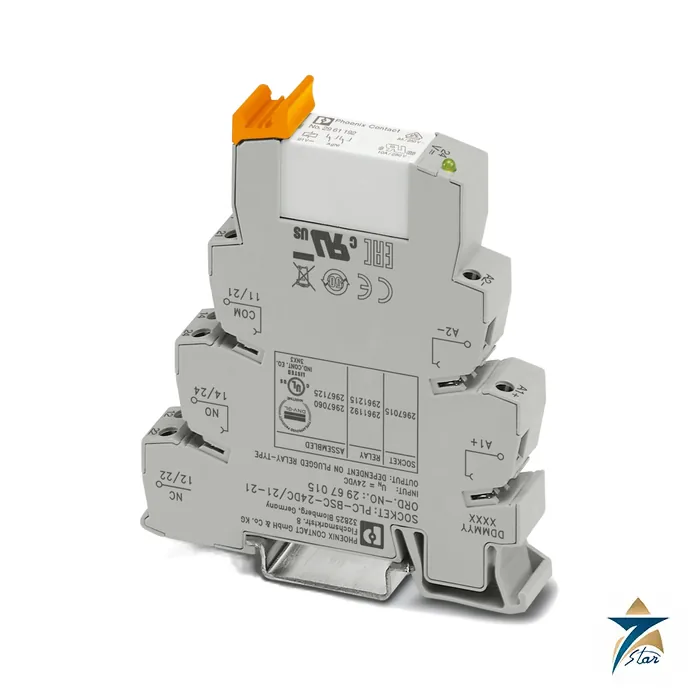
PLC-RSC-24DC/21-21 relay module, 2 changeover contacts, 24 V DC coil
The PLC-RSC-24DC/21-21 (item number 2967060) is a pluggable PLC-INTERFACE relay module from Phoenix Contact with a 24 V DC coil and two changeover contacts. In the PLC-INTERFACE range it is the two-pole version, only 14 mm wide, that lets a low-power PLC output switch loads of up to 6 A at 250 V while keeping the control side electrically isolated. Seven Star LLC supplies the PLC-RSC-24DC/21-21 in Oman and the GCC as an independent supplier in Muscat, and the figures below are taken from the manufacturer technical data for this item.
PLC-RSC-24DC/21-21 type code
- PLC-RSC: PLC-INTERFACE relay module with screw connection.
- 24DC: nominal coil voltage 24 V DC.
- 21-21: two changeover contacts (the single-pole sibling is coded /21).
PLC-RSC-24DC/21-21 technical specifications
| Parameter |
Specification |
| Manufacturer / part number |
Phoenix Contact PLC-RSC-24DC/21-21, item no. 2967060 |
| Product type |
Relay module, PLC-INTERFACE family, universal application |
| Nominal input voltage |
24 V DC; input range 20.2 … 33.6 V DC at 20 °C |
| Coil behaviour |
Monostable, polarised; typical input current 18 mA; typical response time 8 ms, release time 10 ms |
| Protective circuit |
Reverse-polarity protection diode and freewheeling diode; yellow LED operating display |
| Contacts |
2 changeover contacts, AgNi |
| Switching voltage |
250 V AC/DC maximum; 5 V AC/DC (10 mA) minimum |
| Continuous current / inrush |
6 A limiting continuous current; 15 A for 300 ms |
| Breaking capacity (ohmic) |
up to 140 W at 24 V DC; 85 W at 48 V DC; 1,500 VA at 250 V AC |
| Switching capacity |
2 A at 24 V DC13; 3 A at 24 V AC15; 3 A at 250 V AC15 |
| Mechanical life |
3 x 10⁷ cycles |
| Test voltage |
4 kV AC winding/contact; 2.5 kV AC between contacts; rated surge voltage 6 kV |
| Insulation |
Safe isolation control/contact side; overvoltage category III, pollution degree 3 |
| Ambient temperature |
-40 °C … +60 °C; storage -40 … +85 °C |
| Connection |
Screw terminal M3, 0.14 … 2.5 mm² (AWG 26 … 14), strip length 8 mm, torque 0.6 … 0.8 Nm |
| Dimensions / weight |
14 x 80 x 94 mm (W x H x D); about 72 g |
| Approvals / tests listed |
CE, UKCA, shipbuilding approval TAE0000196, corrosive gas test ISA-S71.04 G3 harsh group, IEC 60947-5-1 |
How the PLC-RSC-24DC/21-21 works
A PLC digital output can usually supply only a few tens of milliamperes. The module draws about 18 mA at 24 V DC to energise the relay coil, and its contacts then switch a separate load circuit. The two changeover contacts allow two independent circuits, or one load that needs both a make and a break path, for example switching a signal lamp and a feedback input together. The built-in freewheeling diode suppresses the voltage spike from the coil, and the polarity protection diode prevents damage if the control wiring is reversed. The yellow LED shows when the coil is energised.
Reading the PLC-RSC-24DC/21-21 switching data
The contact figures decide whether the PLC-RSC-24DC/21-21 is the right module for a given load. The 6 A limit is a thermal continuous rating; the real limit on DC loads is the breaking capacity, which falls from 140 W at 24 V DC to 85 W at 48 V DC, 60 W at 60 V DC, 44 W at 110 V DC and 60 W at 220 V DC. In AC15 duty (inductive AC loads such as contactor coils) the module is rated 3 A at 24 V, 120 V and 250 V, and in DC13 duty (inductive DC loads) 2 A at 24 V and 0.2 A at 250 V. The minimum switching level of 5 V and 10 mA means the contacts are not intended for dry-circuit signal levels, and very low-level signals may need a different relay type. Contact life depends on the load, so compare your real duty with these capacity figures instead of the 3 x 10⁷ mechanical figure alone.
Where the module fits and sibling variants
The PLC-RSC-24DC/21-21 is the double-contact version of the PLC-RSC-24DC/21 (2966171). Other family members listed by the manufacturer include the PLC-RSC-24UC/21, PLC-RSC-24UC/21-21, PLC-RSC-120UC/21, PLC-RSC-230UC/21 and PLC-RSC-12DC/21, covering coil voltages from 12 V DC to 230 V AC/DC and one or two changeover contacts. The data states that the divider plate PLC-ATP should be fitted where voltages above 250 V (L1, L2, L3) are present between identical terminals of adjacent modules, and that potential bridging uses FBST 8-PLC or FBST 500 bridges.
Selection checklist
- Coil voltage matching the PLC output (24 V DC here), with its current within the PLC output rating.
- Number of contacts needed: two changeover for the 21-21 version.
- Load type and size: 6 A continuous limit, with DC loads limited by the breaking-capacity figures above.
- Minimum switching level: 5 V and 10 mA, so very small signals may call for a different contact material.
- Ambient temperature range up to 60 °C and zero-spacing assembly.
- Need for divider plates, bridges and markers.
Installation and maintenance
Snap the PLC-RSC-24DC/21-21 onto a DIN rail in rows with zero spacing, connect coil and load conductors to the screw terminals at the stated torque, and use the bridges for common potentials. The relay itself is pluggable on the base, so replacement after contact wear does not require disturbing the wiring; use the mechanical life figure and the actual switching duty to plan replacement. Check the LED during testing and verify the load with a meter.
Typical applications in Oman and the GCC
The module is used wherever a PLC or DCS output must drive a heavier or higher-voltage device: motor starter coils, solenoid valve groups, alarm horns, lamps, interposing signals between marshalling cabinets and field equipment, and shutdown interface chains. The wide temperature capability and the harsh-gas test listing in the data support use in dusty, hot and mildly corrosive plant rooms, in suitable enclosures.
Information to send with an RFQ
- Full type designation or item number and quantity
- Coil voltage and PLC output rating
- Load voltage, current and type (AC, DC, inductive)
- Number of contacts required and any divider plates, bridges or markers
- Ambient conditions and approvals
- Delivery location
Documents and quotation
Send the part number PLC-RSC-24DC/21-21 or item number 2967060 and Seven Star LLC will confirm the documents available for this item. Include quantity and delivery location when you request a quotation.





























Reviews
There are no reviews yet.