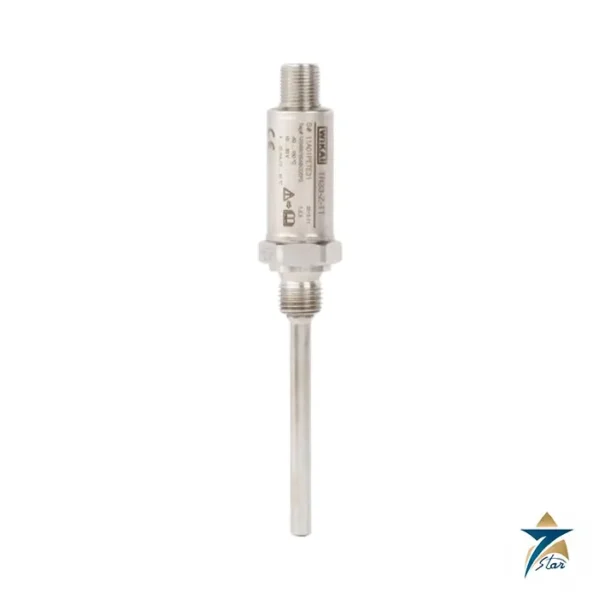
WIKA TR40 cable resistance thermometer with mineral-insulated cable
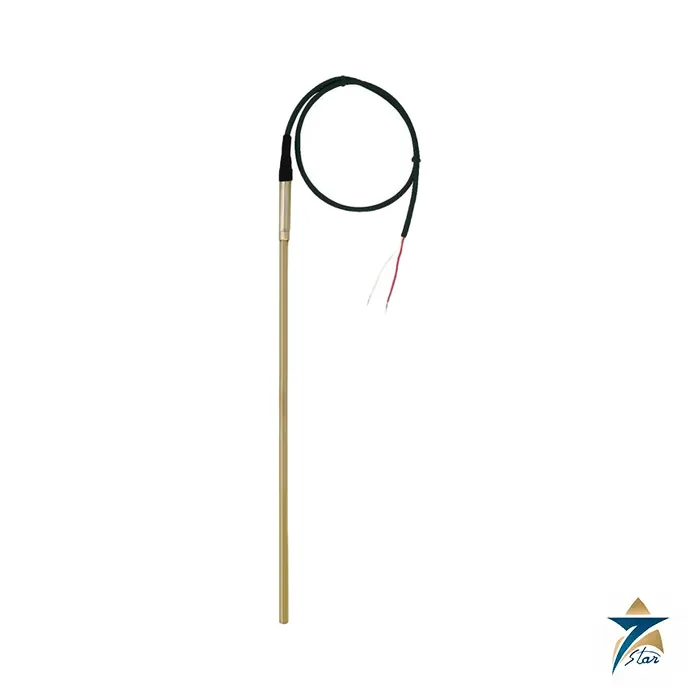
The WIKA TR40 is a flexible cable resistance thermometer for measuring temperature directly in a bore, a machine part or the process itself. Instead of a rigid thermowell assembly with a head, it uses a thin, mineral-insulated metal-sheathed probe that can be bent, with a connection cable made of PTFE, PFA, silicone or another sheath material. WIKA gives sensor ranges from -196 … +600 °C [-320 … +1,112 °F]. Seven Star LLC supplies the TR40 in Oman and the GCC as an independent supplier in Muscat; the guide below explains the construction options that need to be specified for a correct quotation.
Where the TR40 is the right form factor
Cable thermometers are particularly useful when the metallic probe tip is fitted straight into drilled holes in machine components, for example bearing housings, motor stator slots or heater blocks, or directly into a process without chemically aggressive media or abrasion. Because the probe diameter is small and the sheath can be bent to a radius of five times the cable diameter (except for the tip and the transition sleeve, and the first 60 mm of the probe), it reaches places a rigid head-mounted thermometer cannot. WIKA stresses that the bore should be no more than 1 mm larger than the probe, because every air gap acts as insulation.
TR40 technical specifications
| Parameter |
Specification |
| Manufacturer / part number |
WIKA / TR40 (data sheet TE 60.40) |
| Type |
Cable resistance thermometer, mineral-insulated cable (MI cable) |
| Sensor |
Platinum resistance element in the probe tip, single or dual |
| Measuring range |
-196 … +600 °C [-320 … +1,112 °F], depending on sensor and cable |
| Sheathed cable diameters |
3, 6 and 8 mm, or 1/8, 1/4 and 3/8 in [3.17, 6.35, 9.53 mm] |
| Sheath material |
Stainless steel 1.4571 or 316L |
| Connection cable sheath |
PTFE, PFA, silicone and other materials |
| Process connection |
None as standard; optional fixed thread, compression fitting or spring-loaded fitting |
| Thread options |
G 1/8 B up to G ¾ B, 1/8 NPT to ¾ NPT, M8 x 1.0, M12 x 1.5, M14 x 1.5 |
| Bend radius |
5 x cable diameter, except the first 60 mm of the probe tip and the transition sleeve |
| Connection options |
Cable end, with connector, or with connection housing; braided or armoured cable |
| Explosion protection |
Optional Ex i, Ex e and Ex n approvals for many types |
| Compliance |
EU declaration of conformity; EN 61326 emission and immunity (industrial) |
Process connection choices on the TR40
The standard probe is made without a process connection, so a plain smooth probe can simply be inserted. Three fixing options are available. A fixed threaded connection is for mounting the probe into a female thread, but the probe must be rotated to screw it in, so the datasheet says to fit it mechanically before connecting it electrically. A compression fitting with stainless steel ferrule can be slid along the probe once for setting the insertion depth, supports temperatures up to 500 °C at the fitting (unpressurised), and is rated for a maximum pressure of 20 bar at 150 °C with a 6 mm probe. A PTFE-ferrule fitting can be re-set several times but is limited to 150 °C and unpressurised use.
For installation in a thermowell, WIKA specifies a spring-loaded compression fitting, because only that presses the tip onto the bottom of the thermowell and avoids a potentially harmful force on the sensor. The insertion length should be at least 25 mm where a threaded connection could conduct heat away, and a pre-formed (angled) shape can be delivered with the bend position defined by dimensions X and Y.
Cable and connector variants
| Option |
What it means |
Note |
| Connection cable, standard |
PTFE, PFA, silicone or other sheath |
Select by temperature at the cable |
| Stainless steel braid or metal armour |
Protection for mechanical stress |
Both are listed in the datasheet |
| Single wires |
Open leads at the end |
For direct terminal connection |
| Connector |
Fitted on the MI cable or the cable end |
Position only outside hazardous areas |
| Connection housing |
Fitted at the cable end |
For field wiring |
Hazardous-area options
The datasheet lists a long set of ATEX and IECEx marks: Ex ia for zones 0, 1, 20, 21 and 22 gas and dust, Ex eb and Ex ec, Ex tb and Ex tc, and Ex nA, with further EAC, INMETRO, KCs and other national options. The internal inductance is 1 µH per metre and the capacitance 200 pF per metre, values that must be added to the loop calculation when the probe is connected to an intrinsically safe supply. Built-in transmitters have their own certificates, and the allowed ambient temperature follows the certificate and operating instruction.
Using the TR40 correctly
Keep the transition sleeve outside the hot zone and do not bend it or put a compression fitting on it. Do not allow the cable to be loaded in strong flow without support, because the flexible probe can vibrate; when flow velocity is high, WIKA warns that flexibility has to be considered. With dual sensors, check which channel is for control and which for monitoring. Note that the temperature at the cable and connector, not just the probe, defines the true limit of the installed assembly.
Applications in Oman and the GCC
The TR40 is widely used for bearing and winding temperature in motors and pumps, for heat-treatment and test rigs, for pipe-wall and block heaters, and in laboratory or pilot-plant installations. In regional plants this includes motor-bearing monitoring on cooling-water pumps, gas turbine auxiliaries, and ovens or furnaces in fabrication yards, where the small probe and braided cable survive heat and abrasion better than a PVC lead.
TR40 selection checklist
- Probe diameter and sheath material (1.4571 or 316L)
- Insertion length, plus any bend or pre-formed shape
- Measuring range, sensor class and wire method
- Process connection: none, fixed thread, compression fitting or spring-loaded fitting
- Connection cable sheath, length and braid or armour
- End termination: open wires, connector or housing
- Hazardous-area approval and loop parameters
Information to send with an RFQ
Send the measured location (bore, surface or process), probe diameter, length, temperature range, cable length, fitting thread and quantity, along with any approvals. A sketch helps for angled versions.
Documents and quotation
The WIKA data sheet TE 60.40 for the TR40 is attached on this page. Send the configuration and quantity for a quotation from Muscat as an independent supplier.

























Reviews
There are no reviews yet.