Hydrogen-only leak detection for battery rooms and plant buildings
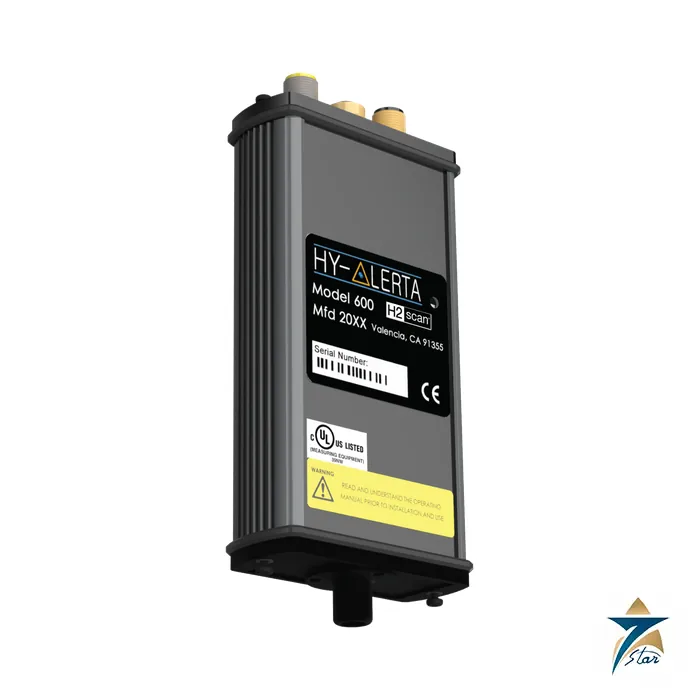
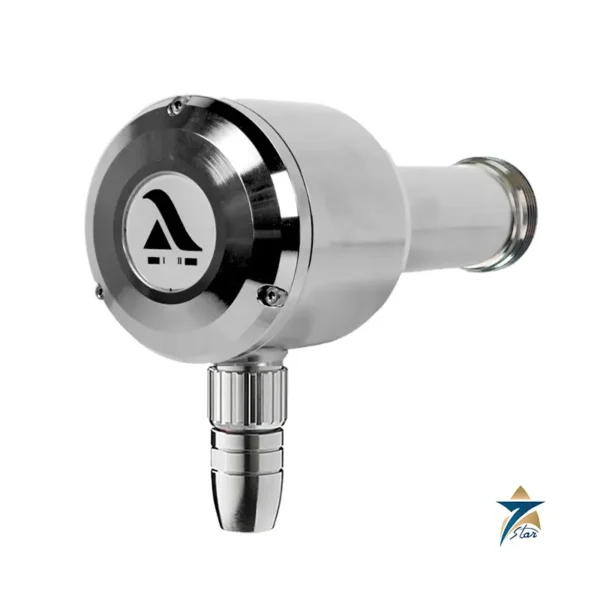
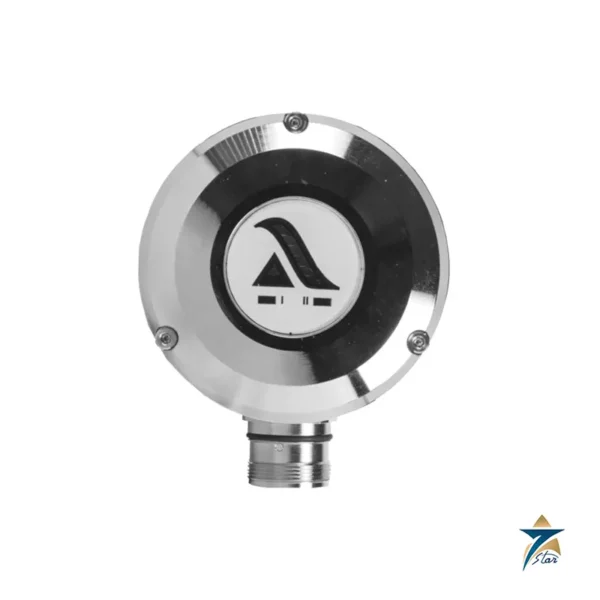
HY-ALERTA 600B is the general purpose model of the H2scan HY-ALERTA fixed area hydrogen safety monitors. It detects hydrogen from 0.4% to 5% by volume, equal to 10% to 125% of the lower explosive limit of hydrogen according to the datasheet, and reports through a 4-20 mA output, RS232 or RS422 serial and relays.
The sensor is solid-state and hydrogen specific, so the datasheet states there is no cross sensitivity to other combustibles and no poisoning like that seen with some other detector types. It works in air, oxygen or an inert background and does not saturate with hydrogen exposure.
Technical specifications
| Parameter |
Specification |
| Measuring range |
0.4 to 5% H2 (10 to 125% LEL) |
| T90 response |
Below 60 seconds |
| Accuracy |
(0.03 x indication + 0.2)% H2 |
| Operating temperature |
-20 to 55°C |
| Operating humidity |
Below 95% RH, non-condensing |
| Calibration background gas |
Air |
| Calibration interval |
90 days |
| Usage |
Indoor and outdoor |
| Analog output |
4-20 mA |
| Serial output |
RS232 or RS422 |
| Relays |
1 A / 30 VDC SPDT: two program relays with NO and NC contacts and one programmable relay with NC contact only |
| Input voltage / power |
10-26 VDC / 10 W |
| Dimensions |
208.28 x 111.76 x 40.64 mm (8.2 x 4.4 x 1.6 in) |
The HY-ALERTA 600B, 1600 and 2620 compared
The datasheet covers three area monitors. The 600B is the general purpose unit. The HY-ALERTA 1600 is the intrinsically safe version and is marked DISCONTINUED in the datasheet. The HY-ALERTA 2620 is the explosion proof version with an AC supply.
| Model |
Type |
Input voltage |
Relay rating |
Hazardous-area marking |
| 600B |
General purpose |
10-26 VDC |
1 A / 30 VDC SPDT |
No hazardous-area rating printed |
| 1600 |
Intrinsically safe (discontinued) |
20-28 VDC |
Two SPST relays with barrier |
Ex ia / Ex ib / Ex db ratings printed |
| 2620 |
Explosion proof |
90-240 VAC |
5 A / 240 VDC SPDT |
Ex db IIB + H2 T4 Gb (ATEX, IECEx) |
If your hydrogen hazard sits inside a classified area, specify the 2620 rather than the 600B.
Applications and installation notes
Applications named by H2scan include lead acid battery charging rooms, control rooms and analyzer buildings, laboratories, refueling stations, fuel cell and electrolyzer leak monitoring, hydrogen-cooled generators and turbines, hydrogen storage and piping areas, and furnaces. Hydrogen-cooled generator halls are particularly relevant to power stations across the region.
Mount the unit where hydrogen is likely to collect, usually near the ceiling in a battery room since hydrogen is lighter than air (general engineering practice, not from the datasheet), and recalibrate every 90 days using the air background gas. Related products are listed under fire and gas detectors.
Selection tips and what the datasheet does not say
The 600B datasheet column lists no hazardous-area certificate, so treat the unit as an ordinary-location device. Where a battery room, analyzer shelter or generator hall is classified, use the explosion proof 2620 with its AC supply, or consult us about the later HY-ALERTA 5320 and 5020 families.
Relays on the 600B are two program relays with normally open and normally closed contacts plus one programmable relay with a normally closed contact only. A typical alarm scheme uses 10% of LEL for a low alarm and a higher level for ventilation or shutdown. Where 4% hydrogen equals 100% LEL (the scale implied by 0.4 to 5% being 10 to 125% LEL), 0.5% H2 is about 12.5% LEL. Set the actual thresholds with the site safety engineer.
Accuracy is stated as (0.03 x indication + 0.2)% H2, which means at 1% H2 the allowable error is 0.23% H2 and at 5% H2 it is 0.35% H2 (derived by us from the printed formula).
Because the monitor covers up to 125% LEL, readings above the lower explosive limit remain on scale during a major leak instead of clipping at the alarm point.
Calibration uses air background gas every 90 days, so budget for gas and a visit schedule across your site list.
Document control: the datasheet used here is H2scan document 90000239, dated 09.25, and it covers three area monitors in one selection table. When comparing figures, always read the 600B column and not the 1600 or 2620 columns, and ask for the 600B operating manual for wiring, alarm settings and calibration procedure.
Placement, alarm levels and site conditions
Hydrogen has a lower explosive limit of about 4% by volume in air and is much lighter than air, so it collects under ceilings and roof peaks. General engineering note (not from the datasheet): mount area monitors high in the room, close to the likely release point and away from fresh-air inlets, and avoid dead pockets where gas cannot reach the sensor. Common practice is a first alarm well below the 25% LEL level, which equals 1% hydrogen, to start ventilation, and a second alarm at a higher level to trip charging or isolate the source.
The 600B is rated for -20 to 55°C. In outdoor or unconditioned buildings in Oman and the GCC, where summer temperatures can approach or exceed that limit, install the monitor in a shaded position or a conditioned room, and protect it from direct sun. Bump-test the alarms and relays when the 90-day calibration is carried out, and record each test.
Frequently asked questions
What gas range does the HY-ALERTA 600B detect? 0.4 to 5% hydrogen, equivalent to 10 to 125% of the lower explosive limit.
Can it be used in hazardous areas? The 600B is the general purpose model; the explosion proof model is the HY-ALERTA 2620.
What outputs does it provide? 4-20 mA, RS232 or RS422 serial and relay outputs rated 1 A at 30 VDC.
What supply does it need? 10 to 26 VDC at 10 W.
How often must it be calibrated? Every 90 days with an air background gas.
Documents and quotation
The H2scan HY-ALERTA datasheet is attached. Seven Star LLC is an independent supplier in Muscat; send site details and the required outputs to request a quotation.













Reviews
There are no reviews yet.