
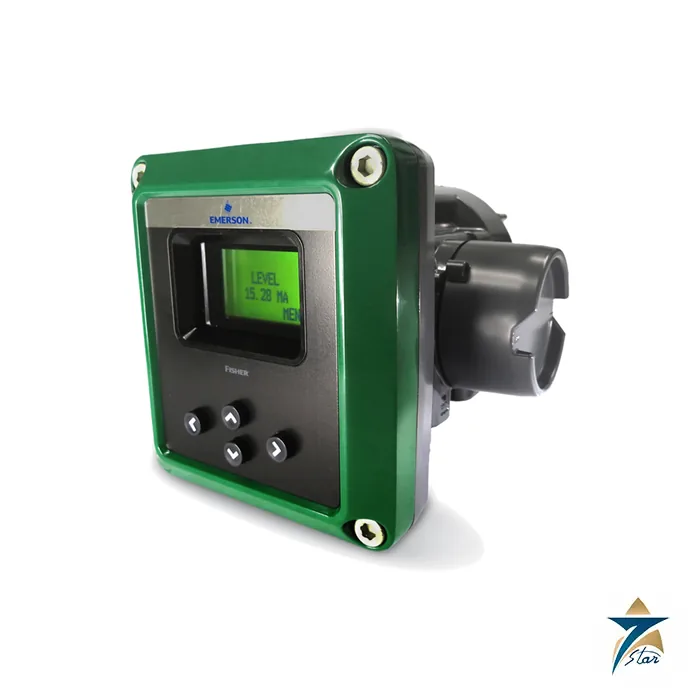
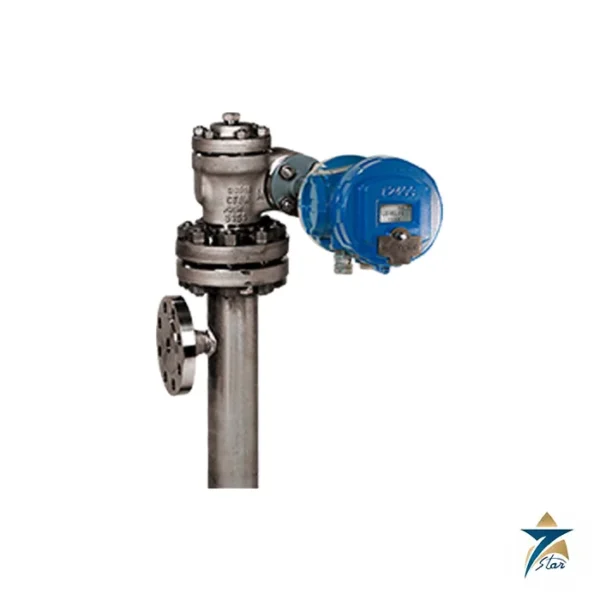
The Fisher DLC3100 is a FIELDVUE digital level controller that works with a displacer-type level sensor to measure liquid level, the level of the interface between two liquids, or liquid density. It is a loop-powered, HART communicating instrument that turns the rotary motion of a torque tube into a 4 to 20 mA transmitter signal, with a local LCD and four push buttons for setup and calibration without an external tool. Two versions are available: the standard DLC3100 and the DLC3100 SIS, which is certified SIL2 capable for safety instrumented functions.
Seven Star LLC supplies the Fisher DLC3100 to oil and gas producers, refineries, gas plants and utilities in Oman and the wider GCC. Many separators, scrubbers and knock-out drums in the region already use Fisher 249 displacers, and our engineers in Muscat help customers specify the Fisher DLC3100 either as a new assembly or as a digital upgrade on an existing sensor, with documentation taken from the official Fisher DLC3100 datasheet.
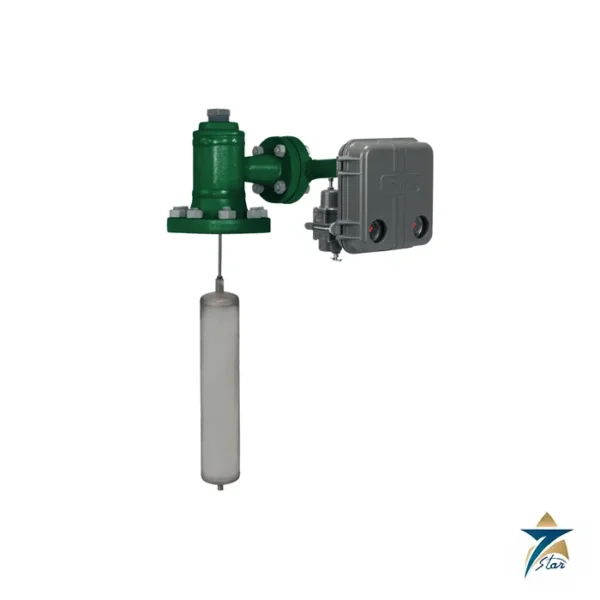
A change in level, interface or density changes the buoyancy acting on the displacer. This force is transferred to the torque tube assembly, which rotates as the measured fluid changes. The rotation is passed to the lever assembly of the controller, where it moves a magnet and changes the magnetic field seen by a Hall-effect sensor. The sensor output is processed digitally to provide linearity correction, sensitivity adjustment and temperature compensation, and an accurate high-gain analog-to-digital conversion allows very small changes in the process variable to be resolved.
The Fisher DLC3100 interprets the signal as a buoyancy change by reference to the stored torque rate, coupling point and moment arm data, then converts it to level, interface or density using the stored displacer volume, specific gravity and displacer length. A user offset can shift the reference from the bottom of the displacer. The resulting primary variable is compared with alarm thresholds and, if no alarm is active, generates the 4 to 20 mA output and a 0 to 100 percent digital range. Saturation is held at 3.8 and 20.5 mA so that saturated readings can be separated from NAMUR NE43 alarm currents.
The housing and cover are low-copper aluminum die casting rated IP66 and Type 4X, with fully encapsulated electronics that resist vibration, temperature and corrosive atmospheres. A separate IP66 wiring terminal box isolates field wiring from the rest of the instrument, and two 1/2-14 NPT conduit connections are located at the bottom of the terminal box. The lever assembly is pinned at the neutral position whenever the coupling access door is open, which stabilizes the mechanism during transport when the controller is purchased separately from the sensor.
The modular design allows components to be interchanged, and part kits are available for spare replacement. The Fisher DLC3100 mounts on caged and cageless 249 sensors, and options include a sunshade, a heat insulator for high or low process temperatures, and mountings for Masoneilan, Yamatake and Foxboro-Eckardt displacers. The complete instrument weighs less than 3.45 kg and operates from 12 to 30 V DC, with a minimum compliance voltage of 17.75 V DC needed to guarantee HART communication.
The product bulletin lists the following Fisher DLC3100 capabilities for level, interface and density service.
Displacer level measurement remains a standard choice for vessels where density is known and stable reading is essential. The Fisher DLC3100 is used for level and oil-water interface control on production separators, slug catchers, flare knock-out drums, glycol and amine contactors, condensate stabilizers and boiler drums, as well as density measurement where the process fluid changes composition. Caged 249 sensors suit vessels with internal obstructions or turbulence, while cageless sensors with large displacers support specific gravity and interface work through flange connections up to 8 inches. These duties are common across upstream fields in the Sultanate of Oman, refineries and petrochemical units in Sohar, and gas processing and LNG facilities on the coast.
Seven Star LLC supports level instrumentation projects across Oman and the GCC with model selection, approvals review and regional delivery. Where a non-contact or switch-based alternative is needed, compare the Fisher DLC3100 with the Rosemount 5300 guided wave radar level transmitter and the Rosemount 2140 vibrating fork level detector. For the final control element of the level loop, the Fisher FIELDVUE DVC6200 digital valve controller uses the same HART infrastructure.
Key Fisher DLC3100 data from Emerson Product Bulletin 11.2:DLC3100 is summarized below.
| Parameter | Specification |
|---|---|
| Model | Fisher DLC3100 (FIELDVUE DLC3100 and DLC3100 SIS) |
| Function | Transmitter for liquid level, interface level or density (density not on SIS version) |
| Compatible sensors | Fisher 249 caged and cageless; Masoneilan, Foxboro-Eckardt and Yamatake with adaptors |
| Output | 4 to 20 mA DC, direct or reverse action, with HART 1200 baud FSK |
| Saturation / alarm | 3.8 / 20.5 mA saturation; high alarm >21.0 mA or low alarm <3.6 mA (NAMUR NE43) |
| Supply | 12 to 30 V DC, 25 mA, reverse polarity protected |
| Temperature input | 2- or 3-wire 100 ohm platinum RTD or user-entered target temperature |
| Independent linearity | ±0.25% of output span (controller); ±0.5% with most 249 sensors |
| Repeatability | ±0.1% of full scale output (controller) |
| Minimum differential specific gravity | 0.05 SGU |
| Operating ambient temperature | –40 to 80 °C (LCD readable –20 to 70 °C) |
| Enclosure | IP66, Type 4X; low-copper aluminum housing |
| Electrical connections | Two 1/2-14 NPT internal conduit connections |
| Hazardous area | CSA, ATEX and IECEx intrinsic safety, flameproof, Type n and dust; ESMA ECAS-Ex (UAE) among other certifications |
| Safety (SIS version) | SIL2 capable per IEC 61508, certified by exida |
| Weight | Less than 3.45 kg |
For a formal RFQ, send Seven Star LLC the Fisher DLC3100 version you need (standard or SIS), the existing or new 249 sensor details, displacer volume and length, process specific gravities, process temperature range, hazardous area approval and any options such as a heat insulator or third-party mounting kit. Our instrumentation division will confirm the configuration against the Fisher DLC3100 datasheet, check current availability and lead time, and provide the bulletin for download, with engineering support in Muscat for level control projects throughout Oman and the GCC.
Browse Fisher products by category: Control Valves, Valve Positioner, Valve Actuator, Regulators.
Choose the option that best fits your needs to get the fastest response from our team.
Automatically fill the RFQ form with this product's details for a faster process.
Manually enter multiple part numbers, specific brands, or custom requirements.











Reviews
There are no reviews yet.