- Automation & ControlView all 2,608 products
- Automation Accessories
- AC Drives
- PLC & I/O Cards
- Industrial Communications
- Vibration Monitoring
- Controllers & Data Acquisition
- Isolator & Barrier
- Safety Switches & Guard Locking
- Motor Soft Starters
- CCTV & Security
- Encoders
- HMI Displays
- Pneumatic Cylinders
- Servo Drives
- Industrial Computers
- Machine Vision
- Automation Software
- Robotics
















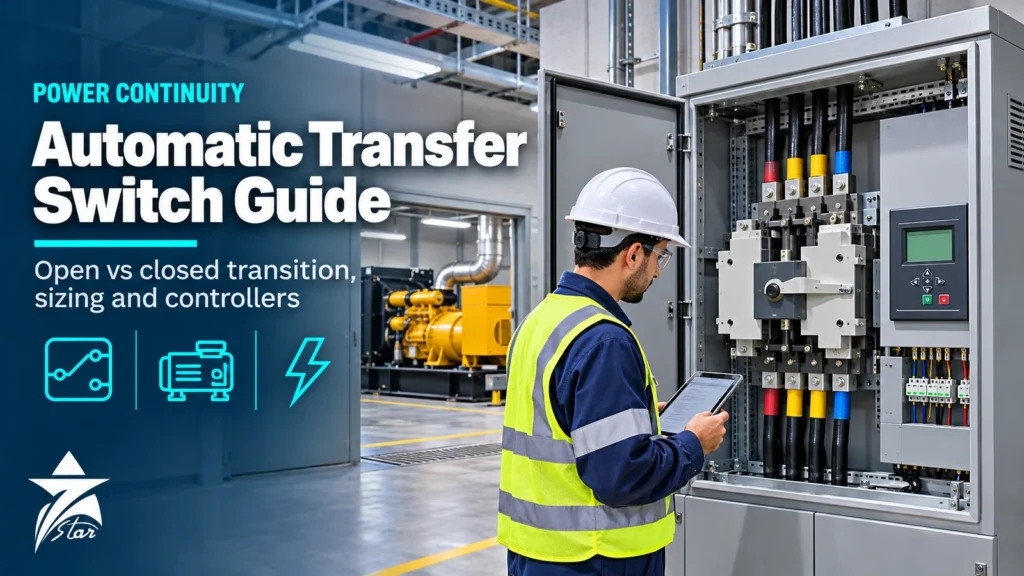
An automatic transfer switch (ATS) is the device that decides, without anyone touching it, whether a building or a plant runs on the utility supply or on its standby generator. When the mains fails it signals the generator to start, waits until the set is ready, moves the load across, and later moves it back when the mains is stable again. On sites in Oman where a short outage can stop a pump station, a cold store, a telecom shelter or a process line, the automatic transfer switch is as important as the generator itself. This guide explains how an ATS works, the difference between open and closed transition, the main switch types and standards, how to size one correctly and which controller settings matter.
How an Automatic Transfer Switch Works
Every ATS has two parts: a power switching device that carries the load current, and a controller that monitors the sources and decides when to switch. In a typical mains-to-generator installation the sequence is:
- Mains monitoring. The controller watches voltage, frequency, phase loss and phase sequence on the utility side, usually on all three phases.
- Mains failure confirmation. A short delay (often a few seconds) filters out dips and auto-reclose events so the generator is not started for every flicker.
- Generator start. The controller closes the remote start contact or, in an AMF controller, cranks the engine directly.
- Generator ready. Transfer happens only when generator voltage and frequency are inside limits and a warm-up delay has elapsed.
- Transfer to generator. The switch opens the mains side and closes the generator side.
- Mains return. When the utility comes back, a return delay (commonly minutes, not seconds) confirms it is stable before the load is moved back.
- Cool-down. The generator runs unloaded for a few minutes after retransfer, then stops and waits for the next event.
The same logic can live in two places. Some sites use a separate ATS controller in the transfer panel and a generator with a simple remote-start controller. Others use an automatic mains failure (AMF) generator controller that monitors the mains and drives both breakers itself. Both are valid; the choice usually depends on how far the generator is from the main switchboard and who maintains which panel.
Open, Delayed and Closed Transition
The transition type describes what the load sees during the transfer. It is the single most important choice in the specification, because it decides whether the switch needs synchronising and whether the utility must approve the installation.
| Transition type | What happens | Load sees | Typical use |
|---|---|---|---|
| Open transition (break-before-make) | One source opens fully before the other closes | A short interruption, typically a fraction of a second | Most commercial and industrial standby systems |
| Delayed transition | The switch rests in a neutral (off) position for an adjustable time | A longer, controlled interruption | Large motors, transformers and drives that keep residual voltage after the supply opens |
| Closed transition (make-before-break) | Both sources are briefly paralleled after a synchronism check, then one opens | No interruption on retransfer or test | Hospitals, data centres, process plants that cannot accept a second blackout on return to mains |
| Soft-load (extended parallel) | The generator ramps load up or down while paralleled with the mains | No interruption and no load step | Larger sites with paralleling controllers and utility approval |
Closed transition only removes the break when both sources are healthy, for example on retransfer or during a planned test. When the mains fails suddenly there is always an interruption until the generator is ready, which is why critical loads still need a UPS. See our guide to UPS topologies and runtime for how the two systems work together. Any paralleling with the utility network, even for a fraction of a second, normally needs the agreement of the distribution company, so check this before choosing a closed transition design.
Delayed transition deserves more attention than it usually gets. A large running motor keeps generating voltage for a moment after the supply opens. If the other source closes onto it out of phase, the inrush can trip breakers or damage couplings. A neutral delay of a second or two, or an in-phase monitor, avoids this.
ATS Switch Types and Standards
Transfer switching equipment is covered internationally by IEC 60947-6-1 (in North America the equivalent is UL 1008). The IEC standard groups equipment into classes, and knowing them helps when comparing quotations that look similar on paper.
| Construction | How it switches | Strengths | Watch-outs |
|---|---|---|---|
| PC-class transfer switch | A dedicated changeover mechanism that makes and withstands short-circuit current but is not designed to break it | Compact, fast, mechanically interlocked, one product | Needs upstream protection; check the rated conditional short-circuit current |
| CB-class transfer switch | Two circuit breakers with motor operators and an interlock | Built-in overcurrent protection, familiar parts | Larger, slower, more parts to maintain |
| Contactor-based changeover | Two interlocked contactors driven by a controller | Low cost at small ratings | Contact wear on frequent tests; mechanical and electrical interlock both needed |
| Manual or motorised changeover switch | A three-position (I-0-II) switch, operated by hand or by a motor | Simple and robust | Manual versions need an operator on site |
IEC 60947-6-1 also assigns utilisation categories. AC-31 covers non-inductive loads, AC-32 mixed resistive and inductive loads, and AC-33 includes motor loads, which is the category most industrial sites in Oman should specify. A switch rated AC-31 at a given current is not equivalent to one rated AC-33 at the same current. If your installation uses moulded-case or air circuit breakers as the switching devices, our circuit breaker types guide explains breaking capacity, trip units and selectivity.
3-Pole or 4-Pole: Switching the Neutral
Whether the neutral should be switched depends on the earthing system and on where the generator neutral is bonded to earth.
- 4-pole switch. Used when the generator is treated as a separately derived source with its own neutral-earth bond, which is common in TN-S systems. Switching the neutral prevents neutral current from returning through two paths and avoids nuisance tripping of earth-fault and residual current protection.
- 3-pole switch. Used where the neutral is solidly connected and bonded at one point for both sources. The neutral stays connected and only the phases are switched.
- Overlapping neutral. Some 4-pole switches close the neutral slightly before and open it slightly after the phases to avoid floating neutral voltages on single-phase loads.
This decision should be made by the electrical designer against the local regulations and the utility’s requirements. Getting it wrong is one of the most common reasons earth-fault relays trip when a site runs on its generator.
How to Size an Automatic Transfer Switch
| Parameter | What to check | Practical note |
|---|---|---|
| Rated current | At least the full-load current of the circuit it feeds | Size to the downstream board or the generator breaker, not to today’s measured load |
| Utilisation category | AC-33 for motor or mixed loads | Ask for the rating at the category you need, not the best-case AC-31 figure |
| Short-circuit rating | Rated short-time withstand current (Icw) or conditional short-circuit current with the stated upstream protection | Must match the prospective fault level at the switchboard |
| Poles | 3P or 4P | Follows the earthing design above |
| Voltage and frequency | 400/415 V or 230 V, 50 Hz in Oman | Confirm control supply voltage too |
| Ambient temperature | Ratings are usually given at 40 °C or lower | Panels in plant rooms and outdoor kiosks in summer can exceed this; apply the maker’s derating |
| Enclosure | IP rating, ventilation, cable entry | Dust and heat drive most outdoor failures |
The generator itself must also be able to accept the load the ATS hands it in one step. If several large motors start together on transfer, the voltage dip can be severe. Our diesel generator sizing guide covers load steps, motor starting and derating for heat.
Controller Settings That Matter
Most transfer problems on site are settings problems, not hardware faults. These are the parameters to agree during commissioning:
- Under- and over-voltage, under- and over-frequency limits for both sources, with hysteresis so the controller does not hunt around the threshold.
- Phase loss, phase sequence and voltage unbalance detection, which protect three-phase motors from running on a faulty supply.
- Mains failure delay to ride through short dips and recloser operations.
- Generator warm-up and stabilisation delay before transfer.
- Mains return delay so the load is not moved back onto a supply that fails again a minute later.
- Neutral position delay for motor loads (delayed transition).
- Cool-down time for the engine after retransfer.
- Exerciser and test modes: test off-load, test on-load, and a weekly or monthly exercise timer.
- Communication: Modbus RTU over RS-485 or Modbus TCP to a BMS or SCADA system, plus volt-free contacts for source status and alarms.
Testing and Maintaining an ATS
An ATS that sits unused for months is the one that fails on the day of the outage. A simple routine keeps it reliable:
- Run an on-load transfer test at the interval set by your maintenance plan, and record transfer and retransfer times.
- Inspect the switch mechanism, interlocks and auxiliary contacts, and check for signs of overheating such as discoloured terminals.
- Use thermography on terminations while the switch is carrying load.
- Check the controller battery or control supply, the event log and the clock used by the exercise timer.
- Confirm that sensing fuses and voltage-sensing wiring on both sources are intact.
These checks fit naturally into the generator routine described in our diesel generator maintenance schedule.
Transfer Switches and ATS Controllers We Supply
We quote complete transfer switches and the controllers that drive them, from makers often specified in Oman, including CHINT, Schneider Electric, Lovato Electric, ComAp, Datakom, Deep Sea Electronics and DEIF. Switches sit in our switchgear, enclosures and distribution category, and AMF and generator controllers in diesel generators and spare parts.
| Product | Type | Where it fits |
|---|---|---|
| CHINT NXZ Automatic Transfer Switch, 80-630 A | PC-class transfer switch, 3P/4P | Main and sub-main boards with a standby generator. |
| Schneider Electric Acti9 iATL Automatic Transfer Switch | Compact modular transfer switch | Small distribution boards and final circuits. |
| Lovato ATL600 ATS Controller | ATS controller, 2 sources | Motorised breakers or contactors in transfer panels. |
| Lovato ATL800 ATS Controller | ATS controller with communication | Transfer panels reporting to a BMS or SCADA. |
| Lovato ATL900 ATS Controller, 3 Sources | Multi-source controller with tie breakers | Two mains plus a generator, or closed transition schemes. |
| Lovato ATL100 ATS Controller | Basic ATS controller | Simple two-source changeover. |
| ComAp InteliATS2 50 ATS Controller | ATS controller | Mains-to-generator, mains-to-mains or generator-to-generator. |
| Datakom DKG-171 ATS Controller | Compact 72 x 72 mm ATS controller | Small panels with contactor changeover. |
| Deep Sea Electronics DSE7320 Auto Mains Failure Generator Controller | AMF generator controller | Generator panels that also drive the transfer. |
| ComAp InteliLite 4 AMF 25 Single Gen-Set Controller | AMF generator controller | Single standby sets with mains monitoring. |
| Lovato RGK600 Automatic Mains Failure Gen-Set Controller | AMF generator controller | Standby sets in commercial buildings. |
| ComAp InteliMains 1010 Mains and Bus-Tie Breaker Controller | Mains supervision controller | Multi-generator plants paralleling with the grid. |
For a quotation, send the rated current, number of poles, system voltage, the fault level at the board, the transition type you need, whether the switch should come in an enclosure, and the generator controller model if the ATS must work with an existing set, through our quote request form or to [email protected].
Buying an Automatic Transfer Switch in Oman Through Seven Star LLC
Seven Star LLC is an independent supplier in Oman of transfer switches, ATS and AMF controllers, motorised changeover switches and generator spare parts for commercial, utility, oil and gas and industrial sites. We match the make and model in your specification or panel drawing, offer comparable alternatives where a model is obsolete, and help cross-check ratings, poles and controller compatibility before you order. Availability and lead time are confirmed at quotation. If you are planning the generator as well, our diesel generator supplier guide explains how to specify the complete set.
Send us the single-line diagram, the switch nameplate or simply the current, poles and transition type, and we will prepare a matching quotation for the switch, the controller and any accessories.
Frequently asked questions
What does an automatic transfer switch do?
An automatic transfer switch monitors the utility supply and, when it fails, signals the standby generator to start and moves the load to the generator once it is ready. When the utility returns and stays stable for a set time, the ATS moves the load back and lets the generator cool down and stop.
What is the difference between open and closed transition?
In an open transition ATS, one source disconnects before the other connects, so the load sees a short interruption. In a closed transition ATS, both sources are briefly paralleled after a synchronism check, so there is no interruption on retransfer or during tests. Closed transition usually needs approval from the electricity distribution company.
Should an ATS be 3-pole or 4-pole?
It depends on the earthing system and where the generator neutral is bonded to earth. A 4-pole switch, which also switches the neutral, is used when the generator is a separately derived source, for example in many TN-S installations. A 3-pole switch is used when the neutral is common to both sources. The electrical designer should decide this against local regulations.
How do I size an automatic transfer switch?
Choose a rated current at least equal to the full-load current of the circuit, in the AC-33 utilisation category for motor or mixed loads, with a short-circuit rating that matches the prospective fault level at the board. Then check the number of poles, voltage, enclosure and derating for high ambient temperature.
What is the difference between an ATS controller and an AMF controller?
An ATS controller monitors two sources and drives the transfer switch, and sends a start signal to the generator. An AMF (automatic mains failure) controller is fitted on the generator and controls the engine, and it can also monitor the mains and operate the transfer breakers itself. Either arrangement can give fully automatic standby operation.
Who supplies automatic transfer switches in Oman?
Seven Star LLC is an independent supplier in Oman that quotes transfer switches and ATS and AMF controllers from makers such as CHINT, Schneider Electric, Lovato Electric, ComAp, Datakom, Deep Sea Electronics and DEIF. Send the current rating, poles, voltage and transition type through the quote request form or to [email protected].
Was this guide helpful?One click helps us write better guides for engineers.
Thank you! Glad it helped. Need this equipment for your project? Request a quotation
Thank you. We will use this to improve the guide.