- Vibration Monitoring
- Industrial Communications
- PLC & I/O Cards
- AC Drives
- Automation Accessories
- Controllers & Data Acquisition
- Industrial Computers
- Encoders
- Safety Switches & Guard Locking
- CCTV & Security
- Isolator & Barrier
- Motor Soft Starters
- HMI Displays
- Pneumatic Cylinders
- Automation Software
- Servo Drives
- Robotics
- Machine Vision
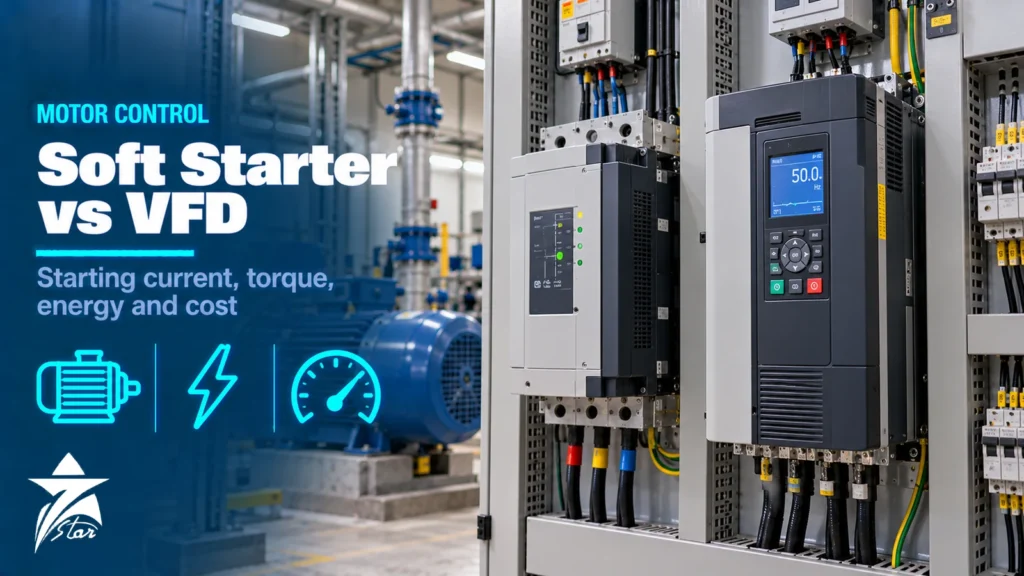
Starting a large induction motor direct on line draws a heavy inrush current, causes a voltage dip on the supply and hits the pump or conveyor with a sudden torque shock. Both soft starters and variable frequency drives solve that, but they do it in different ways and only one of them can control speed afterwards. Choosing between them affects capital cost, panel size, energy use, harmonics and maintenance for the life of the plant. This soft starter vs VFD guide explains how each device works, compares starting current, torque, energy and cost behaviour, and gives clear rules for when to choose each one.
The Problem With Direct-On-Line Starting
When a squirrel-cage induction motor is connected directly to full voltage, it draws a locked-rotor current that is commonly in the range of about 5 to 8 times full-load current, depending on motor design. This current lasts until the motor approaches full speed. The consequences are:
- Voltage dips that can trip other equipment, flicker lighting or exceed the utility’s or generator’s limits, particularly on weak or generator-fed supplies common at remote sites.
- High starting torque that stresses couplings, gearboxes, belts and the driven equipment.
- Pressure surges and water hammer in pumping systems when the pump accelerates and stops abruptly.
- Thermal and mechanical stress on the motor windings with frequent starts.
Star-delta starters reduce the current, but with an abrupt transition and reduced torque that does not suit every load. Soft starters and VFDs give a controlled alternative.
How a Soft Starter Works
A soft starter uses pairs of thyristors (SCRs) in two or three phases to reduce the voltage applied to the motor during start, then increases it to full voltage. Frequency stays at mains frequency, so the motor still runs at its normal speed once started. Because motor current falls roughly in proportion to applied voltage while torque falls roughly with the square of voltage, a start limited to half the direct-on-line current gives only about a quarter of the direct-on-line torque. That is why soft starters suit loads that need little torque at low speed.
Most modern soft starters close an internal or external bypass contactor once the motor reaches speed, which takes the thyristors out of circuit and largely removes their heat losses during running. Typical functions include voltage ramp, current limit, torque control for smoother pump acceleration, soft stop to reduce water hammer, and built-in motor protection on many models. See our motor soft starters range for examples.
How a VFD Works
A variable frequency drive rectifies the incoming AC to a DC bus, then uses IGBTs to synthesise a variable-voltage, variable-frequency output. Keeping the voltage-to-frequency ratio (or using vector control) lets the motor produce rated torque from very low speed while drawing close to rated current. The motor can therefore start a heavily loaded machine without a large inrush and then run continuously at any speed the process needs. Drives also offer controlled deceleration, process PID control, communication and extensive diagnostics. For drive sizing and derating in hot regions see our article on VFD selection for hot climates.
Soft Starter vs VFD: Side-by-Side Comparison
| Factor | Soft starter | VFD |
|---|---|---|
| Speed control | None; full speed only after start | Full speed range, continuous control |
| Starting current | Reduced, commonly set around 2.5–4 × FLC depending on load | Close to rated current for rated torque, within drive overload limits |
| Starting torque | Reduced (falls with the square of voltage) | Rated torque available from near zero speed |
| Suitable loads | Centrifugal pumps, fans, compressors, lightly loaded conveyors | All loads including high-inertia, constant-torque and variable-flow duties |
| Energy saving at run | None beyond avoiding DOL; bypass keeps losses low | Large savings on variable-torque loads run at reduced speed |
| Running losses | Very low with bypass | Typically a few percent of rated power in the drive |
| Harmonics | Only during start and stop | Continuous; may need line reactors, filters or active front end |
| Size and heat | Compact, low heat when bypassed | Larger, continuous heat to remove from the panel |
| Motor and cable issues | Same as DOL during run | Voltage reflection on long cables, bearing currents, motor insulation stress |
| Relative cost | Generally lower purchase cost and simpler | Higher purchase cost; return comes from energy and process control |
Energy: Where the VFD Pays Back
For centrifugal pumps and fans, the affinity laws state that flow varies with speed, pressure with the square of speed and power with the cube of speed. A fan running at 80 % speed needs roughly half of full-speed power in theory. If the process currently throttles flow with a valve or damper, or cycles on and off, a VFD can recover a large share of that wasted energy. If the pump or fan runs at a fixed duty point at full speed most of the time, a VFD saves little and adds its own losses; a soft starter is then the sensible choice.
Static head reduces the benefit for pumps: when much of the pump head is lifting water to a fixed height, speed can only be reduced a little before flow drops sharply. Check the system curve before assuming savings.
When to Choose a Soft Starter
- The motor runs at constant speed and only the start and stop need to be controlled.
- The load has low starting torque: centrifugal pumps, fans, unloaded screw compressors.
- The goal is to reduce inrush current and voltage dip on a transformer or generator.
- Water hammer on pump stop is a problem and a soft stop or pump-control algorithm solves it.
- Panel space, heat removal and harmonics must be kept to a minimum.
- Starts per hour are within the soft starter’s rating; frequent starts may require a heavier duty rating.
When to Choose a VFD
- The process needs variable flow, pressure or speed: booster pumps, cooling tower fans, air handling units, conveyors with speed setpoints.
- The load needs high torque from standstill: loaded conveyors, crushers, mixers, extruders, positive displacement pumps.
- Starting current must be kept close to rated current, for example on a small generator.
- Frequent starts and stops or controlled positioning are required.
- Energy saving on variable-torque loads justifies the investment.
Supply, Harmonics and Generator Considerations
At remote GCC sites many motors run from diesel generators or weak grid connections. Both devices reduce starting kVA compared with direct-on-line starting, which can allow a smaller generator. The VFD reduces it most, but its rectifier injects harmonic currents continuously, which can overheat generators and transformers and disturb other equipment. IEEE 519 is the common reference for harmonic limits at the point of common coupling. Mitigation options include DC chokes, line reactors, passive filters, multi-pulse rectifiers and active front-end drives. A soft starter produces harmonics only while ramping, so it seldom needs mitigation.
Heat, Dust and Panel Design in the GCC
Drives lose heat continuously, typically a few percent of their rated power, and most drives must be derated above their rated ambient. In an outdoor kiosk at 50 °C this can mean a larger drive frame or panel air conditioning. A bypassed soft starter dissipates heat mainly during the start, so the cabinet design is simpler. Fine dust clogs drive heatsink fans and filters, so maintenance intervals in desert locations should be shorter. Both devices need ambient and altitude derating checked against the manufacturer’s data.
Common Soft Starter vs VFD Mistakes
- Installing a VFD on a fixed-speed pump that will never run below full speed, adding cost, losses and harmonics without benefit.
- Using a soft starter on a high-inertia or constant-torque load that stalls or overheats the soft starter at reduced voltage.
- Sizing the soft starter only on motor current and ignoring starts per hour, start duration and ambient temperature.
- Forgetting harmonic mitigation on generator-fed VFD installations.
- Leaving out motor protection or upstream coordination: both devices need correctly selected contactors, overload protection and short-circuit protection as specified by the manufacturer.
- Using long motor cables on a VFD without checking the drive’s cable length limits and the need for output reactors or dV/dt filters.
Maintenance and Troubleshooting
The two devices fail in different ways, so maintenance plans should differ.
- Soft starters: check bypass contact condition and tightness of power terminals; most thyristor failures trace back to overheating from too many starts, blocked ventilation or loose connections. Review the trip log for repeated current-limit or start-time faults, which usually mean the load needs more torque than the settings allow.
- VFDs: clean heatsinks and replace fan filters, check cooling fans, and monitor DC bus capacitors, which age faster at high temperature. Overvoltage trips on deceleration point to a ramp that is too short or a missing braking resistor; overcurrent trips on start point to tuning or motor-cable faults.
- Both: record parameter sets after commissioning and keep a backup, so a replacement unit can be configured quickly.
- Motor side: on VFD-fed motors, inspect bearings for electrical fluting where shaft grounding or insulated bearings were not fitted.
Selection Data to Collect
- Motor nameplate: kW, voltage, full-load current, speed, efficiency class, and starting characteristics if available
- Load type and torque curve: centrifugal, constant torque, high inertia
- Required speed range or confirmation that speed is fixed
- Starts per hour and start duration
- Supply: grid or generator, transformer or generator kVA, allowable voltage dip
- Ambient temperature, altitude, enclosure type and dust or corrosive conditions
- Motor cable length and motor insulation suitability for inverter supply
- Control interface: hard-wired, fieldbus protocol, PLC integration
Sourcing Soft Starters and VFDs Through Seven Star LLC
Seven Star LLC supplies soft starters, AC drives, and associated electric motors and switchgear on request, from manufacturers such as ABB, Siemens, Schneider Electric, Danfoss and WEG. We can help with selection and cross-checking part numbers against your motor data and existing equipment. Availability and lead time are confirmed at quotation.
Not sure whether your motor needs a soft starter or a VFD? Send Seven Star LLC the motor nameplate, the load type and your RFQ, and we will quote suitable options for comparison.
Frequently asked questions
Does a soft starter save energy?
Not during normal running. A soft starter only controls the start and stop; once bypassed, the motor runs at full voltage and speed as it would direct on line. Its benefit is reduced inrush, lower mechanical stress and smoother pump stops, not running energy savings.
Can a VFD be used just as a soft starter?
Yes, a VFD can ramp a motor up and run it at full speed, and it gives better starting performance than a soft starter. However, it costs more, is larger, produces continuous harmonics and running losses, so it is usually only justified when speed control or very high starting torque is needed.
Why can a soft starter not start high-torque loads?
A soft starter reduces voltage at constant frequency. Motor torque falls roughly with the square of voltage, so limiting current to reduce inrush also cuts torque sharply. Loads such as loaded conveyors or crushers may stall, while a VFD can deliver rated torque from near zero speed at close to rated current.
Which is better for a generator-fed pump?
Both reduce the starting kVA demand compared with direct-on-line starting. A VFD reduces it most, but its continuous harmonics must be considered for generator heating and voltage distortion. For a fixed-speed centrifugal pump, a soft starter is often adequate and simpler; for variable flow, a VFD with harmonic mitigation is the better fit.
Does a soft starter prevent water hammer?
It helps. A soft stop ramps the voltage down so the pump decelerates gradually instead of stopping abruptly, and some soft starters include pump-control algorithms designed for this. Severe cases may still need check valve selection, surge vessels or a VFD for fully controlled deceleration.
What does a bypass contactor do in a soft starter?
After the motor reaches full speed, the bypass contactor connects the motor directly to the supply and takes the thyristors out of circuit. This removes most of the soft starter's heat losses during running, allowing a smaller enclosure and less cooling. Many modern soft starters have the bypass built in.
Was this guide helpful?One click helps us write better guides for engineers.
Thank you! Glad it helped. Need this equipment for your project? Request a quotation
Thank you. We will use this to improve the guide.