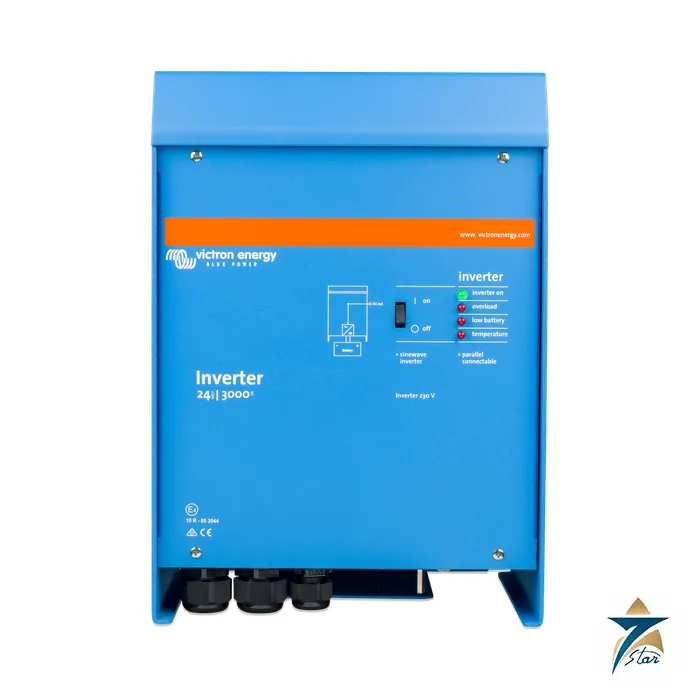
True sine wave inverter for 24 V battery systems
The Victron Phoenix Inverter 24/3000 converts 24 V DC battery power to 230 V AC, 50 Hz, with a continuous rating of 3000 VA at 25 °C. Victron calls its inverter technology SinusMax: a true sine wave design for professional duty, built with hybrid HF technology that combines compact size and light weight with high start-up power for loads such as refrigeration compressors and electric motors.
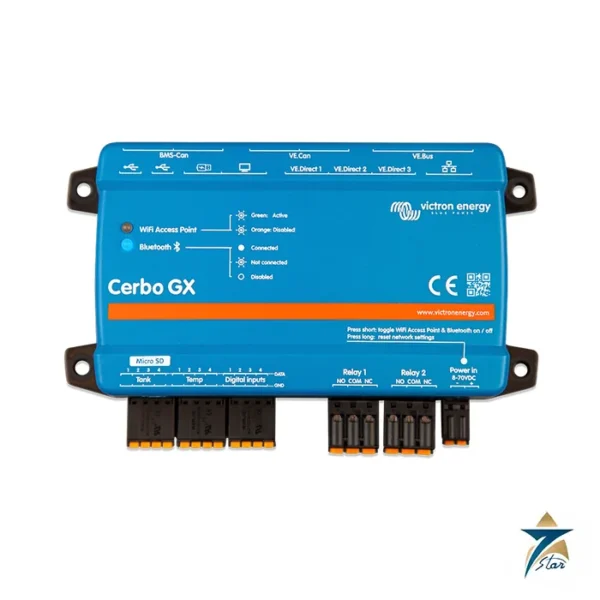
The unit has a VE.Bus communication port, so up to six inverters can be operated in parallel for more power, or in 3-phase configuration. The port connects to a GX device such as the Cerbo GX or Ekrano GX for monitoring, and to a PC through a MK3-USB interface for configuration with VEConfigure.
Technical specifications
| Parameter |
Specification |
| Manufacturer / model |
Victron Energy, Phoenix Inverter 24/3000 (part number PIN243020000) |
| DC input voltage range |
19 to 33 V |
| Output voltage / frequency |
230 VAC ± 2 %; 50 Hz ± 0.1 % (adjustable to 60 Hz and to 240 V) |
| Continuous output power at 25 °C |
3000 VA |
| Continuous output power |
2400 W at 25 °C; 2200 W at 40 °C; 1700 W at 65 °C |
| Peak power |
6000 W |
| Maximum efficiency (24 V) |
94 % |
| Zero load power (24 V) |
20 W; 15 W in AES mode; 10 W in Search mode |
| Parallel and 3-phase operation |
Yes |
| Programmable relay |
Yes: general alarm, DC under voltage or genset start/stop; AC rating 230 V / 4 A; DC rating 4 A up to 35 VDC, 1 A up to 60 VDC |
| Protections |
Output short circuit, overload, battery voltage too high, battery voltage too low, temperature too high, 230 VAC on inverter output, input voltage ripple too high |
| Interface |
VE.Bus port; remote on-off |
| Operating temperature |
-40 to +65 °C (fan assisted cooling); humidity max 95 %, non-condensing |
| Enclosure |
Aluminium, blue RAL 5012; protection IP21 |
| Battery connection |
Battery cables of 1.5 m included |
| Standards |
Safety EN 60335-1; emission and immunity EN 55014-1 / EN 55014-2 |
Applications and sizing
The 24/3000 is used where a battery bank has to supply AC loads: backup of control rooms and telecom shelters, off-grid power for remote sites, and mobile or marine installations. The built-in relay can start a generator on low battery voltage, which links the inverter to a gen-set start-stop scheme.
Size the inverter on the real load, including start-up surges and the temperature at the installation, because continuous power falls from 2400 W at 25 °C to 1700 W at 65 °C. The battery bank and DC cable cross-section must carry the full DC current at low battery voltage, and a DC fuse or breaker is required next to the battery.
Choosing between Phoenix inverters and MultiPlus
| Model (datasheet column) |
DC input range |
Continuous power at 25 °C |
Peak power |
| Phoenix Inverter 24/3000 (this page) |
19 to 33 V |
3000 VA / 2400 W |
6000 W |
| Phoenix Inverter 12/3000 |
9.5 to 17 V |
3000 VA / 2400 W |
6000 W |
| Phoenix Inverter 48/3000 |
38 to 66 V |
3000 VA / 2400 W |
6000 W |
| Phoenix Inverter 24/5000 |
19 to 33 V |
5000 VA / 4000 W |
10000 W |
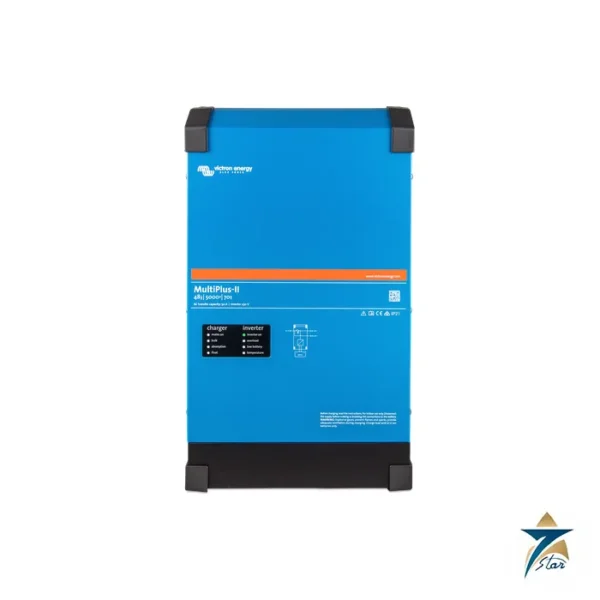
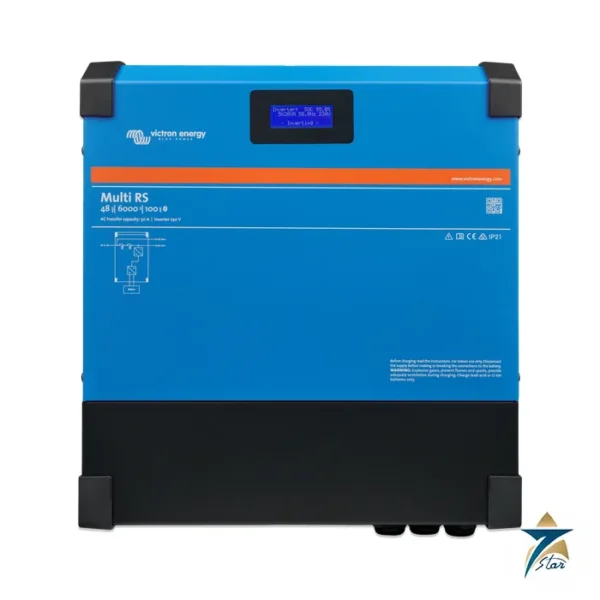
Victron points out in the datasheet that the MultiPlus inverter/charger should be used if an automatic transfer switch is needed, because it includes the switch and a charger. For a charger-inverter see Victron MultiPlus-II 48/5000/70-50 inverter charger.
Key features of the Phoenix 24/3000
- High start-up power: the 6000 W peak rating lets the inverter start loads with high inrush, such as compressors, pumps and motors, that a smaller inverter would trip on.
- Low standby consumption: AES and Search modes cut zero-load consumption from 20 W to 15 W or 10 W, which matters on systems that run from batteries overnight or through long autonomy periods.
- Programmable relay: can signal a general alarm, DC under voltage, or start and stop a generator, which turns the inverter into part of a simple hybrid system.
- VE.Bus scalability: parallel or 3-phase operation with up to six units, plus remote monitoring through a GX device.
- Adjustable output: 50 Hz is standard, with adjustment to 60 Hz and 240 V for equipment that needs it.
Derating with temperature: why it matters in the Gulf
The datasheet shows continuous output falling from 2400 W at 25 °C to 2200 W at 40 °C and 1700 W at 65 °C. In Oman and the wider GCC, inverter rooms, telecom shelters and equipment cabinets regularly exceed 40 °C in summer, so the usable continuous power should be read from the hot end of the table rather than the headline 3000 VA figure. Plan the load list against the 40 °C value as a minimum, and against the higher temperature figure if the inverter sits in an unconditioned enclosure.
Practical measures that help:
- Mount the unit vertically with clear space above and below so its fan can move air through the heatsink.
- Keep it out of direct sun and away from battery off-gassing.
- In dusty locations, clean the air path during routine maintenance; dust on the heatsink raises internal temperature and brings forward overtemperature shutdowns.
Installation notes
At 24 V, a 3 kVA inverter draws a large DC current, so cable size and length on the battery side deserve care. Use short, correctly sized battery cables, a suitable DC fuse close to the battery, and tight, clean lugs; voltage drop on undersized cables causes the inverter to see a lower battery voltage than the battery itself and can trigger low-voltage alarms under heavy load. The input range of 19 to 33 V covers lead-acid and lithium 24 V banks, but low-voltage shutdown and restart levels should be set in VEConfigure to suit the battery chemistry.
On the AC side, follow local wiring rules for earthing and residual current protection. The inverter output should be treated as a separate source, and it should not be back-fed from the grid. If grid or generator charging is also needed, the MultiPlus range covered above is usually the better fit.
Typical applications in Oman and the GCC
- Back-up AC for control panels, SCADA RTUs and communication equipment at remote sites with 24 V battery banks.
- Off-grid solar systems at farms, camps and pumping stations.
- Vehicle, marine and mobile workshop installations running on 24 V.
- Three-phase small loads by combining three units on VE.Bus.
What to include in an RFQ
Please state the part number PIN243020000, quantity, battery voltage and chemistry, the largest motor or compressor load to be started, whether parallel or 3-phase operation is planned, and whether accessories such as a GX device, MK3-USB interface or remote panel are needed. Include the delivery location and the expected ambient temperature at the installation so the rating can be checked against the derating table.
Documents and quotation
The attached Victron datasheet covers the whole 1200 VA to 5000 VA inverter range, so check the 24/3000 column. For a quotation send the part number, quantity and battery voltage. See Solar Power for other solar and power products.




Reviews
There are no reviews yet.