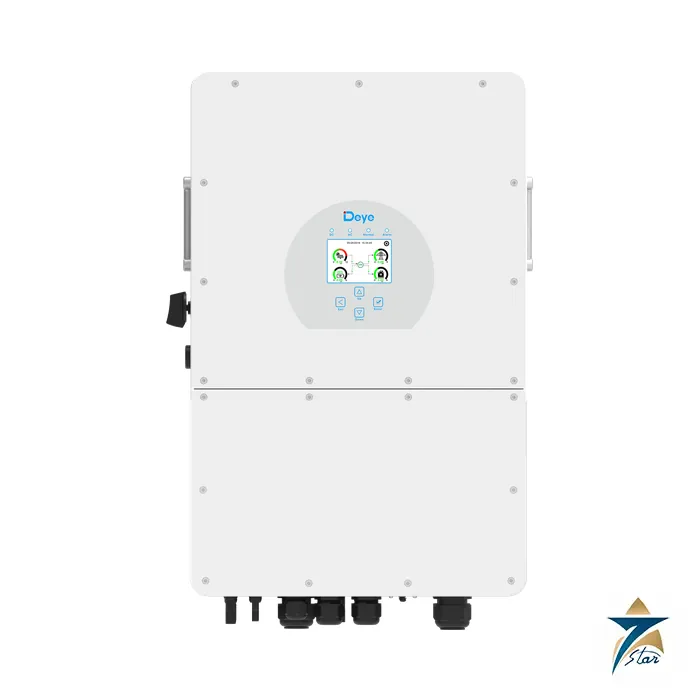
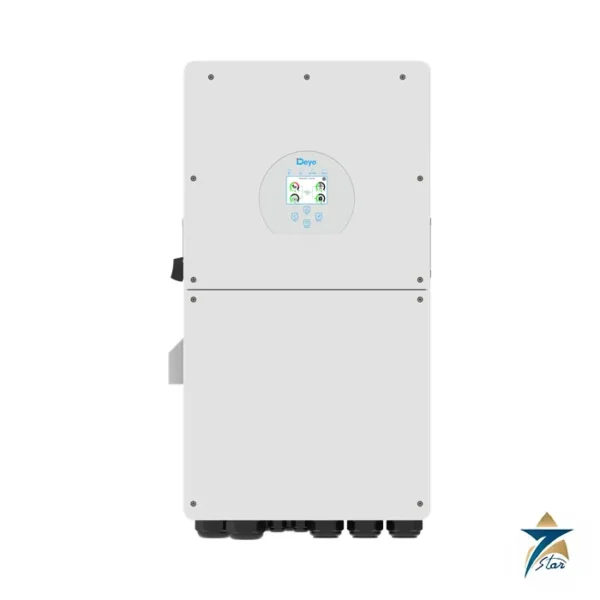
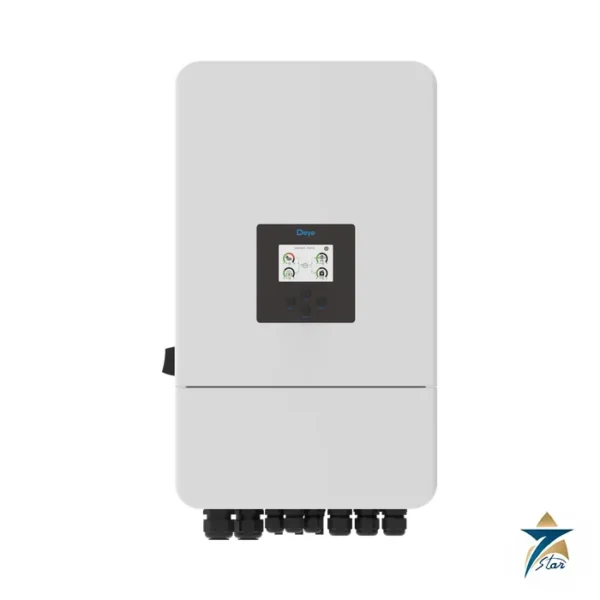
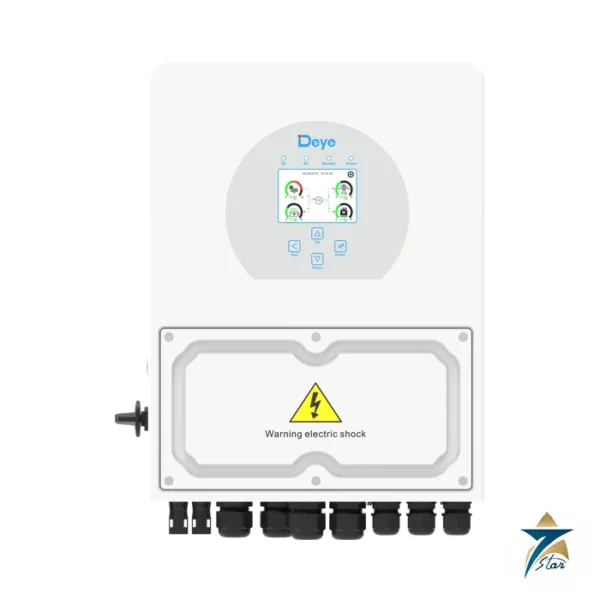
The Deye SUN-20K-SG01HP3-EU-AM2 is a 20 kW three-phase hybrid inverter built for high-voltage lithium batteries between 160 and 700 V. It has two MPP trackers with up to 40 kW of PV access power, a 50 A charge and discharge limit, and a four-wire 380 or 400 V grid connection. It suits commercial roofs and large villas that want solar, storage and backup in a single wall unit, with the battery at a higher voltage than a 48 V system.
What high voltage changes at 20 kW
A 48 V battery moving 20 kW would need several hundred amps, which means heavy copper and big breakers. At 160 to 700 V the same power needs only tens of amps, so cables are thinner, losses are lower and rack batteries can be stacked in series. The trade-off is compatibility: the inverter works with lithium packs that talk to it over CAN or RS485, and it adapts its charging to the battery management system instead of using a lead-acid profile.
What Deye highlights
- Each phase can carry full output when loads are unbalanced.
- An existing solar array can be AC-coupled.
- Up to 10 units run in parallel, on-grid or off-grid, with several batteries.
- Six charge and discharge periods per day.
- A diesel generator can feed energy into storage.
Technical specification
The first table compares the 15, 20 and 25 kW columns of the 2026 datasheet. The second gives the family values.
Selected models
| Item |
15K |
20K (this code) |
25K |
| Rated AC power (W) |
15000 |
20000 |
25000 |
| Max. apparent power (VA) |
16500 |
22000 |
27500 |
| Max. PV input power (W) |
24000 |
32000 |
40000 |
| Max. PV access power (W) |
30000 |
40000 |
50000 |
| Rated AC current in / out (A) |
22.8 / 21.8 |
30.4 / 29 |
37.9 / 36.3 |
| Max. AC current in / out (A) |
25 / 24 |
33.4 / 31.9 |
41.7 / 39.9 |
| PV current per tracker (A) |
26 + 20 |
26 + 26 |
26 + 26 |
Remaining datasheet entries
| Feature |
Printed value |
| Battery side |
One lithium-ion input between 160 and 700 V; 50 A in each direction on the larger models |
| PV side |
Accepts 1000 V; wakes at 180 V; tracks 150 to 850 V; nominal 700 V on the 20K and 25K |
| Mains |
Three phases plus neutral and earth, 380 or 400 V line-to-line, 50 or 60 Hz, power factor 0.8 either way |
| Bypass and surge |
80 A continuous from grid to load; one and a half times rating for ten seconds off-grid |
| Conversion |
Best 97.6%, European 97.0%, tracker efficiency over 99% |
| Safeguards |
Island, insulation and leakage-current supervision with a DC isolator; arresters of type II at both ends; arc-fault interrupter optional |
| Climate limits |
Runs from -40 to +60 C, derating after 45 C; any humidity; to 2000 m; to 55 dB(A) |
| Build |
IP65, transformerless, 408 x 638 x 237 mm, 30.5 kg; larger models use fan cooling |
| Monitoring |
Wi-Fi, RS485 and CAN, with Wi-Fi, GPRS, Bluetooth or 4G modes |
| Cover |
Five years, up to ten by country |
Where the 20K fits in the range
The 15, 20 and 25 kW columns share one enclosure, so the real differences are AC current and PV capacity. The 20K accepts 32 kW on the DC side and two full 26 A tracker inputs, a ratio that suits east-west roofs. Its 33.4 A maximum AC current is the figure for grid breaker and cable, while the 35 A unbalanced-output limit tells you how much single-phase load one phase can carry in backup mode.
Installation notes from the user manual
For 12 to 25 kW the manual recommends a 100 A breaker on both the grid and backup-load ports and 4 AWG (16 mm2) AC cable at 4.0 Nm. Battery cable is 6 mm2 (8 AWG) within a 10 to 6 AWG range, and PV cable 4 mm2 (10 AWG). Keep about 50 cm clear around the unit and 100 cm in front, avoid humidity above 95%, direct cold air and altitudes above about 2000 m, and use a vertical wall.
Gulf site conditions
Large buildings in the region combine a heavy daytime cooling load with a need for backup on essential circuits. A 20 kW inverter with a high-voltage pack lets solar cover the air conditioning while the battery carries critical loads through an outage. Mount it on a shaded wall, since output derates above 45 degrees C, and keep the fan path clear of dust.
Quick sizing arithmetic
With 40 kW of PV access power against 20 kW of AC, the ratio is 2, and the 32 kW rated PV input is 1.6 times the AC rating. At 50 A and a battery voltage of 160 to 700 V, the battery port moves between 8 and 35 kW, so a pack at the low end of the range limits power below the inverter rating. Choose a pack voltage near 400 V or higher to use the full 20 kW from the battery. The cabinet weighs 30.5 kg, which one installer can lift to a prepared bracket.
Selection and installation notes
A hybrid inverter is selected from the PV array voltage and power, the battery voltage and chemistry, the backup load and the grid connection. Check that the string open-circuit voltage at the lowest site temperature stays below the input limit, that the battery is on the maker approved list with the right communication cable, and that the backup loads fit the rated output. Install in a shaded, ventilated place with the clearances on the data sheet, use DC isolators and surge protection, and have the grid settings approved by the local utility before connection.
Information needed for a quotation
Send the full model code, the quantity, the delivery location in Oman or the GCC, the intended use and any accessories needed, so that the complete package can be quoted together.
Documents and supply information
The manufacturer data sheet is attached to this page and should be read together with the project specification and the site risk assessment before a purchase is confirmed. Ratings, standards and dimensions are quoted as printed on that sheet. Lead time, stock position and certificates available with the shipment are confirmed in the quotation, and we supply to Oman and the wider GCC region for industrial, utility and building services projects.
Frequently asked questions
What battery voltage does the SUN-20K-SG01HP3-EU-AM2 accept?
160 to 700 V lithium-ion through a single battery input, with charging that follows the BMS.
How many PV trackers are there?
Two MPP trackers with two strings each, accepting up to 1000 V.
What are the charge and discharge limits?
50 A maximum charging and 50 A maximum discharging current.
Can it run off-grid?
Yes. It supports on-grid and off-grid operation with 1.5 times rated power for 10 seconds.
Why is only the datasheet attached?
Deye’s manual for this range is larger than the size we host, so request it separately.
Documents and quotation
Looking for a quotation on the SUN-20K-SG01HP3-EU-AM2? We are an independent supplier, not the manufacturer, so stock and delivery time are confirmed enquiry by enquiry. Attached here is the Deye datasheet that spans the entire 5 to 25 kW AM2 line. Deye’s manual runs past our hosting limit, so ask us if you need it. Please check the figures on this page against the maker documents before you order. More items in Solar Power.





Reviews
There are no reviews yet.