Brand:

Eurotherm 2404 1/4 DIN PID Controller and Programmer

Description

Overview

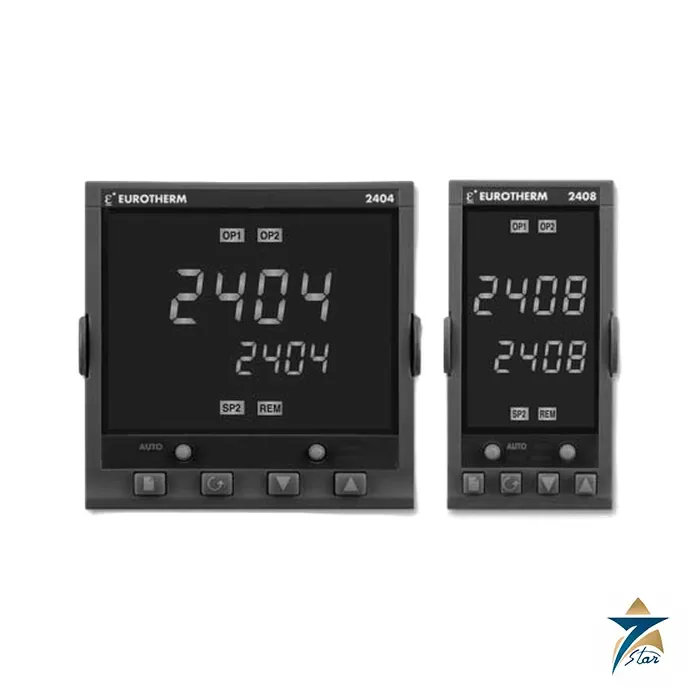
The Eurotherm 2404 is a modular, high-stability temperature and process controller with a built-in setpoint programmer, supplied in the 1/4 DIN panel size. Its architecture is unlike the fixed-hardware 3200 range: the base unit holds the PV input, two digital inputs and an optional alarm relay, and everything else, such as control outputs, retransmission, transmitter supplies and communications, is added as a plug-in module. That makes the 2404 a long-lived choice for furnaces and ovens where the I/O arrangement differs from one machine to the next, and it explains why replacement demand for exact 2404 build codes continues in industrial plants.

Seven Star LLC is an independent supplier serving Oman and the GCC. For the 2404 we work from the build code on your nameplate, because the modules fitted decide the wiring and function.

Control quality inside the Eurotherm 2404

The controller combines a one-shot tuner, which sets the initial PID values and calculates the overshoot inhibition parameters, with an adaptive tuner for processes whose behaviour keeps changing. On electrically heated loads, power feedback stabilises the output against supply voltage fluctuation. Dedicated cooling algorithms handle fan, water and oil cooled systems. Two PID sets can be selected on the process value. A universal input samples at 9 Hz (110 ms) and corrects itself for drift continuously, while 50 and 60 Hz pick-up is rejected for high noise immunity. Sensor diagnostics warn of an open or failed probe.

Operators see a bright custom LED display: the upper line is 21 mm high on the 2404, the lower line 10 mm. Dedicated buttons give auto/manual and programme run/hold, and password-protected access levels (operator, full, edit and configuration) hide everything that should not be touched.

Eurotherm 2404 specification summary

Parameter Eurotherm 2404 value
Panel format 1/4 DIN, cut-out 92 x 92 mm (minus 0.0, plus 0.8)
Depth behind panel 148 mm
Weight 670 g maximum
Supply 85 to 264 V AC, 48 to 62 Hz, 16 W maximum; or 24 V AC / 24 V DC
Inrush current 30 A for under 100 microseconds (high voltage); 15 A (low voltage)
Display Dual 7-segment LED; upper 21 mm, lower 10 mm
PV accuracy Better than 0.2 percent of reading plus 1 LSD
Sample rate 9 Hz (110 ms)
Thermocouples K, J, N, R, S, B, L, T, C, PL2, custom
RTD 3-wire Pt100, 0 to 400 ohm (minus 200 to plus 850 degrees C), 300 microamp bulb current
Linear ranges Minus 100 mV to plus 100 mV; 0 to 10 V; potentiometer 100 ohm to 15 kilohm
Control types PID, On/Off, VP, Dual VP; 2 PID sets
Alarms 4 alarms, latching or blocking available
Programmer Standard 1 program of 8 segments; options 1, 4 or 20 programs of 16 segments
Sealing and climate IP65; 0 to 55 degrees C; 5 to 90 percent RH non-condensing
Approvals CE, cUL (file E57766), Gost; suitable for Nadcap and AMS2750D under System Accuracy Test conditions

Plug-in modules and I/O capacity

Up to three I/O modules can be fitted. The datasheet lists single or dual relay modules (Form A or Form C, 2 A at 264 V AC resistive), single and dual triac modules (up to 1 A at 30 to 264 V AC resistive), logic output modules (single 12 V DC at 24 mA or triple at 9 mA), triple logic and contact-closure input modules, an analogue control output (0 to 20 mA or 0 to 10 V, 10 bits, 2.5 percent accuracy), an analogue retransmission output (11 bits, 0.5 percent), a 24 V DC transmitter supply at 20 mA, and a transducer supply selectable as 5 V or 10 V for bridges of 300 ohm to 15 kilohm. A second DC input module with isolation allows remote setpoint or power limit functions, and a potentiometer module reads valve position.

Programmer, alarms and PDSIO

The 16-segment programmer supports ramp rate, ramp time, dwell, call and step segments, with up to eight programmable events per segment and run, hold, reset, advance and skip functions on the digital inputs. Power failure behaviour can be continue, ramp or reset, and servo action starts from either PV or setpoint. Parallel programmers can be synchronised at chosen segment ends. Up to four alarms can be combined on a single output. PDSIO, the pulse-density signalling input and output, works with a Eurotherm TE10 solid state relay: the controller sends the power demand over two wires while reading back SSR failure and heater circuit failure as scrolling alarm text. The same link can pass a master setpoint profile to slave Series 2000 controllers.

How 2404 differs from other 2400 series variants

The nearest sibling is the Eurotherm 2408. The 2408 is 1/8 DIN with a 45 x 92 mm cut-out, a maximum weight of 440 g, 13 W maximum consumption and a 12 mm upper display digit. The 2404 is larger on every count: 96 x 96 mm face, 92 x 92 mm cut-out, up to 670 g, 16 W and the 21 mm upper digit, giving it the clearer display. Both share 148 mm depth, IP65 sealing and the module set. Variants marked 24xxf are the Profibus DP builds, so confirm the exact build when Profibus is needed.

Applications in Oman and GCC industry

The 2404 appears on heat-treatment furnaces, test chambers, sterilisers, glass and ceramics kilns, plastics and rubber presses, laboratory ovens and small process heaters. For oil and gas and utility users the modular input is helpful on skid-mounted equipment, for example electrically heated sample systems, and tank heaters where a programmed temperature profile is required. Quality-driven sites can use the Nadcap and AMS2750D suitability noted in the datasheet.

Installation notes

Cut the panel to 92 x 92 mm and leave 148 mm behind the bezel for the instrument and terminals. Do not use it in explosive or corrosive atmospheres. Mains and relay wiring should be separated from sensor leads. Because some module types are restricted to particular slots, check the rear terminal diagram in the datasheet against the build code before wiring. iTools can configure, save and clone the controller, and the OPC Scope utility allows trending and logging on a PC with a time axis from one minute to one month.

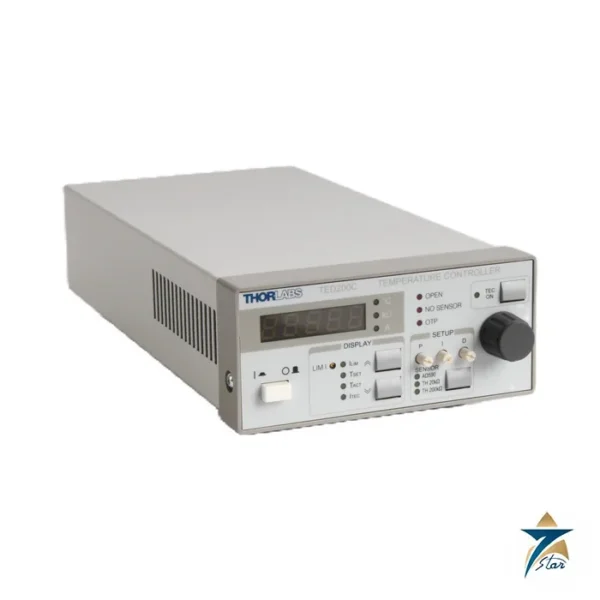
Related items you may also need: Yokogawa UP35A-000-10-00 Program Controller (Ramp/Soak) | Bürkert 316521 Type 8605 Proportional Valve Controller No Display | Thorlabs TED200C Thermoelectric Temperature Controller | All Eurotherm products.

Documents and quotation

The datasheet for the 2404 and 2408 is attached to this page. To receive a quotation for the Eurotherm 2404, send an RFQ listing the complete build code with its modules, the quantity and your delivery location in Oman or the GCC.

Datasheets & Documents
  • PDF Datasheet Eurotherm 2404 1/4 DIN PID Controller and Programmer Datasheet Download
Reviews (0)

Reviews

There are no reviews yet.

How would you rate this product?

It takes about 10 seconds — just tap a star. Your email is never published.

About brand

Eurotherm is a British maker of temperature controllers, process recorders and SCR power controllers, best known for compact PID controllers such as the 3200 and 2400 families. The company was set up in 1965 as Eurotherm Controls in Worthing, West Sussex, to build temperature controllers, and in 1970 its directors created related companies for data recorders, process control and drives. A holding company, Eurotherm International, followed in 1974 and was listed on the London Stock Exchange in 1978. Since 31 October 2022 the company has belonged to Watlow.

Eurotherm company profile

Founded 1965, Worthing, West Sussex, United Kingdom, as Eurotherm Controls
Headquarters Worthing, West Sussex, United Kingdom; core manufacturing in Ledziny, Poland
Ownership Watlow since 31 October 2022; earlier owned by Siebe, Invensys and Schneider Electric
Core technology PID temperature and process controllers, programmers, graphical recorders and thyristor (SCR) power controllers
Typical applications Furnaces and heat treatment, ovens, glass and ceramics, plastics extrusion, sterilisers, chillers, trace heating and laboratory equipment
Standards and approvals AMS2750 field-calibration suitability for Nadcap work, CQI-9 accuracy, 21 CFR Part 11 recording option, EN 14597 TR type approval, EN 60947-4-3 for power controllers

Milestones

  • 1965: The company is formed in Worthing to manufacture temperature controllers.
  • 1970: Related companies are created for data recorders, process control and variable speed drives.
  • 1978: The holding company is listed on the London Stock Exchange.
  • 1998: Siebe plc acquires the group; it later becomes part of Invensys.
  • 2014: Schneider Electric acquires Invensys and the business joins Schneider Electric.
  • 2022: Watlow completes its acquisition on 31 October.

How a Eurotherm PID controller works

A PID controller compares the measured process value from a thermocouple or resistance thermometer with the setpoint and adjusts its output to remove the difference. The proportional term reacts to the size of the error, the integral term removes the remaining offset over time, and the derivative term anticipates fast changes. The maker adds cutback and overshoot inhibition so a furnace or oven approaches setpoint without swinging past it, and its tuners calculate the PID values automatically. The output is time-proportioned to a relay or solid state relay, sent as a 0 to 20 mA signal, or passed to an SCR power controller that fires thyristors by phase angle or burst. A selection tip: confirm the sensor type, the output type and the supply voltage first, because these three fields decide the order code.

Where Eurotherm products are used in Oman and the GCC

In Oman and the wider Gulf, these controllers appear on heat-treatment furnaces for valves and pump parts, on electrically heated sample systems and heat-traced lines at oil and gas sites, on desalination and utility test rigs, and in food, pharmaceutical and laboratory ovens. Recorders with audit features serve plants that must keep validated temperature records, while SCR units drive heater banks on process skids.

Eurotherm models we list

Family Examples
3200 series single-loop controllers 3216, 3204
2400 series controller/programmers 2404
3500 series dual loop controller/programmers 3504
Graphical recorder/controllers nanodac
EPC3000 programmable controllers EPC3016
EPack SCR power controllers EPack-1PH

Ordering Eurotherm products: what we need

These instruments are configured through long order codes, so a short model name is rarely enough. For a new purchase send the model, supply voltage, output types, communications option and any options such as CT input or remote setpoint. For a spare or replacement, copy the full code and serial number from the nameplate. Add the quantity and delivery location in Oman or the GCC, and Seven Star LLC, an independent supplier, will reply to your RFQ with availability and lead time.

Facts checked against published Eurotherm datasheets, company history and the Watlow acquisition announcement, November 2026.

FAQ

Questions about the Eurotherm 2404 1/4 DIN PID Controller and Programmer

Answers from our engineering team on installation, compatibility and integration.

01How many plug-in modules can the Eurotherm 2404 take?
The Eurotherm 2404 accepts up to three I/O modules and two communications modules. Two digital inputs and an optional alarm relay are part of the fixed hardware, so module slots stay free for control outputs.
02What is the difference between the 2404 and the 2408?
The 2404 is 1/4 DIN with a 92 x 92 mm cut-out, up to 670 g and 16 W, with a 21 mm upper display digit. The 2408 is 1/8 DIN with a 45 x 92 mm cut-out, up to 440 g and 13 W, with a 12 mm upper digit.
03Which fieldbus options exist for the 2404?
Modules offer Modbus RTU slave, EI-Bisynch, DeviceNet through CAN, and EIA232 or EIA485 serial. Profibus DP is listed only for the 24xxf variants, so confirm the exact build when quoting.
04What does PDSIO do on the 2404?
PDSIO lets a logic output of the controller send the power demand to a Eurotherm TE10 solid state relay and read back SSR failure and heater circuit failure alarms over the same two wires.
05How large is the programmer in the 2404?
The standard programmer is one 8-segment program. Options give one, four or twenty programs of 16 segments, with up to eight event outputs and ramp rate, ramp time, dwell, call and step segment types.