- Automation & ControlView all 3,120 products
- Automation Accessories
- AC Drives
- PLC & I/O Cards
- Industrial Communications
- Vibration Monitoring
- Isolator & Barrier
- Controllers & Data Acquisition
- Safety Switches & Guard Locking
- Encoders
- Motor Soft Starters
- CCTV & Security
- Pneumatic Cylinders
- HMI Displays
- Servo Drives
- Industrial Computers
- Machine Vision
- Automation Software
- Robotics
Brand: Autonics
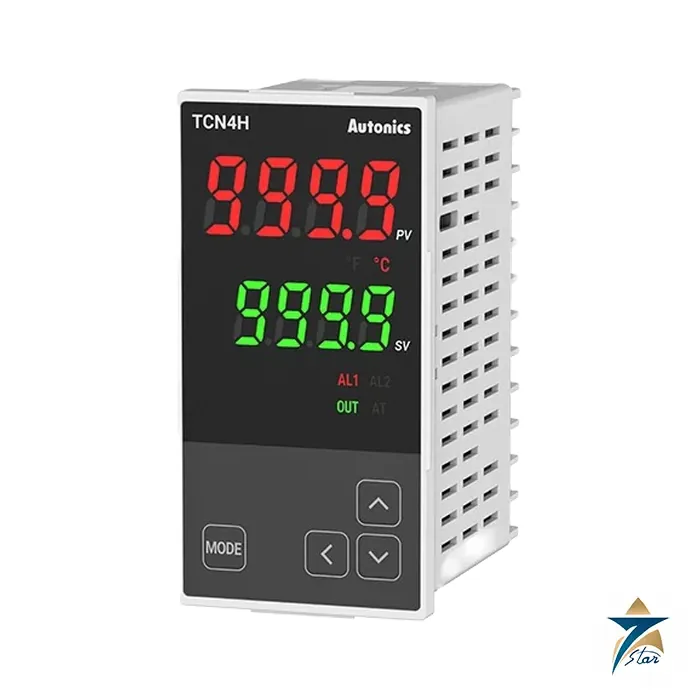
Autonics TCN4H-24R 48×96 Dual Display PID Temperature Controller
Description
Overview
The Autonics TCN4H-24R puts a dual display PID temperature controller into a tall 48 x 96 mm DIN case. Red digits show the process value and green digits the setpoint, a control relay and SSR drive output handle the heater, two alarm relays report faults, and the supply is 100 to 240 V AC. Seven Star LLC is an independent supplier serving Oman and the GCC. Figures below are from the TCN series instruction manual.
Where the horizontal space of a panel is already used up, a vertical controller can be fitted in a column beside others. This is the typical reason for choosing the H size over the 72 x 72 mm M size.
Weights, outputs and inputs of Autonics TCN4H-24R
| Item | Data |
|---|---|
| Size | DIN W 48 x H 96 mm, about 124 g, 194 g packed |
| Supply | 100 to 240 V AC 50/60 Hz, 5 VA or less |
| Display | PV red and SV green, 7-segment LED |
| Inputs | K, J, L, T, R, S thermocouples; Cu50, DPt100 RTD |
| Relay output | 250 V AC 3 A or 30 V DC 3 A, 1a |
| SSR drive output | 12 V DC plus or minus 2 V, 20 mA or less |
| Alarm outputs | Two relays 250 V AC 1 A, 1a |
| Control types | ON/OFF, P, PI, PD, PID |
| Proportional band | 0.1 to 999.9 |
| Integral time | 0 to 9,999 s |
| Derivative time | 0 to 9,999 s |
| Control cycle | 0.5 to 120.0 s |
| Manual reset | 0.0 to 100.0 percent |
| Dielectric strength | 2,000 V AC for one minute |
| Vibration | 0.75 mm amplitude, 5 to 55 Hz |
| Memory retention | About 10 years |
Reading the model name
TCN is the dual display series and 4 stands for four digits. H marks the 48 x 96 mm vertical case. The first number after the dash, 2, adds alarm 1 and alarm 2, and the second, 4, selects 100 to 240 V AC. R is the relay plus SSR drive output, and there is no P so the wiring is by bolt terminals. Replacing the 4 by a 2 gives a 24 V AC or 24 to 48 V DC unit.
TCN4H-24R compared with the TC4H-24R
The two vertical controllers share the 48 x 96 mm cut-out, the outputs and the alarm count. The TC4H-24R has one red display and weighs about 122 g, while this Autonics TCN4H-24R adds a green SV display and weighs about 124 g, and it reads six thermocouple types against three for the TC. If you need to see the setpoint all the time, or need an R, S or T thermocouple, take the TCN. If the process value alone is enough, the TC is the simpler alternative.
Panel work for the Autonics TCN4H-24R
Cut the panel opening for 48 x 96 mm, slide in the Autonics TCN4H-24R from the front and push the bracket in with a flathead screwdriver. Keep the sensor cable away from power wiring or add a varistor or line filter on the supply. Fit a switch or breaker close to the controller. Ground and wire polarity must be checked before the first power-up, because a reversed thermocouple reads backwards when the heater switches on.
Planning a vertical zone panel
A column of vertical controllers such as the Autonics TCN4H-24R suits machines where the operator stands in front of a narrow cabinet door. Each unit is only 48 mm wide, so five or six fit side by side and the green setpoint digits line up in a row, which lets a supervisor scan all zones in a second. Label strips, an additional hooter relay and a master heater contactor can be placed above the row without increasing the panel size.
In such a column each alarm relay can feed a common fault line. Wire alarm 1 of every zone in series into a deviation alarm for the machine, and alarm 2 into a separate over-temperature trip chain. With the contacts rated 250 V AC 1 A, an interposing relay is recommended when the common line carries a larger coil.
The keys and displays are close together on the front, so avoid fitting controllers behind a window that hides the keys; setpoint changes are frequent during recipe changes, and operators prefer direct access to the keys and to the readings of both rows. Put a clear door or a lockable panel over the front if operators who should not edit setpoints can reach it.
When the panel is installed outdoors or in a hot room, keep the door closed and filtered. Dust on the rear terminals causes tracking on mains terminals, so inspect them regularly.
Display messages
When OPEN flashes, the sensor is disconnected or broken. HHHH or LLLL flash when PV is above or below the input range, and the display clears when the input returns to range. During these errors the control output may still act as if the input were at its limit, so do not rely on the controller alone for over-temperature protection.
Use cases in Oman and the GCC
Column-mounted controllers are common in multi-zone ovens, plastic and rubber presses, heated chemical tanks, packaging lines and laboratory furnaces. In a Gulf summer, panel temperature is the main problem: the controller rating is -10 to 50 C, so use fans or air conditioners for enclosures in direct sun, and place SSR heat sinks away from the controller.
Maintenance notes
When a controller is replaced, copy the sensor type, temperature unit, alarm modes and PID values from the old unit or from your commissioning record before connecting the heater contactor, and run the loop with the load disconnected to confirm that the display and relay indicators behave as expected. This takes a few minutes and avoids a heater running away on factory default settings. Verify as well that the alarm relays trip the correct circuits.
Check terminal tightness at each shutdown, because thermal cycling loosens screws. Keep a record of tuned values. Relays have a rated electrical life of 200,000 operations at full load, so if the output cycles quickly, move to an SSR drive. Replace the unit when the relay sticks or when the display segments fade.
Related items you may also need: Autonics E40S6-2500-6-L-5 Rotary Encoder Incremental | Autonics PR18-8DN M18 Inductive Proximity Sensor 8 mm | Woodward 505 Digital Control for Steam Turbines | All Autonics products.
Points to confirm for the Autonics TCN4H-24R
- If the Autonics TCN4H-24R is a like-for-like replacement, read the full code from the installed nameplate and compare it with this page.
- For each Autonics TCN4H-24R request we confirm the exact code, new or surplus condition and lead time in writing.
- Dimensions, ratings and connection data for the Autonics TCN4H-24R are in the datasheet attached to this page.
- The Autonics TCN4H-24R belongs to our controllers & data acquisition range and can be delivered to Muscat, Sohar, Duqm and other GCC locations.
Documents and quotation
The TCN series instruction manual is attached as a datasheet. Send an RFQ for Autonics TCN4H-24R to Seven Star LLC with quantity and delivery location and we will confirm availability and lead time for Oman and the GCC.
Other Models in the TCN4 Range
Seven Star LLC supplies models from the TCN4 range in Oman and the GCC. Compare the related models below and request a quote for the one that matches your application.
| Model | Category | |
|---|---|---|
| Autonics TCN4M-24R 72×72 Dual Display PID Temperature Controller | Controllers & Data Acquisition | View details |
| Autonics TCN4H-24R 48×96 Dual Display PID Temperature Controller | Controllers & Data Acquisition | You are viewing this model |
Datasheets & Documents
- Datasheet Autonics TCN4H-24R 48x96 Dual Display PID Temperature Controller Datasheet Download
Reviews (0)
How would you rate this product? Cancel reply
About brand
Autonics is a South Korean maker of sensors and controllers, founded in 1977 as a small engineering business making controllers for looms. It took the Autonics name in 1988 and opened a new corporate headquarters in Busan in 2014. Autonics makes proximity and photoelectric sensors, rotary encoders, temperature controllers, counters, timers and stepper motor systems, with factories in Busan and Yangsan.
Seven Star LLC lists the Autonics E40S6-2500-6-L-5 incremental rotary encoder and supplies Autonics sensors and control devices in Oman and the GCC.
Autonics company profile
| Founded | 1977, South Korea |
|---|---|
| Current name | Autonics, since 1988 |
| Headquarters | Busan, South Korea |
| Factories | Busan and Yangsan |
| Product families | E40 and E50 rotary encoders, PR proximity sensors, BJ photoelectric sensors, TK temperature controllers |
Milestones
- 1977: The company is founded.
- 1988: Renamed Autonics Corporation.
- 2014: Opens its Busan headquarters.
Reading the Autonics E40S encoder code
E40S is the 40 mm diameter shaft-type incremental encoder, and the 6 that follows is the 6 mm shaft. 2500 is the resolution in pulses per revolution. The next 6 means six output signals: A, B and Z with their inverted signals. L is a line driver output and the final 5 is a 5 V DC supply. The same 40 mm body is made in hollow shaft form as the E40H and E40HB series.
Where Autonics encoders are used
Servo and spindle feedback, conveyor length measurement, packaging and printing machines.
Ordering Autonics encoders: what we need
Send the complete model string from the label. If it is worn off, give the body and shaft diameter, pulses per revolution, output type, supply voltage and cable or connector style.
Facts checked against Autonics corporate profiles, October 2026.
Browse Autonics products by category: Encoders.
FAQ
Questions about the Autonics TCN4H-24R 48×96 Dual Display PID
Answers from our engineering team on installation, compatibility and integration.
01What is the size of Autonics TCN4H-24R?
DIN 48 x 96 mm vertical, about 124 g, with red PV and green SV displays.
02Which thermocouples can TCN4H-24R read?
K, J, L, T, R and S thermocouples, plus Cu50 and DPt100 RTDs.
03How many alarm relays does the TCN4H-24R have?
Two, each 250 V AC 1 A with 1a contact; they are selected by the 2 after the dash in the code.
04Is TCN4H-24R for AC or DC supply?
The 4 in the code means 100 to 240 V AC at 50/60 Hz; the 24 to 48 V DC version has 2 in that position.
05Why choose the TCN4H-24R rather than the TC4H-24R?
For the dual display of PV and SV and the extra T, R and S thermocouple inputs in the same 48 x 96 mm cut-out.


Reviews
There are no reviews yet.