- Automation & ControlView all 3,130 products
- Automation Accessories
- AC Drives
- PLC & I/O Cards
- Industrial Communications
- Vibration Monitoring
- Controllers & Data Acquisition
- Isolator & Barrier
- Safety Switches & Guard Locking
- Encoders
- Motor Soft Starters
- CCTV & Security
- Pneumatic Cylinders
- HMI Displays
- Servo Drives
- Industrial Computers
- Machine Vision
- Automation Software
- Robotics
Brand: Bürkert
Bürkert 316530 Type 8605 Proportional Valve Controller PG Gland
Description
Overview
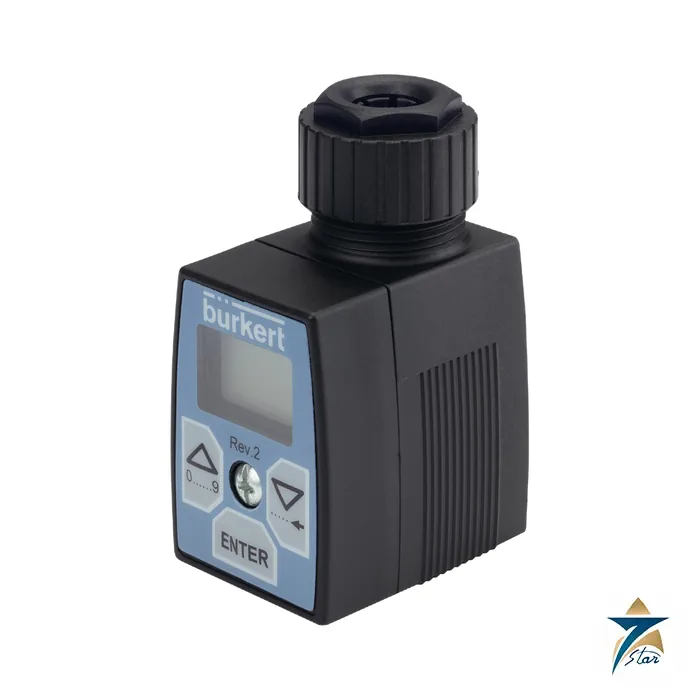
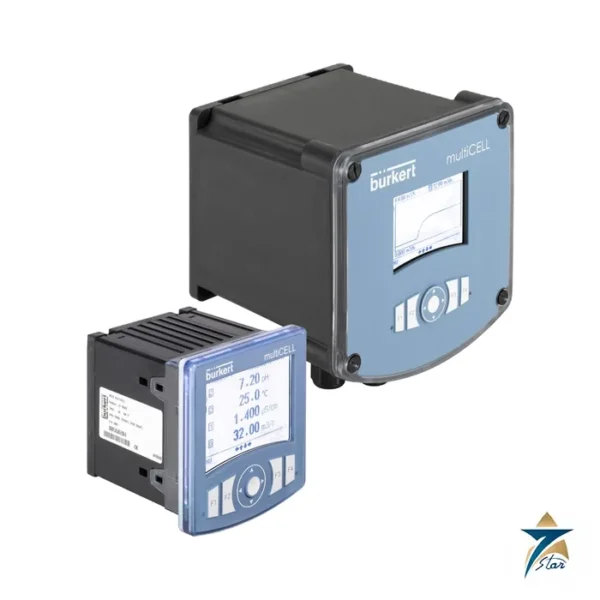
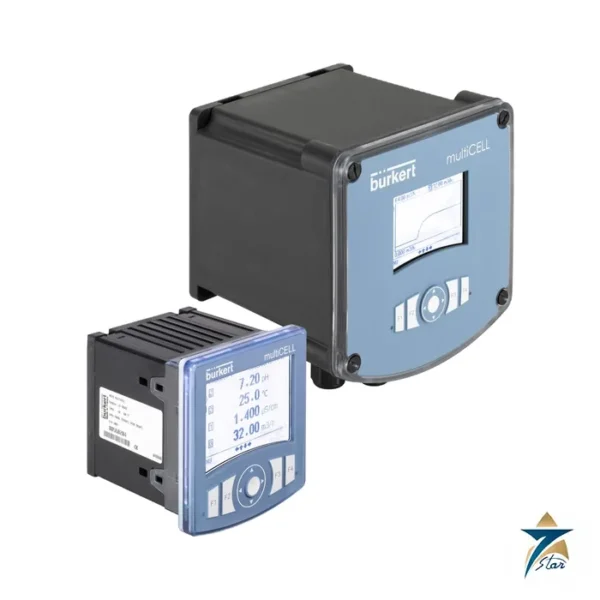
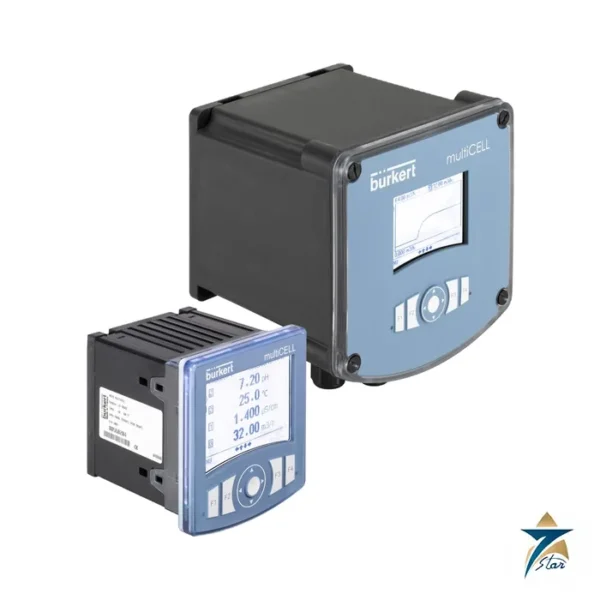
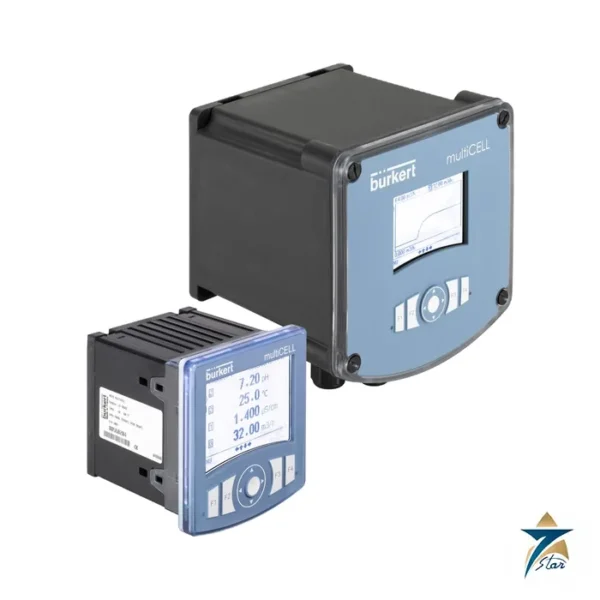
Proportional solenoid valves are only as good as the electronics that drive them, and the Bürkert 316530 is a compact controller built to drive Bürkert proportional valves from a standard signal. It is a Type 8605 control electronics unit in a cable-plug housing with a PG cable gland, an integrated operating unit with display and keys, and a coil current range of 200 to 1000 mA. Seven Star LLC is an independent supplier serving Oman and the GCC.
Instead of a bulky control cabinet module, the electronics sit in the plug that clips onto the valve coil. It converts a 0/4 to 20 mA or 0 to 5/10 V set-point into a pulse-width-modulated current for the coil, and adds a ramp function so that the valve opens and closes smoothly.
Decoding the 8605 chart
The ordering chart is a matrix: valve family across the top, variant down the side. The Bürkert 316530 is the cable plug variant with PG gland and operating unit for the lower current range, 200 to 1000 mA, which covers coils of the 24 V DC and 12 V DC versions of several valve types in the table. A tick in the chart shows the valve families that can be driven, among them types 2863, 2873 and the 6024 and 6223 versions listed. Its M12 sibling for the same current range is 316528, and the 500 to 2000 mA PG variant is 316529.
Data table for Bürkert 316530
| Item | Value |
|---|---|
| Article number | 316530 |
| Output signal | PWM, frequency adjustable 80 Hz to 6 kHz |
| Ramp function | time adjustable 0 to 10 s |
| Valve output current | maximum 2 A PWM |
| Operating voltage | 12 to 24 V DC, plus/minus 10 percent, residual ripple below 5 percent |
| Input signal | 0/4 to 20 mA or 0 to 5/10 V, configurable |
| Input impedance | below 200 ohm (current), above 20 kilohm (voltage) |
| Power consumption | approx. 1 W without valve |
| Housing material | polyamide / PC |
| Degree of protection | IP65 (cable plug variants) |
| Ambient temperature | minus 10 to plus 60 degrees C |
| Minimum valve load | 7 ohm; lower resistance damages the electronics |
| Variant | cable plug with PG gland, with operating unit, coil current 200 to 1000 mA |
The operating unit
Many small controllers must be set up with a laptop. This one has local keys and a display in the plug, so a technician can set the minimum and maximum current, dither or PWM frequency and the ramp time on site. The datasheet describes a ramp time adjustable from 0 to 10 seconds and a frequency adjustable from 80 Hz to 6 kHz. Settings that are done locally mean fewer commissioning problems on remote skids.
How Bürkert 316530 differs from other Type 8605 variants
Three choices separate the variants. First, the connection: PG gland as here, or an M12 connector for a pluggable cable. Second, the current range: 200 to 1000 mA as here, or 500 to 2000 mA for hungrier coils. Third, whether the unit includes the operating unit, with display and keys, or comes without it as a cheaper blind version, as in 316521 and 316522 for the lower range. This unit has the display and the PG gland, which makes it the standard choice for fixed installations with a fixed cable.
Applications
Proportional control of small liquid and gas flows in dosing, mixing, gas blending, burner control and laboratory systems. In Oman such units are found in water treatment dosing, small process skids and test benches where a PLC supplies a standard analogue signal. Because the output is a PWM current, the valve responds with high resolution without the need for an analogue amplifier card in the cabinet.
Installation
Push the controller onto the valve coil contacts, secure it, and wire the supply and the set-point through the PG gland. Use shielded cable for the analogue signal, keep it apart from power wiring and respect the minimum load of 7 ohm if you drive a valve from another manufacturer. Check that the supply is within 12 to 24 V DC and that the coil data match the current range. Then set the minimum and maximum currents so that the valve just opens at the minimum set-point and reaches full flow at the maximum.
Finally enter the ramp time so that sudden set-point jumps do not cause pressure shocks.
Maintenance
The electronics need no routine servicing; check seals of the gland and plug and make sure that cable strain relief is intact. If you replace the valve coil, check that the current range of the controller still matches.
Electrical supply checks
A solenoid coil only performs as specified when the voltage at its terminals is inside the stated tolerance. Long cable runs, shared supplies and ageing power units can pull the voltage below the limit, causing slow opening, humming or failure to move at all. Measure the voltage at the plug with the valve energised, not at the power supply output. Check the polarity marking on DC coils, verify that protective earth is connected where the plug provides a terminal and look at the cable gland for ageing. A coil that runs hot is not always faulty, but one that smells of varnish or shows a darkened housing should be replaced together with the plug, because the insulation may have been damaged already.
Cleanliness during assembly
New piping systems hold more contamination than any operating system will ever see: cutting swarf, weld spatter, thread tape fragments, paint and dust. A small valve with a narrow orifice is the first component to be blocked by it. Blow through or flush all pipes before connecting the valve, fit a temporary strainer during start-up and remove it only after the system has run for several hours. Take care not to push sealant tape into the port when wrapping threads, and wrap the tape in the direction opposite to the tightening. A clean assembly is the cheapest way to extend the life of every valve in the system.
Related items you may also need: Bürkert Type 6026 Direct-Acting 2/2-Way Plunger Solenoid Valve | Bürkert Type 8681 Control Head for Hygienic Process Valves | IDS SM85A Signal Module Card | All Bürkert products.
Documents and quotation
The Type 8605 datasheet, with the compatibility matrix, dimensions and accessories, is attached. Send your RFQ with Bürkert 316530, quantity and delivery location in Oman or the GCC.
Datasheets & Documents
- Datasheet Bürkert 316530 Type 8605 Proportional Valve Controller PG Gland Datasheet Download
Reviews (0)
How would you rate this product? Cancel reply
About brand
Bürkert is a German family-owned maker of fluid control systems, headquartered in Ingelfingen, Baden-Württemberg. Christian Bürkert founded the company in 1946, and it is known for solenoid valves, process and control valves, flow and analytical sensors, and mass flow controllers. Its products serve water treatment, hygienic processing, gas handling and laboratory applications.
Seven Star LLC lists Bürkert valves and valve automation devices and supplies Bürkert solenoid valves and spare parts to plants in Oman as an independent supplier.
Bürkert company profile
| Founded | 1946, by Christian Bürkert |
|---|---|
| Headquarters | Ingelfingen, Germany |
| Ownership | Family-owned |
| Product families | Solenoid valves, angle seat process valves, positioners, flow meters, mass flow controllers |
Bürkert types listed on this page
Two types are listed. Type 6026 is a direct-acting 2/2-way plunger solenoid valve, with a stainless steel bellows that separates the medium from the coil, and as a direct-acting valve it switches without needing a pressure difference. Type 8681 is the Bürkert control head that mounts on top of hygienic process valves to pilot the actuator and report valve position to the control system. Control heads of this kind are common in food, beverage and pharmaceutical plants in the GCC.
Ordering Bürkert valves: what we need
The type number alone is not enough. Send the identification number from the label, or else the type with orifice, port connection, body and seal material, coil voltage and frequency, circuit function and pressure range. For a Type 8681 control head add the communication variant and the make and model of the process valve it sits on.
Facts checked against Bürkert's published company history, October 2026.
Browse Bürkert products by category: Solenoid Valve, Control Valves.
FAQ
Questions about the Bürkert 316530 Type 8605 Proportional Valve
Answers from our engineering team on installation, compatibility and integration.
01What does the Bürkert 316530 do?
It is a Type 8605 PWM control electronics unit in a cable plug that drives Bürkert proportional valves from a standard analogue set-point.
02What is the current range of the Bürkert 316530?
The maximum coil current range is 200 to 1000 mA, with a PWM output of up to 2 A in the platform specification.
03Does the Bürkert 316530 have an operating unit?
Yes, this variant includes the operating unit with display and keys, and a PG cable gland for the cable.
04What input signals can the 316530 accept?
0/4 to 20 mA or 0 to 5/10 V, configurable, with a supply of 12 to 24 V DC.
05What is the minimum valve load for the 8605 electronics?
The datasheet warns that valves from other manufacturers must not fall below 7 ohm, otherwise the electronics will be damaged.


Reviews
There are no reviews yet.