Brand:

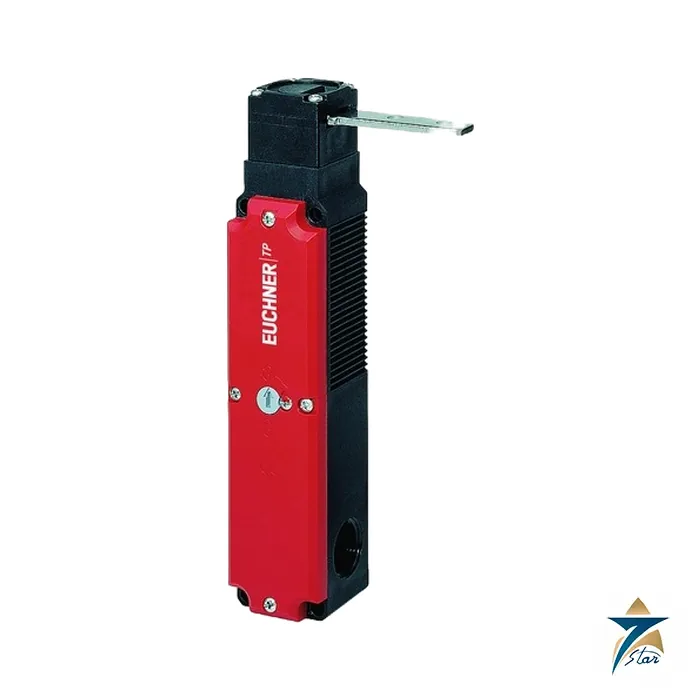
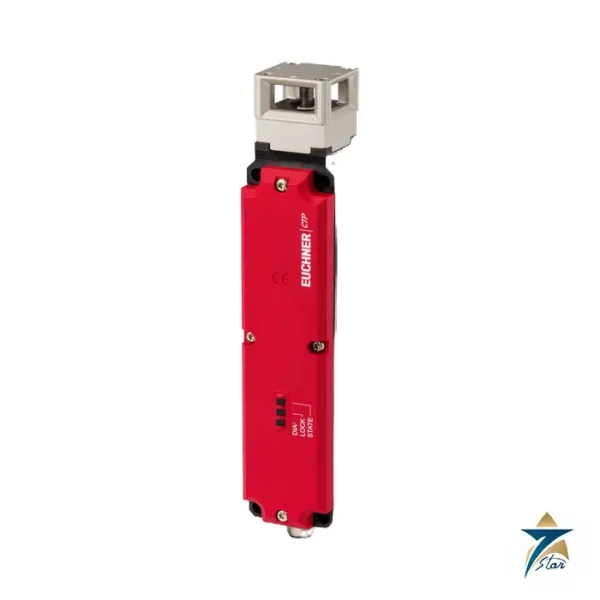
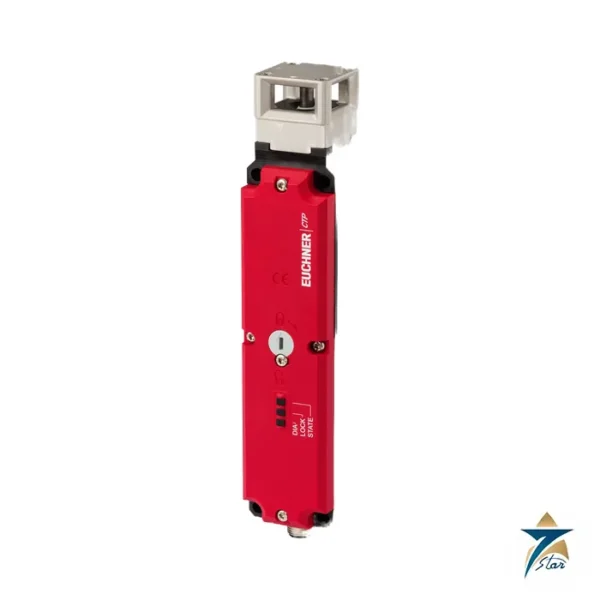
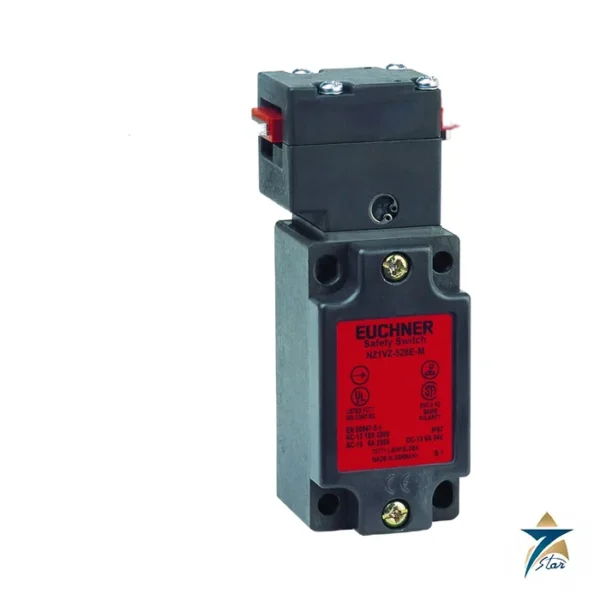
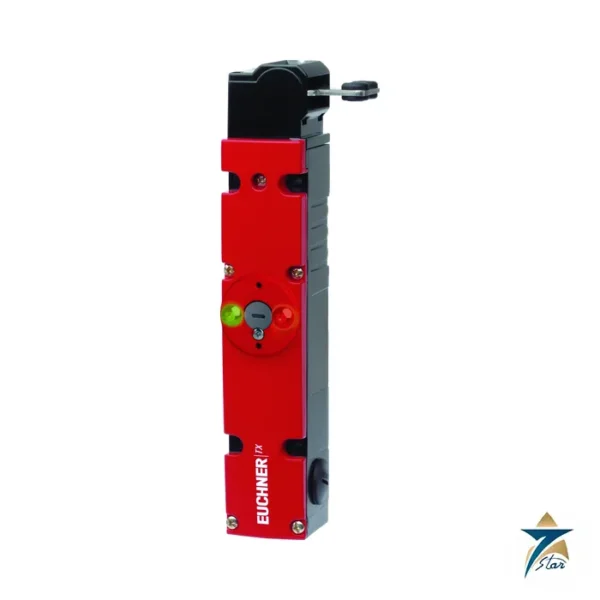
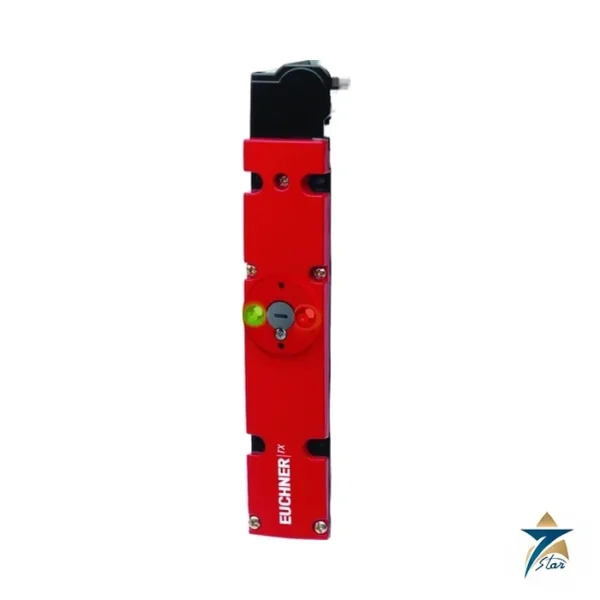
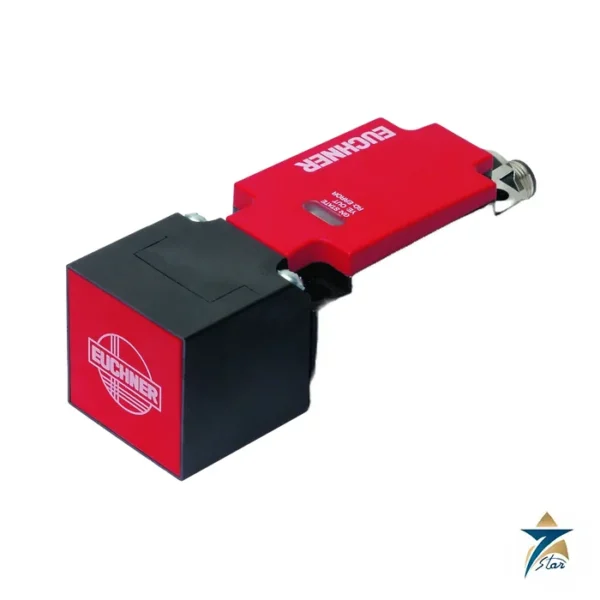
EUCHNER TP1-538A024M Spring-Locked Guard Locking Switch

Description

Overview

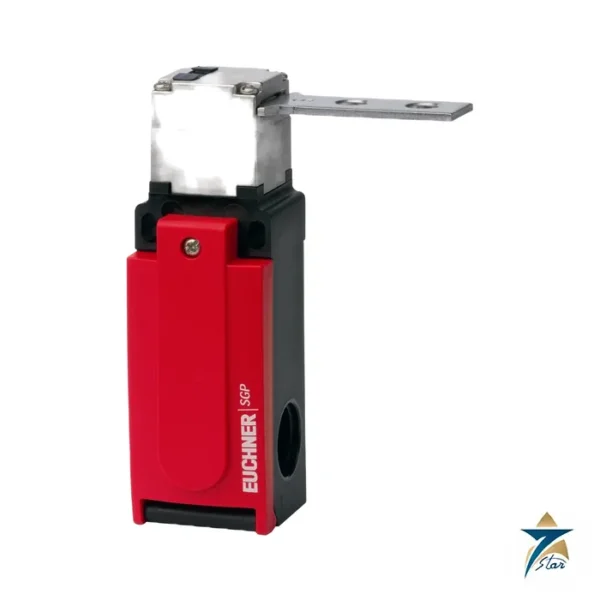
Not every guard needs a door-position contact: many designs read the door state from a separate sensor or from the lock monitoring alone. For those cases the EUCHNER TP1-538A024M offers a slim, light thermoplastic guard locking switch which monitors only the lock, using two positively driven contacts. It belongs to the TP series, locks by spring force, releases on a 24 V solenoid and comes with an M20 x 1.5 cable entry and an auxiliary release. Seven Star LLC is an independent supplier serving Oman and the GCC.

What the numbers 1 and 538 mean in EUCHNER TP1-538A024M

In the TP family the first digit defines the function. TP1 is the spring-locked version without contacts for the door position, while TP3 and related versions add door monitoring. The number 538 identifies the switching element, which here supplies two positively driven contacts for guard lock monitoring and nothing for the door. The letter A refers to the approach arrangement, 024 to the 24 V solenoid, and M to the cable gland. Since there is no door contact, the controller must obtain the door state elsewhere, which is why the TP1 is chosen for guards combined with a magnetic or coded sensor.

Specification for EUCHNER TP1-538A024M

Parameter Value
Guard locking principle Closed-circuit current: spring locked, solenoid releases
Lock monitoring contacts Switching element 538: 2 positively driven contacts
Door position contacts None
Solenoid 24 V AC/DC, minus 15 to plus 10 percent, 8 W, 100 percent duty
Contact utilisation AC-15 4 A 230 V; DC-13 4 A 24 V
Fuse 4 A gG at most
Locking force 1300 N maximum, 1000 N holding
Actuating / extraction / retention force 10 N / 20 N / 10 N
Housing Reinforced thermoplastic
Cable entry 3 x M20 x 1.5
Protection and ambient IP67; minus 20 to plus 55 degrees C
Storage temperature minus 25 to plus 70 degrees C
Mechanical life 1 million operations
B10d lock monitoring 3 million; mission time 20 years

How EUCHNER TP1-538A024M differs from other TP variants

Against the TP2-528A024M, which locks on power with a smaller 528 element, this switch is spring locked and has two positively driven contacts rather than one plus one NO. Against the TP3-2131A024M it has no door contact at all. The 538A024L024M code adds a second solenoid voltage input, and codes ending SR6 or SR11 replace the gland with a connector. The numbers that identify the TP1-538A024M are the 1300 N locking force and 20 N extraction force, both lower than in the metal-bodied TZ or TX switches, which makes the unit best for light doors.

Where it is used in Oman and the GCC

Light-duty guards on packaging lines, labelling stations, small presses and laboratory machines are a typical home. The thermoplastic housing weighs less than die-cast alloy and resists corrosion, which suits humid coastal sites and washdown areas, while IP67 keeps out dust. Integrators in the region use the TP1 together with a separate door sensor so that each function is clearly diagnosed.

Actuators and approach

The actuator is not included. The range covers straight, bent, hinged left-right and hinged top-bottom stainless steel actuators for NP, GP and TP switches, plus versions with rubber bushes and increased overtravel. With the increased-overtravel actuator the horizontal overtravel is 7 mm, while the standard rubber bush type provides 2 mm horizontally and 1.5 mm vertically. This lets doors with rubber end stops rest without constant pressure on the switch head, which reduces wear on the door mechanism.

Wiring and commissioning

Connect the supply and contact wires using 0.34 to 1.5 mm2 conductors, fuse at 4 A gG or less and respect the minimum switching load of 12 V at 10 mA. Adjust the approach direction in 90 degree steps before fastening. Test the auxiliary release, which unlocks the guard with a tool or key if power fails, and keep it protected against misuse by sealing. Confirm that the lock monitoring opens the safety circuit whenever the bolt is not fully engaged.

Inspection and spares

Examine the head, the actuator and the screws at intervals set by your maintenance plan, clear any debris and verify the contacts. Replace the switch at the end of its life of one million operations. Keep a spare actuator and the TP operating instructions with the machine records. Never repair or reopen the device.

Selecting the EUCHNER TP1-538A024M

Use it where the door state is monitored separately and the lock must be spring held. Choose a TP3 version if the switch itself must report the door position. Quote the full code EUCHNER TP1-538A024M together with the actuator.

Pairing the EUCHNER TP1-538A024M with a separate door sensor

Because the switch reports only the lock, the door position must come from another device, typically a coded non-contact sensor or a hinge switch. This split has real advantages. The door sensor can be a high-category device wired to the same safety relay, the lock switch can be wired to a second input, and a fault in one function is easy to locate because each device has its own cable and indicator. It also lets designers choose the door sensor with the right sensing distance for a sagging or vibrating door, while the TP1 only has to hold the bolt. When specifying the pair, check that the logic of the safety controller treats an unlocked state with a closed door as a request to stop, not as a fault, and that restart requires a deliberate reset. Document both devices on the circuit diagram so that technicians do not remove one believing the other covers the function.

Light doors with rubber end stops benefit from the overtravel actuator, because it lets the door rest against its stop without pushing on the bolt. That reduces the extraction force felt when the solenoid is energised and prolongs the life of the actuator tip.

Related items you may also need: EUCHNER ESM-BT411 Safety Relay with Time-Delayed Contacts | EUCHNER CES-IA-BR-U-C07-SA Non-Contact Safety Switch Set | EUCHNER RPS-M-2131SR175M Emergency Stop Rope Pull Switch | All EUCHNER products.

Documents and quotation

The TP operating instructions are attached to this page and cover mounting, wiring and safety data. Please send your RFQ with EUCHNER TP1-538A024M, the quantity and your delivery location in Oman or the GCC.

Datasheets & Documents
  • PDF Datasheet EUCHNER TP1-538A024M Spring-Locked Guard Locking Switch Datasheet Download
Reviews (0)

Reviews

There are no reviews yet.

How would you rate this product?

It takes about 10 seconds — just tap a star. Your email is never published.

About brand

EUCHNER is the German maker of safety switches, guard locking devices, enabling switches, safety controllers and multiple limit switches for machine safety and motion control. Its history began in 1940, when Emil Euchner set up an engineering office near Stuttgart; he developed the first multiple limit switch in 1952 and founded EUCHNER + Co. in 1953. The family-owned company is headquartered in Leinfelden-Echterdingen near Stuttgart.

Seven Star LLC is an independent supplier in Muscat. We list EUCHNER safety components for machine builders and maintenance teams in Oman and the GCC.

EUCHNER company profile

Origins 1940, engineering office of Emil Euchner near Stuttgart, Germany
Company founded 1953, as EUCHNER + Co.
Headquarters Leinfelden-Echterdingen, Baden-Württemberg, Germany
Ownership Family-owned
Product families Transponder-coded safety switches with guard locking (CTM, CTP, MGB), TZ and TX guard locking switches, ZSB enabling switches, MSC modular safety controllers, multiple limit switches, electronic hand wheels and access systems

Milestones

  • 1940: Emil Euchner sets up an engineering office.
  • 1952: He develops the first multiple limit switch.
  • 1953: EUCHNER + Co. is founded.

EUCHNER product series

Guard locking switches include the transponder-coded CTP, CTA and CTS series, the CTM with BiState guard locking, the STP twin switch and the electromechanical TX1B and TZ series. The MGB2 Multifunctional Gate Box combines guard locking, handle and control elements on one door. Non-contact switches include the CES-IA set and the CES-AP RFID safety switch, and the CTP-I version provides monitoring without guard locking.

Control devices include the ZSM and ZSB three-position enabling switches, the RPS emergency stop rope pull switch, the ESM safety relays (including versions with time-delayed contacts and the ESM-TE301 expansion) and the MSC modular safety controller.

Where EUCHNER components are used

Safety guards and doors on machine tools, robot cells, presses, packaging machines and conveyor systems, emergency stop along conveyors and enabling during setup and teaching. A switch or actuator is one part of a safety function; the complete system must be designed and validated for its application.

EUCHNER products we list

Family Examples
Safety Switches & Guard Locking CES-IA-BR-U-C07-SA Non-Contact Safety Switch, CTA-L1-BP-U-HA-AP-SA Guard Locking Safety, CTM-LBI-BP-U-AZ-SA BiState Guard Locking, CTP-I-AP-U-HA-ZZ-SA Safety Switch without, CTP-L1-BP-U-HA-AZ-SA Guard Locking Safety, CTS-C1-BP-CC-FLX-AP-USA Guard Locking Safety, ESM-BA301 Safety Relay, ESM-BT411 Safety Relay with Time-Delayed and 9 more

Ordering EUCHNER components: what we need

Send the full order number or item number from the label, the coding level and actuator required, the supply voltage and the connection type. For replacements, also give the installed device details and the mating components such as actuators and handle modules.

Facts checked against EUCHNER's published company history, October 2026.

FAQ

Questions about the EUCHNER TP1-538A024M Spring-Locked Guard Locking

Answers from our engineering team on installation, compatibility and integration.

01Does the EUCHNER TP1-538A024M have door position contacts?
No. The TP1 version has no contacts for the door position; its 538 element provides two positively driven contacts for guard lock monitoring only.
02How does the TP1-538A024M lock the guard?
It uses the closed-circuit current principle: a spring locks the guard and the 24 V solenoid must be energised to release it.
03What is the locking force of the TP1-538A024M?
The product page lists 1300 N maximum locking force Fmax and 1000 N holding force Fzh.
04What housing and protection does the TP1-538A024M have?
It has a reinforced thermoplastic housing with IP67 protection and an ambient range of minus 20 to plus 55 degrees C.
05Is an actuator supplied with the TP1-538A024M?
No. The actuator must be ordered separately, for example a straight, bent or hinged actuator from the NP, GP and TP range.