A redundant-media ControlNet bridge for ControlLogix
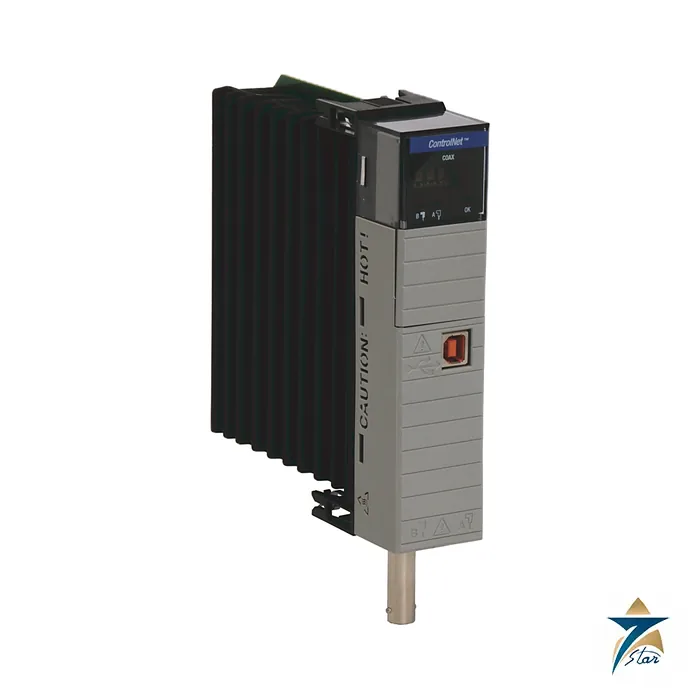
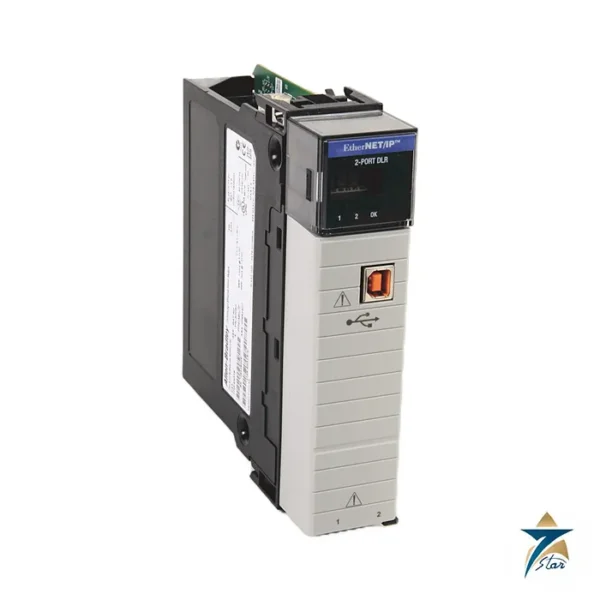
The Allen-Bradley 1756-CN2R connects a ControlLogix chassis to a ControlNet network over two BNC ports, A and B, so the network can run on redundant coaxial media. ControlNet is deterministic and repeatable, and is still used in older oil and gas, power and water installations for I/O and controller-to-controller interlocking.
The R in the catalog number marks the redundant-media version. The standard single-port sibling is the 1756-CN2, and the older 1756-CNB and CNBR modules are the lower-capacity generation with 40 to 48 connections. Existing plants usually keep ControlNet for the reason that rewiring a coax trunk is far more expensive than replacing a faulty module.
Technical specifications
| Parameter |
Specification |
| Catalog number |
1756-CN2R (conformal-coated 1756-CN2RK listed separately) |
| Network |
ControlNet, 5 Mbps |
| Ports |
2 BNC (redundant media) and one USB port |
| Logix communication connections |
128 (an additional three reserved for redundant control) |
| Number of nodes, max |
99 |
| Cable |
1786-RG6 quad-shield RG6 coaxial |
| Backplane current |
1300 mA at 5.1 V DC; 3 mA at 24 V DC |
| Power dissipation |
6.7 W (22.9 BTU/hr) |
| Isolation |
30 V continuous, basic insulation, ControlNet A/B to backplane and A to B; type tested at 500 V AC for 60 s |
| Weight, approx |
0.293 kg (0.64 lb) |
| Slot width / location |
1 slot, any slot |
| Operating temperature |
0 to +60 C |
| Vibration / shock |
2 g 10-500 Hz / 30 g operating |
| Enclosure / temperature code |
Open-style; T4 |
| Hazardous area data as printed |
UL Class I Div 2, FM Class I Div 2, ATEX II 3 G Ex ec IIC T4 Gc, IECEx, UKEX |
Where ControlNet still earns its place
Many Gulf plants installed ControlNet in the 2000s and still run it because the network is deterministic and keeps I/O updates ahead of program uploads and messaging. A CN2R lets the controller keep both media active; if one cable is damaged, traffic continues on the other. The technical data limits a network to 99 nodes and lists 128 connections per module, which is a useful check when a spare is chosen for a busy node. The module draws 1300 mA from the 5.1 V backplane supply, so check the chassis power budget when it replaces the lower-current CNB generation.
Selection and ordering notes
Match the suffix: CN2R is the redundant-media model, CN2 the single-port model, and CN2RK the conformal-coated one. The module requires a 5 Mbps ControlNet design with proper taps and terminators, and the 1786-RG6 cable family named by the manufacturer. The product page gives its summary as 100 connections while the technical data states 128 Logix connections; the technical data is the better reference for design checks, but confirm the series with the existing module label. Upstream, the module is configured in Studio 5000 as a ControlNet bridge, and scheduled traffic is set with RSNetWorx for ControlNet.
Typical applications in existing plants
The 1756-CN2R is most often found in brownfield ControlLogix systems where ControlNet already carries I/O traffic and controller-to-controller interlocks. Oil and gas gathering stations, power plants and water treatment works installed this kind of network because it gives deterministic, repeatable timing, and many of those sites still depend on it for remote I/O chassis and drive communication. In these plants the main job of the module is continuity: it keeps a running system on the same network design, the same coaxial trunk and the same configuration files while the controller hardware around it is maintained. The redundant-media version is chosen where a single damaged cable must not stop the process, for example on long cable runs between buildings, through pipe racks or across areas where mechanical damage to cabling is a realistic risk.
Planning a replacement or expansion
Before a module is swapped, record how the existing one is used. Note whether both media channels are actually connected, which node address the module holds, and whether the chassis also hosts other communication modules that share the backplane power budget. Because the CN2R draws noticeably more backplane current than the older CNB generation, a chassis that was close to its power limit with the older module may need its budget re-checked before the upgrade. It is also worth comparing the number of connections the application really uses against the technical data figure, especially on a busy node that serves several remote racks and produced or consumed tags. Where the existing module is the conformal-coated variant named on this page, keep the same variant so that the panel continues to match its original protection concept.
Configuration and network scheduling
After the hardware is in place, the module is added to the controller project in Studio 5000 as a ControlNet bridge, and the network schedule is created or re-applied with RSNetWorx for ControlNet. Scheduled traffic is what gives ControlNet its predictable I/O timing, so any change of module, node or connection count should be followed by a fresh schedule rather than relying on the previous one. On redundant-media networks, both cable channels should be checked after commissioning so that a fault on one path is noticed before the second path is ever needed. Keeping a saved copy of the network schedule with the project documentation makes later replacements much quicker.
Site conditions in Oman and the GCC
The module is open-style equipment, so it relies entirely on the cabinet for protection. In Omani and Gulf installations that usually means a well-closed, cooled control panel, because outdoor shelters and field rooms can run hot during summer and dust finds its way into poorly closed enclosures. Keep the cabinet interior within the operating temperature range given in the specification table, leave space around the chassis for air movement, and route the coaxial cables so that they are not bent tightly or pulled against the module. For panels in classified areas, check the hazardous-area data printed for the module against the area classification of the actual installation before it is put into service.
Documents and quotation
The linked technical data sheet covers all ControlLogix communication modules. Other communication hardware is under the Industrial Communications category. Send the catalog number and quantity to Seven Star LLC, an independent supplier in Muscat, to request a quotation.












Reviews
There are no reviews yet.