EtherNet/IP over multimode fibre in the ControlLogix chassis
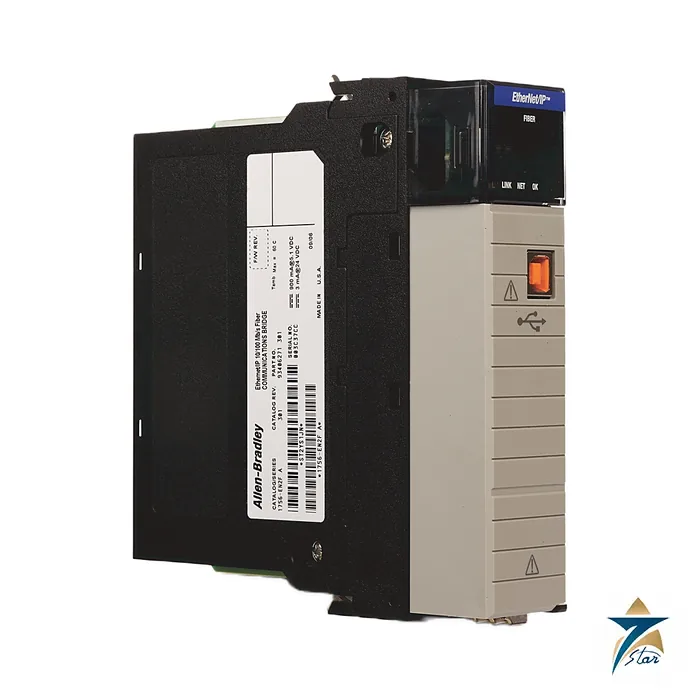
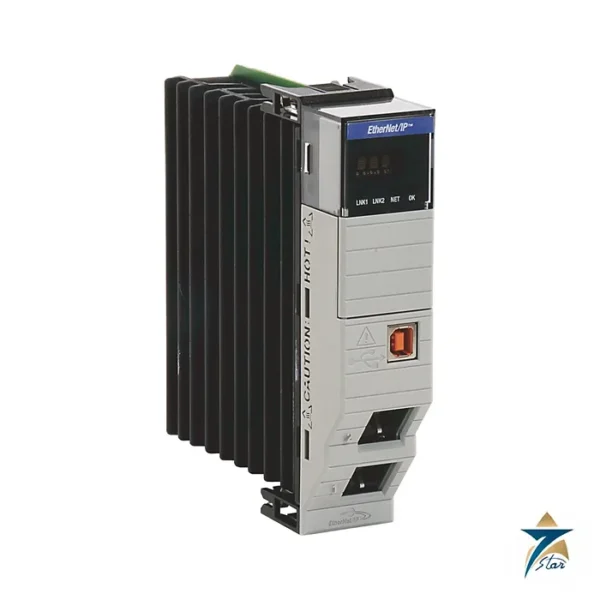
The Allen-Bradley 1756-EN2F brings EtherNet/IP into a ControlLogix chassis over a single multimode fibre port with an LC connector. Fibre removes ground-loop and noise problems between a control room and remote equipment rooms, and suits oil and gas, water and power sites where field cabinets sit far from the controller or in electrically noisy yards.
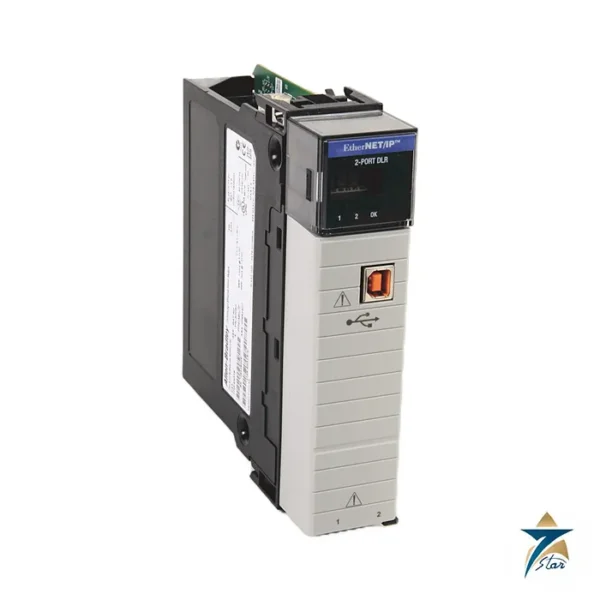
Rockwell Automation classes it with the 1756-EN2T family for controlling I/O modules and drives, but it is the only member of the group that uses a fibre link instead of copper. Because the link is glass, the module also isolates the controller chassis electrically from the remote end, a useful property across large sites where earth potentials differ between buildings.
Technical specifications
| Parameter |
Specification |
| Catalog number |
1756-EN2F (conformal-coated 1756-EN2FK listed separately) |
| Network port |
1 fibre port, multimode, LC connector, 100 Mbps with no auto-negotiation |
| Fibre type |
62.5/125 um or 50/125 um multimode |
| Transmitter launch power at BOL, min |
-19 dBm into 62.5/125 um; -22.5 dBm into 50/125 um (allow -1 dB at end of life) |
| TCP connections |
128 |
| CIP connections |
256 |
| Unconnected messages |
128 plus 128 (backplane plus Ethernet) |
| Packet rate, I/O |
10,000 packets/s on firmware 2.x; 25,000 on 3.6 or later |
| Backplane current |
1.2 A at 5.1 V DC; 3 mA at 24 V DC |
| Power dissipation |
6.2 W (21.28 BTU/hr) |
| Slot width / location |
1 slot, any slot of the chassis |
| Operating temperature |
0 to +60 C, Series C chassis; 0 to +50 C, Series B |
| USB port |
Full speed, temporary local programming only |
| Enclosure / temperature code |
Open-style; T4 |
Choosing fibre
A single fibre port means this module cannot join a Device Level Ring on its own, and the link runs at a fixed 100 Mbps. Treat it as a point-to-point or star leg into a fibre switch. For a ring, the 1756-EN2TR or EN3TR copper modules are the Rockwell options. The launch-power figures in the technical data are the numbers to use when you check an optical budget, together with the length and loss of the installed cable.
Installation and ordering points
The module is used with Series B or C chassis 1756-A4 to 1756-A17 and with the standard and redundant 1756 power supplies named in the manufacturer document. Fibre cable and connectors are ordered separately, and the transceiver wavelength should be matched with any fibre switch at the other end. Isolation is stated as 30 V continuous basic insulation with the USB port tested at 980 V AC for 60 seconds, and the module has the standard CE, UL and hazardous-location marks shown in the certification table. Confirm the firmware revision and the series with your engineering team before ordering a replacement. As with other 1756 communication modules, the USB port is only for temporary local use and should not be used in a hazardous location.
Typical architectures using the fibre module
On large industrial sites the ControlLogix controller usually sits in a central control room or main electrical building, while the equipment it supervises is spread across process areas, pump stations, tank farms or substations. The 1756-EN2F lets that controller reach remote EtherNet/IP devices across this distance using a fibre leg into a fibre switch, which then distributes the network to I/O modules, drives and other devices in the remote area. Because the module controls I/O modules and drives in the same way as the copper members of the 1756-EN2T family, the control program does not need to treat remote equipment differently simply because the physical link is glass.
A common approach is to dedicate one module to each remote area, giving each fibre leg its own path back to the controller chassis. This keeps traffic separated and limits the effect of a damaged cable to a single area. Where the remote network must be redundant or arranged as a ring, the ring is typically formed by switches or copper ring modules in the remote area, with the fibre module providing the trunk connection back to the chassis.
Planning the fibre link
Before installation, engineers should confirm that the multimode fibre type installed on site matches one of the two types listed for the module, and calculate the optical budget from the launch power figures, the cable length and the losses of every splice and patch connection along the route. Allowing for the end-of-life reduction in launch power stated in the technical data avoids a link that works at commissioning but becomes marginal over time. The far-end fibre switch must run at the same fixed speed, since the module does not auto-negotiate. Clean LC connectors and correctly routed patch cords inside the cabinet are basic but important points; contamination on connector end faces is a frequent cause of unexplained link loss.
Site conditions in Oman and the GCC
Oil and gas fields, water networks and power facilities in Oman and across the GCC often span long distances between buildings, with high ambient temperatures and differing earth potentials between structures. These are the conditions where the electrical isolation of a fibre link is most valuable, as it prevents ground-loop currents and induced noise from reaching the controller chassis. The chassis series determines the permitted operating temperature range, so the control panel should be located in an air-conditioned room and the chassis series checked against the expected panel temperature. Because a conformal-coated version is listed separately as 1756-EN2FK, the exact catalog number required by the project specification should be confirmed with the engineering team before the order is placed.
Maintenance teams also benefit from clear labelling. Marking each fibre leg at both ends with the chassis slot and the remote area it serves, and keeping the optical budget calculation with the panel documentation, makes fault finding faster when a link is disturbed during later construction or cabinet modifications on an operating site.
Documents and quotation
The technical data below also covers ControlNet, DeviceNet and other 1756 communication modules. More networking products are listed under Industrial Communications. To request a quotation send the catalog number and quantity to Seven Star LLC, an independent supplier in Muscat.











Reviews
There are no reviews yet.