A 32-point DC input module for ControlLogix chassis
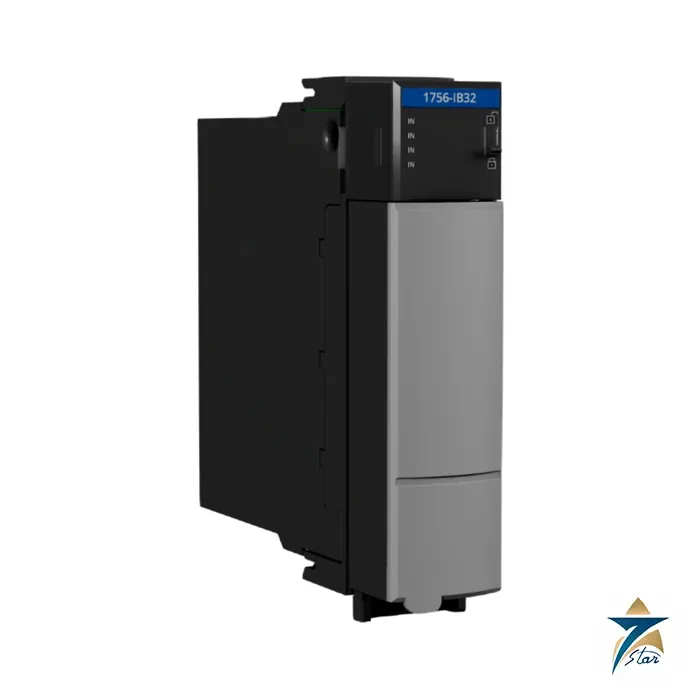
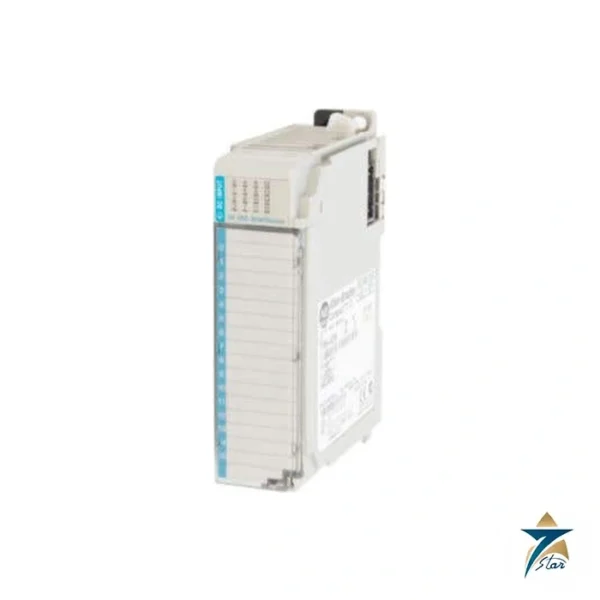
The Allen-Bradley 1756-IB32 is a high-density 12/24V DC sinking input module for the ControlLogix 1756 chassis. It carries 32 inputs in two groups of 16 and fits in a single slot, which makes it a common choice for marshalling large numbers of limit switches, pushbuttons, status contacts and proximity switches into one controller.
Because the module is a sinking input, the field device sources current into the point and the group common returns to the supply. Use the module sheet to confirm the wiring of sensors, since a source-type device needs a different arrangement from a contact.
Technical specifications
| Parameter |
Specification |
| Manufacturer / family |
Allen-Bradley (Rockwell Automation) / ControlLogix 1756 |
| Catalog number |
1756-IB32 (1756-IB32K is the conformal-coated version) |
| Inputs |
32 points in two groups of 16 |
| Voltage category |
12/24V DC sink |
| Operating voltage range |
10 to 31.2V DC; nominal 24V DC |
| On-state current |
4.8 mA min at 10V DC; 5.5 mA max at 31.2V DC |
| Off-state voltage / current, max |
5V / 2.27 mA |
| Input impedance, max |
5.67 kΩ at 31.2V DC |
| Input delay, off to on |
Hardware 380 us max plus filter time (0, 1 or 2 ms) |
| Input delay, on to off |
Hardware 420 us max plus filter time (0, 1, 2, 9 or 18 ms) |
| Backplane current |
120 mA at 5.1V DC; 2 mA at 24V DC |
| Power dissipation, max |
6.2 W at 60 °C |
| Isolation |
250V continuous, reinforced insulation inputs-to-backplane; basic insulation group-to-group |
| Removable terminal block |
1756-TBCH (36-pin cage clamp) or 1756-TBS6H (36-pin spring clamp), ordered separately |
| Operating temperature |
0 to 60 °C (32 to 140 F) |
| Slot width / keying |
1 slot / electronic keying, software configurable |
Input timing and thresholds
The published operating range is 10 to 31.2V DC, with 24V DC nominal. The on-state current is 4.8 mA at 10V DC rising to 5.5 mA at 31.2V DC, and the off-state limits are 5V and 2.27 mA, so leakage from two-wire sensors should be checked against the off-state current. The input impedance is up to 5.67 kΩ at 31.2V DC.
The hardware delay is 380 microseconds off-to-on and 420 microseconds on-to-off, to which a selectable filter time is added. Off-to-on filters are 0, 1 or 2 ms; on-to-off filters are 0, 1, 2, 9 or 18 ms. Inputs can be time-stamped to plus or minus 200 microseconds, and the cyclic update time ranges from 200 microseconds to 750 ms.
Terminal block, keying and power
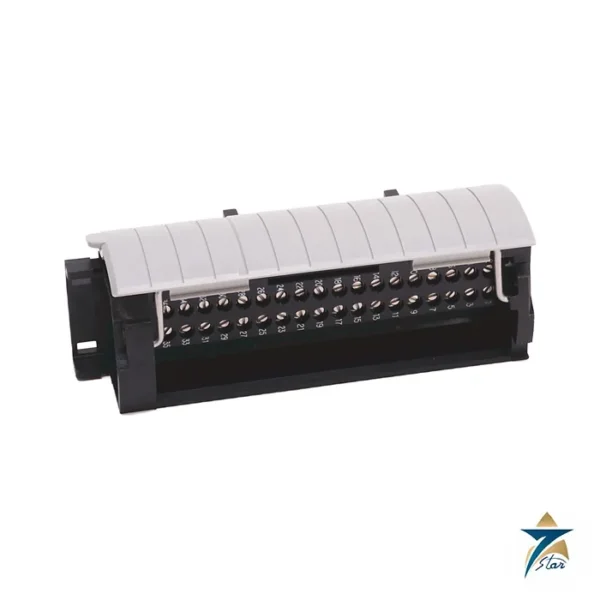
The module does not include its field terminal. The 1756-TBCH 36-pin cage-clamp removable terminal block is the standard choice, with the 1756-TBS6H spring-clamp block as an alternative, and both must be ordered separately. The standard housing is not deep enough for 14 AWG wire, so use the extended housing 1756-TBE if the maximum wire size is needed.
The module draws 120 mA at 5.1V DC and 2 mA at 24V DC from the backplane (0.66 W total) and dissipates up to 6.2 W at 60 °C. Electronic keying is software configurable and reverse polarity protection is provided. The family sheets list the operating temperature as 0 to 60 °C and the open-style enclosure rating, so mount it in a suitable chassis and cabinet.
Key features for panel builders and integrators
- 32 sinking inputs in a single ControlLogix slot, split into two isolated groups of 16 so two separate 24V DC field supplies can be used if the plant design requires it.
- Wide 10 to 31.2V DC operating range, which tolerates the voltage drop of long field runs and the upper tolerance of typical 24V DC power supplies.
- Software-selectable input filters, so the same module can read fast proximity switches with no filter and bouncing mechanical contacts with a 9 or 18 ms on-to-off filter.
- Change-of-state reporting and time-stamping to ±200 microseconds, useful for sequence-of-events work on trip and alarm signals.
- Removal and insertion under power is supported by the ControlLogix architecture, which lets maintenance staff replace a module without shutting down the whole chassis when the application permits it.
Selecting between 1756-IB32 and other DC input modules
Choose the 1756-IB32 when point density matters more than per-point diagnostics. If the application needs open-wire or field-power-loss detection per channel, a diagnostic input module is the better fit. If the field devices are sourcing-type outputs that must sink current, check that the wiring matches a sinking input; a sourcing input module is needed for the opposite arrangement. For panels exposed to corrosive or humid atmospheres, the conformal-coated 1756-IB32K version is the variant to specify.
Wiring practice
With 32 points on one 36-pin terminal block, wire bundles are dense. Label each conductor at both ends, keep 24V DC input wiring separated from AC power and VFD motor cables, and route the bundle so the terminal block can be swung out without strain. Check that two-wire proximity sensors have an off-state leakage below the module’s 2.27 mA off-state limit, otherwise the input may read as permanently on.
Applications in Oman and GCC plants
In oil and gas wellsites, desalination plants, power stations and water networks across Oman and the Gulf, the 1756-IB32 typically collects valve limit switches, motor run feedback, pump status, panel door switches and emergency-stop status contacts. Control rooms are usually air-conditioned, but remote I/O panels in shelters can see high internal temperatures in summer. Keep the cabinet below the 60 °C module limit with ventilation or cooling, filter incoming air against fine dust, and consider the conformal-coated K version near the coast where humidity and salt are present.
Maintenance and spares
Keep at least one spare module and one spare terminal block per site for critical systems. Before swapping a module, confirm the catalog number, series and firmware revision expected by the controller project, because electronic keying can reject a module that does not match. Periodically re-tighten or inspect terminations after commissioning and check the status indicators during routine rounds.
What to include in your RFQ
- Catalog number 1756-IB32 or 1756-IB32K, required series and quantity
- Terminal block type (1756-TBCH, 1756-TBS6H) and whether the extended housing 1756-TBE is needed
- Chassis and controller in use, for compatibility checks
- Delivery location in Oman or the GCC and the required delivery time
Documents and quotation
The installation sheet 1756-IN062 covers the DC digital modules; the full 1756-TD002 technical data holds the complete input table used for this page. Send the 1756-IB32 reference, series, quantity, the chassis and the terminal block required when requesting a quotation. Related hardware is shown in PLC & I/O Cards.






Reviews
There are no reviews yet.