Ethernet/IP with Device Level Ring for resilient networks
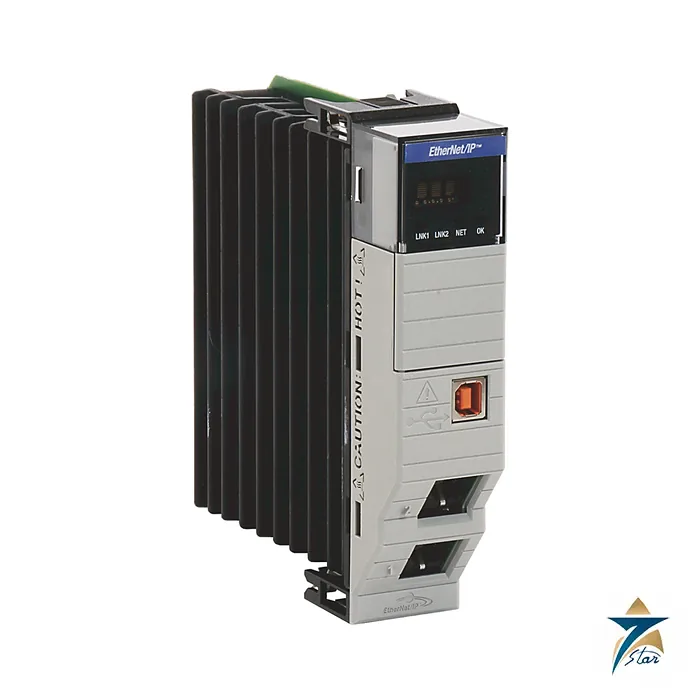
The Allen-Bradley 1756-EN2TR is a ControlLogix EtherNet/IP module that adds Device Level Ring (DLR) support to the standard bridge functions. In a DLR topology, devices are connected in a ring with two ports each, and a single cable break is recovered without a network outage. The module also supports linear topologies.
The manufacturer selection table lists the EN2TR as the interface for communicating with other EtherNet/IP devices for messages and HMI, as well as for DLR and linear topologies. Where a ring is not used, the single-port style 1756-EN2T serves the same bridge role.
Technical specifications
| Parameter |
Specification |
| Manufacturer / family |
Allen-Bradley (Rockwell Automation) / ControlLogix 1756 |
| Catalog number |
1756-EN2TR (1756-EN2TRK coated; 1756-EN2TRXT extended temperature) |
| Function |
EtherNet/IP bridge with Device Level Ring (DLR) and linear topology support |
| Communication rate |
10/100 Mbps |
| TCP connections |
128 |
| CIP connections |
256 (128 plus 128 unconnected messages) |
| Packet rate capacity |
10,000 (firmware 2.x) or 25,000 packets/second (firmware 5.x or later), I/O |
| Integrated motion |
Up to 8 axes (RSLogix 5000 18.02.00 or later) |
| Software |
RSLogix 5000 17.01.02 or later (firmware 2.x); 18.02.00 or later (firmware 5.x) |
| Backplane current |
1 A at 5.1V DC |
| Power dissipation / thermal |
5.1 W / 17.4 BTU/hr |
| Isolation |
30V continuous, basic insulation: Ethernet to backplane, USB to backplane, USB to Ethernet |
| Operating temperature |
0 to 60 °C for standard chassis series C |
| Ethernet cable |
RJ45, Category 5e minimum cable per TIA 568-B.1 |
| Slot width / location |
1 / any chassis slot |
Capacity and software requirements
Like the EN2T, the module supports 128 TCP connections and 256 CIP connections. Packet capacity is stated as 10,000 per second for 2.x firmware and 25,000 per second for 5.x firmware, with up to eight axes of integrated motion on the EtherNet/IP network when used with 1756-L8x or 1756-L7x controllers.
The technical data lists the minimum RSLogix 5000 software version as 17.01.02 for 2.x firmware and 18.02.00 for 5.x firmware, and RSLinx environment 2.55 or later and 2.56 or later respectively. Confirm these with the controller firmware before upgrading an existing chassis.
Mode switch and ring notes
The installation sheet describes a mode rotary switch at the upper left of the module, reserved for DLR, PRP and redundancy features, with a default position of 0. Position 9 selects DLR or single-port operation on the modules that support it. Port plugs must remain installed in unused ports at all times.
The module draws 1 A at 5.1V DC from the backplane and dissipates 5.1 W. The surrounding temperature range is 0 to 60 °C in series C chassis. Use RJ45 cable of Category 5e or better, and treat the USB port as a temporary programming port only.
Record the IP address and firmware revision of the module at commissioning, so that a replacement can be configured quickly without disturbing neighbouring devices on the ring.
Planning a Device Level Ring around the 1756-EN2TR
Before ordering, decide whether the network really needs a ring. DLR pays off where a single cable fault would stop a process, for example on long conveyor lines, distributed remote I/O drops or skids connected across a plant. Every device in the ring must support DLR with two ports, or be connected through a DLR-capable tap; devices with a single port hang off the ring through such a tap or a managed switch. One node in the ring acts as the active supervisor, and a second can be configured as a backup supervisor so the ring stays supervised if the first is removed.
- List every node with its DLR capability and firmware before drawing the ring.
- Count TCP and CIP connections for HMIs, drives and messaging, and keep a margin against the module limits.
- If integrated motion is planned, check the controller family and software version listed in the specifications.
- Choose the coated or extended temperature catalogue variant at the design stage if the environment calls for it.
Installation and commissioning
Insert the module in the chosen chassis slot with power applied only if the installation instructions permit it for your location, and check the backplane power budget of the chassis supply first. Set the IP address, either with the rotary switches or through software, then add the module to the controller project with the matching firmware revision. Connect the ring cables last, then enable the supervisor and confirm in the module diagnostics that the ring reports normal status. A practical commissioning test is to unplug one ring segment and confirm that the ring reports a fault while I/O continues to update, then reconnect it and check that the status returns to normal.
Maintenance and troubleshooting
Ring faults are often caused by a loose connector, a damaged patch cable or a device that was replaced without its DLR settings. Use the module web pages and the diagnostics in the programming software to locate the last active node on each side of a break. Keep spare cables of the correct category on site, label each segment at both ends, and store a copy of the module configuration with the controller project.
- Do not leave a ring broken after maintenance; a single unrecovered break removes the redundancy the ring was built for.
- Check firmware compatibility before swapping a module from stores into a running chassis.
Application notes for Oman and GCC conditions
ControlLogix chassis are normally installed in air-conditioned control rooms or panels, and that matters in Oman, where outdoor kiosks can exceed the standard operating range during summer. For panels that cannot be kept cool, the extended temperature 1756-EN2TRXT listed above is the variant to evaluate. Dust ingress at RJ45 ports causes intermittent contact, so keep unused ports plugged as the instructions require and use sealed cabinets on dusty sites. In coastal and oil and gas facilities, the conformal coated 1756-EN2TRK offers better resistance to humidity and corrosive atmospheres, and outdoor ring segments should use industrial-grade cable and connectors suited to UV exposure and heat.
Documents and quotation
The installation sheet 1756-IN050 and the technical data 1756-TD003 describe the module. For a quotation send the 1756-EN2TR reference, series, firmware needed, quantity and the chassis. Related automation hardware is in Industrial Communications.










Reviews
There are no reviews yet.