- Automation & ControlView all 2,855 products
- Automation Accessories
- AC Drives
- PLC & I/O Cards
- Industrial Communications
- Vibration Monitoring
- Controllers & Data Acquisition
- Isolator & Barrier
- Safety Switches & Guard Locking
- Motor Soft Starters
- CCTV & Security
- Encoders
- Pneumatic Cylinders
- HMI Displays
- Servo Drives
- Industrial Computers
- Machine Vision
- Automation Software
- Robotics
















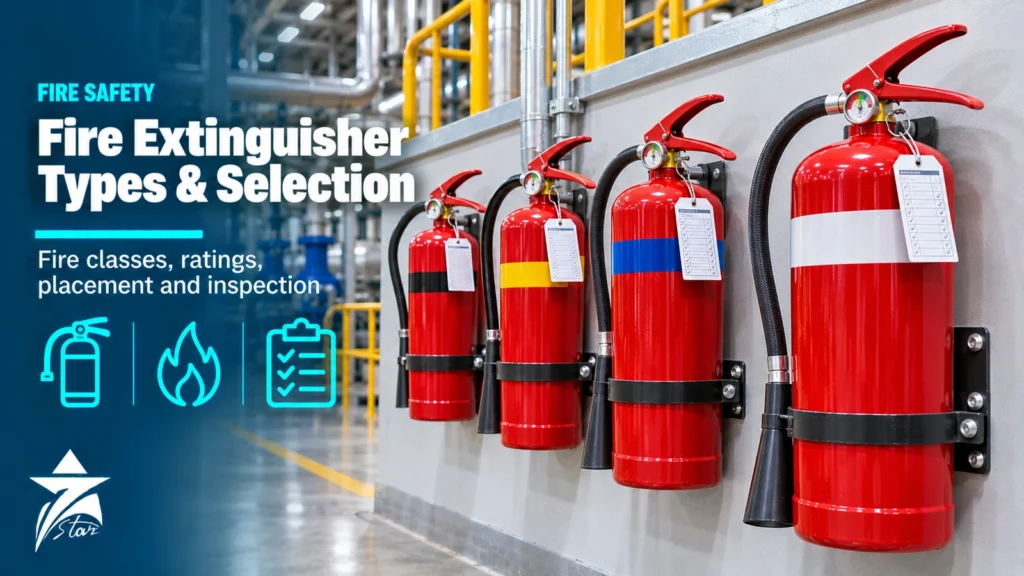
A portable extinguisher is the first line of defence against a small fire, but only if it is the right type, in the right place and in working order. Using a water unit on a burning electrical panel or a CO2 unit on a deep fat fryer can make a fire worse. This guide explains the fire classes, compares the main fire extinguisher types, shows how to read the ratings on the label, and covers how many units to install, where to mount them and how often to inspect and service them.
Fire Classes: European and US Systems
Extinguishers are rated for the classes of fire they can put out. Two systems are in common use: EN 2 and EN 3 in Europe and many other countries, and NFPA 10 with UL ratings in the United States. Projects in the GCC often use both, depending on the consultant and the client specification.
| Fuel | European class (EN 2) | US class (NFPA 10) |
|---|---|---|
| Ordinary combustibles: wood, paper, textiles, plastics | A | A |
| Flammable liquids: petrol, diesel, solvents, paints | B | B |
| Flammable gases: LPG, natural gas, hydrogen | C | B (gases are included in class B) |
| Energised electrical equipment | No separate class; marked as suitable for electrical risks | C |
| Combustible metals: magnesium, sodium, lithium, aluminium powder | D | D |
| Cooking oils and fats | F | K |
Note the difference in class C: in Europe it means gas fires, while in the US it means electrical fires. Always read the pictograms on the label rather than relying on a letter alone.
Common Fire Extinguisher Types Compared
| Type | Suitable for | Not suitable for | Typical locations |
|---|---|---|---|
| Water (jet or spray) | Class A | Class B liquids, electrical equipment (unless dielectrically tested), cooking oil | Offices, warehouses, schools |
| Water mist | Class A, some class F and electrical (tested models) | Metal fires | Offices, hotels, mixed-risk areas |
| AFFF or fluorine-free foam | Class A and B | Class C gases, metal fires; electrical only if tested | Workshops, fuel stores, garages, vehicles |
| ABC dry powder | Class A, B and C, electrical | Cooking oil fires; leaves corrosive residue on electronics | Plant rooms, vehicles, outdoor sites, fuel areas |
| CO2 | Class B and electrical | Class A deep-seated fires; confined unventilated rooms with people | Electrical rooms, server rooms, laboratories |
| Wet chemical | Class F/K, also class A | Electrical equipment while live | Commercial kitchens with deep fat fryers |
| Clean agent (halocarbon) | Class A, B and electrical | Metal fires | Control rooms, data rooms, museums |
| Class D powder | Combustible metals | All other classes | Metal machining, battery and chemical facilities |
Choosing between fire extinguisher types starts with the fuel present. ABC dry powder is the most versatile, but its fine powder reduces visibility, can be inhaled in small rooms and is hard to clean from electrical and electronic equipment. CO2 leaves no residue and is preferred near switchboards and computers, but it has little cooling effect, so a class A fire may re-ignite, and the horn can cause cold burns if held incorrectly.
Reading the Rating on the Label
The rating tells you the size of test fire the extinguisher has put out, not just the class it is suitable for.
- EN 3 ratings, for example 27A 183B: the number before A is the length in decimetres of the wooden crib test fire; the number before B is the volume in litres of the liquid test fire. Higher numbers mean more firefighting capacity.
- UL ratings, for example 4-A:80-B:C: the A number is the water-equivalent capacity (1-A is about 1.25 US gallons of water), the B number is the approximate square feet of liquid fire a non-expert can extinguish, and C shows the agent is non-conductive.
- Weight is not a rating: two 6 kg powder units from different makers can have different ratings. Compare the test ratings when selecting.
- Dielectric test: water and foam units marked as tested to 35 kV under EN 3-7 can be used near electrical equipment from a safe distance, though CO2 remains the usual choice for switchrooms.
Body Colour and Identification
Under EN 3, the body of every portable extinguisher is red, and a coloured zone of up to 10% of the surface may identify the agent. To tell fire extinguisher types apart quickly, common practice in the GCC follows the British convention:
| Agent | Identification colour |
|---|---|
| Water | Red (no band) |
| Foam | Cream |
| Dry powder | Blue |
| CO2 | Black |
| Wet chemical | Yellow |
| Clean agent | Green (often used) |
Colour is a quick guide only. The label, pictograms and operating instructions must be legible and facing outward, so that anyone can identify the correct unit in a few seconds.
How Many Extinguishers and Where to Mount Them
The quantity and position of extinguishers come from the applicable code and the risk assessment of the area. The main principles in BS 5306-8 and NFPA 10 are:
- Travel distance: under BS 5306-8, no one should have to travel more than about 30 m to reach a class A extinguisher. NFPA 10 sets a maximum of 22.9 m (75 ft) for class A and 9.1 m or 15.25 m (30 or 50 ft) for class B, depending on the rating.
- Minimum capacity per floor: BS 5306-8 links the total class A rating to the floor area, with a minimum of two units on each floor in most buildings.
- Near the hazard, not in it: place units on escape routes, near exits and close to specific risks such as fuel dispensers, kitchens and switchrooms, so the user moves away from the fire to reach them.
- Mounting height: NFPA 10 limits the top of units up to 18.14 kg (40 lb) to 1.53 m (5 ft) above the floor, and the bottom must be at least 102 mm (4 in) above the floor. Wall brackets or stands keep units visible and protected.
- Signage: provide a location sign above each unit, visible from the approach direction.
- Outdoor and vehicle units: use covers or cabinets to protect against sun, sand and corrosion.
Portable units complement, but do not replace, fixed systems. Kitchens with deep fryers also need a fixed wet chemical system over the hood and appliances, and server rooms often have a gaseous system. Our clean agent fire suppression comparison covers FM-200, Novec 1230, CO2 and inert gas options, and our addressable fire alarm guide explains how suppression is integrated with detection.
Inspection, Maintenance and Testing Intervals
| Activity | Typical interval | What is checked |
|---|---|---|
| Visual inspection by the occupier | Monthly | In place, accessible, pin and seal intact, pressure gauge in green, no visible damage |
| Basic service by a competent technician | Annually | Weight, pressure, hose, nozzle, labels, bracket, record tag |
| Extended service or discharge test | Every 5 years for water, foam, powder and wet chemical (BS 5306-3) | Discharge, internal inspection, recharge, new parts |
| Internal examination of stored-pressure powder (NFPA 10) | Every 6 years | Internal condition and agent |
| Hydrostatic test | 5 years for water, foam, CO2 and wet chemical; 12 years for dry powder (NFPA 10) | Pressure test of the cylinder |
| CO2 cylinder overhaul and pressure test | Every 10 years (BS 5306-3) | Cylinder test and valve service |
The same rules apply to all fire extinguisher types: replace any extinguisher that has been used, even partly, and any unit with a damaged body, corrosion, missing seal or a gauge outside the operating range. Keep a register of all units with serial numbers, locations and service dates; civil defence inspections normally ask for it.
Fire Extinguisher Types for Oman Facilities
In Oman, fire safety requirements are set by the Public Authority for Civil Defence and Ambulance, and most consultants refer to NFPA or British Standards for portable extinguisher selection. High ambient temperatures, dust and coastal humidity affect units stored outdoors, so check the rated operating temperature range on the label, which is often from -20 to +60 °C, and use cabinets or shades at fuel stations, construction sites and plant areas. Typical selections are ABC powder and foam for workshops and plant rooms, CO2 for electrical rooms, wet chemical for commercial kitchens, and wheeled units of 25 to 50 kg for fuel depots and tank farms. For large hydrocarbon risks, foam systems and monitors are needed in addition to portable units; see our foam fire protection guide for tank farms.
Selected Fire Protection Products in Our Catalogue
The table below lists examples of portable and fixed fire protection equipment we can quote alongside portable units.
| Product | Type | Typical use |
|---|---|---|
| NAFFCO NP Series UL listed ABC dry powder units | Portable dry powder | Plant rooms, workshops, vehicles |
| NAFFCO NFH-040A fixed automatic hose reel | First-aid hose reel | Class A risks in buildings |
| Ansul R-102 restaurant suppression system | Fixed wet chemical | Commercial kitchen hoods and fryers |
| Ansul A-101 dry chemical vehicle system | Vehicle suppression | Mining and construction vehicles |
| Kidde NATURA-Micro LHS cabinet system | Cabinet suppression | Electrical and control cabinets |
| Minimax OneU 19 inch rack detection and extinguishing | Rack suppression | Server and network racks |
| Ansul FM-200 clean agent system | Clean agent system | Control and data rooms |
| Ansul INERGEN clean agent system | Inert gas system | Occupied electrical rooms |
| Minimax carbon dioxide extinguishing systems | Fixed CO2 | Unoccupied machinery spaces |
| Kidde CARDOX low-pressure CO2 system | Bulk CO2 | Turbine and industrial hazards |
| Task Force Tips QuadraFog FQS125PS selectable nozzle | Hose nozzle | Fire brigade and site teams |
Browse more in our fire fighting category. To get a quotation, send the agent type, capacity, rating, approval required (UL, EN 3 or other), quantity and the areas to be protected through our quote request form or to [email protected].
Sourcing Fire Protection Equipment in Oman Through Seven Star LLC
Seven Star LLC is an independent supplier in Oman of portable extinguishers, hose reels, fixed suppression systems, nozzles and fire fighting accessories for industrial, commercial and oil and gas facilities, and can help match the fire extinguisher types listed in a fire safety plan or consultant schedule. We quote products from manufacturers such as NAFFCO, Ansul, Kidde, Minimax and Task Force Tips. Ratings, approvals and lead time are confirmed against the manufacturer data at quotation.
Frequently asked questions
Which extinguisher should be used on an electrical fire?
CO2 is the usual choice for energised electrical equipment because it is non-conductive and leaves no residue. ABC dry powder also works but contaminates equipment. Water and foam should only be used if the unit is dielectrically tested, and isolating the power is always the first step.
What is the difference between class F and class K?
Both refer to fires in cooking oils and fats. Class F is the European designation and class K is the US designation. Wet chemical extinguishers are designed for these fires because they cool the oil and form a soap-like layer that prevents re-ignition.
How often should portable extinguishers be serviced?
They should be visually checked monthly and serviced annually by a competent technician. Extended services, discharge tests and hydrostatic tests are required at longer intervals, typically every 5 to 12 years depending on the agent and the standard followed.
Can one ABC powder unit cover every risk?
No. ABC powder covers class A, B and C fires and electrical risks, but it is not suitable for cooking oil fires or metal fires, and it causes damage and poor visibility indoors. Most buildings need a mix of agents matched to each area.
What does a rating like 27A 183B mean?
It means the extinguisher put out a class A wooden crib test fire of size 27 and a class B liquid test fire of 183 litres under EN 3 test conditions. The higher the numbers, the larger the fire the unit can control.
Who supplies fire extinguisher types and fire protection equipment in Oman?
Seven Star LLC is an independent supplier in Oman that quotes portable extinguishers, hose reels and fixed suppression systems from leading manufacturers. Send your requirements through the quote request form or to [email protected].
Was this guide helpful?One click helps us write better guides for engineers.
Thank you! Glad it helped. Need this equipment for your project? Request a quotation
Thank you. We will use this to improve the guide.