- Automation & ControlView all 1,861 products
- AC Drives
- PLC & I/O Cards
- Industrial Communications
- Vibration Monitoring
- Automation Accessories
- Controllers & Data Acquisition
- Isolator & Barrier
- CCTV & Security
- Safety Switches & Guard Locking
- Encoders
- HMI Displays
- Industrial Computers
- Servo Drives
- Motor Soft Starters
- Pneumatic Cylinders
- Machine Vision
- Automation Software
- Robotics
















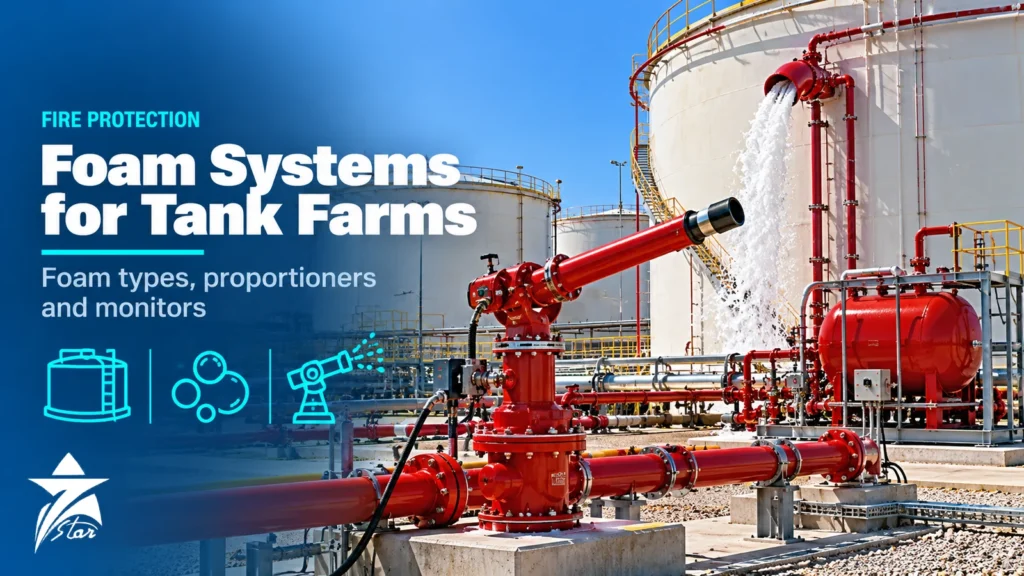
A full-surface fire on a crude or gasoline storage tank is one of the hardest fires a terminal can face, and water alone will not put it out: it sinks through the burning hydrocarbon and can cause boil-over in crude tanks. Foam fire protection is the standard answer, but a foam system is only as good as its weakest link – the concentrate, the proportioner, the discharge device or the water supply. This guide walks through foam types, expansion ratios, proportioning methods, fixed outlets versus monitors, the NFPA 11 application-rate logic for storage tanks, and the shift away from fluorinated foams that every tank farm owner now has to plan for.
How Foam Fire Protection Works
Finished foam is a blanket of bubbles made from water, foam concentrate and air. It extinguishes a flammable-liquid fire in four ways at once: it separates the fuel surface from oxygen, suppresses the release of flammable vapour, cools the fuel and adjacent metal with the drained water, and – for film-forming types – spreads an aqueous film over hydrocarbon surfaces. The blanket must flow across the whole surface and stay intact long enough to prevent re-ignition from hot tank shells.
Foam is defined by three numbers: the proportioning rate (concentrate percentage in water, typically 1 %, 3 % or 6 %), the expansion ratio (volume of foam per volume of solution) and the drainage time. NFPA 11 classifies low-expansion foam up to 20:1, medium expansion from 20:1 to 200:1, and high expansion above 200:1. Storage tank protection almost always uses low-expansion foam because it can be thrown and poured over long distances and resists heat and wind.
Foam Concentrate Types
- Protein (P) – made from hydrolysed animal protein; heat-stable, slow-flowing, now largely obsolete.
- Fluoroprotein (FP) – protein with fluorosurfactants for better fuel shedding; suitable for subsurface injection.
- Film-forming fluoroprotein (FFFP) – combines protein stability with film formation.
- AFFF – synthetic, fast knockdown on hydrocarbons, usable with non-aspirating nozzles; contains fluorosurfactants (PFAS).
- Alcohol-resistant AFFF (AR-AFFF) – adds a polymer membrane so polar solvents such as methanol, ethanol and MTBE do not destroy the bubbles; often labelled for 3 % on hydrocarbons and 3 % or 6 % on polar solvents.
- Fluorine-free foams (SFF/F3) – synthetic foams without PFAS; performance depends heavily on aspiration and gentle application, and listings are specific to fuel, device and rate.
A concentrate is approved together with the discharge devices and rates it was tested with. Switching concentrate without checking the proportioner calibration, the discharge outlets and the application rate is one of the most common foam-system errors.
Proportioning Methods Compared
The proportioner injects concentrate into the water stream at the correct ratio across the full flow range. Too lean and the foam breaks down; too rich and the concentrate stock runs out before the required discharge time.
| Proportioner | How it works | Strengths | Limitations |
|---|---|---|---|
| In-line eductor | Venturi draws concentrate from a drum or tank | Simple, no external power, portable | Large pressure loss (roughly a third of inlet pressure), fixed flow, sensitive to back-pressure and hose length |
| Around-the-pump | Eductor on a pump bypass returns foam solution to pump suction | Common on fire trucks, adjustable | Needs low suction pressure; ratio drifts with flow |
| Balanced pressure (pumped) | Dedicated concentrate pump; valve balances concentrate and water pressure at a ratio controller | Accurate over a wide flow range; large fixed systems | Concentrate pump, controls and power required |
| Bladder tank | Water pressure squeezes a bladder holding concentrate into a ratio controller | No concentrate pump; accurate; widely used in fixed systems | Bladder must be inspected; refill procedure is slow |
| Water-driven proportioner | Water motor drives a positive-displacement concentrate pump | Accurate over wide flows without electrical power | Higher equipment cost, mechanical maintenance |
| Direct injection | Metered concentrate pump injects into water by flow signal | Very accurate, flexible | Controls and power dependent |
Fixed-Roof Tanks: Surface and Subsurface Application
On cone-roof tanks, foam is usually delivered by Type II discharge outlets – foam chambers mounted on the top of the shell that deflect aspirated foam gently down the inside wall onto the liquid surface. Each chamber has a vapour seal (frangible glass or a burst disc) that stops tank vapour from entering the foam line. For hydrocarbon fixed-roof tanks NFPA 11 sets a minimum application rate of about 4.1 L/min·m² (0.10 gpm/ft²) of foam solution over the liquid surface, with a minimum discharge time that depends on the product: commonly 30 minutes for combustible liquids with flash points between 37.8 °C and 93.3 °C, and 55 minutes for flammable liquids with lower flash points, liquids heated above their flash point and crude oil.
Subsurface injection pumps foam through a high-back-pressure generator into the product line near the tank bottom, so it rises through the fuel. It avoids roof-mounted equipment that a roof explosion could destroy, but it only suits hydrocarbons with fluoroprotein, FFFP or AFFF concentrates; it is not used on polar solvents or on floating-roof tanks.
Floating-Roof Tanks: Rim Seal Protection
The most frequent fire on an open-top floating-roof tank is a rim seal fire, often started by lightning. Protection uses foam pourers on the shell or on the roof that fill the annular space between the seal and a foam dam welded on the roof, a short distance in from the shell. For top-of-seal application with a foam dam, NFPA 11 uses a rate of about 12.2 L/min·m² (0.30 gpm/ft²) of the annular seal area for 20 minutes; check the exact table, foam dam height and pourer spacing in the edition your project uses. A full-surface fire on a large floating-roof tank after roof sinking is a different problem that needs large-capacity monitors and pre-planning, as industry work such as the LASTFIRE project has highlighted.
Monitors, Hose Streams and Bund Protection
Fixed or trailer-mounted foam monitors can throw large flows over long distances and are used for bund fires, for supplementing fixed outlets and, within the limits NFPA 11 sets, as primary protection for smaller fixed-roof tanks. Because much of the foam is lost to wind and thermal updraft, the standard applies higher application rates and longer durations to monitor application than to fixed outlets. In the GCC’s strong afternoon winds, monitor positions should be chosen with the prevailing wind direction in mind.
NFPA 11 also requires supplementary foam hose streams for small spill fires around tanks, each based on 189 L/min (50 gpm):
| Diameter of largest tank | Minimum number of hose streams | Minimum operating time |
|---|---|---|
| Up to 10.5 m (35 ft) | 1 | 10 min |
| 10.5–19.5 m (35–65 ft) | 1 | 20 min |
| 19.5–28.5 m (65–95 ft) | 2 | 20 min |
| 28.5–36 m (95–120 ft) | 2 | 30 min |
| Over 36 m (120 ft) | 3 | 30 min |
Dike or bund areas are typically protected with low-level foam pourers or generators fixed to the bund wall, sized on the bund area and the product.
Sizing a Tank Foam System: Data to Collect
- Product stored, flash point, whether it is a polar solvent, and storage temperature.
- Tank type (cone roof, internal floating roof, open-top floating roof), diameter and height.
- Surface area or annular seal area and foam dam height.
- Required application rate and discharge time from NFPA 11 or the governing company standard.
- Foam solution flow = area × rate; concentrate quantity = solution flow × time × proportioning percentage, plus hose streams and a reserve.
- Water supply: firewater pump capacity, pressure at the proportioner and cooling-water demand for adjacent tanks, which often governs the total firewater demand.
- Hydraulic calculation of the worst-case tank including pipe friction and the pressure required at each outlet.
For example, a 30 m diameter cone-roof tank storing gasoline has a surface of about 707 m²; at 4.1 L/min·m² that needs roughly 2,900 L/min of solution, and a 3 % concentrate for 55 minutes needs close to 4,800 L of concentrate before hose streams and reserve are added.
The Move Away From Fluorinated Foams
AFFF, AR-AFFF, FFFP and fluoroprotein foams contain PFAS, which are persistent in soil and groundwater. The EU adopted Regulation (EU) 2025/1988 restricting PFAS in firefighting foams, with transition periods that run longer for high-hazard establishments and offshore installations, and several US states and Australian jurisdictions have their own restrictions. Changing to fluorine-free foam is not a drop-in swap: listings, application rates, aspiration and proportioner settings may all change, existing pipework and tanks must be cleaned of PFAS residues, and run-off from tests and incidents needs containment. Plan transitions as an engineering project, not a purchasing decision.
Inspection, Testing and Common Failures
- Sample foam concentrate at least annually and send it for laboratory testing of expansion, drainage and sediment.
- Flow-test proportioners to confirm the actual ratio; a blocked strainer or wrong orifice silently leaves the system lean.
- Check foam chamber vapour seals, which can crack in the heat or be painted over.
- Inspect bladders and concentrate tanks for leaks, sludge and cross-contamination of different concentrates.
- Flush and drain solution lines after testing to prevent corrosion, particularly where seawater is used.
- Confirm the concentrate is listed for use with seawater if the firewater system uses it, and store drums out of direct sun within the manufacturer’s temperature limits.
Foam systems depend on reliable firewater pumps and valves; see our industrial pumps and fittings and valves ranges for related equipment.
Tank Foam Fire Protection Checklist
- Concentrate type matched to product (hydrocarbon or polar solvent) and listed with the discharge devices
- Proportioner type, flow range and last calibration result
- Application rate and discharge time per tank from NFPA 11 or the governing standard
- Concentrate stock covering the largest tank, hose streams and reserve
- Foam chamber seals, pourers, foam dams and monitors inspected
- Firewater supply covering foam and tank cooling at the required pressure
- PFAS transition plan and run-off containment
Foam and Deluge Equipment We Supply
These products cover parts of the foam and water spray systems discussed above.
| Product | Type | Where it fits |
|---|---|---|
| Safco Italia Z4 Foam Mixer 400 l/min, Series Z | Foam mixer | Mixing foam concentrate into water. |
| Safco Italia S4 Low Expansion Foam Nozzle 400 l/min | Low expansion foam nozzle | Foam application on spills and bunds. |
| Reliable DDX Deluge Valve with Wet, Dry or Electric Release Trim | Deluge valve | Releasing water to open sprinklers or foam systems. |
| Minimax FSX Deluge Valve Set (DN 50 to DN 200) | Deluge valve set | Water spray and foam systems. |
| Weflo Fig. 9266 UL Listed Deluge Valve | Deluge valve | Water spray systems. |
Send the system design or the tank sizes, product and protection standard through our quote request form.
Sourcing Foam System Equipment Through Seven Star LLC
Seven Star LLC supplies foam concentrates, proportioners, foam chambers, monitors and related parts on request for terminals and plants in Oman and the GCC. Browse our fire fighting equipment and the wider fire and gas systems category. We help with selection and cross-checking part numbers, and availability and lead time are confirmed at quotation.
Replacing a proportioner, foam chamber or monitor, or switching concentrate? Send us the equipment nameplates, the foam system datasheet or your RFQ and we will come back with matched options and a clear quotation.
Frequently asked questions
What foam application rate does NFPA 11 require for a fixed-roof hydrocarbon tank?
For surface application with Type II foam chambers, NFPA 11 sets a minimum of about 4.1 L/min·m² (0.10 gpm/ft²) of foam solution over the liquid surface. The discharge time depends on the product, commonly 30 minutes for higher-flash-point combustible liquids and 55 minutes for low-flash-point liquids and crude oil.
What is the difference between AFFF and AR-AFFF?
AFFF forms an aqueous film on hydrocarbon fuels for fast knockdown. AR-AFFF adds a polymer that forms a protective membrane on polar solvents such as alcohols and MTBE, which would otherwise destroy ordinary foam, so it is used where both fuel types are stored.
Can subsurface foam injection be used on every tank?
No. Subsurface injection suits fixed-roof tanks storing hydrocarbons, using fluoroprotein, FFFP or AFFF concentrates. It is not used for polar solvents, which destroy the foam as it rises, or for floating-roof tanks.
What does a foam proportioner do?
It mixes foam concentrate into the water stream at the design ratio, such as 3 %, across the system's flow range. Common types are in-line eductors, balanced-pressure pump systems, bladder tanks and water-driven proportioners, each with different accuracy, pressure loss and power needs.
How often should foam concentrate be tested?
NFPA 11 calls for concentrate samples to be tested at least annually, typically checking expansion, drainage time and sediment against the manufacturer's specification. Proportioners should also be flow-tested to confirm the actual mixing ratio.
Can a tank farm simply switch from AFFF to fluorine-free foam?
Not without engineering review. Fluorine-free foams are listed for specific fuels, devices and application rates, often need aspirated gentle application, and may require proportioner changes; pipework and tanks also need cleaning to remove PFAS residues.
Was this guide helpful?One click helps us write better guides for engineers.
Thank you! Glad it helped. Need this equipment for your project? Request a quotation
Thank you. We will use this to improve the guide.