- Automation & ControlView all 2,800 products
- Automation Accessories
- AC Drives
- PLC & I/O Cards
- Industrial Communications
- Vibration Monitoring
- Controllers & Data Acquisition
- Isolator & Barrier
- Safety Switches & Guard Locking
- Motor Soft Starters
- CCTV & Security
- Encoders
- Pneumatic Cylinders
- HMI Displays
- Servo Drives
- Industrial Computers
- Machine Vision
- Automation Software
- Robotics
















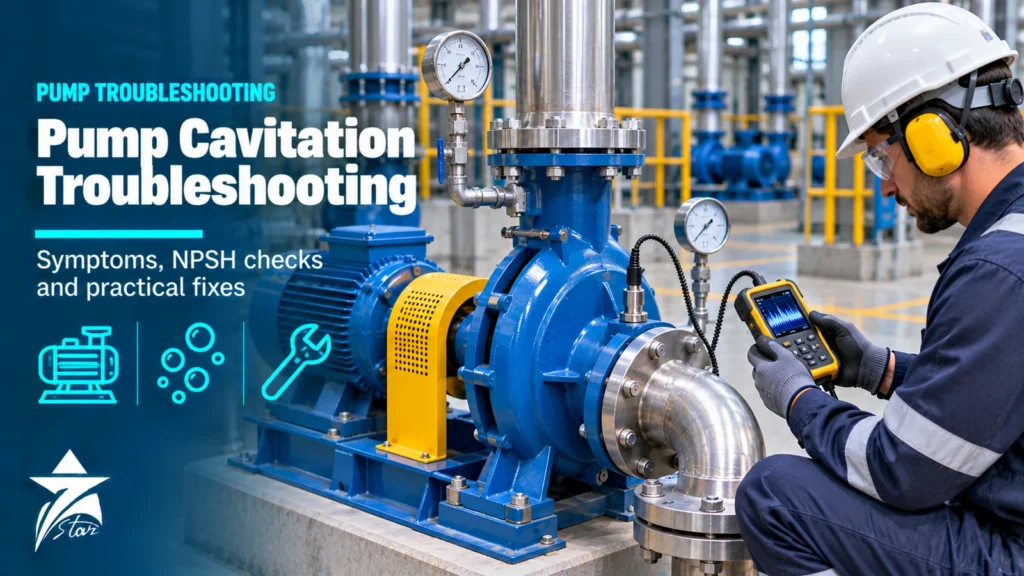
A centrifugal pump that sounds like it is pumping gravel, loses head and eats impellers every few months is usually cavitating. Pump cavitation is one of the most common causes of early impeller, seal and bearing failure, yet it is often misdiagnosed or treated by replacing parts without changing the conditions that cause it. This guide explains what is happening inside the pump, how to tell true vaporisation from recirculation and air entrainment, how to check NPSH in the field, and which practical fixes actually work.
What Happens During Pump Cavitation
As liquid enters the impeller eye, its velocity rises and its static pressure falls. If the local pressure drops below the vapour pressure of the liquid at that temperature, small vapour bubbles form. The bubbles are carried into higher-pressure regions of the impeller passages, where they collapse violently. Each collapse produces a micro-jet and a pressure shock against the metal surface. Millions of these events per second erode the vanes, create noise and vibration, and reduce the head and flow the pump can deliver.
The key measure is net positive suction head. NPSH available (NPSHa) is the margin of pressure above vapour pressure at the pump suction, set by the system. NPSH required (NPSHr) is a property of the pump, published by the manufacturer, normally defined as the NPSH at which head drops by 3% (NPSH3). Because some bubbles already form at NPSH3, a safety margin above it is always needed.
Symptoms of Pump Cavitation to Look and Listen For
- Noise: a crackling or gravel-like sound near the suction and the casing, often louder at high flow.
- Vibration: broadband, random high-frequency vibration rather than clean peaks at running speed.
- Unstable discharge pressure and flow: the gauge needle flickers and the head is below the curve.
- Rising motor current fluctuation and erratic power readings.
- Impeller damage: sponge-like pitting on the low-pressure side of the vanes near the eye, or on the pressure side near the vane tips with recirculation.
- Repeated mechanical seal and bearing failures caused by shaft vibration and vapour at the seal faces.
Damage location is the best clue when diagnosing pump cavitation. Pitting on the visible underside of the inlet vanes points to classic suction vaporisation. Damage on the hidden pressure side of the vanes, or at the outer diameter and on the casing cutwater, points to recirculation.
Vaporisation, Recirculation and Air Entrainment Compared
| Type | Root cause | Operating condition | Typical damage location |
|---|---|---|---|
| Classic vaporisation | NPSHa too low compared with NPSHr | Often worse at high flow, right of BEP | Low-pressure (visible) side of inlet vanes near the eye |
| Suction recirculation | Flow too low for the impeller eye design | Low flow, left of BEP | Pressure (hidden) side of inlet vanes |
| Discharge recirculation | Flow too low for the impeller outlet | Low flow, left of BEP | Vane tips at outer diameter, cutwater, shrouds |
| Vane passing syndrome | Too small gap between impeller and cutwater | Any flow, worse near BEP on high-energy pumps | Shroud and cutwater near the outlet |
| Air or gas entrainment | Vortex, leaking suction joints, gas in the liquid | Low sump level, poor submergence | Little erosion; loss of head and noisy operation |
Entrained air is not true cavitation, but it sounds similar and is often confused with it. It reduces head and flow and can make the pump lose prime, and it is fixed by stopping air from reaching the suction rather than by raising NPSHa.
How to Calculate NPSH Available
NPSHa is calculated at the pump suction flange in metres of liquid:
NPSHa = Hatm + Hs – Hf – Hvp
- Hatm: pressure on the liquid surface (about 10.3 m of water at sea level for an open tank; the vessel pressure for a closed tank).
- Hs: static height of the liquid surface above the pump centreline (negative for suction lift).
- Hf: friction losses in the suction pipe, strainers, valves and fittings at the actual flow.
- Hvp: vapour pressure of the liquid at the pumping temperature, expressed as head.
Temperature has a large effect on pump cavitation. Water at 30 °C has a vapour pressure of about 0.43 m; at 80 °C it is about 4.8 m. A cooling water pump that is fine in winter can start cavitating in an Omani summer when the basin warms up, and a condensate or boiler feed pump has almost no margin unless the vessel is elevated. Liquids close to their boiling point, such as LPG, ammonia and hot hydrocarbons, need careful analysis.
A common guideline is an NPSH margin ratio (NPSHa/NPSHr) of at least 1.1 to 1.3 for general services, and 1.5 to 2.5 for high-energy pumps, boiler feed and hydrocarbon services, as described in ANSI/HI 9.6.1. Our centrifugal pump selection guide explains how to read the NPSH curve and BEP on the manufacturer curve.
Field Checks for Pump Cavitation Step by Step
| Step | What to do | What it tells you |
|---|---|---|
| 1 | Install a compound gauge or absolute pressure transmitter at the suction flange and read it with the pump running | Actual suction pressure for the NPSHa calculation |
| 2 | Read discharge pressure and flow, and plot the point on the pump curve | Whether the pump runs far left or far right of BEP |
| 3 | Measure liquid temperature and look up the vapour pressure | Hvp term in the calculation |
| 4 | Throttle the discharge valve slightly and listen | Noise falling at lower flow suggests vaporisation; noise rising suggests recirculation |
| 5 | Check sump level, submergence and inlet geometry for vortices | Air entrainment |
| 6 | Measure vibration velocity and high-frequency acceleration on the bearing housings | Broadband energy typical of cavitation versus imbalance or misalignment |
| 7 | Inspect the suction strainer, foot valve and isolation valve | Hidden friction losses from blockage or a partly closed valve |
When the suction pressure is near or below atmospheric, an ordinary gauge cannot show it accurately; use a compound gauge or an absolute pressure transmitter. Online accelerometers and vibration transmitters on critical pumps give early warning before damage builds up. See our vibration monitoring system guide for sensor and system options.
Practical Pump Cavitation Fixes on the Suction Side
- Raise the liquid level in the suction tank or lower the pump to increase static head.
- Shorten the suction line, increase the pipe diameter and remove unnecessary elbows, valves and fittings.
- Clean or enlarge the suction strainer, and add differential pressure monitoring so blockage is caught early.
- Fully open the suction isolation valve; never throttle the suction side to control flow.
- Provide at least five to ten pipe diameters of straight pipe before the pump, or a flow straightener, and use an eccentric reducer with the flat side on top.
- Cool the liquid or pressurise the suction vessel when vapour pressure is the problem.
- Check submergence above the inlet and add anti-vortex baffles or a suction bell where air is drawn in.
Fixes at the Operating Point and on the Pump
- Return the pump to its preferred operating region: control flow with the discharge valve or, better, a variable speed drive. Lower speed reduces NPSHr roughly with the square of speed.
- Add a minimum flow bypass for pumps that must run at low flow, to avoid suction and discharge recirculation.
- Trim or change the impeller if the pump is oversized for the duty, or select a pump with a lower NPSHr or a suction-specific-speed design suited to the flow range.
- Fit an inducer ahead of the impeller where the pump design allows it, to lower the NPSHr.
- Use a double-suction pump for large flows, which halves the flow per impeller eye.
- Choose more resistant materials such as duplex or 13Cr-4Ni stainless impellers to extend life where some cavitation cannot be avoided.
- Correct the gap between impeller and cutwater on high-energy pumps if vane passing damage is present.
Material upgrades only slow the damage caused by cavitation. They should be combined with a fix to the root cause, otherwise the new impeller will follow the old one. If the seal has failed repeatedly, review its flush plan as well; our mechanical seals guide covers seal plans that keep the faces cool and wetted.
Pump Cavitation Risks in Oman Plants
Several local conditions make the problem more common. High ambient and cooling water temperatures in summer raise vapour pressure and reduce NPSHa. Seawater intake pumps for desalination plants see changing sump levels with the tide and suffer from vortices and marine growth on the screens. Oil and gas facilities pump hydrocarbons and condensate close to their bubble point, and water networks run pumps far from BEP during low night demand. A periodic check of suction pressure, temperature and vibration on critical pumps helps catch these conditions before impellers are damaged.
Pumps and Instruments We Supply
The table lists examples of pumps and diagnostic instruments we can quote for cavitation-prone services and troubleshooting work.
| Product | Type | Typical use |
|---|---|---|
| Sulzer SMD axially split double-suction pump | Double-suction pump | Large flows with low NPSHr |
| Xylem Lowara e-XC double-suction split-case pump | Split-case pump | Water supply and HVAC |
| KSB RPHd double-suction BB2 process pump | API 610 process pump | Refinery and petrochemical services |
| Goulds 3196 i-FRAME ANSI process pump | ANSI end-suction pump | Chemical and general process |
| Sulzer OHV API 610 vertical inline pump | Vertical inline pump | Hydrocarbon process services |
| Grundfos CR 10-5 vertical multistage pump | Multistage pump | Boosting and water treatment |
| Gorman-Rupp V4A Ultra V self-priming trash pump | Self-priming pump | Suction lift and dewatering |
| Rosemount 2088 gauge and absolute pressure transmitter | Suction pressure measurement | NPSHa checks |
| Honeywell SmartLine STA800 absolute transmitter | Absolute pressure measurement | Vacuum and near-atmospheric suction |
| SKF CMSS 2200 industrial accelerometer | Vibration sensor | Bearing housing monitoring |
| PCB Piezotronics 352C03 ICP accelerometer | High-frequency sensor | Cavitation and bearing diagnostics |
| Bently Nevada 990-04-70-01-00 2-wire transmitter | Vibration transmitter | 4-20 mA vibration to DCS or PLC |
| Fluke 805 FC vibration meter | Portable meter | Route-based field checks |
Browse more in our centrifugal pumps category. To get a quotation, send the liquid, temperature, flow, head, suction conditions and NPSHa, or the model and serial number of the existing pump and the sensors you need, through our quote request form or to [email protected].
Sourcing Pumps and Diagnostic Instruments in Oman Through Seven Star LLC
Seven Star LLC is an independent supplier in Oman of centrifugal pumps, spare impellers, pressure transmitters, compound gauges and vibration sensors for water, desalination, oil and gas and industrial plants dealing with cavitation and other reliability problems. We quote products from manufacturers such as Sulzer, KSB, Flowserve, Goulds, Grundfos, Xylem Lowara, Gorman-Rupp, Rosemount, Honeywell, SKF, PCB Piezotronics, Bently Nevada and Fluke. Performance data, materials and lead time are confirmed against the manufacturer data at quotation.
Frequently asked questions
What causes pump cavitation?
Pump cavitation occurs when the pressure at the impeller eye falls below the vapour pressure of the liquid, so vapour bubbles form and then collapse in higher-pressure areas. The main causes are low NPSH available, high liquid temperature, blocked suction strainers and running the pump far from its best efficiency point.
How do I know if my pump is cavitating?
Typical signs are a gravel-like noise, broadband vibration, unstable discharge pressure, lower head than the curve and pitting on the impeller vanes. A suction pressure reading and an NPSHa calculation confirm whether vaporisation is the cause.
What is the difference between NPSHa and NPSHr?
NPSHa is the suction head available above vapour pressure, set by the system design and operating conditions. NPSHr is the head the pump needs, published by the manufacturer. NPSHa must exceed NPSHr by a safety margin for reliable operation.
Can a variable speed drive stop cavitation?
Often yes. Reducing speed lowers the NPSHr and brings the pump back toward its best efficiency point. However, running too slowly at low flow can cause recirculation, so the speed range should be checked against the pump curve.
Is air entrainment the same as cavitation?
No. Air entrainment is caused by air or gas drawn into the suction through vortices or leaking joints. It sounds similar and reduces head, but the fix is to improve submergence and seal the suction line rather than increase NPSHa.
Who supplies pumps and vibration sensors for pump cavitation problems in Oman?
Seven Star LLC is an independent supplier in Oman that quotes centrifugal pumps, pressure transmitters and vibration monitoring instruments from leading manufacturers. Send your requirements through the quote request form or to [email protected].
Was this guide helpful?One click helps us write better guides for engineers.
Thank you! Glad it helped. Need this equipment for your project? Request a quotation
Thank you. We will use this to improve the guide.