- Automation & ControlView all 2,855 products
- Automation Accessories
- AC Drives
- PLC & I/O Cards
- Industrial Communications
- Vibration Monitoring
- Controllers & Data Acquisition
- Isolator & Barrier
- Safety Switches & Guard Locking
- Motor Soft Starters
- CCTV & Security
- Encoders
- Pneumatic Cylinders
- HMI Displays
- Servo Drives
- Industrial Computers
- Machine Vision
- Automation Software
- Robotics
















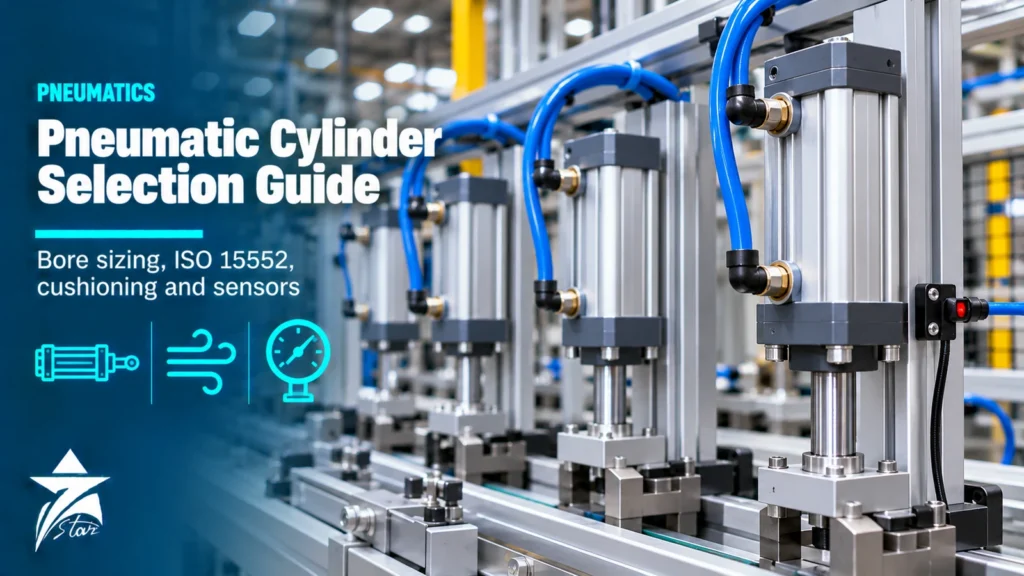
A pneumatic cylinder converts compressed air into straight-line motion and force. It is simple, fast, tolerant of overload and cheap to maintain, which is why it remains the standard actuator for clamping, pushing, lifting, sorting and gate operation in packaging lines, process plants, water treatment and machinery. Selecting the right one is mostly a matter of getting the force, stroke, speed, cushioning and mounting right. This guide walks through each step, with formulas and worked examples.
Single Acting and Double Acting Pneumatic Cylinder Designs
- Single acting: air drives the piston in one direction and a spring returns it. Air use is lower and the cylinder returns to a safe position on air loss, but the spring reduces the available force and limits the stroke, usually to around 100 mm or less.
- Double acting: air drives the piston in both directions. This is the most common type, with full force in both directions and long strokes possible.
- Through rod: the rod passes through both end caps, giving equal areas on both sides and better guiding.
- Rodless: a carriage runs along the barrel, coupled magnetically or mechanically to the piston. The installation length is about half that of a rod cylinder with the same stroke.
- Guided and compact cylinders: integrated guide rods take side loads and prevent rotation, useful for pick and place.
- Rotary actuators and grippers: related pneumatic actuators for turning and gripping motions.
The Main ISO Standards for Cylinders
| Standard | Type | Bore range | Typical use |
|---|---|---|---|
| ISO 15552 (replaced ISO 6431 and VDMA 24562) | Profile or tie rod cylinder | 32 to 320 mm | General machinery, heavy duty automation |
| ISO 6432 | Round mini cylinder | 8 to 25 mm | Light duty, small machines |
| ISO 21287 | Compact short-stroke cylinder | 20 to 100 mm | Clamping and limited space |
| NFPA (US) | Tie rod cylinder in inch sizes | 1.5 to 14 in | Machines built to US standards |
The great advantage of ISO 15552 is interchangeability: mounting dimensions, rod threads and overall lengths are standard, so a cylinder of the same bore and stroke from another manufacturer will normally fit the same mountings. This matters for spares in Oman, where replacing a failed unit quickly is often more important than the brand.
Calculating Pneumatic Cylinder Force and Bore Size
Theoretical force equals pressure multiplied by piston area. On the return stroke of a double acting cylinder the rod area is deducted:
- Push force F = p × π × D² / 4
- Pull force F = p × π × (D² − d²) / 4, where d is the rod diameter
- With p in bar and area in cm², force in newtons is roughly p × A × 10.
Worked example: a 50 mm bore at 6 bar has a piston area of 19.6 cm², so the theoretical push force is about 1,180 N. With a 20 mm rod, the annular area is 16.5 cm² and the pull force is about 990 N.
Friction and the need for acceleration mean you should never use the theoretical value. A practical rule is to apply a load ratio:
| Application | Load ratio (required force / theoretical force) |
|---|---|
| Static clamping or holding | Up to about 0.7 to 0.8 |
| Slow horizontal movement | About 0.6 to 0.7 |
| Fast or vertical movement | About 0.5 or less |
So to lift 600 N vertically at speed with 6 bar available, the theoretical force needed is around 1,200 N, which points to a 50 mm bore. Always size with the lowest pressure that will be available at the machine, not the compressor setting, because pressure drops in long lines and during peak demand.
Stroke, Speed and Buckling
Choose the stroke to suit the motion plus a small margin; do not use the end caps as a mechanical stop for a heavy load unless the cushioning is rated for it. Typical piston speeds for a standard cylinder are 50 to 1,000 mm/s, controlled by flow control valves. Meter-out control, restricting the exhaust air, gives smoother motion than meter-in for double acting cylinders. For long strokes with a compressive load, check the rod against buckling using the manufacturer charts, and consider a larger rod, a guide unit or a different mounting.
Cushioning: Protecting the Cylinder and the Machine
At the end of the stroke of a pneumatic cylinder, the moving mass must be stopped. The kinetic energy, half the mass times the speed squared, must be absorbed by the cushioning, or the end caps and the machine will be damaged over time.
- Elastic cushioning: rubber or polyurethane rings at the ends. Suitable for light loads and low speeds.
- Adjustable pneumatic cushioning: a cushioning spear traps air in the last part of the stroke and a needle valve sets the deceleration. The standard choice for ISO 15552 cylinders.
- Self-adjusting pneumatic cushioning: the cushioning adapts automatically to load and speed changes, reducing commissioning time.
- External shock absorbers: for heavy loads or high speeds beyond the energy rating of the internal cushioning.
Manufacturers publish the maximum allowable mass for a given speed for each bore. If your application is above the curve, reduce speed, increase bore size, or add shock absorbers.
Position Sensing on a Pneumatic Cylinder
Most modern cylinders have a magnet in the piston, so position sensors can be clamped in the profile slots or on the tie rods without touching the air chamber.
- Reed switches: simple and economical, but mechanical contacts have limited life at high switching rates.
- Magnetoresistive or Hall effect sensors: solid state, PNP or NPN outputs, long life, suitable for PLC inputs. Most are 3-wire with an M8 or M12 connector.
- Analogue position transmitters: give a continuous 0-10 V or 4-20 mA signal over a range of the stroke.
- Inductive sensors: used for detecting the rod end or machine parts where no magnetic piston is fitted.
Check that the cylinder version includes the magnetic piston, as the code is often a single letter in the order code. For hazardous areas, ATEX-rated cylinders and sensors are available.
Mounting and Alignment
Common mounting types for a pneumatic cylinder are foot, front or rear flange, rear clevis, swivel eye and centre trunnion. Fixed mountings such as foot and flange require the load to move exactly in line with the rod. Where the load moves in an arc, use a pivoting mount such as a clevis or trunnion. A floating joint or rod clevis at the rod end compensates for small misalignments. Side loads on the rod are the most common cause of early seal and bearing wear; if they cannot be avoided, use a guided cylinder or an external guide.
Calculating Pneumatic Cylinder Air Consumption
Air consumption matters for compressor sizing and energy cost. The free air volume per stroke is the swept volume multiplied by the compression ratio, (p + 1.013) / 1.013 with p in bar gauge.
Worked example: a 50 mm bore, 200 mm stroke, 20 mm rod, 6 bar, 10 cycles per minute. The swept volume on the push stroke is 19.6 cm² × 20 cm = 0.39 litres, and on the return stroke 16.5 cm² × 20 cm = 0.33 litres. The compression ratio is about 6.9, so each cycle uses about 5.0 normal litres and the cylinder needs about 50 Nl/min, plus the volume of the tubes and valve ports. Reducing the pressure on the return stroke, using smaller tubes or choosing a smaller bore where force allows can cut air use significantly.
Valves, Air Preparation and Fittings
A double acting cylinder is normally controlled by a 5/2 or 5/3 directional valve, a single acting one by a 3/2 valve. Our solenoid valve selection guide covers valve types, coils and protection ratings. Supply clean, dry air through a filter-regulator; most modern cylinders are pre-lubricated and should run on non-lubricated air, and if a lubricator is added it must be kept in service for the life of the cylinder. For quarter-turn valve automation, which uses rack and pinion or scotch yoke actuators instead of linear cylinders, see our pneumatic actuator sizing guide.
Choosing a Pneumatic Cylinder for Dusty and Hot Sites in Oman
- Fit heavy duty rod scrapers or protective bellows where sand and dust are present, as abrasive particles damage rod seals quickly.
- Check the seal temperature range. Standard seals are typically rated to about 80 °C; high temperature FKM seals extend this to 120 or 150 °C for equipment near ovens, sun-exposed surfaces or hot process lines.
- Use stainless steel cylinders in coastal, food, desalination and washdown environments.
- Use dryers on the compressed air system. Condensation forms when hot, humid air cools in the lines, and water in the cylinder washes out the grease.
- Keep spare seal kits and at least one spare cylinder of each critical size, especially on packaging and bottling lines.
Selected Cylinders and Pneumatic Actuators in Our Catalogue
| Product | Type | Typical use |
|---|---|---|
| Festo DSBC-40-70-PPVA-N3 | ISO 15552 profile cylinder, 40 mm | General automation |
| Festo DSBC-100-200-PPSA-N3 | ISO 15552, self-adjusting cushioning | Heavy loads |
| SMC CP96SDB63-100C | ISO 15552, 63 mm bore | Machine building |
| Norgren PRA/182000/M | ISO 15552 profile cylinder | Process and packaging |
| Norgren RM/57200/M Roundline | Stainless steel round body | Food and washdown |
| Festo DSNU-20-100-PPV-A | ISO 6432 round, 20 mm | Light duty motion |
| Festo ADN-100-30-A-P-A | Compact ISO 21287, 100 mm | Clamping in tight spaces |
| SMC CG1BN40-100 | Round body, 40 mm bore | Gates and pushers |
| Camozzi Series 61 | Tie rod and profile cylinder | General industry |
| SMC CY1S20-300Z | Magnetically coupled rodless | Long strokes, short space |
| SMC MGQM25-30 | Compact guide cylinder | Side loads, pick and place |
| SMC CRQ2BS20-90 | Compact rotary actuator | 90 degree turning |
| SMC MHZ2-16D | Parallel air gripper | Gripping parts |
Browse more in our cylinders category. To get a quotation, send the bore, stroke, standard, cushioning, magnetic piston, mounting, seal material and quantity, or the full order code of an existing unit, through our quote request form or to [email protected].
Sourcing Cylinders in Oman Through Seven Star LLC
Seven Star LLC is an independent supplier in Oman of linear cylinders, rodless and guided units, rotary actuators, grippers, sensors and mountings for machinery, packaging and process plants, including replacements for an existing cylinder by order code. We quote products from manufacturers such as Festo, SMC, Norgren and Camozzi. Dimensions, options and lead time are confirmed against the manufacturer data at quotation.
Frequently asked questions
How do I calculate the force of a pneumatic cylinder?
Multiply the air pressure by the piston area: force in newtons is roughly pressure in bar times area in square centimetres times 10. For the return stroke subtract the rod area. Then apply a load ratio of 0.5 to 0.7 for moving loads to allow for friction and acceleration.
What is the difference between ISO 15552 and ISO 6432 cylinders?
ISO 15552 covers profile and tie rod cylinders from 32 to 320 mm bore for medium and heavy duty use. ISO 6432 covers small round cylinders from 8 to 25 mm bore. Both standardise mounting dimensions so that units from different manufacturers are interchangeable.
Why does my cylinder bang at the end of the stroke?
The cushioning is not absorbing the kinetic energy, either because it is not adjusted, the speed is too high, or the moving mass exceeds the cushioning rating. Adjust the cushioning screws, reduce speed with flow controls, or add external shock absorbers.
Do pneumatic cylinders need lubricated air?
Most modern cylinders are factory lubricated for life and should run on clean, dry, non-lubricated air. If lubricated air has been used, it must continue, because the oil washes away the original grease.
How can I reduce air consumption?
Use the smallest bore that meets the force requirement, reduce the supply pressure on the return stroke, shorten the tubes between valve and cylinder, and fix leaks. Air consumption is proportional to bore area, stroke, pressure and cycle rate.
Who supplies pneumatic cylinders in Oman?
Seven Star LLC is an independent supplier in Oman that quotes ISO, compact, round, rodless and guided cylinders, rotary actuators and grippers from manufacturers such as Festo, SMC, Norgren and Camozzi. Send your requirements through the quote request form or to [email protected].
Was this guide helpful?One click helps us write better guides for engineers.
Thank you! Glad it helped. Need this equipment for your project? Request a quotation
Thank you. We will use this to improve the guide.