- Automation & ControlView all 2,855 products
- Automation Accessories
- AC Drives
- PLC & I/O Cards
- Industrial Communications
- Vibration Monitoring
- Controllers & Data Acquisition
- Isolator & Barrier
- Safety Switches & Guard Locking
- Motor Soft Starters
- CCTV & Security
- Encoders
- Pneumatic Cylinders
- HMI Displays
- Servo Drives
- Industrial Computers
- Machine Vision
- Automation Software
- Robotics
















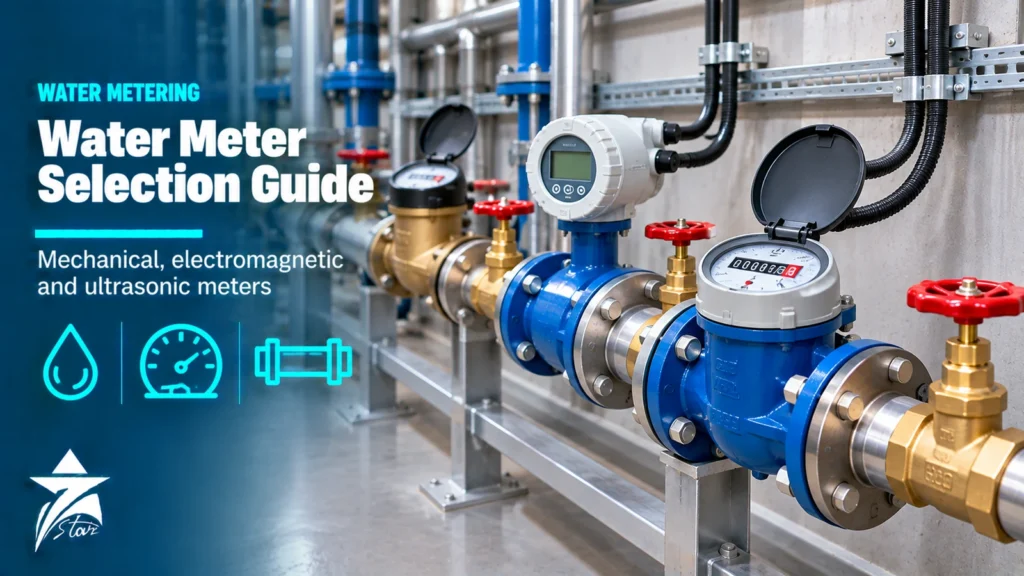
Every cubic metre of water that is produced, desalinated, pumped and treated has a cost, and the meter is where that cost is turned into a bill or a loss figure. A water meter that is oversized, the wrong technology or badly installed can under-register low flows for years, while a well chosen one reduces non-revenue water and supports leak detection. This guide compares the main technologies, explains the ISO 4064 metrological ratings that appear on the dial, shows how to size by flow rather than by pipe diameter, and covers installation and smart reading.
Main Water Meter Technologies
| Technology | How it works | Typical sizes | Strengths | Limitations |
|---|---|---|---|---|
| Single-jet | One jet of water turns an impeller | DN 15 to DN 25 | Low cost, compact, good for homes | Lower R ratio, wears with sand and scale |
| Multi-jet | Several jets around the impeller balance the load | DN 15 to DN 50 | Robust, less sensitive to flow profile | Moving parts, accuracy drifts with wear |
| Volumetric (rotary piston) | Each rotation of the piston displaces a fixed volume | DN 15 to DN 40 | Very good low-flow accuracy, any mounting position | Sensitive to solids, needs a strainer |
| Woltman turbine | Axial or vertical turbine in the flow | DN 40 to DN 500 | High flow capacity, low pressure loss | Poor at low flow, needs straight pipe |
| Compound | Large turbine plus small meter with a changeover valve | DN 50 to DN 200 | Wide range for buildings with variable demand | Two mechanisms to maintain |
| Electromagnetic | Faraday law: velocity of conductive water through a magnetic field | DN 15 to DN 2000 and above | No moving parts, no pressure loss, wide range | Needs power (battery or mains), needs full pipe |
| Ultrasonic (static) | Transit time difference of sound pulses up and downstream | DN 15 to DN 600 and above | No moving parts, very high R ratio, data logging | Battery life, higher purchase price for small sizes |
Mechanical designs are still the most common meter type on domestic connections in many countries because they are cheap and need no battery. Static meters, meaning electromagnetic and ultrasonic designs, keep their accuracy for the whole service life because nothing wears, register very low flows from dripping taps and leaks, and come with built-in radio for remote reading. On bulk and district metering, electromagnetic and ultrasonic designs have largely replaced turbines because their low-flow accuracy is far better during the night, when leakage is easiest to see. For a broader view of industrial flow technologies, see our guide to choosing a flow meter for industrial applications.
ISO 4064 Water Meter Flow Rates: Q1, Q2, Q3 and Q4
Modern meters for cold and hot potable water are rated to ISO 4064 and OIML R 49, which replaced the old EEC classes A, B, C and D. The rating is printed on the dial or label as Q3 and R, for example Q3 = 4, R160.
| Term | Meaning | Relationship |
|---|---|---|
| Q3 | Permanent flow rate: the highest flow at which the meter works continuously within the maximum permissible error | Main sizing value, in m³/h |
| Q4 | Overload flow rate: may be reached for short periods without damage | Q4 = 1.25 × Q3 |
| Q2 | Transitional flow rate: boundary between the lower and upper accuracy zones | Q2 = 1.6 × Q1 |
| Q1 | Minimum flow rate at which the meter must still be within the lower-zone error limit | Q1 = Q3 / R |
| R | Measuring range ratio Q3/Q1, for example R80, R160, R400, R800 | Higher R means better low-flow accuracy |
The maximum permissible error for accuracy class 2 meters is ±5% in the lower zone, from Q1 up to Q2, and ±2% in the upper zone, from Q2 to Q4, for water up to 30 °C (±3% above 30 °C). A DN 20 meter with Q3 = 4 m³/h and R160 therefore measures accurately down to 25 litres per hour, while the same size with R400 measures down to 10 litres per hour. That low-flow range is where small leaks, dripping fittings and float valves on roof tanks are hidden, so a higher R ratio has a direct effect on revenue.
Other Markings to Check on the Label
- Temperature class: T30 for cold water up to 30 °C, T50 up to 50 °C, and T90 or higher for hot water. In hot climates, buried and exposed pipes can exceed 30 °C in summer, so T50 is a safer choice for cold water service.
- Pressure class: maximum admissible pressure, usually MAP 16 (16 bar); some bulk meters are rated to 25 bar or more.
- Pressure loss class: Δp 63, Δp 40, Δp 25, Δp 16 or Δp 10, the maximum pressure loss in kPa between Q1 and Q3.
- Flow profile sensitivity: U0 to U10 and D0 to D10 give the straight pipe needed upstream and downstream in multiples of the diameter. U0 D0 means no straight length is required.
- Installation orientation: H for horizontal, V for vertical, or both. Volumetric and static meters often accept any orientation.
- Approval: MID type examination in Europe or a national approval; utilities often require their own type approval before a meter can be connected.
Sizing a Water Meter by Flow, Not by Pipe Size
The most common mistake is to choose the meter diameter to match the pipe. A meter should be sized from the expected flow profile, and is often one size smaller than the pipe. The procedure is:
- Estimate the normal continuous flow: the average demand during working hours, which should fall well below Q3, ideally around 30% to 60% of it.
- Check the peak flow: from fixture units, process demand or fire service requirements. The peak must stay below Q4 and should only occur for short periods.
- Check the minimum flow: night flow, leakage and float valves. It should be above Q1, otherwise water passes unregistered. If it is not, select a higher R ratio or a smaller meter.
- Check pressure loss at peak flow: especially where the supply pressure is low and roof or ground tanks are filled by gravity.
- Separate fire service: fire mains usually need a full-bore meter or a detector check arrangement approved by the authority, not a standard domestic meter.
Oversizing is costly: an oversized mechanical meter spends most of its life near or below Q2, where it under-registers. Compound meters or wide-range static meters solve this in hotels, hospitals and mixed-use buildings where demand swings from almost zero at night to high peaks in the morning.
Water Meter Installation Rules
- Full pipe: electromagnetic and ultrasonic meters must run full. Avoid high points where air collects; on intermittent supplies install an air release valve upstream.
- Straight lengths: respect the U and D class. Typical mechanical meters need 5D upstream and 3D downstream; turbines need more; some static meters need none.
- Strainer and isolation: a strainer upstream protects mechanical meters from sand and debris; isolation valves on both sides and a non-return valve where required by the utility.
- Grounding: electromagnetic meters on plastic pipe need grounding rings; see our electromagnetic flow meter guide.
- Protection: use a meter box or chamber with a lid that is shaded from direct sun, and keep the register readable without entering the chamber.
- Air in pipes: on networks with intermittent supply, air pushed through a mechanical meter can spin the impeller and over-register. Air valves and static meters with empty-pipe detection reduce disputes.
Smart Water Meter Reading and Data
Automatic meter reading (AMR) and advanced metering infrastructure (AMI) replace manual reading with radio data. Options range from pulse outputs and Wireless M-Bus walk-by or drive-by reading to fixed networks using LoRaWAN, NB-IoT or proprietary RF. A smart meter typically logs hourly or 15-minute consumption and raises alarms for leak, burst, back flow, dry pipe and tampering. For utilities, district meter areas (DMAs) with bulk electromagnetic or ultrasonic meters at the inlets, combined with customer smart meters, make it possible to calculate the water balance per zone and target leak detection crews where they are most needed. In industrial plants, the same data supports water intensity reporting and identifies abnormal consumption on cooling towers and process lines.
Choosing a Water Meter for Oman Conditions
In Oman, potable water comes mainly from desalination plants and is moved over long distances, so every unregistered cubic metre represents a high production cost. Network and site conditions favour particular choices: high ground temperatures point to T50 rated meters; roof and ground storage tanks with float valves create long periods of very low flow, which mechanical meters with low R ratios miss; and intermittent supply in some areas introduces air into the pipes. Static meters with high R ratios, empty-pipe detection and built-in radio address all three issues. For industrial and bulk supplies, electromagnetic flowmeters with battery power are widely used at reservoirs, pumping stations and DMA inlets. Our article on industrial water security in Oman covers how accurate measurement supports supply stability, and our water quality analyzers guide covers the analytical side of water treatment.
Selected Metering Products in Our Catalogue
The table lists examples of domestic, bulk and district meters we can quote.
| Product | Type | Typical use |
|---|---|---|
| Sensus iPERL+ | Static electromagnetic smart meter | Residential and small commercial connections |
| Kamstrup MULTICAL 21 flowIQ 2101 | Compact ultrasonic meter | Homes and apartments with remote reading |
| Sensus DomoJet | Single-jet mechanical meter | Domestic connections DN 15 to 20 |
| Sensus 420 and 420PC | Multi-jet mechanical meter | Domestic and small commercial |
| Sensus 620 | Volumetric rotary piston meter | High low-flow accuracy, any orientation |
| Badger Meter Recordall Disc Series | Nutating disc meter | Residential and light commercial |
| Sensus WPV-MS 150 | Compound meter | Buildings with widely varying demand |
| Sensus WP-Dynamic | Woltman turbine meter | Bulk supply DN 40 to 300 |
| Sensus MeiStream Plus | Bulk meter DN 40 to 150 | Commercial and industrial supplies |
| Sensus Cordonel | Static ultrasonic bulk meter | Large commercial and district metering |
| Kamstrup flowIQ 3200 | Ultrasonic district meter | DMA inlets and bulk customers |
| Kamstrup flowIQ 4200 | Ultrasonic bulk meter DN 125 to 300 | Network and zone metering |
| ABB AquaMaster4 FEW400 | Battery electromagnetic flowmeter | Network revenue and leakage metering |
| KROHNE Waterflux 3070 | Battery electromagnetic flowmeter | Remote sites and pumping stations |
Browse more in our utility metering category. To get a quotation, send the pipe size, expected minimum, normal and peak flow, temperature, pressure, approval required and reading system (pulse, M-Bus, LoRaWAN or other) through our quote request form or to [email protected].
Sourcing Water Meters in Oman Through Seven Star LLC
Seven Star LLC is an independent supplier in Oman of domestic, bulk and district metering for contractors, facility owners, industrial plants and network operators. We quote products from manufacturers such as Sensus, Kamstrup, Badger Meter, ABB and KROHNE, and can help check that the selected meter matches the flow profile and the reading system on your project. Ratings, approvals, communication options and lead time are confirmed against the manufacturer data at quotation.
Frequently asked questions
What does R160 mean on a meter?
R is the ratio of the permanent flow rate Q3 to the minimum flow rate Q1 under ISO 4064. R160 means Q1 is Q3 divided by 160. A higher R value, such as R400 or R800, means the meter stays accurate at much lower flows.
Should the meter be the same size as the pipe?
Not necessarily. The meter should be sized from the expected minimum, normal and peak flows. It is often one size smaller than the pipe, so that normal flow sits in the accurate upper zone and night flows stay above Q1.
Are ultrasonic meters better than mechanical meters?
Ultrasonic and electromagnetic meters have no moving parts, keep their accuracy over time, register very low flows and usually include data logging and radio. Mechanical meters are cheaper and need no battery, but they wear and lose low-flow accuracy, especially with sand or scale.
What is the difference between Q3 and Q4?
Q3 is the permanent flow rate that the meter can handle continuously within its accuracy limits. Q4 is the overload flow rate, 1.25 times Q3, which the meter can tolerate for short periods without damage or loss of accuracy.
Why does air in the pipe affect billing?
On networks with intermittent supply, air pushed ahead of the returning water can turn the impeller of a mechanical meter and be registered as water. Air release valves and static meters with empty-pipe detection help prevent these over-readings and the disputes that follow.
Who supplies water meters in Oman?
Seven Star LLC is an independent supplier in Oman that quotes domestic, bulk, district and electromagnetic meters from leading manufacturers. Send your requirements through the quote request form or to [email protected].
Was this guide helpful?One click helps us write better guides for engineers.
Thank you! Glad it helped. Need this equipment for your project? Request a quotation
Thank you. We will use this to improve the guide.