- AC Drives
- Industrial Communications
- PLC & I/O Cards
- Vibration Monitoring
- Automation Accessories
- Controllers & Data Acquisition
- CCTV & Security
- Safety Switches & Guard Locking
- Encoders
- Industrial Computers
- Servo Drives
- HMI Displays
- Motor Soft Starters
- Isolator & Barrier
- Pneumatic Cylinders
- Automation Software
- Machine Vision
- Robotics
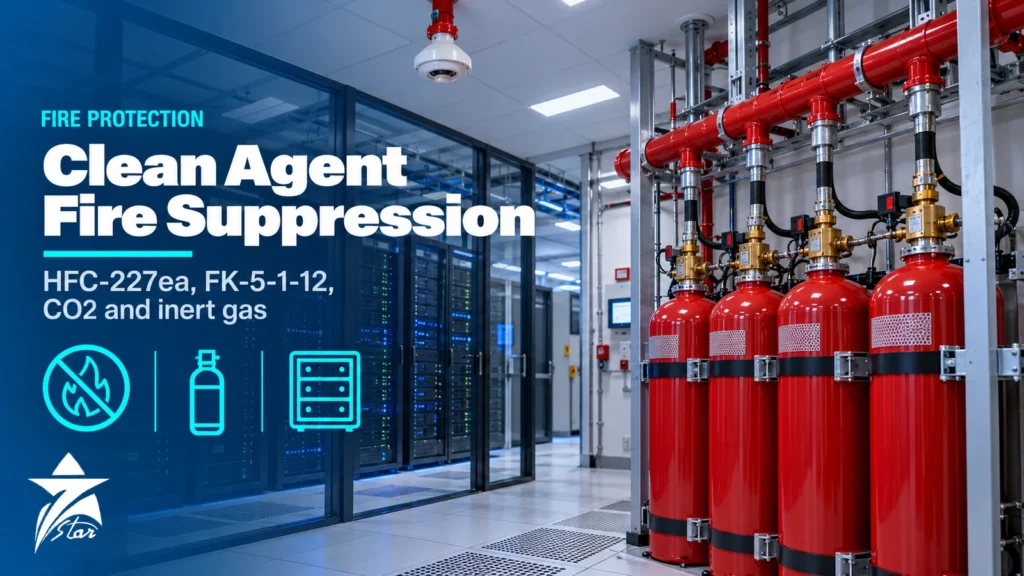
Control rooms, switchgear buildings, analyzer houses, battery rooms and turbine enclosures cannot be protected with water sprinklers without accepting serious collateral damage, so most GCC facilities rely on clean agent fire suppression. The four agent families on the market today – HFC-227ea (sold as FM-200 and other names), FK-5-1-12 (best known as Novec 1230), carbon dioxide and inert gas blends – behave very differently in terms of occupant safety, storage space, enclosure integrity and long-term regulatory risk. This guide compares them on engineering terms, explains how quantities are calculated and what NFPA 2001 and ISO 14520 require, and lists the information needed to specify, extend or recharge a system.
How Gaseous Agents Extinguish a Fire
Halocarbon agents such as HFC-227ea and FK-5-1-12 work mainly by absorbing heat: the vapour has a high heat capacity, so it cools the flame zone below the temperature at which combustion can sustain itself, with some chemical interference in the flame reactions. Inert gases and carbon dioxide work mainly by dilution, lowering the oxygen concentration in the room below the level that supports flaming combustion. The mechanism drives everything else: halocarbons need a few percent by volume and are stored as liquids, while inert gases need tens of percent by volume and are stored as high-pressure gas.
The Standards Behind the Design
- NFPA 2001 – clean agent fire extinguishing systems (halocarbon and inert gas agents), including design concentrations, discharge times, occupant exposure limits and enclosure integrity testing.
- ISO 14520 series – the international equivalent, with separate parts for each agent.
- NFPA 12 – carbon dioxide extinguishing systems, kept separate because CO2 at extinguishing concentrations is lethal.
- Product listings and approvals (UL, FM, VdS, LPCB) apply to the complete engineered system, not to the agent alone, so cylinders, valves, nozzles and software from different suppliers cannot be mixed freely.
The Main Clean Agent Fire Suppression Options
HFC-227ea (FM-200 and equivalents)
HFC-227ea has been the most widely installed halocarbon since the Halon 1301 phase-out. It is stored as a liquid super-pressurised with nitrogen, typically at 25 or 42 bar, and discharged in 10 seconds or less. Typical Class A design concentrations fall around 6.7–8.7 %, depending on the listing and the hazard, against a no-observed-adverse-effect level (NOAEL) of 9.0 % and a lowest-observed-adverse-effect level (LOAEL) of 10.5 %. The margin between design and NOAEL is therefore narrow, which matters for occupied rooms and for rooms whose volume changes after the system is designed.
Its weakness today is environmental: HFC-227ea has a global warming potential of about 3,220 (IPCC AR4 basis) and falls under HFC phase-down rules such as the Kigali Amendment and the EU F-gas Regulation (EU) 2024/573. Existing systems remain legal to maintain in most jurisdictions, but owners should expect rising recharge costs and tighter rules on new installations over the system’s life.
FK-5-1-12 (Novec 1230 and equivalents)
FK-5-1-12 is a fluorinated ketone that is liquid at room temperature, with a boiling point of about 49 °C. It is also super-pressurised with nitrogen and discharged within 10 seconds, vaporising as it leaves the nozzle. Class A design concentrations typically sit around 4.2–5.9 % against a NOAEL of 10 %, giving a far wider safety margin than HFC-227ea, and its global warming potential is about 1 with an atmospheric lifetime measured in days.
Two points need attention. First, 3M announced its exit from PFAS manufacturing by the end of 2025, which ended supply of the Novec 1230 brand; FK-5-1-12 is the same molecule, and several system manufacturers now offer it under their own names, but each system remains bound to the agent listed in its approval. Second, FK-5-1-12 is classed as a PFAS under some regulatory definitions, so its long-term regulatory status should be checked for new projects.
Carbon dioxide (CO2)
CO2 is cheap, leaves no residue and works on surface and deep-seated fires, which is why it still protects turbine enclosures, generator compartments, printing presses and cable vaults. The price is safety: NFPA 12 design concentrations start at 34 % for surface fires and go well above 50 % for deep-seated hazards, levels that are lethal within minutes. Recent editions of NFPA 12 restrict total flooding to spaces that are not normally occupied and require lock-out valves, pre-discharge alarms and time delays. CO2 also discharges very cold, can generate static, and needs careful venting.
Inert gases: IG-541, IG-55, IG-01 and IG-100
Inert gas agents are naturally occurring gases or blends: IG-541 (52 % nitrogen, 40 % argon, 8 % CO2), IG-55 (50 % nitrogen, 50 % argon), IG-01 (argon) and IG-100 (nitrogen). They have zero ozone depletion and zero global warming potential, produce no decomposition products, and the agent cost per recharge is low. Design concentrations are typically in the 35–50 % range, reducing oxygen to roughly 12–15 %, low enough to stop flaming combustion but survivable for short exposures under the limits NFPA 2001 sets for occupied spaces.
The trade-offs are space and pressure. Agent is stored at 200 or 300 bar, so a room needs many more cylinders than a halocarbon system, and discharge time is longer (60 seconds to 95 % of design concentration, with up to 120 seconds allowed for certain hazards in recent editions). The large gas volume entering the room makes correctly sized pressure relief vents essential.
Clean Agents Compared
| Property | HFC-227ea | FK-5-1-12 | CO2 | Inert gas (IG-541/IG-55) |
|---|---|---|---|---|
| Main mechanism | Heat absorption | Heat absorption | Oxygen dilution, cooling | Oxygen dilution |
| Typical design concentration | ~6.7–8.7 % | ~4.2–5.9 % | 34 % and higher | ~35–50 % |
| Occupant safety margin | Narrow (NOAEL 9 %) | Wide (NOAEL 10 %) | Lethal – unoccupied spaces only | Defined by residual O2 |
| Storage | Liquid, 25 or 42 bar | Liquid, 25 or 42 bar | Liquid, high or low pressure | Gas, 200 or 300 bar |
| Discharge time | ≤ 10 s | ≤ 10 s | Per NFPA 12 hazard type | 60 s (up to 120 s for some hazards) |
| Cylinder footprint | Small | Small | Medium | Large |
| GWP | ~3,220 | ~1 | 1 | 0 |
| Regulatory outlook | HFC phase-down | PFAS scrutiny in some regions | Stable, safety-driven limits | Stable |
| Pressure relief venting | Required (positive and negative) | Required (often negative peak) | Required | Essential, larger vents |
Calculating Agent Quantity
For halocarbons, NFPA 2001 and ISO 14520 use the flooding equation W = (V / S) × C / (100 − C), where W is agent mass, V the net protected volume, S the specific vapour volume at the minimum expected room temperature and C the design concentration. At 20 °C this works out to roughly 0.55 kg/m³ of HFC-227ea at 7 % and roughly 0.65 kg/m³ of FK-5-1-12 at 4.5 %. Inert gases use a logarithmic equation for agent volume because the gas displaces room atmosphere through the vents during discharge; at around 40 % design, the agent volume is in the order of half the room volume.
Design temperature matters: S varies with temperature, so a room that runs hot in summer or is cooled to 18 °C needs the calculation run at the correct minimum and maximum temperatures. Altitude corrections apply at elevated sites. Final quantities always come from the listed manufacturer’s design software, not a hand calculation.
Enclosure Integrity and Hold Time
A clean agent only works if the room holds the concentration long enough for the fire to stop and cool, and for responders to arrive; 10 minutes is the common minimum hold time to the protected height. NFPA 2001 Annex C describes a door fan test that measures room leakage and predicts hold time. Typical failures are unsealed cable trays, raised-floor voids open to adjacent rooms, ceiling tiles that lift, door undercuts and HVAC dampers that do not close. Every modification to a protected room – a new cable penetration, a new duct – should trigger a re-check.
Detection, Control and Release
Most systems use cross-zoned detection, with two independent detectors confirming a fire before release, feeding a releasing control panel with pre-discharge alarms, an abort switch, a manual release and HVAC shutdown interlocks. Very early smoke detection is often added in data and control rooms. For the alarm side of the system, see our guide to addressable fire alarm systems; for the detectors themselves browse our fire and gas detectors.
Common Clean Agent Fire Suppression Mistakes
- Changing room volume (removing a false ceiling, opening a void) without recalculating agent quantity.
- Omitting or undersizing pressure relief vents, especially on inert gas systems in lightweight partition rooms.
- Mixing cylinders, valves or nozzles from different listed systems during an extension.
- Installing halocarbon cylinders in un-air-conditioned spaces where temperatures exceed the listed storage range.
- Leaving HVAC dampers outside the release logic, so the agent is extracted before hold time is reached.
- Using CO2 for spaces that operators routinely enter without strict lock-out procedures.
Maintenance and GCC Considerations
- Check halocarbon cylinder pressure and agent weight or liquid level at the intervals NFPA 2001 and the manufacturer require; a loss beyond the permitted limit means refill or replacement.
- Keep cylinder rooms within the listed temperature range; in a Gulf summer, a container or rooftop room without cooling can exceed 50 °C.
- Seal against dust ingress so detectors do not false-alarm and doors still close fully.
- Hydrostatically test or replace cylinders at the intervals required by the applicable pressure-vessel regulation.
- Review the agent’s regulatory status before committing to a large HFC-227ea extension; FK-5-1-12 or inert gas may be the more future-proof choice.
Clean Agent System Specification Checklist
- Hazard type (Class A, B or C) and the room’s contents
- Net protected volume, ceiling and floor void heights, minimum and maximum room temperature
- Normally occupied or unoccupied, and egress time
- Preferred agent and the listed system family for extensions
- Wall and door construction strength for vent sizing
- Detection philosophy, releasing panel and interfaces (HVAC, ESD, fire alarm)
- Existing cylinder nameplates, valve types and agent weights for recharge or extension work
- Hazardous-area classification of the protected space, if any
Fire Suppression Systems We Supply
These examples cover the agents compared above, plus the release panels that control them.
| Product | Type | Where it fits |
|---|---|---|
| Ansul FM-200 Clean Agent Fire Suppression System | HFC-227ea clean agent system | Control rooms, server rooms and electrical rooms. |
| Ansul SAPPHIRE FK-5-1-12 Clean Agent Fire Suppression System | FK-5-1-12 clean agent system | Occupied spaces where a low global warming potential agent is preferred. |
| Ansul INERGEN Clean Agent Fire Suppression System | Inert gas system | Large protected volumes, with a zero global warming potential. |
| Kidde HPCO2 High Pressure CO2 Fire Suppression System | High-pressure CO2 system | Normally unoccupied spaces such as turbine and machinery enclosures. |
| Minimax OneU 19 Inch Rack Fire Detection and Extinguishing | In-rack detection and extinguishing | Individual server or control cabinets. |
| Kentec Syncro XT+ A32162M3 Extinguishant Control Panel | Extinguishant control panel | Detection, countdown, release and status signals for a suppression zone. |
To quote a system, send the room dimensions, the hazard and occupancy, and the agent preferred by your consultant through our quote request form. Final design and installation must follow the approved system manual and local civil defence requirements.
Sourcing Clean Agent Components Through Seven Star LLC
Seven Star LLC supplies fire suppression components, detectors and releasing panels on request for industrial sites in Oman and the GCC. See our fire fighting equipment and the wider fire and gas systems range. We help with selection and cross-checking part numbers against your existing listed system, and availability and lead time are confirmed at quotation.
Extending or refurbishing a gaseous suppression system? Send us the cylinder and valve nameplates, the system drawings or your RFQ and we will return matched options and a clear quotation.
Frequently asked questions
Is FK-5-1-12 the same as Novec 1230?
Yes. Novec 1230 was 3M's brand name for the chemical FK-5-1-12. 3M has exited PFAS manufacturing, but several system manufacturers now supply FK-5-1-12 under their own names; an existing system should be recharged only with the agent approved in its listing.
Can FM-200 be used in occupied rooms?
Yes, HFC-227ea is used in normally occupied rooms when the design concentration stays at or below the limits NFPA 2001 sets, with its NOAEL of 9.0 % as the key reference. Because typical design concentrations are close to that value, room volume changes and over-design must be controlled carefully.
Why is CO2 not used in control rooms?
CO2 extinguishes by reducing oxygen, and its design concentrations, starting at 34 %, are lethal within minutes. Recent editions of NFPA 12 restrict total flooding CO2 to spaces that are not normally occupied, so control rooms and offices normally use a clean agent or inert gas.
Why do inert gas systems need pressure relief vents?
An inert gas system injects a volume of gas comparable to a large fraction of the room volume within about a minute. Without a correctly sized vent, the pressure rise can damage walls, ceilings and doors, so vent area is calculated from room volume, discharge rate and wall strength.
What is an enclosure integrity test?
It is a door fan test that pressurises or depressurises the protected room to measure its leakage area. From the result, the method in NFPA 2001 Annex C predicts how long the agent concentration will be held, typically compared against a 10-minute minimum hold time.
What do I need to send for a recharge or extension quote?
Send the cylinder and valve nameplates, the agent type and fill weight, the system manufacturer and listing, and the room dimensions. Drawings and the original design calculation help confirm that new components stay within the same listed system.
Was this guide helpful?One click helps us write better guides for engineers.
Thank you! Glad it helped. Need this equipment for your project? Request a quotation
Thank you. We will use this to improve the guide.