- Automation & ControlView all 2,750 products
- Automation Accessories
- AC Drives
- PLC & I/O Cards
- Industrial Communications
- Vibration Monitoring
- Controllers & Data Acquisition
- Isolator & Barrier
- Safety Switches & Guard Locking
- Motor Soft Starters
- CCTV & Security
- Encoders
- HMI Displays
- Servo Drives
- Pneumatic Cylinders
- Industrial Computers
- Machine Vision
- Automation Software
- Robotics
















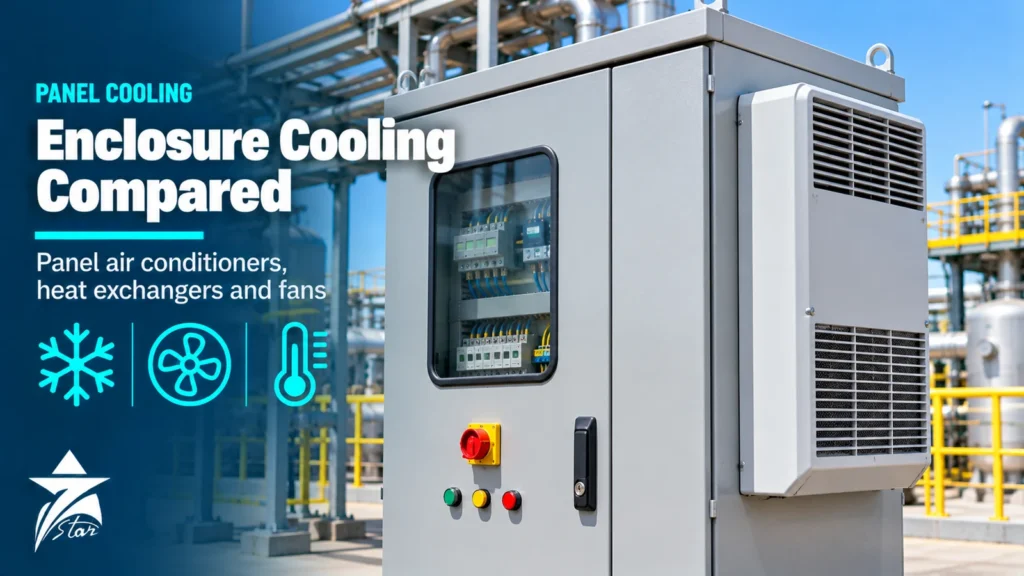
Drives, PLCs, power supplies and UPS units inside a control cabinet all turn part of their power into heat. If that heat is not removed, the internal temperature rises, components derate, and failures multiply. A common rule of thumb for electronics is that the service life roughly halves for every 10 K rise above the rated temperature. In places like Oman, where summer ambient air reaches 45 to 50 °C and outdoor cabinets also take solar gain, choosing between a filter fan, a heat exchanger and a panel air conditioner is one of the most important decisions in panel design. This guide compares the options and shows how to size them.
Step 1: Know the Two Temperatures That Decide Everything
Every enclosure cooling choice starts with two numbers: the highest ambient temperature around the cabinet and the highest internal temperature the components allow. Most control gear is rated for about 40 °C, and many designers target an internal temperature of 35 °C for margin.
- If the ambient is well below the allowed internal temperature, ambient air can carry the heat away: a filter fan or an air/air heat exchanger can work.
- If the ambient is at or above the allowed internal temperature, ambient air cannot cool the cabinet. You need active cooling: a panel air conditioner, an air/water heat exchanger connected to chilled water, or in small cases a thermoelectric (Peltier) cooler.
In the Gulf, the second case is normal for outdoor and non-air-conditioned locations for many months of the year. That is why the panel air conditioner is the default choice for many cabinets in the region.
Step 2: Calculate the Heat Load
The cooling capacity needed is the heat produced inside the cabinet plus (or minus) the heat that passes through the enclosure walls:
- Internal heat loss (Qv): add the power losses from the data sheets. A VFD typically loses about 2 to 3% of its rated power, a UPS several percent of its load, and power supplies roughly 10 to 15% of output power.
- Heat through the walls (Qs) = k × A × ΔT: k is about 5.5 W/m²K for painted sheet steel and about 3.5 W/m²K for plastic enclosures; A is the exposed surface area; ΔT is ambient minus internal temperature.
- Solar gain: outdoor cabinets in direct sun can gain several hundred extra watts. A sun shield or canopy with an air gap reduces this considerably.
Worked example: a 2000 × 800 × 600 mm steel cabinet standing against a wall has about 6 m² of exposed surface. Internal losses are 1,200 W. Ambient is 50 °C and the target internal temperature is 35 °C, so heat flows in: 5.5 × 6 × 15 ≈ 495 W. The total load is about 1,700 W, so a cooling unit rated for at least 2 kW at L35/L50 is a sensible choice.
Always read the cooling capacity at the real operating point. Ratings are given to EN 14511 as internal/ambient temperature pairs, for example L35/L35 or L35/L50. A unit rated 2 kW at L35/L35 delivers noticeably less at L35/L50.
Filter Fans: Lowest Cost, Only When Ambient Air Is Cool Enough
A filter fan pushes ambient air through the cabinet and out through an exhaust filter. The air flow required is roughly V = 3.1 × Qv / ΔT (m³/h) at sea level, where ΔT is the allowed internal temperature minus the ambient temperature.
Example: 500 W of losses, 30 °C ambient and a 40 °C limit give V = 3.1 × 500 / 10 ≈ 155 m³/h. Choose a fan whose flow with the filter installed meets this, because the free-blowing figure is higher than the real one.
- Blow air into the cabinet at the bottom and exhaust at the top, so the cabinet is slightly pressurised and dust enters only through the filter.
- Filter mats clog quickly in dusty sites; a blocked filter can cut air flow drastically. Plan regular replacement.
- Filter fans bring in humidity and salt air, which is a problem at coastal sites.
- IP54 or IP55 is typical with filters; the enclosure rating drops compared with a sealed cabinet.
Air/Air Heat Exchangers: Sealed Cabinet, Still Limited by Ambient
An air/air heat exchanger has two separate air circuits, so the inside air never mixes with outside air. This keeps dust, oil mist and moisture out and keeps the enclosure sealed (IP54 to IP55 typical). Capacity is given in W/K, so a 17.5 W/K unit removes 175 W when the inside is 10 K warmer than the outside. Because it still uses ambient air, it only works when the ambient is clearly lower than the internal limit, which makes it suitable for indoor plant rooms but rarely for summer outdoor duty in the Gulf.
Air/Water Heat Exchangers: High Capacity Where Chilled Water Exists
An air/water heat exchanger transfers cabinet heat to a water circuit, often from the plant chilled water system. It can remove several kilowatts in a compact unit, keeps the cabinet sealed up to IP55 or higher, works in very hot or dirty surroundings and does not release heat into the room. It needs a reliable water supply at a suitable temperature, condensation control, and leak protection. For background on chilled water plants in hot climates, see our guide to chillers and cooling towers in hot climates.
Panel Air Conditioners: Cooling Below Ambient Temperature
A panel air conditioner (also called an enclosure cooling unit) uses a refrigeration circuit with a compressor, evaporator inside the cabinet and condenser outside. It is the only common option that cools the cabinet below the ambient temperature and works with sealed enclosures. Typical capacities range from about 300 W to more than 4 kW, and many units are rated for ambient temperatures up to 55 °C, with some models going higher.
- Mounting: wall (side) mounted, roof (top) mounted, or partially or fully recessed to save space. Roof units save side space but must have reliable condensate management so water never drips onto components.
- Dust: in sandy sites, choose units with filterless condensers or coated, wide-fin condensers that can be blown clean, and protect the condenser inlet from direct sand.
- Condensate: the evaporator removes moisture from the cabinet air; a door switch that stops the unit when the door is open prevents large amounts of condensate from humid outside air.
- Control and monitoring: modern units offer electronic controllers, alarm contacts and Modbus or IoT interfaces for remote monitoring.
- Efficiency: inverter-driven compressors and EC fans reduce energy use when the load is partial, which is most of the time.
- Hazardous areas and corrosion: stainless steel and NEMA 4X versions exist for washdown and coastal sites; Ex-rated units are specialist products.
Selection Table: Which Enclosure Cooling Method?
| Method | Works when ambient is | Enclosure stays sealed | Typical capacity | Best for |
|---|---|---|---|---|
| Natural convection / vents | Much lower than internal | No | Low | Small loads, indoor rooms |
| Filter fan | Lower than internal | No (filtered) | Up to about 1 kW at a 10 K difference | Clean, cool indoor locations |
| Air/air heat exchanger | Lower than internal | Yes | About 10 to 100 W/K | Dusty or oily indoor sites |
| Air/water heat exchanger | Any (needs chilled water) | Yes | About 0.5 to 10 kW | Plants with chilled water, very hot or dirty areas |
| Panel air conditioner | Any, up to about 55 °C or more | Yes | About 0.3 to 4+ kW | Outdoor cabinets, hot climates, sealed panels |
| Thermoelectric (Peltier) | Any | Yes | Up to a few hundred watts | Small enclosures, no refrigerant |
Hot-Climate Design Tips for Panel Air Conditioners
- Size for the worst real ambient, not the average: use the hottest summer temperature plus solar gain for outdoor cabinets.
- Use sun shields and light-coloured enclosures outdoors; keep cabinets off hot west-facing walls where possible.
- Do not oversize too much: a heavily oversized unit cycles frequently and dehumidifies poorly.
- Arrange components so that cold air reaches the hottest devices and does not short-circuit straight back to the cooling unit inlet.
- Add a thermostat and, in humid coastal sites, a hygrostat with an anti-condensation heater, so that the cabinet does not drop below the dew point at night.
- Plan maintenance: clean condensers and replace filter mats more often during dusty months.
Batteries are particularly sensitive to heat; see our article on VRLA vs lithium-ion UPS batteries in hot climates. For operator panels in hot locations, see industrial panel PC selection.
Enclosure Cooling Units From Our Catalog
Examples of panel air conditioner models, heat exchangers, filter fans and climate control accessories in our catalog. Each link goes to the product page.
Browse more in our enclosure climate control category. To get a quotation, send the cabinet size, internal heat loss, maximum ambient temperature, indoor or outdoor location, mounting preference, supply voltage and any existing model number through our quote request form or to [email protected].
Sourcing Enclosure Cooling in Oman Through Seven Star LLC
Seven Star LLC is an independent supplier in Oman of enclosure climate control products for oil and gas, utilities, water treatment, telecom and building services. We quote panel air conditioners, air/air and air/water heat exchangers, filter fans, thermostats, hygrostats and heaters from manufacturers such as Pfannenberg, Rittal and STEGO, and can match an installed unit by part number. Capacities, ratings and lead time are confirmed against the manufacturer data at quotation.
Frequently asked questions
When do I need a panel air conditioner instead of a filter fan?
When the ambient temperature is at or above the maximum allowed internal temperature, ambient air cannot cool the cabinet, so a filter fan or air/air heat exchanger will not work. A panel air conditioner can cool below ambient and keeps the enclosure sealed.
How do I size enclosure cooling?
Add the internal heat losses of all components, then add the heat entering through the walls (k × A × ΔT) and any solar gain. Choose a unit whose capacity at your real internal and ambient temperatures, for example L35/L50, exceeds the total.
What internal temperature should a control cabinet be kept at?
Most control components are rated for about 40 °C, and many designers set the cooling to keep the cabinet at about 35 °C for margin. Check the lowest rating of the components inside.
Why does my enclosure cooling unit produce water?
The evaporator removes moisture from the cabinet air. Large amounts of condensate usually mean outside air is entering through open doors, poor seals or cable entries. Use a door switch and seal the cabinet.
Can air/water heat exchangers be used outdoors in Oman?
Yes, if a reliable chilled water supply is available. They are sealed, compact and work in very high ambient temperatures, but need leak protection and condensation control.
Who supplies panel air conditioners in Oman?
Seven Star LLC is an independent supplier in Oman that quotes panel air conditioners, heat exchangers, filter fans and climate control accessories from Pfannenberg, Rittal and STEGO. Send your requirements through the quote request form or to [email protected].
Was this guide helpful?One click helps us write better guides for engineers.
Thank you! Glad it helped. Need this equipment for your project? Request a quotation
Thank you. We will use this to improve the guide.