- Automation & ControlView all 2,718 products
- Automation Accessories
- AC Drives
- PLC & I/O Cards
- Industrial Communications
- Vibration Monitoring
- Controllers & Data Acquisition
- Isolator & Barrier
- Safety Switches & Guard Locking
- Motor Soft Starters
- CCTV & Security
- Encoders
- HMI Displays
- Servo Drives
- Pneumatic Cylinders
- Industrial Computers
- Machine Vision
- Automation Software
- Robotics
















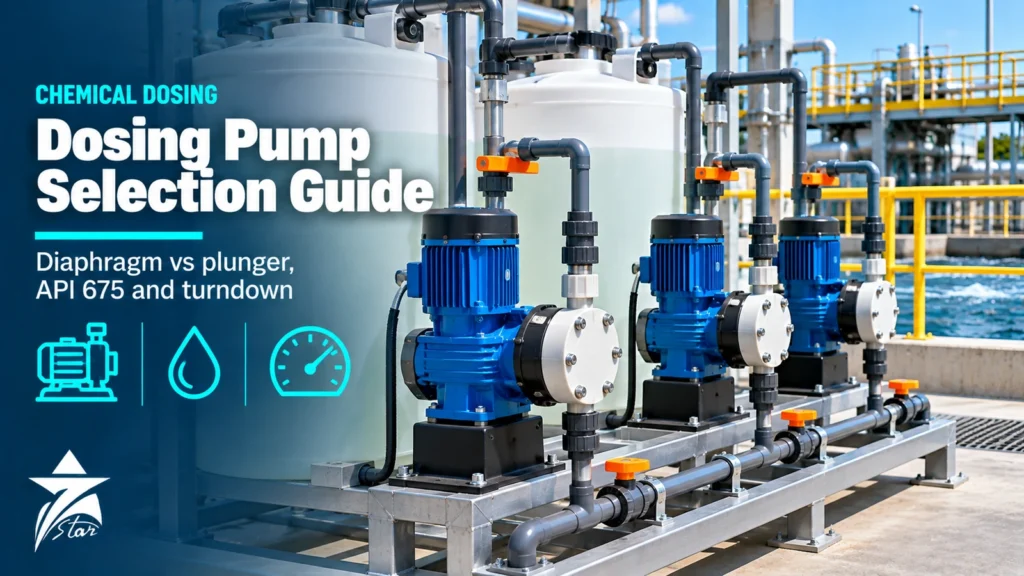
A dosing pump, also called a metering pump, delivers a precise and adjustable volume of liquid per stroke or per revolution. It is used to inject chemicals such as sodium hypochlorite, acids, caustic soda, coagulants, corrosion inhibitors, scale inhibitors, biocides and odorants into water, process streams and pipelines. Unlike a transfer pump, the goal is accuracy and repeatability, often at small flows and high pressures. This guide explains the main designs and how to choose the right dosing pump for an application.
How a Metering Pump Works
Most metering pumps are positive displacement pumps. A diaphragm, plunger or rotating element moves a fixed volume on each cycle, and check valves on the suction and discharge sides make the flow go in one direction. The flow is adjusted by changing the stroke length, the stroke rate (frequency or motor speed), or both. Because the displacement is fixed, the flow stays nearly constant when the discharge pressure changes, which is why this type of pump is used for chemical injection.
Main Dosing Pump Designs
Solenoid-Driven Diaphragm Pumps
A solenoid (electromagnetic) dosing pump moves the diaphragm with an electromagnet pulse. It is compact, inexpensive and easy to control by pulse, 4-20 mA or a built-in timer. It suits small flows, typically from a fraction of a litre to around a hundred litres per hour, at low to moderate pressure. Water treatment, swimming pools, cooling towers and boiler dosing are common uses.
Motor-Driven Mechanical Diaphragm Pumps
An electric motor drives the diaphragm through a gearbox and a cam or eccentric, often with a spring return. These pumps give a smoother, more powerful stroke than solenoid pumps, larger flows and better accuracy. Stroke length is set by hand or by an actuator, and speed by a variable frequency drive.
Hydraulically Actuated Diaphragm Pumps
A plunger moves hydraulic oil, and the oil moves the diaphragm. The diaphragm is supported evenly by the oil on one side and the process fluid on the other, so it can work at high pressure with a long life. Double diaphragm versions with leak detection are used for toxic or hazardous chemicals. This design is widely used in refineries, chemical plants and oil and gas installations that follow API 675.
Plunger (Piston) Pumps
In a plunger pump the plunger is in direct contact with the liquid and is sealed by packing. It reaches very high pressures with good accuracy, but the packing needs regular adjustment and replacement, and a small leakage is normal. It is not the first choice for toxic, hazardous or expensive chemicals, where a sealless diaphragm design is safer.
Peristaltic, Gear and Progressing Cavity Pumps
A peristaltic pump squeezes a hose or tube with rollers. Only the tube touches the liquid, so it handles gassing chemicals like sodium hypochlorite, abrasive slurries and viscous liquids well, with no check valves to block. Gear metering pumps give a smooth, pulse-free flow for clean, viscous liquids such as additives, polymers and resins. Progressing cavity pumps suit viscous, shear-sensitive or solids-laden fluids, such as polymer and lime slurries in water treatment.
Diaphragm vs Plunger: Quick Comparison
| Feature | Diaphragm (mechanical or hydraulic) | Plunger / piston |
|---|---|---|
| Leakage | Sealless, no leakage to atmosphere | Packing leaks a small amount by design |
| Pressure range | Low to high (hydraulic designs reach high pressure) | Very high |
| Maintenance | Diaphragm and check valves | Packing, plunger and check valves |
| Hazardous or toxic chemicals | Preferred, double diaphragm with leak detection available | Less suitable |
| Abrasive fluids | Good with suitable valves | Packing wears faster |
API 675 and Accuracy
API 675 is the American Petroleum Institute standard for positive displacement controlled-volume pumps used in petroleum, chemical and gas industry services. It defines design, materials, testing and performance requirements. The performance requirements most often quoted are:
- Steady-state flow accuracy within ±1% of rated capacity over a 10:1 turndown range.
- Repeatability within ±3% of rated capacity.
- Linearity within ±3% of rated capacity.
Not every metering pump is built to API 675. Water treatment and general industry often use pumps built to the manufacturer’s own standard, which is perfectly acceptable for that service. If a project specification calls for API 675, make sure the offered model and its test documentation comply.
Turndown and Sizing
Turndown is the ratio between the maximum and minimum flow at which the pump still keeps its stated accuracy. Stroke length control usually gives about 10:1; adding stroke speed control can extend it much further. A digital pump with a stepper motor can reach very high turndown ratios.
- Calculate the required chemical flow from the main flow and the required dose, and include the solution concentration and density.
- Check the minimum, normal and maximum dose rates, not only the normal value.
- Select a pump whose maximum flow at the actual discharge pressure covers the maximum dose with a margin, but which does not run at the very bottom of its range for normal duty.
- Use the highest system pressure the pump will see, including the pipeline or vessel pressure at the injection point and the line losses.
- For viscous chemicals, check the viscosity limit and the need for larger valves, slower stroke rates or a different pump type.
A simple dose calculation: chemical flow (L/h) = main flow (m³/h) × dose (mg/L) / (solution concentration in g/L). For example, 100 m³/h of water dosed at 2 mg/L chlorine with a 120 g/L hypochlorite solution needs 100 × 2 / 120 = about 1.7 L/h.
Chemical Compatibility of Wetted Parts
The liquid end (pump head, diaphragm, valve balls, seats and seals) must resist the chemical at the process temperature and concentration. Typical options include:
| Material | Typical use | Notes |
|---|---|---|
| PVC | Many water treatment chemicals at ambient temperature | Limited temperature; not for many solvents |
| Polypropylene (PP) | Acids and alkalis at moderate temperature | Not for strong oxidisers at high concentration |
| PVDF | Sodium hypochlorite, many acids and oxidisers | Good chemical and temperature resistance |
| PTFE (diaphragm faces, seals) | Most aggressive chemicals | Standard diaphragm face on many pumps |
| 316 stainless steel | Hydrocarbons, solvents, many inhibitors, high pressure | Not for hypochlorite or hydrochloric acid |
| Alloy 20, Hastelloy | Special acids and corrosive media | Check against the manufacturer chart |
Always check the manufacturer compatibility chart for the exact chemical, concentration and temperature, and include elastomers such as FKM or EPDM. Chemicals that release gas, such as sodium hypochlorite and hydrogen peroxide, can cause vapour lock; use a pump head with degassing or automatic venting, or a peristaltic design.
Accessories Every Dosing System Needs
- Injection quill or injection valve: introduces the chemical into the centre of the pipe and prevents backflow.
- Back-pressure valve: keeps a constant pressure on the discharge so the pump stays accurate and prevents siphoning when the discharge pressure is lower than the suction pressure.
- Pressure relief valve: protects the pump and piping if a valve is closed downstream. A positive displacement pump will otherwise build pressure until something fails.
- Pulsation dampener: smooths the pulsating flow and reduces pipe vibration and acceleration losses, especially with long lines.
- Calibration column: a graduated cylinder on the suction side to check the real flow during operation.
- Foot valve and suction strainer: keep the suction line primed and protect the check valves.
- Level switch or low-level lance on the chemical tank: stops the pump before it runs dry.
Control Options
Simple pumps run at a fixed rate set by hand. Most applications need the dose to follow the process: pulse input from a water meter for flow-proportional dosing, a 4-20 mA signal from a controller or analyser, or a fieldbus or Ethernet connection to the PLC. Digital pumps can also report flow, alarms, diaphragm failure and empty-tank signals. For hazardous areas, check that the pump, motor and controls carry the correct ATEX or IECEx certification.
Dosing Pump Selection Checklist
- Chemical name, concentration, density, viscosity and temperature.
- Minimum, normal and maximum flow, and the turndown needed.
- Suction conditions (flooded or suction lift) and maximum discharge pressure.
- Required standard (API 675 or manufacturer standard) and accuracy.
- Wetted materials and elastomers.
- Drive type, power supply, motor enclosure and hazardous area rating.
- Control signal and communication.
- Single or multiple heads, and whether a complete skid with tank, accessories and panel is required.
Dosing and Metering Pumps From Our Catalog
Examples of metering pump designs in our catalog. Each link goes to the product page.
| Product | Type | Typical use |
|---|---|---|
| ProMinent gamma/ XL Solenoid-Driven Metering Pump | Solenoid diaphragm | Water treatment and process dosing |
| ProMinent Sigma X S1Cb Motor-Driven Diaphragm Metering Pump | Motor-driven diaphragm | Larger flows with stroke control |
| Grundfos DME Digital Dosing Pump | Digital diaphragm | Wide turndown, flow-proportional dosing |
| SEKO Tekna TPG Digital Solenoid Pump 0.4-110 l/h | Solenoid diaphragm | Pulse and mA controlled dosing |
| SEKO Tekna ATEX Solenoid Pump 0.4-110 l/h | Solenoid diaphragm, ATEX | Hazardous area dosing |
| SEKO Spring MS1 Mechanical Diaphragm Pump 5.5-500 l/h | Mechanical diaphragm | Medium flow chemical injection |
| SEKO Spring PS1 Plunger Piston Pump 1.5-304 l/h | Plunger | High-pressure injection |
| Walchem IX Series Digital Diaphragm Metering Pump | Digital diaphragm | Precise dosing with feedback |
| Blue-White M3 FLEXFLO Peristaltic Metering Pump 126 LPH | Peristaltic | Hypochlorite and gassing chemicals |
| Blue-White CD3 CHEM-FEED Multi-Diaphragm Metering Pump | Multi-diaphragm | Low-pulsation chemical feed |
| KRACHT KD1 Gear Metering Pump | Gear metering pump | Clean viscous liquids |
| NETZSCH NEMO C.Pro Progressing Cavity Pump | Progressing cavity | Viscous and solids-laden media |
Browse more in our metering and dosing pumps category and the wider pumps category. To get a quotation, send the chemical, concentration, flow range, discharge pressure, power supply, control signal and any existing model number through our quote request form or to [email protected].
Sourcing Dosing Pumps in Oman Through Seven Star LLC
Seven Star LLC is an independent supplier in Oman of pumps and chemical injection equipment for water treatment, desalination, oil and gas and process industries. We quote metering pumps and spare parts from manufacturers such as ProMinent, Grundfos, SEKO, Walchem, Blue-White, KRACHT, NETZSCH and Allweiler, and can match an installed pump or its liquid end by part number. Specifications, materials and lead time are confirmed against the manufacturer data at quotation.
Frequently asked questions
What is the difference between a dosing pump and a metering pump?
The terms are used for the same kind of equipment: a positive displacement pump that delivers a precise, adjustable volume of liquid. "Metering pump" is common in process and oil and gas specifications, while "dosing pump" is common in water treatment.
When should I choose a plunger pump instead of a diaphragm pump?
A plunger pump suits very high pressures and clean, non-hazardous liquids where a small packing leakage is acceptable. For toxic, hazardous, expensive or abrasive chemicals, a sealless diaphragm design is usually preferred.
What accuracy does API 675 require?
API 675 requires steady-state flow accuracy within plus or minus 1% of rated capacity over a 10:1 turndown, with repeatability and linearity within plus or minus 3%.
Why does a dosing system need a back-pressure valve?
A back-pressure valve keeps a constant pressure on the pump discharge. This keeps the check valves seating correctly for accurate dosing and prevents siphoning when the injection point pressure is lower than the suction pressure.
Which pump is best for sodium hypochlorite?
Sodium hypochlorite releases gas and can cause vapour lock. Use a diaphragm pump with a degassing or self-venting head in PVDF or PVC with PTFE seals, or a peristaltic pump. Avoid stainless steel wetted parts.
Who supplies dosing pumps in Oman?
Seven Star LLC is an independent supplier in Oman that quotes dosing and metering pumps from ProMinent, Grundfos, SEKO, Walchem, Blue-White, KRACHT and NETZSCH. Send your requirements through the quote request form or to [email protected].
Was this guide helpful?One click helps us write better guides for engineers.
Thank you! Glad it helped. Need this equipment for your project? Request a quotation
Thank you. We will use this to improve the guide.