- Automation & ControlView all 1,956 products
- AC Drives
- PLC & I/O Cards
- Industrial Communications
- Vibration Monitoring
- Automation Accessories
- Controllers & Data Acquisition
- Isolator & Barrier
- CCTV & Security
- Safety Switches & Guard Locking
- Encoders
- HMI Displays
- Motor Soft Starters
- Industrial Computers
- Servo Drives
- Pneumatic Cylinders
- Machine Vision
- Automation Software
- Robotics
















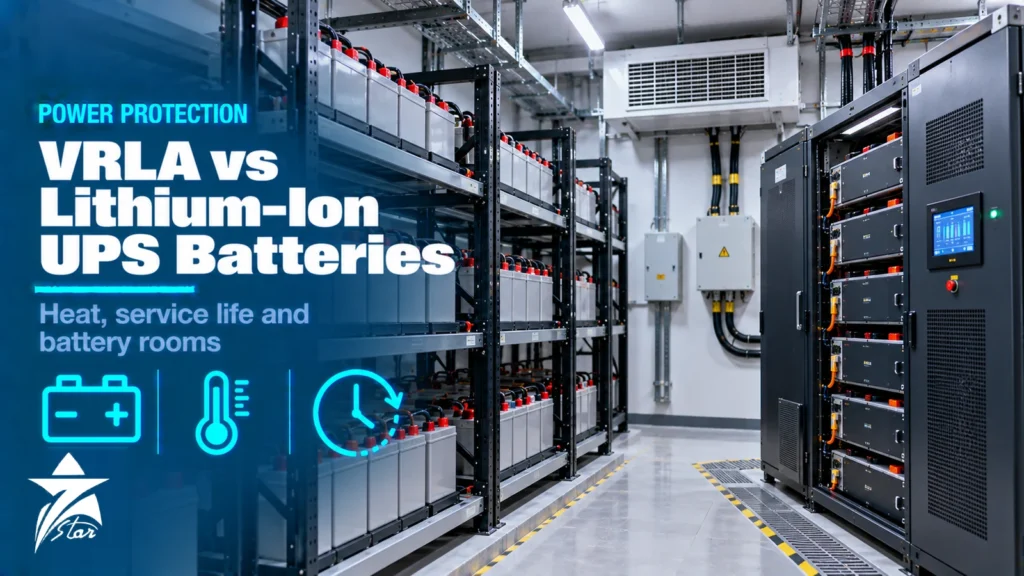
In a UPS installation, the battery is usually the component that fails first, and in the Gulf the main reason is heat. A battery string that would last many years in a cooled data centre in Europe can need replacement far sooner in a hot switchroom or an outdoor telecom shelter. Choosing between VRLA vs lithium-ion chemistry is therefore not just a question of cost per kWh; it is a question of how each chemistry ages at the temperatures your site really sees. This guide explains how heat affects UPS batteries, compares VRLA and lithium-ion in hot climates, and covers charging, room design, ventilation, monitoring and replacement planning.
Why Heat Is the Main Enemy of UPS Batteries
Battery life in standby UPS service is mostly determined by the chemistry’s slow ageing reactions, and those reactions speed up with temperature. Manufacturers rate design life at a reference temperature, normally 20 or 25 °C. Above that, life shortens quickly. For VRLA batteries a widely used rule of thumb is that service life roughly halves for every 8 to 10 °C of sustained operation above 25 °C. The exact figure varies between manufacturers and designs, but the direction is not in doubt: a battery kept at 35 °C ages far faster than one kept at 25 °C.
What matters is the battery’s own temperature over time, not the outdoor peak. A battery room that averages 30 °C all year will shorten life more than a room that briefly reaches 40 °C on a few days. That is why air conditioning reliability, cabinet airflow and sun exposure on shelters are central to battery life in the GCC.
VRLA Batteries in Hot Conditions
Valve-regulated lead-acid (VRLA) batteries, in absorbent glass mat (AGM) or gel form, remain the most common UPS battery. They are sealed, recombine most of the gas they produce, and need no water topping. In heat, several failure mechanisms accelerate:
- Positive grid corrosion: the main ageing mechanism in float service, which grows faster at higher temperature and reduces capacity.
- Dry-out: higher temperature increases water loss through the valve, raising internal resistance.
- Thermal runaway risk: if float voltage is not compensated, rising temperature increases float current, which produces more heat, which can cause swelling and in extreme cases venting.
- Case swelling and leakage: visible signs that the battery has been operated too hot or overcharged.
Design life classes help compare products. Eurobat guidance groups VRLA batteries by design life at 20 °C, from standard commercial blocks with a few years of design life to long-life and very long life types designed for ten years or more. In a hot room, even a long-life battery will not reach its catalogue design life, so choose the class with real operating temperature in mind.
Lithium-Ion Batteries for UPS
Lithium-ion UPS batteries, commonly lithium iron phosphate (LFP) or lithium manganese oxide and nickel manganese cobalt (LMO/NMC) blends, are supplied as cabinets or racks with a battery management system (BMS). The BMS monitors every cell’s voltage and temperature, balances cells and disconnects the string if limits are exceeded.
- Longer service life: manufacturers commonly claim around two to three times the life of VRLA under similar conditions, and much higher cycle life.
- Smaller and lighter: a significant reduction in floor space and weight for the same runtime.
- Faster recharge: useful on sites with frequent outages or generator transfers.
- Built-in monitoring: the BMS reports state of charge and state of health without separate monitoring hardware.
Lithium-ion is not immune to heat. Its ageing also accelerates at high temperature, and manufacturers specify recommended operating ranges, often similar to or modestly wider than VRLA. The advantage in hot climates comes from slower ageing at the same temperature, not from tolerance of unlimited heat. Fire safety requirements also differ: lithium-ion systems are evaluated using test methods such as UL 9540A and installed according to codes such as NFPA 855 where they apply, and local authority requirements must be checked.
VRLA vs Lithium-Ion: Side-by-Side Comparison
| Factor | VRLA (AGM or gel) | Lithium-ion (LFP or NMC) |
|---|---|---|
| Initial cost | Lower | Higher |
| Service life in heat | Shortened significantly above 25 °C | Also shortened, but typically longer than VRLA at the same temperature |
| Footprint and weight | Larger and heavier | Typically much smaller and lighter |
| Monitoring | Needs external monitoring for cell-level data | BMS included with cell monitoring |
| Recharge time | Longer | Shorter |
| Replacement compatibility | Widely interchangeable blocks by size and capacity | Supplied as a system matched to the UPS model and firmware |
| Fire and installation codes | Established practice, ventilation for hydrogen | Specific fire testing and code requirements, no routine hydrogen release |
| Disposal | Established lead-acid recycling | Specialist lithium recycling |
Total cost of ownership over the UPS’s life is the fairer comparison. Where VRLA strings would need replacing several times in a hot room, lithium-ion can be competitive despite its higher initial cost. Where the room is well cooled and the UPS is near the end of its own life, VRLA usually remains the economic choice.
Sizing Runtime for Heat and Ageing
Runtime calculations should not use the capacity of a new battery at the reference temperature. IEEE sizing practice for stationary batteries, such as IEEE 485 for lead-acid, applies an ageing factor so that the battery still meets the required runtime at end of life, commonly by sizing for 80 percent of rated capacity. Temperature affects capacity in both directions: cold batteries deliver less capacity, while hot batteries deliver slightly more in the short term but age much faster.
In practice, this means sizing the string so that the required runtime is still available after several years in the real room conditions, and checking the result against the UPS manufacturer’s runtime tables or software. It also means avoiding the temptation to raise the room temperature setpoint to save energy: the energy saved on cooling is usually small compared with the cost of replacing strings early and the risk of losing runtime during an outage.
Charging and Temperature Compensation
VRLA batteries must be float charged at the voltage the manufacturer specifies at the reference temperature. Most UPS chargers support temperature-compensated charging: a sensor on the battery reduces the float voltage as temperature rises, typically by a few millivolts per cell per °C, in the order of 3 to 5 mV per cell per °C depending on the manufacturer. This reduces float current and the risk of thermal runaway.
- Confirm that the UPS charger supports temperature compensation and that the sensor is fitted on the battery, not in the room air.
- Set the float voltage and compensation coefficient to the battery manufacturer’s datasheet values.
- Limit charge current according to the battery capacity, particularly after long discharges.
- For lithium-ion, use only the battery system approved for that UPS, so the charger and BMS communicate correctly.
Battery Room and Cabinet Design
- Cooling: keep battery temperature as close as practical to the reference temperature. Redundant air conditioning matters, because a single unit failing in summer can age batteries significantly in a short time.
- Separation: where possible, put batteries in a separate cooled space or cabinet away from the UPS, whose losses heat the surrounding air.
- Ventilation: VRLA batteries release small amounts of hydrogen, especially during charging. Ventilation requirements are given in standards such as IEC 62485-2 for stationary batteries and in local codes.
- Airflow between blocks: leave the spacing the manufacturer specifies between blocks and shelves so that inner blocks do not run hotter than outer ones.
- Outdoor shelters and kiosks: shade, insulation, reflective finishes and enclosure air conditioners or heat exchangers make a large difference to battery life. On remote sites, solar-powered systems face the same issue; see our solar power category for related equipment.
Monitoring, Testing and Maintenance
IEEE 1188 gives recommended practice for maintenance, testing and replacement of VRLA batteries in stationary applications, and IEEE 1184 is a guide for batteries in UPS systems. Good practice typically includes:
- Regular visual inspection for swelling, leaks, corrosion and loose connections.
- Measuring float voltage of each block and the string, and recording battery and room temperature.
- Trending internal resistance, impedance or conductance per block to identify weak units before they cause a failure.
- Periodic capacity or discharge testing to confirm actual runtime against requirement.
- Replacing the entire string when capacity falls below the replacement threshold, commonly 80 percent of rated capacity, rather than mixing new and old blocks.
Remote battery monitoring systems that measure each block continuously are worthwhile on critical sites and remote shelters, because a single failed block can stop an entire string from supporting the load.
Planning Replacements: VRLA vs Lithium-Ion Life Cycles
Plan battery replacement on condition and age rather than waiting for failure. Recording the installation date, operating temperatures and test results lets you predict end of life. When ordering replacements, match the battery type, capacity, terminal type, dimensions and float voltage, and replace whole strings with blocks from the same production batch. If switching from VRLA to lithium-ion, confirm that the UPS model supports it, as this often requires a specific battery cabinet, firmware and charger settings. Our overview of APC UPS and power protection covers related equipment from one manufacturer.
Hot-Climate Battery Checklist
- Actual battery temperature over the year, not just outdoor or room peak values.
- Required runtime at end-of-life capacity, including any generator start time.
- Chemistry choice based on total cost of ownership at real temperature.
- Temperature-compensated charging set to the battery datasheet.
- Redundant cooling and separate battery space where practical.
- Ventilation and fire safety requirements for the chosen chemistry.
- Block-level monitoring and a regular testing schedule.
- Existing UPS model, battery part numbers and quantity per string for replacements.
UPS and Backup Batteries We Supply
These examples cover lead-acid and battery monitoring products.
| Product | Type | Where it fits |
|---|---|---|
| EnerSys PowerSafe SBS EON VRLA Battery 62-3900Ah | VRLA battery | UPS and standby systems. |
| EnerSys PowerSafe OPzV 2V Gel Battery 215-3170Ah | OPzV gel battery | Long-life standby. |
| Yuasa NPL65-12I 12V 65Ah Long-Life AGM VRLA Battery | Long-life AGM battery | UPS systems. |
| Yuasa SWL3300 12V 110Ah High-Rate AGM Battery | High-rate AGM battery | UPS systems with short backup times. |
| Victron Lynx Smart BMS Battery Management System | Battery management system | Lithium battery systems. |
Send the UPS model, the existing battery and the backup time needed through our quote request form.
APC by Schneider Electric models from our catalogue, grouped by type. Each model page lists the ratings, the replacement battery it uses and the manufacturer documents.
APC replacement battery cartridges (pre-wired VRLA sets): APC RBC7 Replacement Battery Cartridge #7, APC RBC55 Replacement Battery Cartridge #55, APC APCRBC155 APCRBC155 Replacement Battery Cartridge #155, APC RBC43 Replacement Battery Cartridge #43, APC RBC44 Replacement Battery Cartridge #44, APC RBC6 Replacement Battery Cartridge #6, APC RBC17 Replacement Battery Cartridge #17 and APC APCRBC123 APCRBC123 Replacement Battery Cartridge # 123.
APC lithium-ion and external battery options: APC APCRBC173-LI APCRBC173-LI Lithium Ion Replacement Battery Cartridge 173 LI, APC APCRBC174-LI APCRBC174-LI Lithium Ion Replacement Battery Cartridge #174 LI, APC SCL500RMI1UC Smart-UPS Line Interactive 500VA Lithium-ion, APC SRT96BP Smart-UPS SRT 96V 3kVA Battery Pack, APC SRT192BP2 Smart-UPS SRT 192V 8kVA and 10kVA Battery Pack, APC SRV72BP-9A Easy UPS On-Line SRV 72V Battery Pack for 2/3KVA and APC SRV240BP-9A Easy UPS On-Line SRV 240V Battery Pack.
See every model on the APC brand page or in UPS and Batteries.
Sourcing UPS Batteries Through Seven Star LLC
Seven Star LLC supplies VRLA and lithium-ion UPS batteries, battery cabinets and monitoring accessories on request, together with wider emergency power equipment, from manufacturers such as APC by Schneider Electric, Eaton, Vertiv, Yuasa, CSB and Panasonic. We help with selection and cross-checking part numbers so replacements match your UPS; availability and lead time are confirmed at quotation.
Need replacement batteries or considering lithium-ion? Send us the UPS model, the battery label or part number, the number of blocks per string and your runtime requirement, or your RFQ, and we will prepare a quotation.
Frequently asked questions
How much does heat shorten VRLA battery life?
A widely used rule of thumb is that VRLA service life roughly halves for every 8 to 10 °C of sustained operation above 25 °C. The exact effect depends on the manufacturer and design. What matters is the battery's average temperature over the year, not short peaks.
Is lithium-ion better than VRLA in hot climates?
Lithium-ion usually ages more slowly than VRLA at the same temperature and offers longer cycle life, smaller footprint and built-in monitoring. However, it still has a recommended operating range and costs more initially. Total cost of ownership at your real operating temperature is the best way to compare.
What is temperature-compensated charging?
It is a charger function that lowers the float voltage as battery temperature rises, using a sensor on the battery. This reduces float current and the risk of thermal runaway in VRLA batteries. The coefficient should be set to the battery manufacturer's datasheet value.
Can I replace VRLA batteries with lithium-ion in my existing UPS?
Only if the UPS manufacturer supports lithium-ion for that model. It usually requires a specific battery cabinet, firmware and charger settings so the UPS and battery management system communicate correctly. Generic lithium blocks should not be used as drop-in replacements.
When should UPS batteries be replaced?
A common practice is to replace the string when tested capacity falls below 80 percent of rated capacity, or when monitoring shows rising internal resistance or physical signs such as swelling. Replace the whole string rather than mixing old and new blocks.
Do VRLA batteries need ventilation?
Yes. Although they recombine most gas, VRLA batteries still release small amounts of hydrogen, especially during charging. Ventilation should follow battery standards such as IEC 62485-2 and local codes, and cooling is needed to keep the battery temperature down.
Was this guide helpful?One click helps us write better guides for engineers.
Thank you! Glad it helped. Need this equipment for your project? Request a quotation
Thank you. We will use this to improve the guide.