- Automation & ControlView all 1,726 products
- AC Drives
- Industrial Communications
- PLC & I/O Cards
- Vibration Monitoring
- Automation Accessories
- Controllers & Data Acquisition
- CCTV & Security
- Safety Switches & Guard Locking
- Isolator & Barrier
- Encoders
- Industrial Computers
- Servo Drives
- Motor Soft Starters
- HMI Displays
- Pneumatic Cylinders
- Automation Software
- Machine Vision
- Robotics
















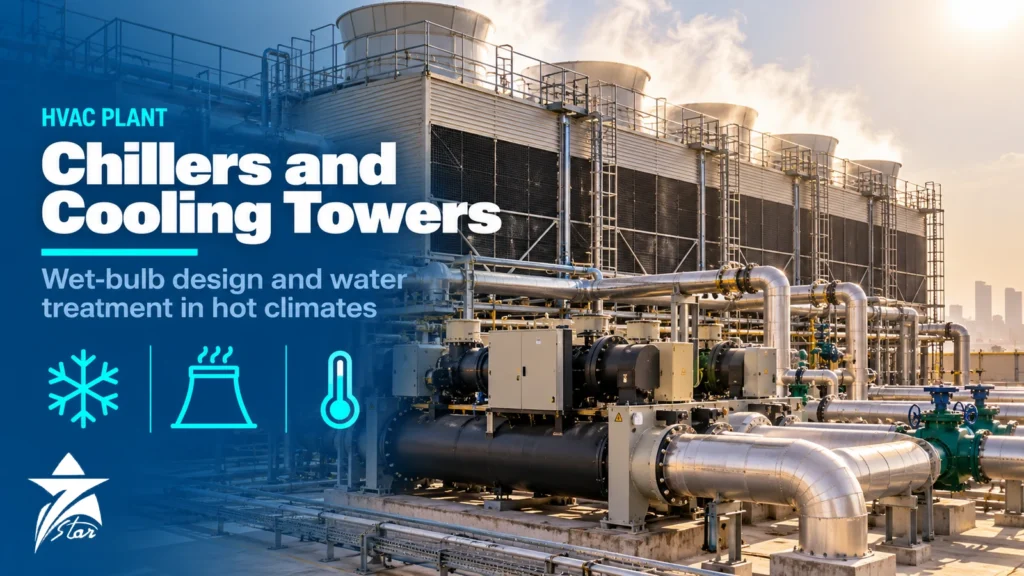
Cooling plants in the Gulf work harder than almost anywhere else. Dry-bulb temperatures near 50 °C, high coastal humidity, blowing sand and scarce fresh make-up water all push chillers and cooling towers toward their limits at exactly the time the process needs them most. Selecting and operating chillers and cooling towers in hot climates starts with getting the design wet-bulb and approach right, continues with chiller lift and condenser design, and depends year-round on water treatment. This guide covers the terms engineers use, the trade-offs between air-cooled and water-cooled systems, water chemistry and the maintenance that keeps capacity on summer afternoons.
Range, Approach and Wet-Bulb: The Three Numbers That Size a Tower
An evaporative cooling tower cools water mainly by evaporating a small portion of it into the air stream. Its performance is described by three temperatures:
- Range: hot water temperature entering the tower minus cold water temperature leaving it. Range is set by the heat load and the circulating flow, not by the tower.
- Approach: cold water temperature leaving the tower minus the ambient wet-bulb temperature. Approach is what the tower design controls.
- Design wet-bulb: the ambient wet-bulb temperature the tower must achieve its duty at. The cold water can never reach the wet-bulb; it approaches it.
Tower size grows steeply as approach gets smaller. Moving from a typical design approach of around 4–5 °C down to 2–3 °C can require a much larger tower for the same heat load and range, which is why very close approaches are rarely economic. Tower effectiveness is sometimes expressed as range divided by (range plus approach).
The design wet-bulb has to come from local climatic data, such as the ASHRAE design conditions for the nearest station, at the percentile the owner accepts (0.4%, 1% or 2% of hours exceeded). Coastal Gulf sites have high summer wet-bulb temperatures, commonly around 29–31 °C at design percentiles, while inland desert sites are hotter but drier. Using an inland wet-bulb for a coastal plant, or a generic value from a cooler region, guarantees that cold water temperature will drift above design on humid summer days. Also allow for recirculation: a tower placed close to buildings or other towers can ingest its own warm, moist plume and see an effective inlet wet-bulb above ambient.
Water Balance: Evaporation, Blowdown and Cycles of Concentration
Water leaves a cooling tower in three ways: evaporation, drift (droplets carried out with the air) and blowdown (water deliberately drained to limit dissolved solids). Make-up replaces all three.
- Evaporation: a widely used estimate is about 1% of circulating flow for each 5.6 °C (10 °F) of range, often reduced by a factor of around 0.85 to account for sensible heat transfer.
- Cycles of concentration (COC): the ratio of dissolved solids in the circulating water to those in the make-up.
- Blowdown: from the mass balance, blowdown ≈ evaporation ÷ (COC − 1), ignoring drift. Raising COC from 3 to 6 cuts blowdown sharply, which is why water treatment programmes aim for the highest COC the water chemistry allows.
- Drift: modern drift eliminators reduce it to a very small fraction of circulating flow; damaged or missing eliminators increase water loss and spread treatment chemicals and bacteria.
Air-Cooled vs Water-Cooled Chillers in High Ambient
Chiller efficiency depends mainly on lift: the difference between the refrigerant condensing temperature and the evaporating temperature. A water-cooled chiller rejects heat to condenser water whose temperature follows the tower’s cold water, which is tied to wet-bulb. An air-cooled chiller rejects heat directly to ambient dry-bulb air, which in the Gulf summer can be 15–20 °C higher than the wet-bulb. That difference is the core of the decision.
| Factor | Air-cooled chiller | Water-cooled chiller with cooling tower |
|---|---|---|
| Heat rejection reference | Ambient dry-bulb (up to about 50 °C) | Wet-bulb plus tower approach |
| Standard rating basis (AHRI 550/590) | 35 °C entering condenser air | 29.4 °C entering condenser water |
| Lift and efficiency at Gulf peak | High lift; capacity and efficiency fall at peak ambient | Lower lift; better efficiency, but condenser water usually above rating condition |
| Water use | None for heat rejection | Evaporation, blowdown and drift; needs reliable make-up |
| Water treatment | Not required for condenser | Essential: scale, corrosion, fouling and Legionella control |
| Space and plant | Packaged, roof or grade mounted | Chiller room, tower, condenser pumps, treatment system |
| Typical fit | Small to medium loads, water-scarce sites, remote facilities | Large continuous loads such as process cooling and district cooling |
For air-cooled chillers, ask for performance at the real site design ambient, not the 35 °C standard rating. High-ambient versions use larger condenser coils, compressors and motors selected for higher condensing pressure, and control panels and drives rated for the heat. Check the maximum operating ambient at which the unit continues to run, often with reduced capacity, rather than tripping on high head pressure.
For water-cooled chillers, specify the actual entering condenser water temperature that the tower can deliver at design wet-bulb. If wet-bulb is 30 °C and the tower approach is 4 °C, condenser water enters at 34 °C, well above the 29.4 °C rating point, and the chiller must be selected for that lift. Condenser tube fouling raises lift further, which makes water treatment part of chiller efficiency.
Water Treatment for Gulf Cooling Towers
Make-up water in the region varies widely: desalinated water with low hardness and alkalinity, treated sewage effluent (TSE), brackish groundwater and, for some plants, seawater. Each brings different risks.
- Scale: calcium carbonate, calcium sulfate and silica precipitate as water concentrates and as it heats in condensers. Saturation indices such as the Langelier or Ryznar index guide the maximum COC and the inhibitor programme.
- Corrosion: soft desalinated water and high chlorides attack carbon steel and copper alloys; seawater towers need suitable materials for basins, fill supports and condensers.
- Fouling: wind-blown sand and dust are scrubbed out of the air by the tower and settle in basins and condensers. Side-stream filtration and regular basin cleaning keep them out of heat exchangers.
- Biological growth and Legionella: warm water, sunlight and nutrients encourage algae and biofilm. A documented water management programme, as described in ASHRAE Standard 188, with controlled biocide dosing and monitoring, is the accepted approach.
Online measurement of conductivity, pH and oxidant residual lets blowdown and chemical dosing follow the actual water rather than a timer. Instruments from the liquid analytics range are commonly used for this, and our guide to water quality analyzers for desalination, wastewater and boiler water explains the sensor choices.
Specification Data to Collect
- Heat load (kW) at design and part load, with the load profile across a day and a year.
- Chilled water supply and return temperatures, or process cooling water temperatures.
- Site design dry-bulb and wet-bulb at the agreed percentile, altitude and nearby obstructions or heat sources.
- Make-up water source and full analysis: hardness, alkalinity, chlorides, sulfates, silica, TDS and pH.
- Discharge limits for blowdown and any restrictions on chemical use.
- Electrical supply, hazardous area classification and noise limits.
- Redundancy (N+1 chillers, cells or pumps) and whether the plant must run at partial capacity during maintenance.
- Performance test basis: for example CTI ATC-105 for cooling tower acceptance testing and AHRI 550/590 conditions for chiller rating.
Installation Details That Affect Capacity
- Leave enough clearance around towers and air-cooled chillers to avoid recirculation of hot discharge air; follow the manufacturer’s layout guidance for multiple units.
- Orient towers so the prevailing wind does not push the plume back into the air inlets of the tower or neighbouring chillers.
- Mount fans, pumps and compressors on suitable vibration isolation to protect structures and piping.
- Provide access for fill inspection, drift eliminator replacement, basin cleaning and condenser tube cleaning.
- Shade or ventilate control panels and drives, and specify their ambient rating for the site.
Common Mistakes With Chillers and Cooling Towers in Hot Climates
- Selecting an air-cooled chiller on its 35 °C rating and discovering in July that it delivers far less capacity, or trips.
- Using a design wet-bulb that is too low for a humid coastal site.
- Running towers at low cycles of concentration to avoid scale, wasting large volumes of scarce water.
- Neglecting basin cleaning after sandstorms, so silt reaches condensers and heat exchangers.
- Treating Legionella control as an occasional chemical shock rather than a managed, documented programme.
Maintenance and Troubleshooting
If cold water temperature rises above design, compare the measured approach with the design approach at the actual wet-bulb. A higher approach points to tower problems: clogged or collapsed fill, uneven water distribution from blocked nozzles, fan blade pitch or belt slip, or recirculation. If approach is fine but the chiller struggles, look at the condenser: rising condenser approach (refrigerant condensing temperature minus leaving condenser water temperature) indicates tube fouling or non-condensables. On air-cooled units, check coil cleanliness after dust events, fan operation and refrigerant charge.
- Weekly: water chemistry checks, blowdown and dosing operation, visual inspection of distribution and basins.
- Monthly: fan and gearbox or belt condition, vibration, drift eliminator condition.
- Seasonally before summer: fill inspection, nozzle cleaning, basin cleaning, condenser tube cleaning, coil cleaning on air-cooled chillers.
- Annually: chiller performance check against design lift, refrigerant leak checks, tower structural inspection.
Cooling Plant Checklist
- Design wet-bulb and dry-bulb taken from local climatic data at an agreed percentile.
- Tower approach and range defined; recirculation allowance considered in layout.
- Chillers selected at actual condenser conditions, not standard rating points.
- Make-up water analysis available and target COC agreed with the water treatment specialist.
- Online monitoring of conductivity, pH and biocide residual with automatic blowdown.
- Legionella water management programme documented.
- Electrical and control equipment rated for site ambient.
Cooling Equipment We Supply
These examples cover the chiller, cooling tower and water treatment control discussed above.
| Product | Type | Where it fits |
|---|---|---|
| Thermal Care TSE Series Central Chiller 10 to 240 Ton | Central chiller, 10 to 240 tons | Process cooling for plastics, machining and plant loads. |
| EVAPCO LSTE Forced Draft Centrifugal Fan Cooling Tower | Forced draft centrifugal fan cooling tower | Indoor or noise-sensitive installations. |
| EVAPCO LPT Low Profile Centrifugal Fan Cooling Tower | Low profile cooling tower | Sites with height restrictions. |
| EVAPCO AXS Advanced Crossflow Induced Draft Cooling Tower | Crossflow induced draft cooling tower | Larger heat rejection loads. |
| Walchem W100W Cooling Tower and Boiler Controller | Cooling tower and boiler controller | Conductivity-based bleed and chemical dosing. |
| Copeland ZR125KCE Commercial AC/Chiller Scroll Compressor | Scroll compressor | Replacement compressors for commercial chillers. |
Send the cooling load, water temperatures, wet bulb design temperature and site limits through our quote request form.
Sourcing Chillers and Cooling Tower Components Through Seven Star LLC
Seven Star LLC supplies industrial cooling equipment and HVAC and combustion components, including spare fans, motors, fill, nozzles, drift eliminators, instruments and chiller parts, on request for plants across Oman and the GCC. We help with selection and with cross-checking part numbers; availability and lead time are confirmed at quotation.
Send your chiller or tower nameplate, the heat load and site conditions, or your RFQ, and we will prepare options for your review.
Frequently asked questions
What is cooling tower approach?
Approach is the cold water temperature leaving the tower minus the ambient wet-bulb temperature. It shows how close the tower brings the water to the theoretical limit of evaporative cooling. Smaller approaches need much larger towers, so typical designs settle on a few degrees Celsius.
Why do air-cooled chillers lose capacity in the Gulf summer?
They reject heat to ambient dry-bulb air, so at 45–50 °C the refrigerant must condense at a much higher temperature and pressure. That raises lift, cuts capacity and efficiency, and can trip units not designed for high ambient. Select them at the real site design temperature, not the 35 °C rating point.
How do I calculate cooling tower blowdown?
From the water balance, blowdown is approximately evaporation divided by (cycles of concentration minus one), ignoring drift. Evaporation is roughly 1% of circulating flow for each 5.6 °C of range. Increasing cycles of concentration reduces blowdown and make-up water use.
What design wet-bulb should I use for a coastal Gulf site?
Use local climatic design data, such as ASHRAE design conditions for the nearest weather station, at the percentile the owner accepts. Coastal Gulf sites commonly have summer design wet-bulb values around 29–31 °C, but confirm with data for your exact location.
How is Legionella controlled in cooling towers?
Through a documented water management programme that identifies risk points, controls biocide dosing, maintains water chemistry, keeps drift eliminators in good condition and cleans basins and fill. ASHRAE Standard 188 describes how such a programme is structured.
Is a water-cooled chiller always more efficient?
At Gulf peak conditions a water-cooled chiller usually has lower lift because wet-bulb is well below dry-bulb. However, it needs make-up water, treatment and more plant. Where water is scarce or the load is small, an air-cooled high-ambient chiller can still be the better overall choice.
Was this guide helpful?One click helps us write better guides for engineers.
Thank you! Glad it helped. Need this equipment for your project? Request a quotation
Thank you. We will use this to improve the guide.