- Automation & ControlView all 2,717 products
- Automation Accessories
- AC Drives
- PLC & I/O Cards
- Industrial Communications
- Vibration Monitoring
- Controllers & Data Acquisition
- Isolator & Barrier
- Safety Switches & Guard Locking
- Motor Soft Starters
- CCTV & Security
- Encoders
- HMI Displays
- Servo Drives
- Pneumatic Cylinders
- Industrial Computers
- Machine Vision
- Automation Software
- Robotics
















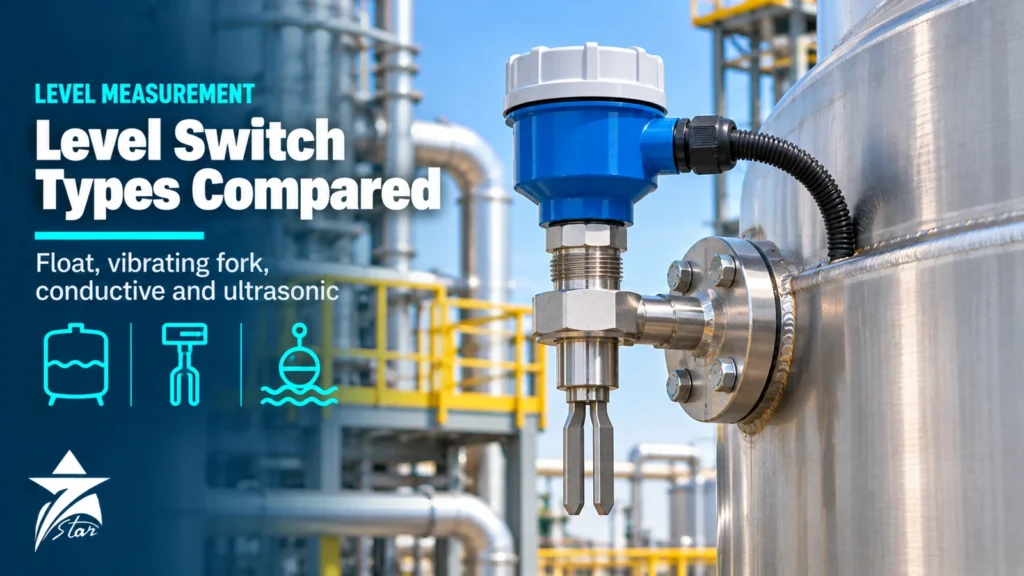
A level switch tells a control system that a material has reached, or left, one fixed point in a tank, silo or pipe. It does not measure the full level; it gives a simple on/off signal for high alarm, low alarm, pump protection, overfill prevention or dry-run protection. Because each technology senses the material in a different way, the right choice depends on whether the medium is a liquid or a solid, and on its density, conductivity, viscosity, temperature and tendency to build up. This guide compares the main types and explains how to choose and install them.
Point Level vs Continuous Level
Continuous level instruments, such as radar, guided wave radar, ultrasonic transmitters and differential pressure, report the level across the whole range. A point level switch only changes state at one height. Many plants use both: a transmitter for control and an independent level switch for the high-high alarm, so a single failure cannot cause an overfill. A switch is also cheaper, simpler to set up and easy to test.
Float Switches
A float rides on the liquid surface and moves a magnet or a mechanical lever that operates a reed contact or a microswitch. Types include horizontal side-mounted floats, vertical stem floats with one or more switch points, cable floats for sumps and wastewater, and external chambers that keep the float outside the tank.
- Advantages: simple, no power needed for the basic contact, low cost, works with most clean liquids.
- Limits: moving parts, sticking with sludge, viscous or crystallising liquids, and the float must suit the liquid density.
- Typical uses: water tanks, lube oil, condensate pots, sumps and simple pump control.
Floats and magnetic level gauges are covered in detail in our magnetic level gauge and float level switch guide.
Vibrating Fork Switches
A vibrating fork, also called a tuning fork or vibronic switch, is driven at its resonant frequency by a piezoelectric element. When liquid covers the fork, the frequency changes (falls) and the electronics switch the output. It is now the most widely used point level sensor for liquids because it has no moving parts and is largely unaffected by flow, turbulence, bubbles, foam, conductivity and most changes in density.
- Works in most liquids, including oils, solvents, water and many slurries, within the viscosity limit given by the manufacturer.
- Can be installed in any orientation, including in pipes, as a dry-run protection for pumps.
- Many models offer self-monitoring and functional safety approvals for overfill protection; check the SIL rating on the data sheet.
- Limits: heavy buildup that bridges the tines, very viscous media and large solids that jam between the tines.
For bulk solids there are fork and rod versions with a stronger vibrating element, used for powders, granules and pellets with a minimum bulk density given by the manufacturer.
Conductive Probe Switches
A conductive switch uses one or more electrodes. When a conductive liquid touches the electrodes, a small AC current flows between them, or between an electrode and the tank wall, and a relay switches. Multiple rods of different lengths give several switch points, such as pump start and pump stop.
- Advantages: very simple, low cost, good for water, wastewater, many acids and alkalis.
- Limits: only works with conductive liquids; it does not work with oils, hydrocarbons, demineralised water or most solvents.
- Boiler water limiters use special conductive electrodes with approvals for steam boilers.
Capacitance Probe Switches
A capacitance switch measures the change in capacitance between a probe and the tank wall, or a reference electrode, when the material covers the probe. Because almost every material has a dielectric constant higher than air, capacitance works with both liquids and solids, conductive or not. Rod probes suit tanks and small silos; rope (cable) probes suit tall silos.
- Works with liquids, pastes, powders and granules.
- Active shielding or buildup compensation reduces false signals from material that sticks to the probe.
- Insulated probes (PTFE or PFA) are used with conductive and aggressive media.
- Limits: materials with a very low dielectric constant are harder to detect, and the switch point depends on calibration.
Compact capacitive point level sensors, often with IO-Link, are also common on machines and hydraulic units for oil and coolant level.
Ultrasonic Gap and Thermal Switches
An ultrasonic gap switch has a transmitter and receiver crystal facing each other across a small gap. In air the ultrasonic signal is weak; when liquid fills the gap the signal passes strongly and the switch operates. It has no moving parts and suits clean liquids, interface detection and high-pressure applications. Thermal dispersion switches detect the change in heat transfer from a heated sensor when it is covered by liquid, and are also used for flow and no-flow detection.
Rotating Paddle and Microwave Barrier Switches for Solids
A rotating paddle switch uses a small motor to turn a paddle inside the silo. When bulk material covers the paddle, the torque stops it and a switch operates. Paddles are robust and inexpensive for grain, cement, plastic pellets and similar materials. A microwave barrier uses an emitter and a receiver on opposite sides of a chute or silo. Material passing between them interrupts the beam, so it can detect level or blockage without contact, even through non-metallic windows.
Level Switch Selection Table
Use this table to narrow the choice. Always confirm the final selection against the manufacturer data for your medium, pressure and temperature.
| Type | Liquids | Solids | Moving parts | Main limits |
|---|---|---|---|---|
| Float | Yes | No | Yes | Sticky or viscous media, density dependence |
| Vibrating fork | Yes | Fork and rod versions | No | Heavy buildup, very high viscosity, large particles |
| Conductive | Conductive liquids only | No | No | Not for oils, solvents or demineralised water |
| Capacitance | Yes | Yes | No | Low dielectric constant, needs calibration |
| Ultrasonic gap | Yes (clean) | No | No | Foam, aeration, solids in the gap |
| Thermal dispersion | Yes | No | No | Slow response, temperature changes |
| Rotating paddle | No | Yes | Yes | Needs power, wear, very light powders |
| Microwave barrier | Limited | Yes | No | Needs line of sight, alignment |
Practical Questions Before You Choose
- Is the medium a liquid, a slurry, a powder or granules? What are its density or bulk density, viscosity and dielectric constant?
- Is it conductive? Does it foam, crystallise, coat surfaces or contain solids?
- What are the process pressure and temperature, and is the area hazardous (ATEX or IECEx zone)?
- Is the switch for control (pump start and stop) or for safety (overfill or dry-run protection with a SIL requirement)?
- Which output is needed: relay, PNP, NAMUR, 8/16 mA, two-wire, IO-Link?
- Should the switch be fail-safe at maximum (high alarm) or at minimum (low alarm)? Most electronic switches let you select this mode.
- Which process connection and wetted materials are required: thread, flange, hygienic fitting, stainless steel, Alloy C or coated?
Installation Tips for Every Level Switch
- Mount the sensing element away from the filling stream, so falling liquid or material does not cause false switching.
- For forks mounted horizontally in liquids, align the tines vertically to let liquid drain and solids slide off; check the alignment mark.
- In silos, protect probes from falling material with a deflector plate where needed, and consider the tensile load on rope probes.
- For high alarm duty, choose fail-safe operation so that power loss, wire break or sensor fault produces the alarm state.
- Leave access for periodic functional testing; many vibrating forks have a test magnet or a test function.
- Keep cable entries sealed and use the correct glands for the IP rating and hazardous area certification.
A switch used in a safety function must be proof tested at the interval set in the safety requirements, and the test should confirm the full chain from the sensor to the final element.
Common Problems and How to Avoid Them
| Problem | Likely cause | What to do |
|---|---|---|
| Switch does not change state when covered | Wrong type for the medium (for example conductive switch in oil), wrong density setting, wiring or mode setting | Check the medium properties against the data sheet and the min/max mode |
| False alarms when the tank is empty | Buildup on the probe or fork, condensation, filling stream hitting the sensor | Clean the sensor, use buildup compensation, move it away from the inlet |
| Switch chatters at the switch point | Turbulence, waves or foam at the surface | Use a switching delay, a stilling tube or a type less sensitive to foam |
| Float stuck in one position | Sludge, crystallisation or a damaged float | Clean or replace the float, or change to a vibrating fork |
| Paddle motor runs but never switches | Material too light or aerated to stop the paddle | Use a larger paddle, a vibrating rod or a capacitance probe |
Record every functional test and every fault. A pattern of false alarms usually points to an application mismatch rather than a faulty unit.
Level Switches From Our Catalog
Examples of each type in our catalog. Each link goes to the product page.
Browse more in our level switches category. To get a quotation, send the medium, process connection, pressure and temperature, insertion length, output type, hazardous area requirements and any existing model number through our quote request form or to [email protected].
Sourcing Point Level Instruments in Oman Through Seven Star LLC
Seven Star LLC is an independent supplier in Oman of level instrumentation for oil and gas, water, power and process plants. We quote point level models from manufacturers such as Endress+Hauser, VEGA, Rosemount, Mobrey, Magnetrol, SOR, KOBOLD, Barksdale, GESTRA, JUMO, ifm and ABB, and can match an installed unit by its order code. Specifications, approvals and lead time are confirmed against the manufacturer data at quotation.
Frequently asked questions
What is the most common type of level switch for liquids?
The vibrating fork, also called a tuning fork or vibronic switch, is the most widely used point level device for liquids. It has no moving parts, can be mounted in any orientation, and is largely unaffected by flow, foam, bubbles and changes in conductivity.
Can a conductive level switch detect oil?
No. A conductive switch needs a conductive liquid to close the circuit between its electrodes. Oils, hydrocarbons, solvents and demineralised water do not conduct enough; use a vibrating fork, capacitance or float switch instead.
Which level switch is best for powders and granules?
Vibrating fork or rod switches made for solids, capacitance probes, rotating paddle switches and microwave barriers are used for bulk solids. The choice depends on bulk density, particle size, buildup and silo height.
What does fail-safe mode mean on a level switch?
Fail-safe means that a power loss, broken wire or sensor fault puts the output in the alarm state. For a high-level alarm, select maximum fail-safe mode; for dry-run protection, select minimum mode.
Do I need a level switch if I already have a level transmitter?
For safety functions such as overfill protection, an independent level switch is often required so that a single failure of the transmitter cannot cause an overfill. The requirement depends on the plant risk assessment and the applicable standards.
Who supplies level switches in Oman?
Seven Star LLC is an independent supplier in Oman that quotes level switches from Endress+Hauser, VEGA, Rosemount, Mobrey, Magnetrol, SOR, KOBOLD, Barksdale and other manufacturers. Send your requirements through the quote request form or to [email protected].
Was this guide helpful?One click helps us write better guides for engineers.
Thank you! Glad it helped. Need this equipment for your project? Request a quotation
Thank you. We will use this to improve the guide.